Chinese furniture types are named by how a piece is built and used, not by one style label: a zhuo is a table with legs at the corners, an an a table with set-in legs, a kang table a low table for a heated platform. Museum records carry these names and the woods behind them, and this guide reads them from the Cleveland Museum of Art, the V&A and the Metropolitan Museum.
Most of the Chinese furniture types these collections hold date from the Ming (1368–1644) and Qing (1644–1911) dynasties, and much of it is made of a few dense hardwoods. Where the records disagree on a wood name or leave a date wide, the guide says so rather than choosing.
From floor to chair: how Chinese furniture is built
Cleveland’s note on a pair of armchairs says that China moved from an original floor culture to high chairs and tables, and that the making and styles of furniture differ by region. It adds that the subject is still relatively unexplored, so a regional attribution on a piece is a claim to ask about, not a label to take on trust.
The same museum describes classic Chinese furniture as an art of carpentry and joinery that uses a mortise-and-tenon framework. The V&A’s record of a Ming kang table shows what that means in practice: a mitered, mortised and tenoned frame, a single flush floating panel braced underneath, and legs ending in club feet. Joints are the first thing to look at on any piece.
Chinese furniture types and names, at a glance
Each row of these Chinese furniture types gives a name used in a museum record, what the piece is, the period as the record states it, and the source. Chinese terms appear only where a record uses them.
| Name | What it is | Period | Source |
|---|---|---|---|
| Zhuo | A plain wooden table with legs at the corners. The V&A’s example is a high rectangular table of polished huali wood on square legs with plain stretchers, 87.7 cm high. | Ming | V&A FE.21-1980 |
| An | The contrasting table type, with set-in legs. The V&A notes that both zhuo and an had numerous uses and cannot be sorted by function: eating, writing, or standing against a wall to display flowers or ornaments. | Ming (V&A style label) | V&A FE.21-1980 |
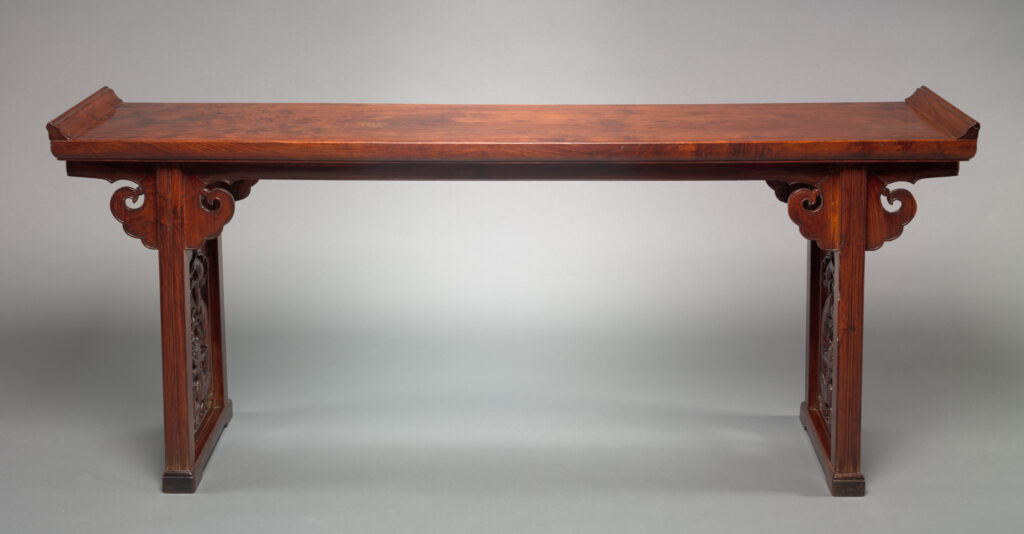
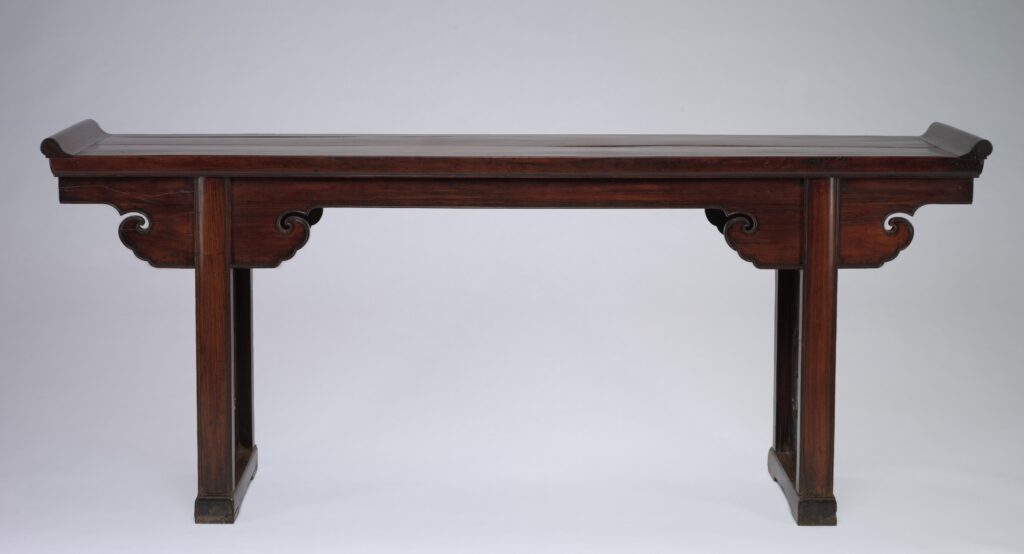
| Side table | A long, narrow table placed against a wall to hold candlestands, vases or incense burners, with ancestor portraits or seasonal paintings hung above. Cleveland’s example is 199 cm long in huanghuali, with cloud-shaped spandrels and openwork dragon panels. Its legs are described as recessed; the record does not use the word an. | 1600s (Ming or Qing) | Cleveland 1964.229 |
| Altar table | A side table with upturned ends, which Cleveland says makes it more formal and possibly an altar table. The example is catalogued as redwood veneer and camphor wood, not huanghuali. A second Cleveland piece is titled Altar Table outright. | Late 1500s–1600s; 1368–1644 | Cleveland 1955.42; 1964.230 |
| Kang table (kang zhuo, kang ji) | A low table for a kang, the raised brick platform heated from beneath that served as bed and living space in northern China; two people could sit either side. In the south such tables stood on wooden daybeds. The V&A catalogues a Ming example as Kang ji, huanghuali. | Ming or Qing; Ming | Cleveland 1964.228; V&A FE.120-1978 |
| Low table (anji) | Titled Low Table (Anji) in huanghuali, about 37 cm high and 134 cm wide. The record carries no description. | 1500s (Ming) | Cleveland 1964.232 |
| Roundback armchair (lohan type) | Horseshoe-back armchairs made in Jiangsu province, in the simple Suzhou style. The curved back is seven pieces of wood joined and secured with an inserted wooden pin. | 1600–1700s (Ming to Qing) | Cleveland 1955.40 |
| Armchair | The Met titles it simply “Armchair”: purple sandalwood (zitan), about 102 cm high. The Met’s other armchair of about 1700 is huali. | 17th century; about 1700 | Met 1976.193.1a, b; 67.57 |
| Folding chair | The Met holds a lacquer chair with a rattan seat, titled for two birds among flowers, and a plain-wood folding chair about 100 cm high. | 13th–14th century; 16th century | Met 69.217; 1973.34 |
| Couch | A huanghuali couch about 205 cm wide, catalogued in four parts. The Met also holds a small “couch table” of the same century. | 17th century | Met 1976.193.6a–d; 1981.97 |
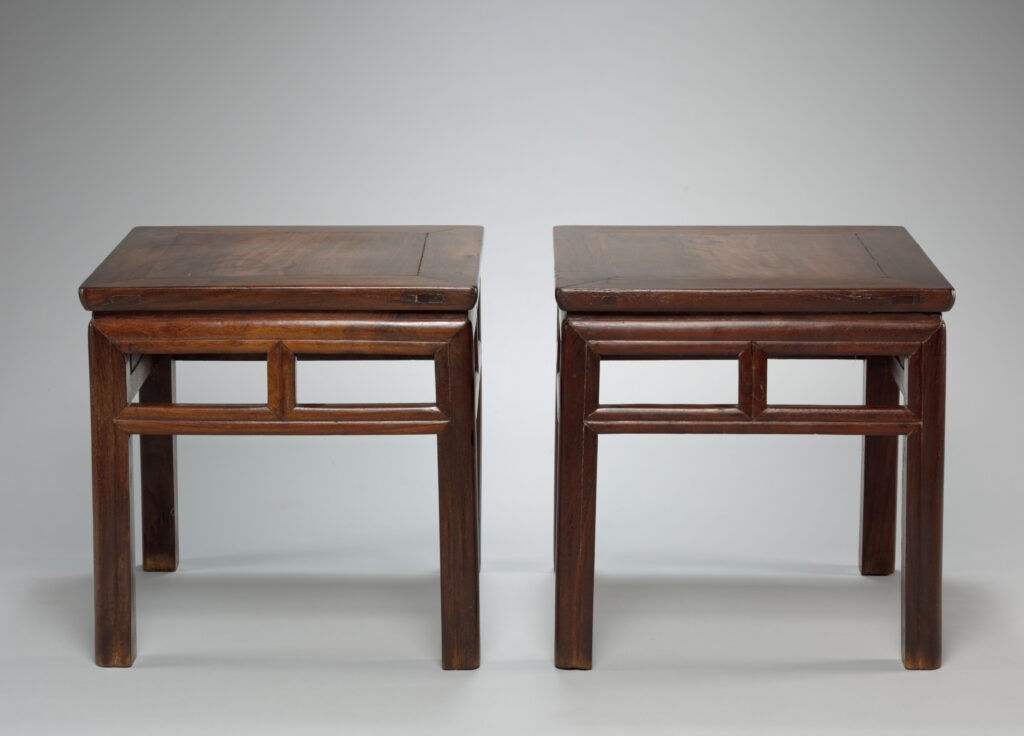
| Stool | Square stools about 48 cm high. One Cleveland pair is chicken-wing wood (jichimu); another is ironwood (tielimu). | 1700–1725; 1644–1911 (Qing) | Cleveland 1982.114; 1982.262 |
| Table-top cupboard (gui) | A small huanghuali cupboard made to stand on a table. | 1500s (Ming) | Cleveland 1964.231 |
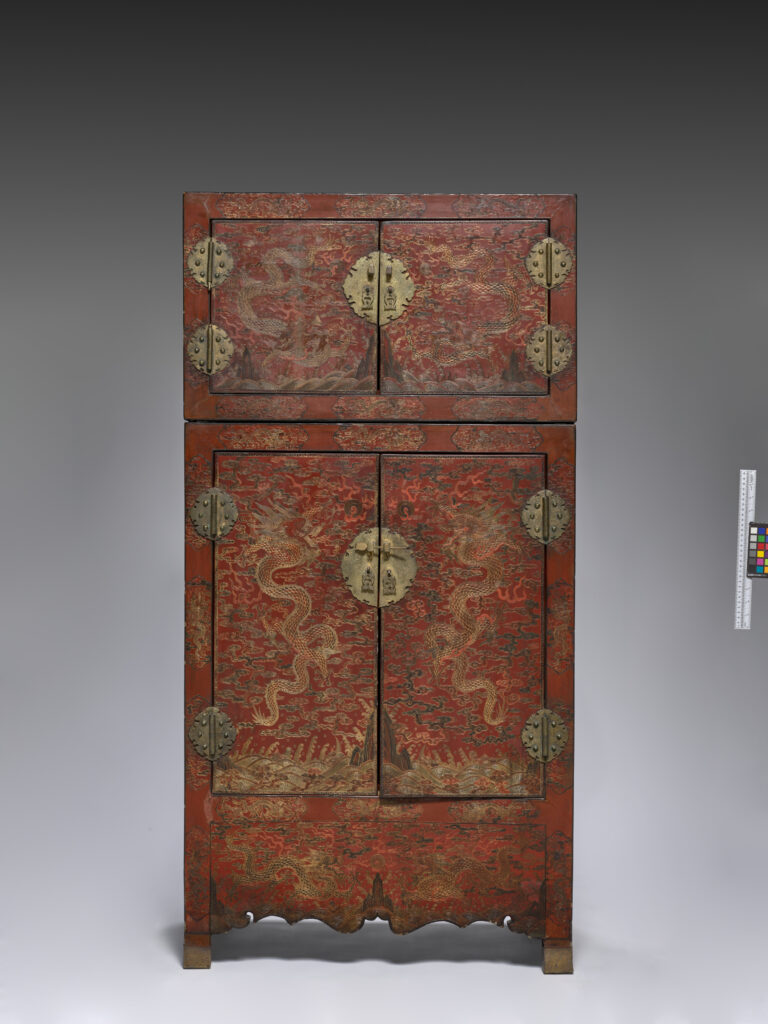
| Double cabinet | A tall cabinet in two stacked parts, a cupboard below and a top chest above, in red lacquer on wood with pigment and gilding, 152 cm high. | 1600s (Ming or Qing) | Cleveland 1997.124 |

Woods: the names behind the colors
The records name five woods. Huanghuali is the one Cleveland calls rosewood, and it says Ming and Qing makers used rare tropical hardwoods such as it. The V&A’s table is huali, the Met’s pair of armchairs of about 1700 is huali too, and its 17th-century armchair is purple sandalwood (zitan). Cleveland also lists chicken-wing wood (jichimu) and ironwood (tielimu) for stools.
The English names differ between museums: the Met gives huanghuali as “Dalbergia odorifera” on some pieces, Cleveland says “rosewood (huanghuali)”. A seller’s wood name is therefore worth a follow-up question: which Chinese name, and on what evidence?
Seating, storage and what each of the Chinese furniture types was for
Chairs and stools came after the floor: the roundback armchair in Jiangsu, the folding chair that the Met dates as early as the 13th–14th century, the stools in chicken-wing wood. Storage took the form of compound cabinets and small cupboards such as the gui. Cleveland’s red-lacquer double cabinet is catalogued as a cupboard and a top chest, which is a reminder that many forms were made in sections and can be separated or recombined.
Reading a piece before buying
A museum record shows what to ask about any of these Chinese furniture types. Look for the Chinese name, the period stated as a range, the wood named with its Chinese name, and a note of how the piece is constructed. The V&A’s kang table also lists where it came from: from the collection of Gustav Ecke in Peking, and published in Craig Clunas’s Chinese Furniture (1988). That kind of history is worth asking for.
- Is the piece one object or several parts (the Met’s couch is catalogued in four)?
- Are the joints mortise-and-tenon, and do they match the age claimed?
- Is the wood given in Chinese and English, and by whom?
- Is a regional style claimed, and on what basis?
For the Japanese tradition, built around a floor-level way of living, see the guide to Japanese furniture. Chinese porcelain from the same dynasties, which the Chinese furniture types above were made alongside, is covered in the guides to blue and white porcelain and famille rose porcelain.
Questions about Chinese furniture types
What is the difference between zhuo and an? Among Chinese furniture types, the V&A defines a zhuo as a table with legs at the corners and an an as a table with set-in legs. Both had many uses, so function does not separate them.
What was a kang table for? Cleveland says low tables were placed on the kang, a heated brick platform, where two people could sit either side of the table; in the south they stood on wooden daybeds.
What wood is Chinese classical furniture made of? The records name huanghuali, huali, purple sandalwood (zitan), chicken-wing wood and ironwood. Cleveland says Ming and Qing makers used rare tropical hardwoods such as huanghuali.
Sources
- The Cleveland Museum of Art, Open Access (CC0) records: 1955.40, 1955.42, 1964.228, 1964.229, 1964.230, 1964.231, 1964.232, 1982.114, 1982.262, 1997.124.
- Victoria and Albert Museum, East Asia Collection: FE.21-1980 (table) and FE.120-1978 (kang table).
- The Metropolitan Museum of Art, Open Access records: 1976.193.1a, b, 1976.193.6a–d, 1981.97, 67.57, 1973.34, 69.217.