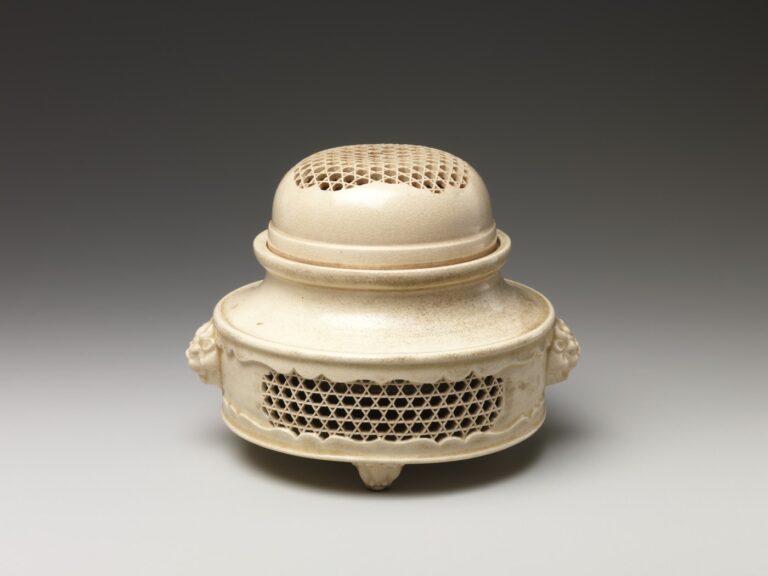
A traditional Japanese room, as Britannica describes it, held very little furniture: perhaps a cabinet of blackwood or lacquer, a low writing table or a screen. Bedding went into cupboards by day, and the valuables of a well-off household were kept in a detached fireproof storehouse and brought out occasionally. The phrase now also names a retail category of Japanese-style beds, floor tables and screens. Museum collections hold something older and smaller, made for a way of living that did not involve chairs.
Most of what those collections record follows from one fact, which is that people sat, ate and slept at floor level. The pieces that resulted are chests, low tables, shelves, cabinets and screens, made in woods and joints with their own logic.
A room built around the mat
Britannica notes that the Japanese cover their floors with rice-straw mats and sit on them instead of on chairs, so tables are low and are also used as an armrest. Rooms are reckoned in multiples of the mat, which measures about 6 by 3 feet, and the interior partitions are paper on a wooden frame, usually moveable, so a room can be rearranged. Furniture had to suit that kind of space, and in practice that meant very little of it.
Storage was built in as much as it was carried in. Britannica describes spacious cupboards where the bedding was kept, which allowed any room to serve as a bedroom, and a chigai-dana near the alcove, an asymmetric arrangement of cupboards and shelves that it compares to a sideboard. No bedstead appears in that account; the bedding lived in the cupboards. Tiers of shelves, usually lacquered and painted, occur in many forms, and the number and position of the shelves differ from one side to the other. The tea masters who became the aesthetic advisers of the household toward the end of the 16th century aimed, Britannica says, at beauty with frugality, asymmetry and economy of movement, and it credits them with much of the simple grace of Japanese interiors. Readers who know the vocabulary from what wabi-sabi means in a room may recognize some of these ideas.
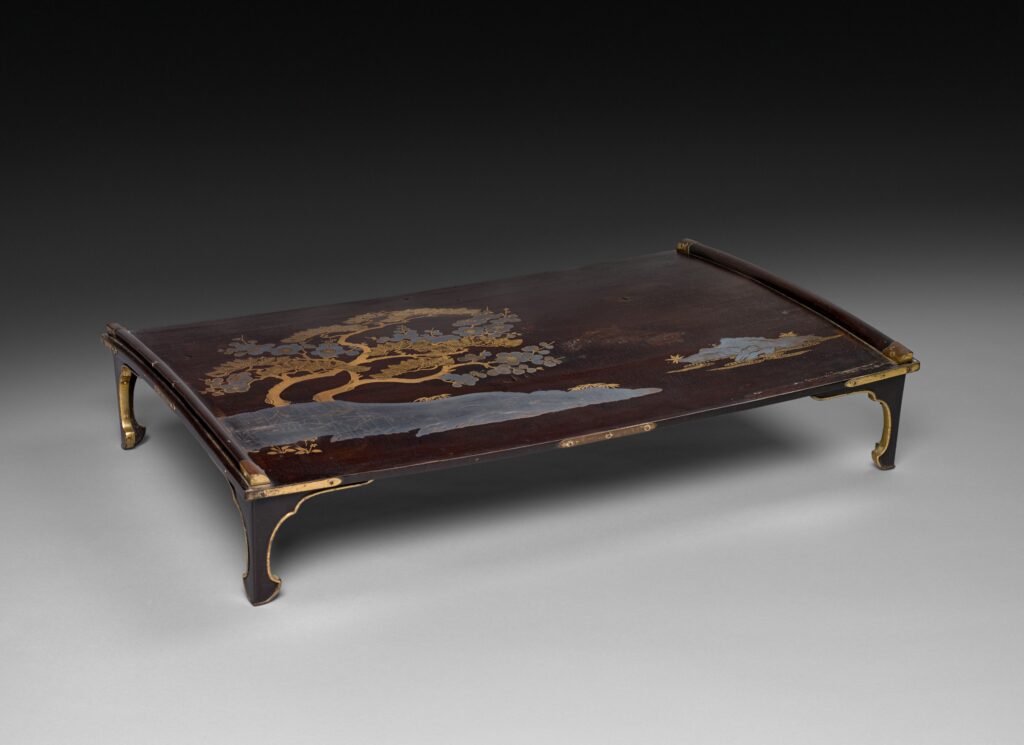
The low writing table shows furniture shaped by floor living most clearly. The Cleveland Museum of Art notes that low writing tables were developed for use by people seated on the floor, and that they often had matching writing boxes. Its example from the 1400s is lacquered in gold and silver with pine, bamboo and plum, the combination known as the Three Friends of Winter. A Met table of the first half of the 17th century, decorated with melons and squirrels, was likely made as a set with its writing box.
The main kinds, and what each was for
- Chests of drawers. One example is a V&A chest of about 1800, catalogued as a tansu, with a box with a deep hinged lid above six drawers, covered in olive-green leather, with brass fittings.
- Merchant’s shop chests. The V&A describes chests with differently sized drawers, lockable compartments and sections with sliding doors, used by merchants to hold sales ledgers and the other equipment of a shop, with Kanazawa an important regional centre for making them.
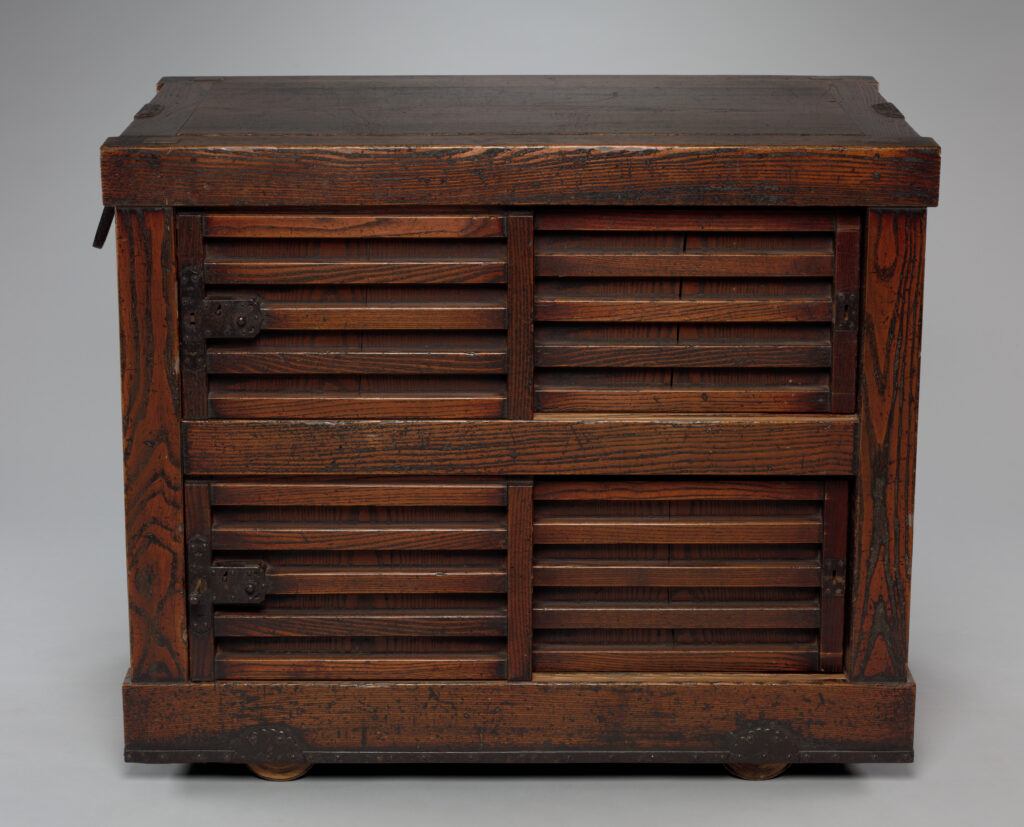
- Chests on wheels. The Cleveland Museum of Art has one dated 1715, in wood with iron fittings.
- Low tables and writing tables, as above, which are often lacquered.
- Shelves and cabinets. Britannica mentions a cabinet of blackwood or lacquer, and the Met has a small drop-front lacquer cabinet of the 18th century, with six drawers, made to hold the forty-two volumes of the Taiheiki.
- Screens. Britannica describes twofold or sixfold screens, the latter generally in pairs, decorated with landscapes on a gold or silver background and mounted in brocade, and notes that a single-leaf screen sometimes stands in the entrance hall.
The chests and the screens each have enough detail to deserve a guide of their own, so this one stays with what they share.
Woods and joinery
The Traditional Craft Industries Promotion Association describes Kyo sashimono, the joinery of Kyoto, as high-quality furniture made from solid wood planks, made alongside tea-ceremony utensils. Its origins go back to the Heian period, specialist woodworkers appeared from the Muromachi period, and the craft flourished with the tea ceremony. The association names paulownia, cedar, mulberry and zelkova, and says the craft is best known for paulownia, which resists moisture and heat and has become synonymous with high-quality storage furniture. The wood is prepared by long natural drying and tannin removal. The craft was designated on 2 June 1976.
The association’s technical standards for designated chests of drawers call for solid-wood boards, dovetail joints between the top and the sides, and drawers joined with wrap joints and dovetails. Tables and shelves use mortise and tenon joints. The finish follows the wood: the standards have paulownia polished with wax and zelkova treated with rubbed lacquer. The V&A’s merchant’s chest, probably from Kanazawa, is zelkova and a softwood it calls deal, with a clear lacquer finish, which suggests that zelkova and lacquer were not paired only in Kyoto. Metal appears as hinges, locks and pulls, and that chest has iron fittings and copper-alloy door pulls. Britannica adds that the woodwork of a traditional house is unpainted and rarely lacquered, while its shelves are usually lacquered and painted, so lacquer belongs to the furniture more than to the building.
Lacquer, and furniture made for export
Some of the most elaborate pieces in museums are lacquered, and some were not made for Japanese rooms at all. The Met explains that in the second half of the 16th century Japanese lacquer made for Western markets was known as Nanban lacquer, and that many export pieces were made in Kyoto. Six-drawer cabinets of this type were listed in European collections as secretaires or comptoiren. The Met’s example is small, about 8 inches high, and its size and decoration suggest a special order.

The point for a reader is that a lacquered cabinet with drawers might have been made for a household in Kyoto or for a collector in Europe, and the museums keep the two apart in their descriptions. For how that decoration is named and read, see the guide to Japanese lacquerware.
Reading a piece before buying
The museum and craft sources read for this article give no authentication tests, so what follows is limited to what their records show. Work out the type and the job it did, since the layout of drawers and doors in the V&A’s shop chest is what identifies it as a shop chest. Look at how it is joined and what it is made of, and at whether the metalwork and finish belong to it. Treat dates as ranges.
A seller can reasonably be asked which type a piece is, where it is thought to have been made and what has been replaced, and the answers will often be qualified. The general inspection points, from drawers to repairs, are in how to inspect and price an old piece, and an auction listing that describes a chest only as Japanese is worth reading against a guide to auction catalogue wording. Japandi, which mixes Japanese and Scandinavian ideas, is a modern style and a separate subject, covered in the guide to Japandi and wabi-sabi.
Even a museum dates a working chest loosely: the V&A catalogues its shop chest, probably from Kanazawa, as made at some point between 1875 and 1925, a range of fifty years. The room these pieces belong to is described in the guide to the tatami room.
Sources
- Encyclopaedia Britannica, Interior design: Japan
- Traditional Craft Industries Promotion Association, Kyo sashimono (joinery)
- The Cleveland Museum of Art, Chest on Wheels (Kurumadansu), 1992.355 and Writing Table with Pine, Bamboo, and Plum, 1958.429
- Victoria and Albert Museum, Merchant’s shop chest, FE.7:1-1986 and Chest of drawers (tansu), M.977:1-1916
- The Metropolitan Museum of Art collection records: Writing Table (Bundai) with Melons and Squirrels (2015.300.283), Nanban Cabinet with Drawers (2015.500.2.45a–h) and Book Cabinet (Shodansu) for the Taiheiki (2015.300.285.1)