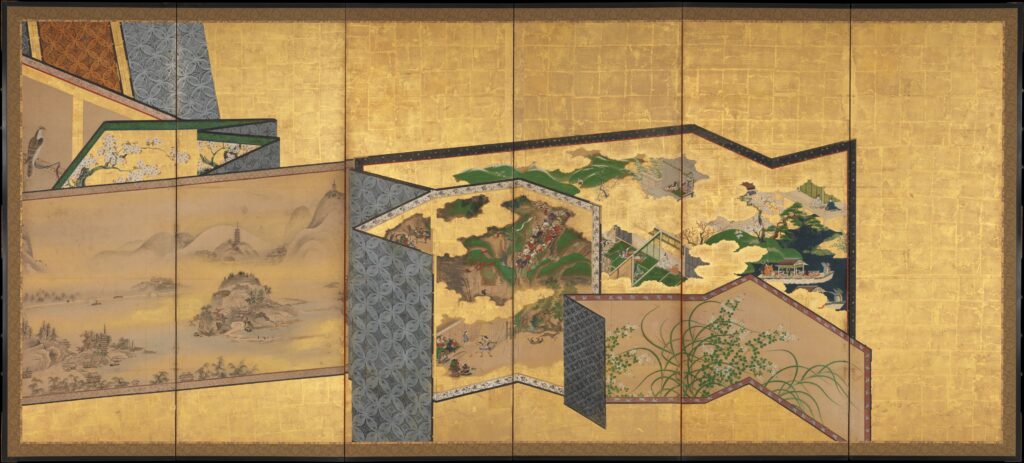
One pair of screens at the Metropolitan Museum is a catalogue of other screens. Painted on gold-leafed paper in Japan in the late seventeenth or early eighteenth century, it shows miniature folding screens, each in a different workshop style. The museum calls the subject unusual and the result a fanciful catalogue of the styles practiced in Japan in the 1700s. It is also a fair introduction to the Japanese folding screen, which was furniture, partition and painting at once.
The Japanese word, byōbu, names the job. The Met breaks it into byō, a wall, fence or screen, and bu, wind, so that a byōbu is literally protection against the wind. The name is about the screen’s work in a room, not about the painting on it.
Furniture that divided rooms
The Met’s essay on screens says they served as furnishing and as decoration, dividing large open spaces into more intimate and private areas, often for dressing or sleeping. Their gold-leaf surfaces reflected ambient light, and outdoors they could be set up as portable partitions to shield revelers from prying eyes. Britannica describes the large, generally dark interiors of Azuchi-Momoyama castles as subdivided by sliding panels (fusuma) and folding screens, which together gave painters their format, according to the wealth and predilection of the patron daimyo. Sliding doors and shoji are covered in the guide to Japanese interior design, and screens as one kind of furniture among others in the Japanese furniture guide.
A subject chosen for the room
The essay adds that the subject of a screen often hints at its original function and its patron’s tastes. Hawks and pines by a well-known Kano School painter were considered right for a military warlord’s castle, while a gnarled, ancient plum tree on the sliding doors of a Zen abbot’s quarters suited another kind of room. The Met’s pair of six-panel screens attributed to Mitani Tōshuku, from the early seventeenth century, shows the first kind.
The pair sets a thin, supple willow against a mighty pine, and the museum reads them as vitality and purity. The hawks, set among blossoms, suggest the indifference of the natural order, the museum says, and the hawk was a symbol of kings and a favorite theme of warlords in the era of civil wars.

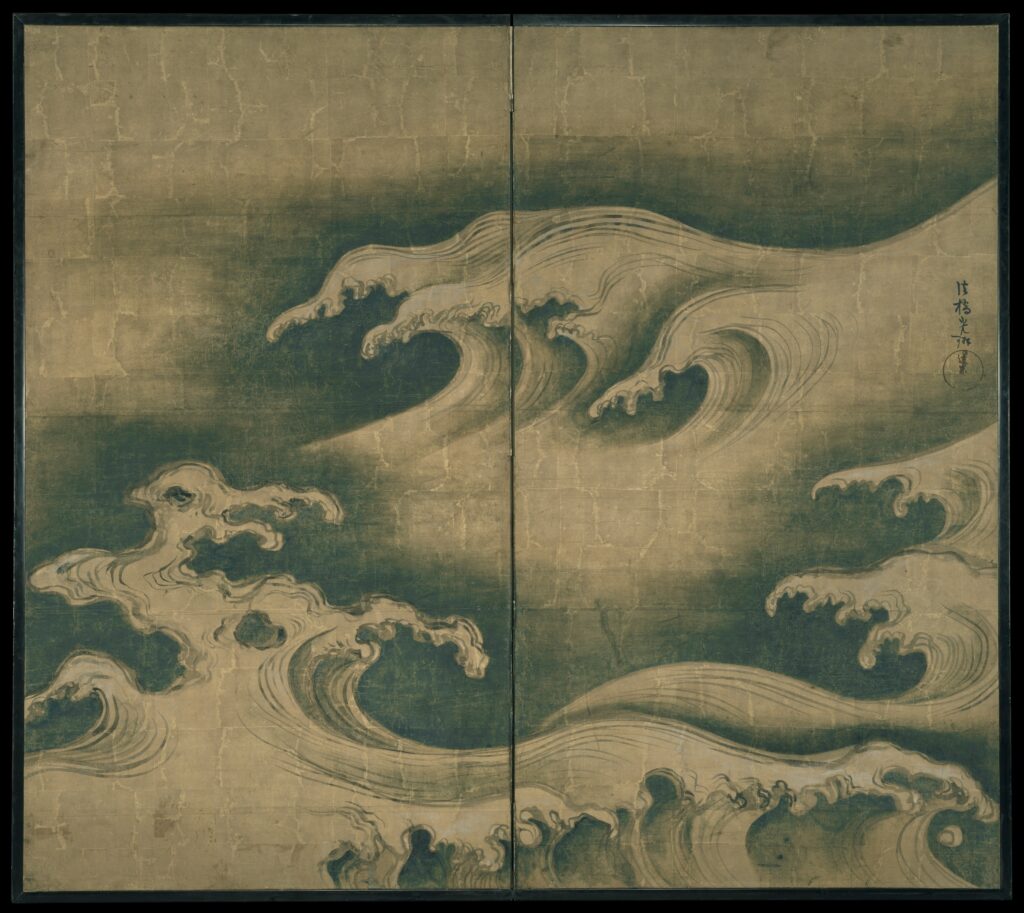
Not every screen is a long gold panorama. Ogata Kōrin’s Rough Waves, about 1704 to 09, is a two-panel folding screen in ink, color and gold leaf, just under five feet high and a little over five feet wide. The Met calls the waves strangely menacing, with long, tentacle-like fingers of foam that recall dragons’ talons, and notes that Kōrin outlined them in ink with the Chinese technique of holding two brushes in one hand. The screen carries a seal reading Dōsū, the name he adopted in 1704, which is why recent research, the museum says, places it between 1704 and 1709, while he lived in Edo.
Gold leaf can also sit out of sight. In Kano Chikanobu’s Birds and Flowers of Autumn and Winter, an early 18th-century six-panel screen, the Met says the leaf was applied to the back of the silk, which gives the painted scenes a soft glow and depth. The artist set the seasons inside two fan-shaped frames, so the screen reads like a pair of windows onto autumn and winter.

Whose sleeves?
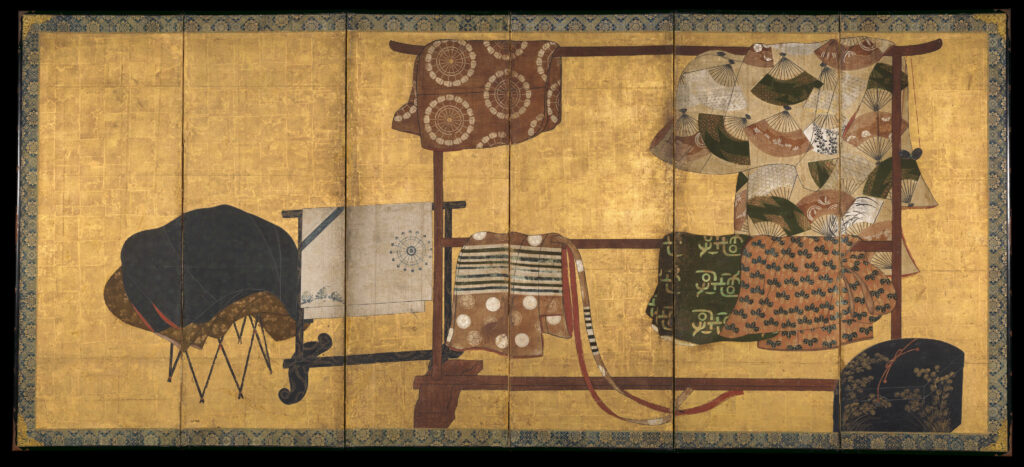
One of the stranger subjects in the genre is a room with nobody in it. In the Met’s tagasode (“Whose Sleeves?”) screens, lavish kimonos hang over clothing stands against gold-leafed paper, with the owners’ accessories and furniture, and no people. The title, the museum says, invites the viewer to wonder who owns the robes. The essay counts more than forty surviving examples, painted in mineral pigments, and finds that securely dated ones have yet to be identified. Attributions have been proposed to Sōtatsu and the Rinpa school, and to the Hasegawa and Kaihō schools, but most of the screens are credited to anonymous town painters.
Even the name is a later label. The phrase comes from classical love poems and, the museum’s record says, was not commonly applied to this type of screen until the late nineteenth century. The essay traces the earliest reference to the term to an auction catalogue of 1911. The two Met texts differ on how late, but both agree that the name is not a seventeenth-century one. The Met adds a caution that applies to any painted wardrobe: a garment may be accurately depicted for its period without being contemporary with the painting.
Before you buy a Japanese folding screen
The museum records suggest a few questions. Look first at whether a screen is one half of a pair. The Met’s tagasode screens are catalogued together, but the right screen dates from the late sixteenth or early seventeenth century and the left from the early or middle seventeenth, so even in a museum a pair can be two screens of different dates. Format varies as much as subject. The Met’s Kōrin screen has two panels, its Tōshuku pair has six panels each, and a late nineteenth-century tea-ceremony screen by Shibata Zeshin has two panels each barely fifteen inches high.
Treat a subject as a clue to use, not as proof of date, and ask what an attribution rests on, since even the museum calls many of these questions open. A seal can narrow a date to a few years, as the Kōrin screen shows, though a seal needs checking too. Most screens offer no such help, and a listing that promises a precise date and a famous hand is claiming more certainty than most museum records do for screens of this kind. The wider questions of condition and provenance are in the buying vintage furniture guide.
Sources
- The Metropolitan Museum of Art, Heilbrunn Timeline of Art History: Terry Satsuki Milhaupt, Interiors Imagined: Folding Screens, Garments, and Clothing Stands
- Encyclopaedia Britannica, Japanese architecture: The Azuchi-Momoyama period
- The Metropolitan Museum of Art collection records: Whose Sleeves? (Tagasode), 29.100.493, .494, Screens within Screens, 2010.402.1, .2, Hawks with Pine Trees and Camellias, 29.100.491, .492, Rough Waves, 26.117 and Folding Screen for Tea Ceremony, 54.56