Japanese lacquerware is usually bought by the object, not by the material: a writing box, an incense box, a tray. Much of it is decorated in maki-e, which the Met defines as decoration with gold and/or silver sprinkled powder. This guide reads four boxes at the Metropolitan Museum of Art to show what a piece is, how its surface was made and what to ask when you meet one.

Start with what the object was for
The Met describes a writing box (suzuribako) as a container for an inkstone (suzuri), a water dropper and writing brushes, and notes that such boxes are often decorated with images that carry literary references. Its example from the eighteenth century is covered in gold maki-e with a design referring to Naniwa, present-day Osaka, and a poem from the Shin kokin wakashū (about 1206) appears on the outside and inside the lid (Met 2015.300.286a–h). The form tells you the function, and the decoration tells you how the owner meant it to be read.

Maki-e: gold on lacquer, in several ways
Maki-e is a family of techniques, and museum records name the ones used. An eighteenth-century incense box in the Met, eight-lobed and standing on small curved legs, is decorated with several of them, among them okibirame, in which individual gold flakes are placed onto the sticky lacquer surface, and mother-of-pearl inlay (Met 14.40.824a–h). Its lid shows Chinese children playing with large snowballs, and its sides carry auspicious animals, among them the hare, tiger, crane and lion, in cartouches. Inside are three small incense containers, two of them in the shape of butterflies.
The same record lists its techniques as togidashi, hiramaki-e and takamaki-e, plus cut-out gold foil and red lacquer. For a buyer, that vocabulary is the practical point: a description that names the techniques is a description someone has looked at closely.
Japanese lacquerware by region: the Kaga school
Lacquer was also a matter of place. The Met says that next to Kyoto and Edo, Kanazawa in Kaga Province was a third major center of lacquer art in the early Edo period. Around the middle of the seventeenth century the daimyo Maeda Toshitsune summoned the Kyoto lacquer master Igarashi Dōho to Kanazawa, and Dōho and a few others, including Igarashi Fujin, established the Kaga lacquer school. Maki-e decorated with gold mattered there because Kaga was known for its gold mines and its gold leaf and powder.
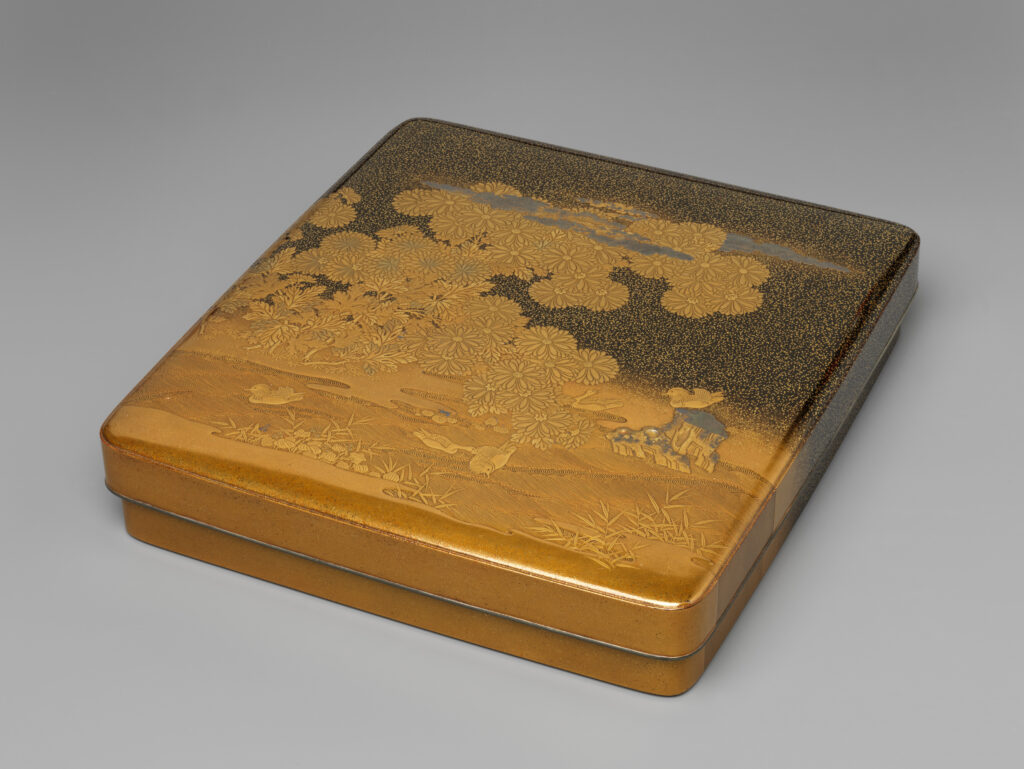
Fujin’s writing box (Met 2023.377a–e), made in the second half of the seventeenth or early eighteenth century, shows chrysanthemums and a river with mandarin ducks. The Met reads the chrysanthemums as a symbol of immortality, tied to the legend of the Chrysanthemum Boy, and the mandarin ducks as symbols of love and fidelity, and suggests the combination could mark a wedding or birthday gift.
When lacquer traveled: a box with French mounts
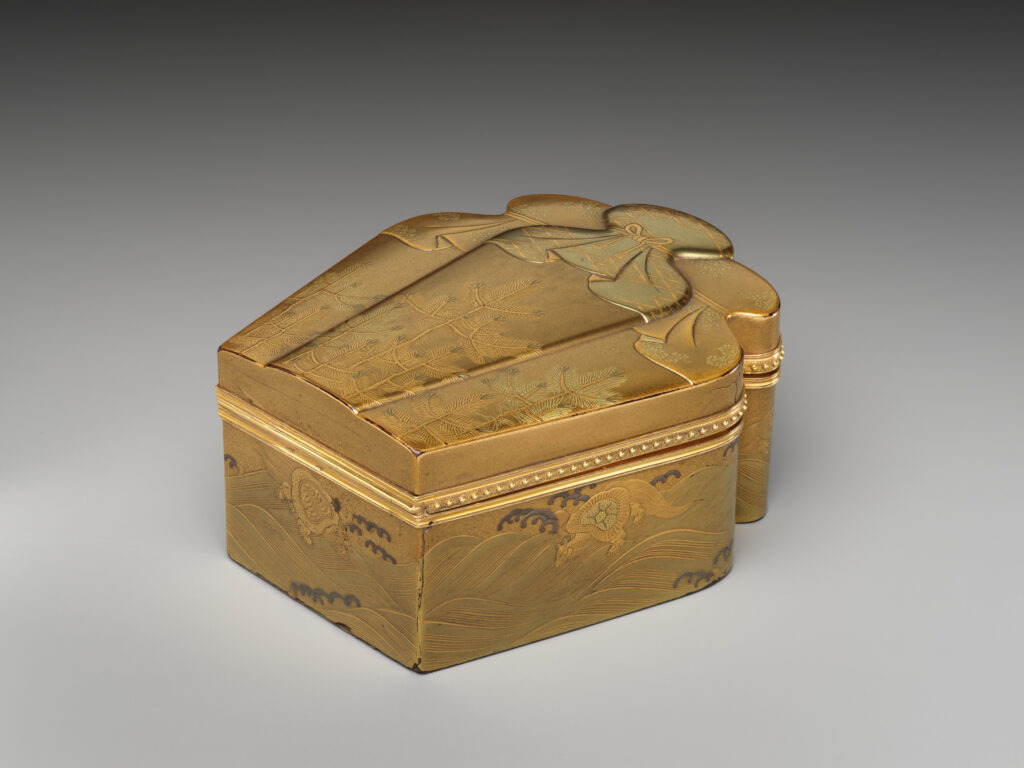
Lacquer that left Japan was sometimes changed. The Met’s incense box in the shape of three overlapping jars was made in Japan in the mid-eighteenth century, with maki-e young pines on the lid and a continuous seashore on the sides. It was exported to Europe, by the Dutch or through the China trade, a route the museum compares with that of the Japanese lacquer boxes owned by Marie Antoinette. In Paris the craftsman Barthélémy Paviet applied gilded mounts to the rims and lined the inside with a gold-like metal sheet (Met 2019.281.2).
The result is a Japanese object and a French one at once, which is exactly why a mounted box needs a closer look than an unmounted one. For the French habit of mounting Asian porcelain and lacquer in gilt bronze, see the guide to ormolu and gilt bronze.
What to ask before you buy
The four records suggest a short list. What was it made to hold? Which maki-e techniques does the description name, and can the seller say where they show? Is it attributed to a school or region, and on what grounds? Has it been altered, as the Paviet box was, by mounts or linings? And how does the seller date it, and on what evidence? Lacquer furniture is covered in the guide to Japanese furniture, and the wider tradition in the Japanese archive. For another Japanese craft read through Met records, see the guide to chawan.
Sources
- The Metropolitan Museum of Art, 14.40.824a–h, Incense box with Chinese children playing with snowballs
- The Metropolitan Museum of Art, 2015.300.286a–h, Writing Box (Suzuribako) with “Dream in Naniwa” Design
- The Metropolitan Museum of Art, 2023.377a–e, Writing box (suzuribako) with chrysanthemums and mandarin ducks
- The Metropolitan Museum of Art, 2019.281.2, Incense Box (Kōbako) in the Shape of Three Overlapping Jars