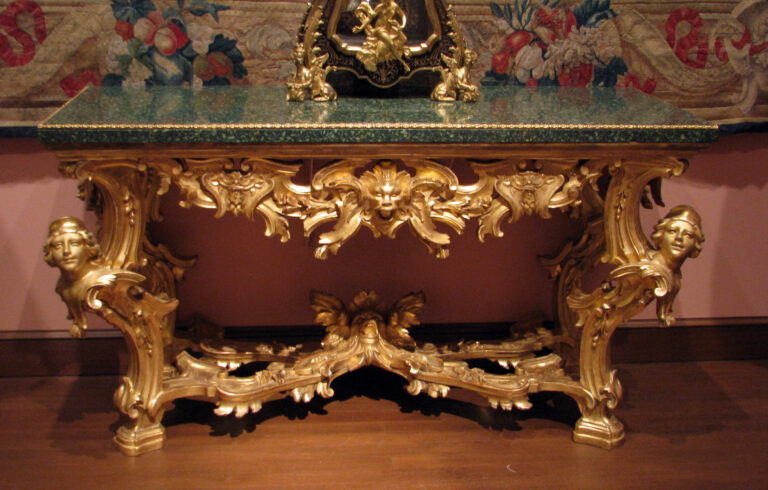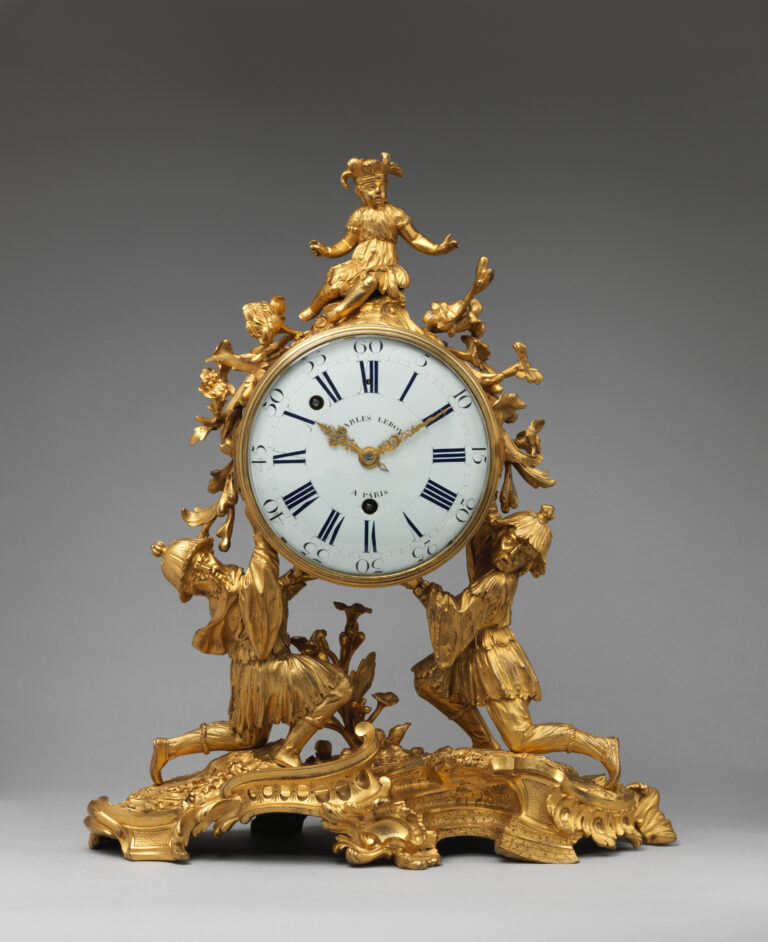
Much of what passes for ormolu on an eighteenth-century French commode may never have been gilded at all. According to the Metropolitan Museum’s account of the Paris bronze trade, most bronze objects were simply dipped in acid to clean them and then coated with a clear or yellow varnish that made them look like gold. Real gilding, done with mercury over an open fire, added a substantial cost.
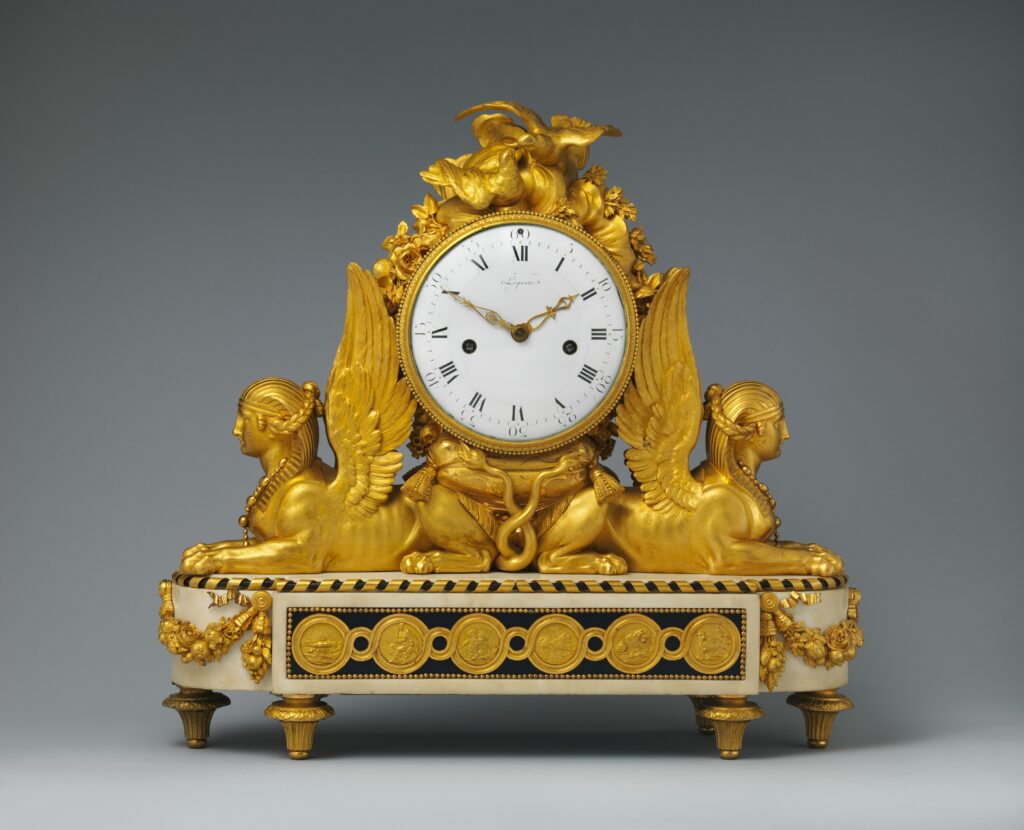
In its dictionary sense, ormolu is the gold-colored metalwork this trade produced: gilded brass or bronze, used for furniture mounts and for clocks, wall lights and firedogs. The word comes from the French or moulu, “ground gold”, and is pronounced OR-muh-loo. The clock at the top of this page, designed about 1783, is gilt bronze put to work as a mantel ornament. The word is used in two ways, the base metal is itself disputed, and the sequence of French periods it belongs to is laid out in the timeline of French furniture periods.
The short version
- The word: from the French or moulu, “ground gold”. Merriam-Webster dates its first known use in English to 1765.
- The material: a gilded copper alloy, called bronze or brass depending on the source.
- The finish: strictly, mercury gilding. Acid-cleaned, varnished metal imitated it, and later electro-gilded work is often wrongly called ormolu.
- Who made it: casters, chasers and gilders working under Paris guild rules.
- Where you find it: furniture mounts, wall lights, firedogs and clocks.
- Main period: used in France from the second half of the seventeenth century, with its heyday in the eighteenth.
- The catch: mounts were seldom signed, were often regilded and could be cast again from the originals.
What ormolu means, and where the sources disagree
Merriam-Webster defines ormolu as golden or gilded brass or bronze used for decorative purposes, with furniture mounts as its example. That is the broad meaning. The Wallace Collection in London uses it too, calling ormolu another English name for gilt bronze, and a guide on LAPADA’s site by the antiques dealer Butchoff says gilt bronze is also called ormolu.
Britannica is stricter. It reserves “true ormolu” for metal gilded with a paste of powdered gold and mercury that was fired until the mercury evaporated, and it notes that pieces gilded by electrolysis in the later nineteenth century are often wrongly called ormolu.
So the word has two working meanings: any French gilt bronze, or only the mercury-gilded kind. The sources are not contradicting each other so much as drawing the line in different places. Here the two words are used interchangeably, and where the mercury process matters the text says “strictly”.
Bronze or brass?
The name gilt bronze, like the French bronze doré, suggests bronze, and the Met and the LAPADA guide both describe casting in molten bronze, an alloy of copper and tin. The Wallace Collection notes that gilt bronze is the English rendering of the French but that the metal is actually a copper and zinc alloy, which is brass. Britannica defines ormolu as an alloy of copper, zinc and sometimes tin, Merriam-Webster says brass or bronze, and a National Park Service conservator, speaking about mounts on a piece in a historic house, calls them brass.
The practical point is modest. “Gilt bronze” is the traditional trade name for these mounts, and it does not settle what the metal is.
How a mount was made
Making a mount was a chain of specialists. A designer’s drawing became a three-dimensional model in wood, clay or wax. A mold taken from the model was pressed into sand and molten metal poured into the hollow, and complicated shapes were cast by the lost-wax method. The rough casting was cleaned up and passed to the chaser, who tooled it to leave burnished areas beside finely or coarsely grained ones. That finishing matters more than it looks: the Met says it is what gives a mount its life as the light moves across it.
Gilding came last. The surface was coated with a mixture of ground gold and mercury and heated over an open fire. The mercury evaporated, leaving the gold, and the process was repeated until the layer was thick enough. It could be left matte or burnished with a heliotrope stone. It was expensive and, because of the fumes, dangerous. A 1995 conservation paper that photographed each step of the sequence notes that the technique is still practiced in the original manner.
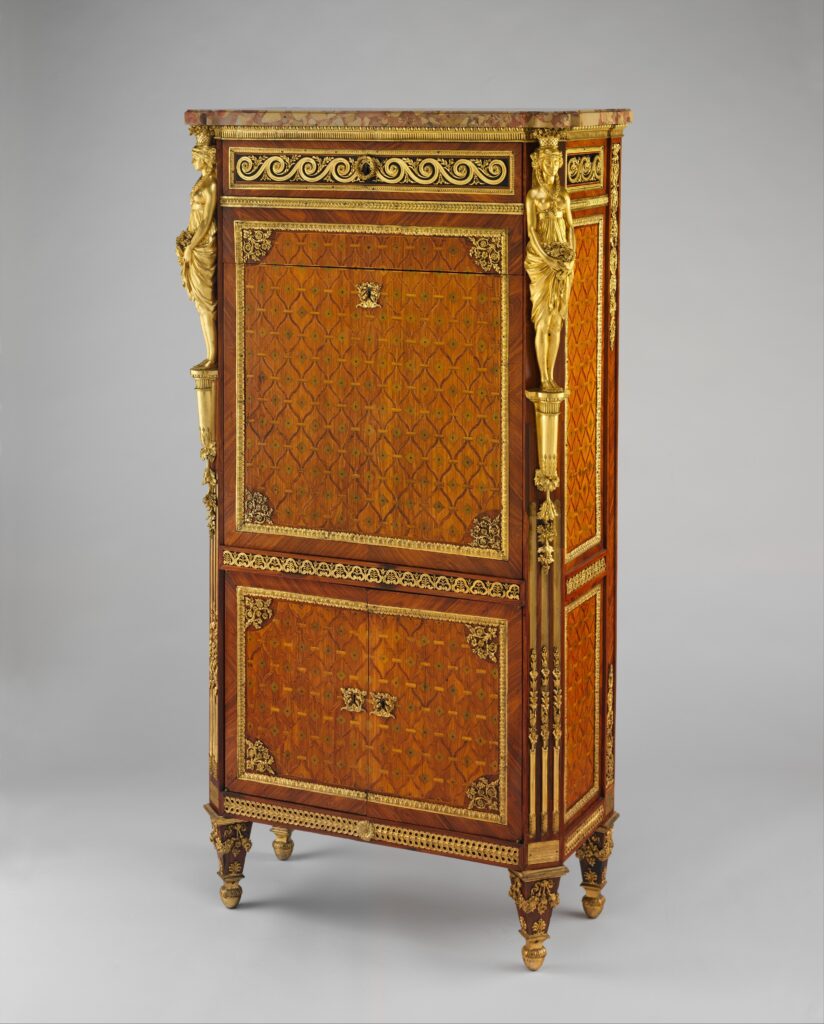
In Paris the work was divided by trade. The Met explains that eighteenth-century bronze makers belonged to two guilds, the casters and chasers (fondeurs-ciseleurs) and the chasers and gilders (ciseleurs-doreurs), and that a reform in 1776 merged them. Its record for the secretary above shows what that meant on a royal commission. The mounts were modeled by Louis Simon Boizot, chased by Pierre Philippe Thomire among others and gilded by Gallé, with Jean Haure coordinating, while Guillaume Benneman supervised the cabinetwork.
Not everything gold was gilded
The Met’s essay is blunt about this. Most of these objects were not gilded. They were cleaned in acid and given a clear or yellow varnish, which looked like gold until it wore, and then they were revarnished. Some were gilded afterward, which is why few varnished examples have survived.
On the strict definition above, the varnished pieces were never true ormolu. That is the reason to ask, whenever you read the word, which meaning is intended.
What the mounts were for
On furniture the mounts were first of all armor. The Met says their role was primarily functional. Feet, called sabots, and corner mounts protected the wood from being knocked about or carted from one residence to the next, escutcheons kept the key from scratching the veneer, and handles opened the drawers.
They also drew the shape of a piece. Mounts emphasized the outline, which counted most in the Rococo with its serpentine curves, and they added a lively, sculptural element. Under the Neoclassical and Empire styles they became more decorative, with the refinement of jewelry. For the Rococo furniture that these curving mounts decorated, see Rococo furniture of Louis XV’s reign, and for the Neoclassical pieces whose mounts reached that jewelry-like finish, the royal makers of Louis XVI’s reign. The Wallace Collection adds that mounts were a vital part of a design, sparkling in candlelight, and that Jean-Henri Riesener was one of the first makers to hide their fixings.
Cabinetmakers were generally not allowed to make their own mounts. They bought them from suppliers in a separate guild and were permitted to attach them. Charles Cressent did not stay in his lane. Trained as both a cabinetmaker and a sculptor, he had mounts, wall lights and firedogs of gilt bronze made in his own workshop, which the Met records as strictly against guild regulations and a cause of repeated conflict with the guild of casters and gilders.
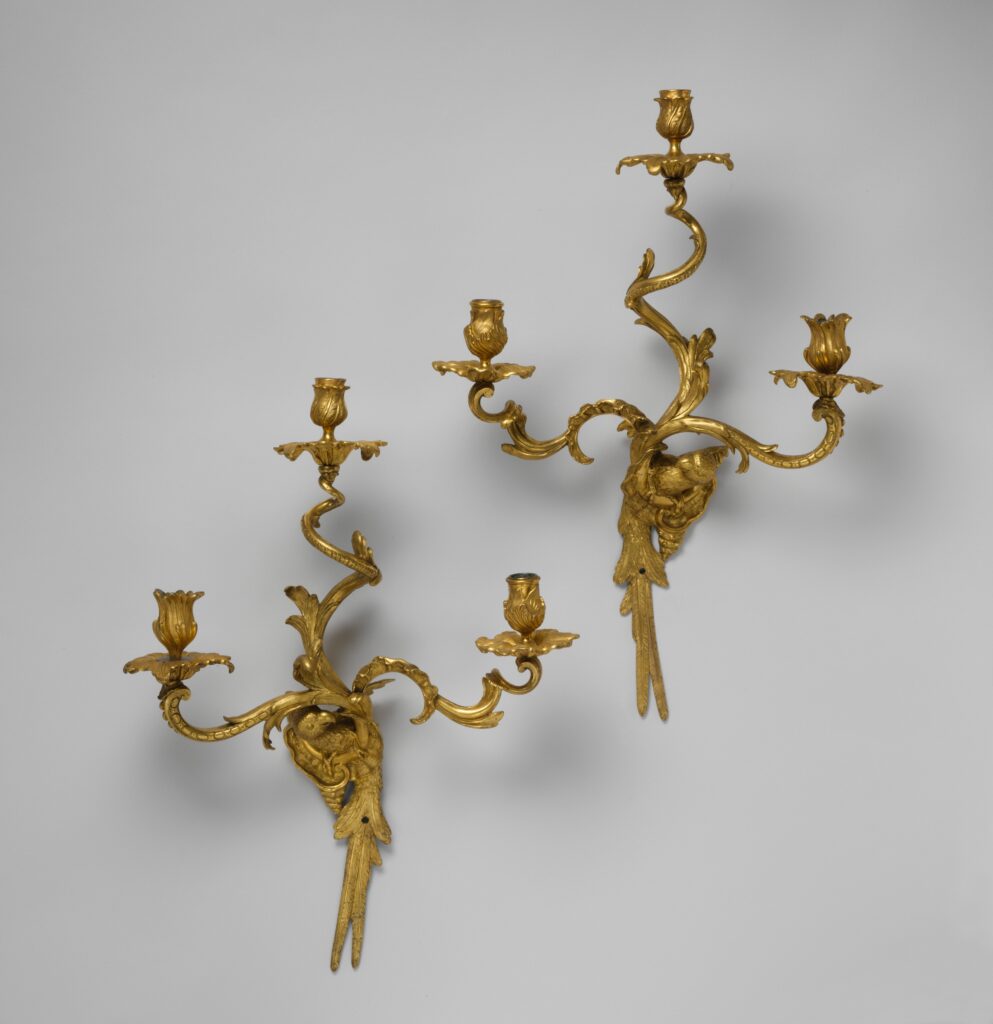
The wall brackets above are attributed to his design, with the casting and chasing attributed to Jacques Confesseur, who collaborated with him. The tails of the parrots perched on a shell-shaped rocaille are part of the overall design, and the sales Cressent organized of his stock in 1749 and 1757 listed wall lights with parrots in either lacquered or gilded bronze. More French furniture is collected in the furniture section.
Beyond furniture: clocks, firedogs and wall lights
The Met groups gilt-bronze mounts with the other bronzes d’ameublement, the wall lights, firedogs and clocks that furnished French rooms from the late seventeenth to the early nineteenth century. The clock at the top of this page is one. It was designed by François Joseph Bélanger about 1783, with the gilt bronze of the case attributed to Pierre Gouthière, one of the masters Britannica names alongside Jean-Jacques Caffieri and Pierre-Philippe Thomire. Look at how the light moves across the sphinxes, the garlands and the medallions on the base: varied reflections are what the Met says the chaser’s differently treated surfaces were meant to create. Lamps and other lighting are gathered in the lighting section.
The signatures, stamps and cases on clocks like it are the subject of a guide to antique French mantel clocks.
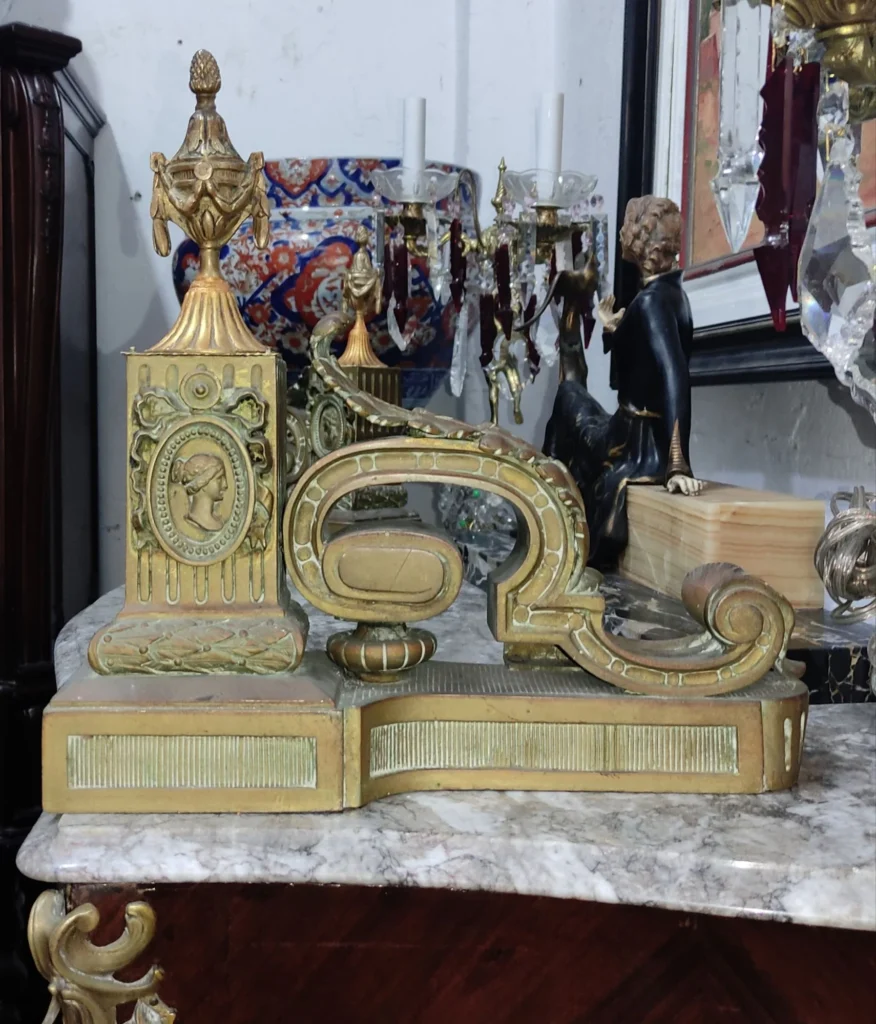
Chandeliers, including French gilt-bronze ones, are covered in antique chandeliers.
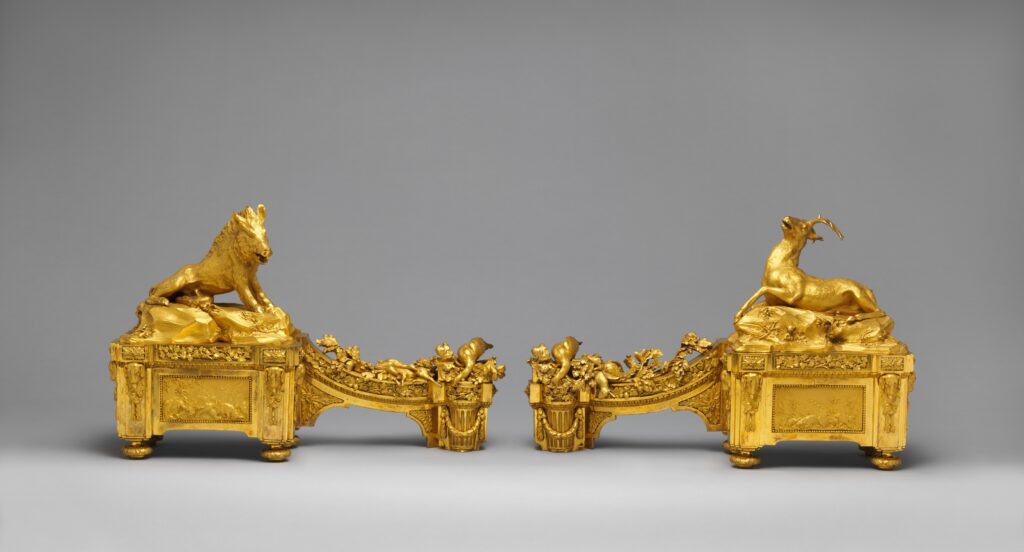
The firedogs below, by Quentin-Claude Pitoin about 1772, use the same material for a hunting scene, a boar on one andiron and a reclining stag on the other. The Met notes that these models are known to have been repeated in different sizes, a reminder that popular designs were made more than once.
Is ormolu toxic?
The danger the sources describe belongs to the making. Mercury gilding released dangerous fumes, the Met says, and the Wallace Collection calls it a complex and dangerous process that exposed the gilder to them. A National Park Service conservator describes the fumes as highly poisonous. The sources this guide draws on do not address handling a finished antique, so there is no safety verdict here. If a piece is heavily worn, or you are thinking of stripping or regilding it, that is a question for a conservator.
How to identify ormolu, and what cannot be proved
Expect less proof than you would like. The Met says gilt bronze is seldom signed, so an attribution rests on a contemporary description or on the quality of the piece. Certain models were used again and again, and in the nineteenth century mounts were copied by taking molds from the originals, a practice called surmoulage. The Wallace Collection adds that master models were bought and sold, so mounts could be recast after a designer’s death, and that some original mounts were overcast from a mold taken off the real thing. Regilding can make even an eighteenth-century mount look new.
Two things help. One is the finish the chaser left, burnished areas beside grained or matte ones, because the Met stresses that varied surface treatment is what gives a mount its vitality. The other is a single date mark. From February 1745 to February 1749 a tax mark in the form of a crowned C, for cuivre, copper, was struck on bronzes above a certain weight, and it is the only aid to dating the Met names. Because only the heavier bronzes carried it, a piece without the mark is not ruled out.
Watch the vocabulary as well. A description that says ormolu leaves open whether it means all gilt bronze or only the mercury kind, and electro-gilded work of the later nineteenth century is often called ormolu by mistake. Ask what the metal is and how it was gilded. For how such descriptions are worded in a sale, see how sale-room descriptions are worded, and for the checks that come before a purchase, what to check before you buy.
Cleaning and caring for ormolu
The one cautionary case in the sources is a polish. National Park Service conservators working on a piece in a historic house found its brass ormolu mounts damaged by aggressive use of commercial polishes, which had left them dull and blotchy, and they recreated the original look with dyed coatings. It is a single case from a conservators’ newsletter, not a care manual. It is still a good reason to leave metal polish alone and to ask a conservator before cleaning or regilding anything you value, since, as the Met notes, regilding can make even an old mount look new.
Sources
- The Metropolitan Museum of Art, The Art, Form, and Function of Gilt Bronze in the French Interior
- The Wallace Collection, Riesener’s gilt-bronze mounts
- Encyclopaedia Britannica, Ormolu
- Merriam-Webster, Ormolu
- LAPADA, LAPADA Guide to Gilt Bronze, by Ian Butchoff, Adam Kaye and James Kaye Butchoff
- Brian Considine, The fabrication of gilt bronze mounts for French furniture of the 18th century, Objects Specialty Group Postprints, vol. 3 (1995)
- National Park Service, Longfellow-Washington Bulletin, 2013 issue
- The Metropolitan Museum of Art collection records: 1972.284.16, 1974.356.133–.136, 1977.102.5, .6 and 1971.206.17