The main rule of the 1925 Paris exposition was that nothing in it could copy the styles of the past. The Metropolitan Museum’s account of the fair then notes the awkward part: much of what was exhibited, it says, was “firmly rooted in the traditions of the past.” That tension is a good way into French Art Deco furniture. At the luxury end that Ruhlmann represented, it was modern in outline and old in habit: rare veneers, ivory inlay and exacting craftsmanship, from a workshop that took late eighteenth-century cabinetmaking as its starting point.
The name came afterward. The fair’s full title was the Exposition Internationale des Arts Décoratifs et Industriels Modernes, and the Met says it was later shortened to Art Deco, which it concedes is a catch-all label and “perhaps somewhat imprecise.” Visitors in 1925 were going to a fair of modern decorative arts, not to Art Deco.
A fair meant to win back the luxury trade
The French government voted in 1912 to sponsor an international exhibition of decorative arts. It was scheduled for 1915, the First World War postponed it, and it opened in 1925. French designers had reason to want it: they were disillusioned by the commercial failure of Art Nouveau and worried by Austrian and German advances in design and manufacturing. Their remedy was to reclaim France’s traditional place as the leader of the luxury trades, a reputation that had reached its apex in the eighteenth century, the era of the Rococo and Neoclassical French furniture styles.
The fair was large and state-sponsored: more than 16 million visitors over a seven-month run, with more than twenty countries invited. Exhibits ran from architecture and interiors to jewelry and perfume, and were meant above all to proclaim French supremacy in luxury goods.
Ruhlmann’s house for an imaginary collector
Émile-Jacques Ruhlmann (1879 to 1933) designed the pavilion that the Met calls the fair’s most admired attraction. The Hôtel du Collectionneur, which the Albert-Kahn museum catalogues as the Hôtel d’un riche collectionneur, was intended to suggest the villa of an imagined collector with money and discernment. The Gulbenkian Museum says Ruhlmann worked on it with the architect Pierre Patout, and names Antoine Bourdelle, Joseph Bernard, Jean Dunand and Edgar Brandt among those who also contributed to the space.
Ruhlmann could supply every element an interior needed, from furniture to lighting, ceramics, carpets and textiles, and he planned entire suites of rooms along with their contents. For the pavilion, furniture, carpets and decorative objects were created for the rooms, so a chair, the carpet under it and the light above it could belong to one scheme.
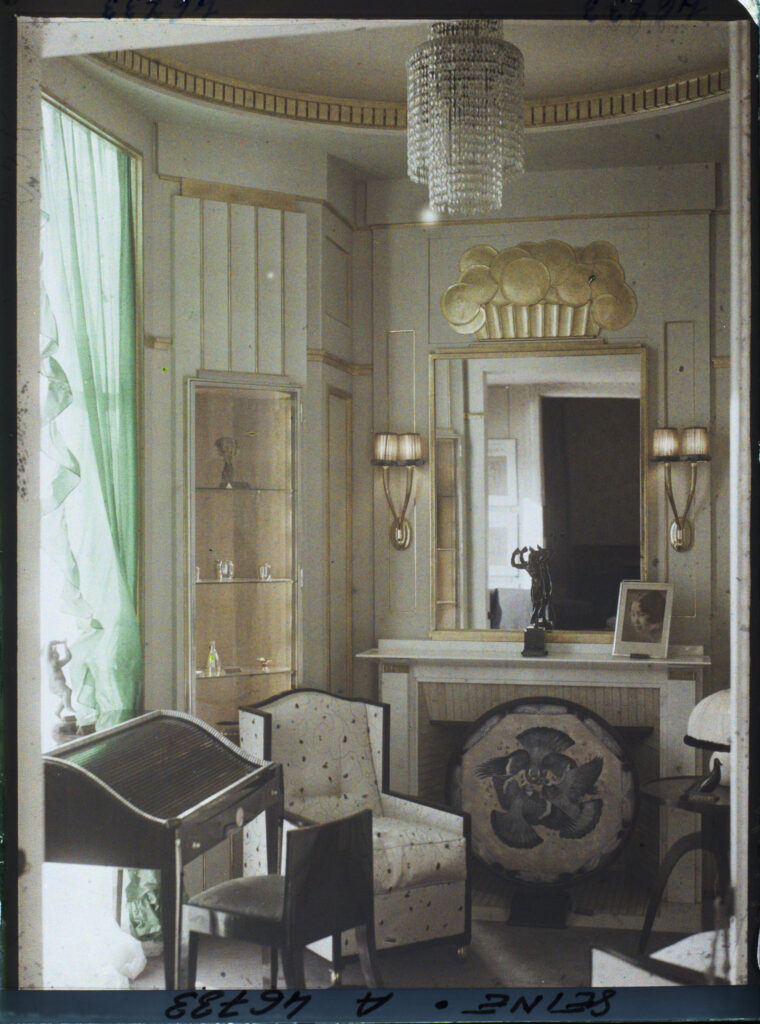
Colour plates in the Musée départemental Albert-Kahn show one of those rooms. The operator Auguste Léon photographed the pavilion in September 1925 in autochrome, a colour process on glass plates.
In the Petit Salon, photographed on 15 September, the walls are pale panels edged in gilt. A tiered crystal chandelier hangs from the ceiling, and above the fireplace a gilded relief of a basket of flowers tops a gilt-framed mirror, with a sconce with a pleated shade on either side. In the foreground stand a dark desk with a slatted lid and an armchair covered in cream fabric flecked with small dark marks, and in front of the fireplace a round panel painted with birds. The catalogue records the room and not the makers of its pieces, so none is attributed here.
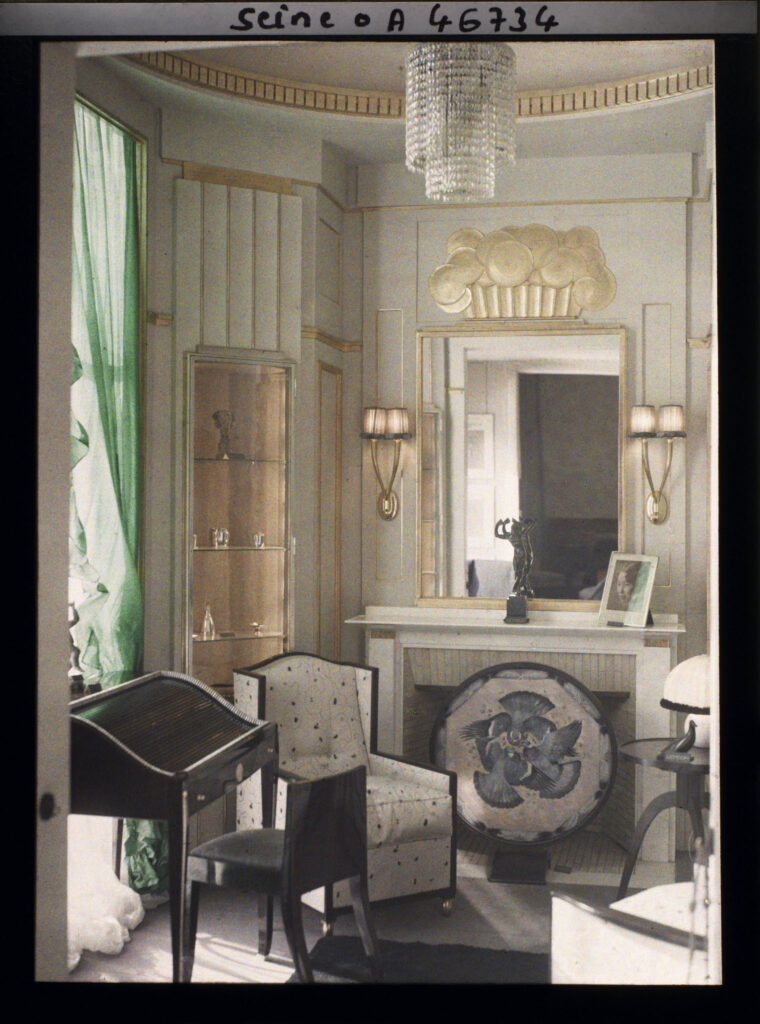
The museum holds two plates of this corner, A46733S and A46734S, and the one reproduced here is the second. It is the cooler of the two: the walls look greyer and the curtain a deeper green, a reminder that a century-old colour plate is better evidence of arrangement than of exact colour.
French Art Deco furniture and the eighteenth century
Ruhlmann’s model was the cabinetmaking of late eighteenth-century France. His furniture recast the Neoclassical tradition for his own time: well-judged proportions, a clear structure and restrained ornament, in the costly materials his ancien-régime predecessors had used, which meant rare woods, ivory, lacquer and precious metals, finished with fine veneer and inlay. He was dubbed “the Riesener of the twentieth century”, after the celebrated royal cabinetmaker to Louis XVI, and a nickname like that at a fair devoted to the modern is its own commentary.
The luxury drew on distant sources. The Met ties the vogue for sharkskin, ivory, exotic woods and lacquer work to official encouragement: the French government urged designers to use raw materials and skilled labor from the colonies in Asia and Africa. The clientele was narrow. Ruhlmann’s patrons were the newly rich of post-war Paris, who wanted their wealth and taste noticed, and one large, elaborate piece is reported to have taken up to 1,000 hours of work and to have cost about as much as a house.
The V&A holds a Ruhlmann writing table of about 1925 that puts those materials on a domestic scale. It is mahogany with the top and legs veneered in macassar ebony, and a gilt-tooled calf-leather writing surface that the museum notes is a modern replacement. Its record says the table formed part of a suite said to have been shown at the Paris exposition of 1925, and that the macassar ebony veneer would have made it affordable only to the wealthiest buyer.
Beyond the rooms
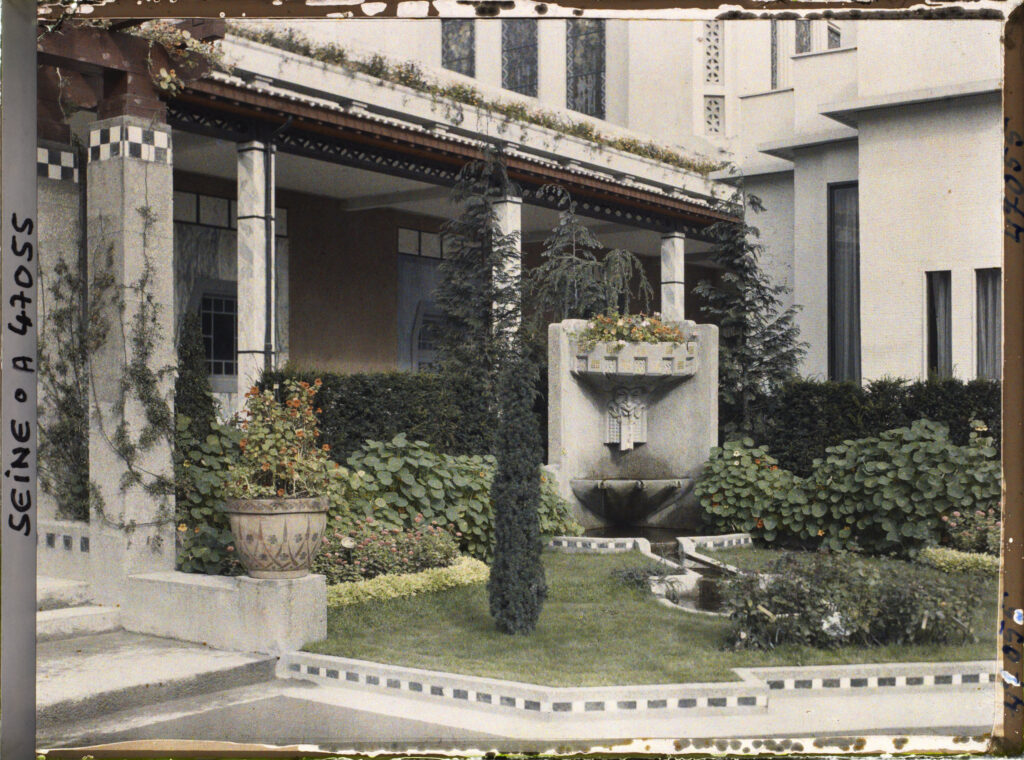
The pavilion was not only rooms. On 18 September, three days after photographing the Petit Salon, Léon photographed the pavilion’s garden, which the catalogue credits to Vacherot and Riousse, on the esplanade of the Invalides. The plate shows a loggia with pale columns, a lawn edged with a band of small tiles, clipped hedges and conifers, flowers in pots and borders, and a wall fountain with relief ornament, all in front of a pale, stepped building.
Inside, the catalogue also records a rotunda salon with a decorative panel by Jean Dupas, Les Perruches (The Parakeets), for a fireplace. It credits Dupas for the panel but names no maker for the furnishings in that room, so none is attributed here.
What else the fair argued
Not everyone at the fair agreed with Ruhlmann. Le Corbusier’s Pavilion de l’Esprit Nouveau, at the same exposition, answered Art Deco head-on: it rejected costly exotic materials and one-off showpieces. Le Corbusier called the house “a machine for living in” and furniture “domestic equipment”, and furnished the pavilion with off-the-shelf pieces such as leather club chairs.
Britain’s contribution was limited, the V&A says, and critics dismissed it as conservative. The museum’s collection nonetheless includes a desk designed by Sir Edward Maufe and made by W. Rowcliffe in 1925, in mahogany with a white-gold surface and details of exotic wood, ivory and silk.
The wealth that carried the Paris style did not last the decade. The 1929 crash and the Depression diminished the money and the attitudes that had sustained Art Deco, according to the Met, and by the V&A’s account chromed steel, aluminium, coloured glass and new plastics such as Bakelite became the favored materials of the 1930s, replacing exotic woods, ivory and sharkskin. Ruhlmann died in 1933, at fifty-four, just as the style he had championed was going out of favor.
Art Deco furniture style: exotic woods in the 1920s, new materials in the 1930s
The V&A dates the Art Deco style to about 1910 to 1939 and counts Émile-Jacques Ruhlmann’s work among the finest in it. Its Ruhlmann writing table of about 1925 (V&A CIRC.363:1 to 5-1970) is mahogany with the top and legs veneered in macassar ebony, and the museum says the ebony veneer would have made it affordable only to the wealthiest buyer. It notes that Ruhlmann often used non-European and expensive materials, and that the table’s calf-leather top is a modern replacement, a reminder to ask what on an antique piece is original. The table is said to have formed part of a suite shown at the 1925 Paris exposition.
By the 1930s the materials had changed. In its article Art Deco in the home, the V&A says chromed steel, aluminium, mirror, coloured glass and new plastics such as Bakelite and Catalin became the favoured materials of the decade, replacing exotic woods, ivory and sharkskin. A macassar ebony piece and a chromed-steel one can therefore both be period Art Deco, from different decades. For the style that came before, see French Art Nouveau furniture, and for both together the Art Nouveau and Art Deco archive.
Sources
- The Metropolitan Museum of Art, Jared Goss, French Art Deco (June 1, 2010), and Design, 1925–50, read October 12, 2026.
- The Metropolitan Museum of Art, Ruhlmann: Genius of Art Deco (exhibition page, 2004), and the press release for the exhibition, read October 12, 2026.
- Victoria and Albert Museum, Art Deco in the home (updated April 17, 2024), and the record for the Ruhlmann writing table (CIRC.363:1 to 5-1970), read October 12, 2026.
- Calouste Gulbenkian Museum, work page for Janniot’s sculpture, which names the Hôtel du Collectionneur, Ruhlmann and Patout, read October 12, 2026.
- Musée départemental Albert-Kahn (Département des Hauts-de-Seine), online collections: autochromes A46733S, A46734S and A47055S, whose records state the licence “Librement réutilisable (CC-00) – Domaine Public”, read October 12, 2026. The catalogue gives titles, dates and subject tags; the descriptions of the plates above are the editor’s own reading of the images.