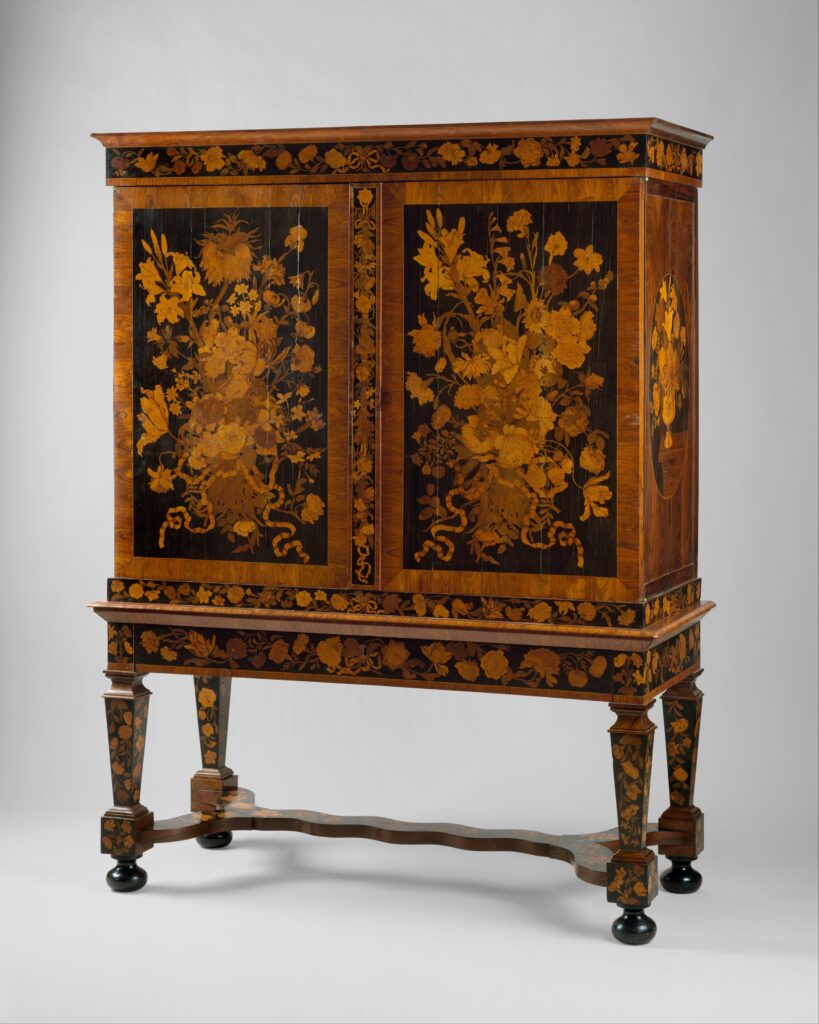
A cabinet at the Metropolitan Museum carries more than two hundred flowers, several of them repeated, some in reverse. None is painted. The museum says the maker chose bright yellow barberry wood for the daffodils and used natural dyes to lift paler woods, aiming at a palette close to the flower painters of his day. This is marquetry: a picture or pattern assembled from thin pieces of wood, shell or ivory, cut to a design and laid into a veneer on the surface of furniture.
The cabinet is attributed to Jan van Mekeren of Amsterdam and dates from about 1700 to 1710. It is oak, veneered with rosewood, olivewood, ebony, holly, tulipwood and barberry, some of it stained green. The Met notes that cabinets on open stands became fashionable towards the end of the seventeenth century, and that the cabinetmaker’s attention went to the surface, especially the floral work the Dutch called blomwerk.
Marquetry, parquetry, inlay and veneer
The four words overlap in practice. Merriam-Webster defines marquetry as decorative work in which pieces of material such as wood, shell or ivory are inserted into a wood veneer that is then applied to a surface. Britannica separates the terms. Veneer is a very thin sheet of fine wood or precious material applied to a surface; inlay is cut-out pieces set into cavities in the main structure; and marquetry is a more elaborate kind of veneering. Parquetry, in Britannica’s account, is veneer made from small pieces cut from the same larger piece of wood, laid with the grain running in opposing directions in a formal geometric pattern.
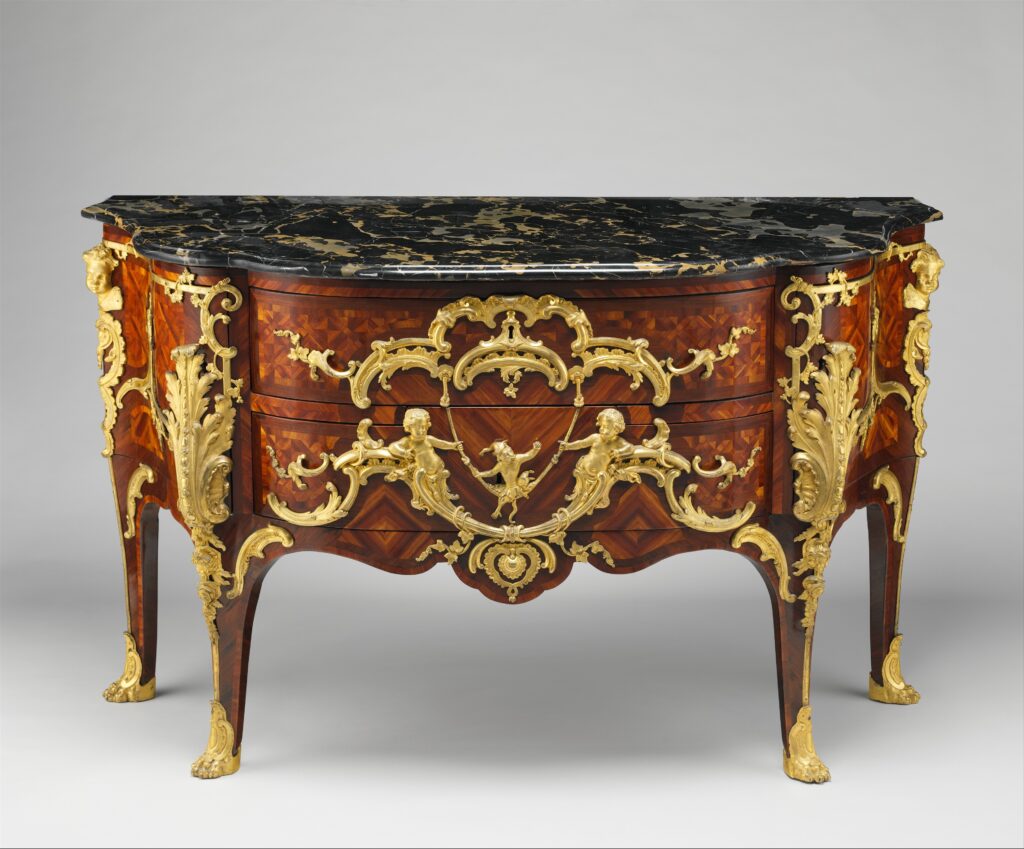
A practical way to tell them apart on a piece is the pattern, though only as a rule of thumb, since Britannica notes marquetry can be geometric as well as floral or narrative. Flowers, birds and scenes are marquetry. Designs built from the angle of the grain, like the diamonds on the Cressent commode below, are parquetry.
The Met’s commode by Charles Cressent, about 1745 to 49, a piece of the Rococo era described in the Louis XV guide, has a carcass entirely covered, in the museum’s words, with marquetry veneer in a fine geometric pattern known as parquetry, so even the Met calls one a kind of the other. Cressent, the museum adds, did not sign a single piece of furniture, and his large body of work is attributed.
The decade the ebony went out
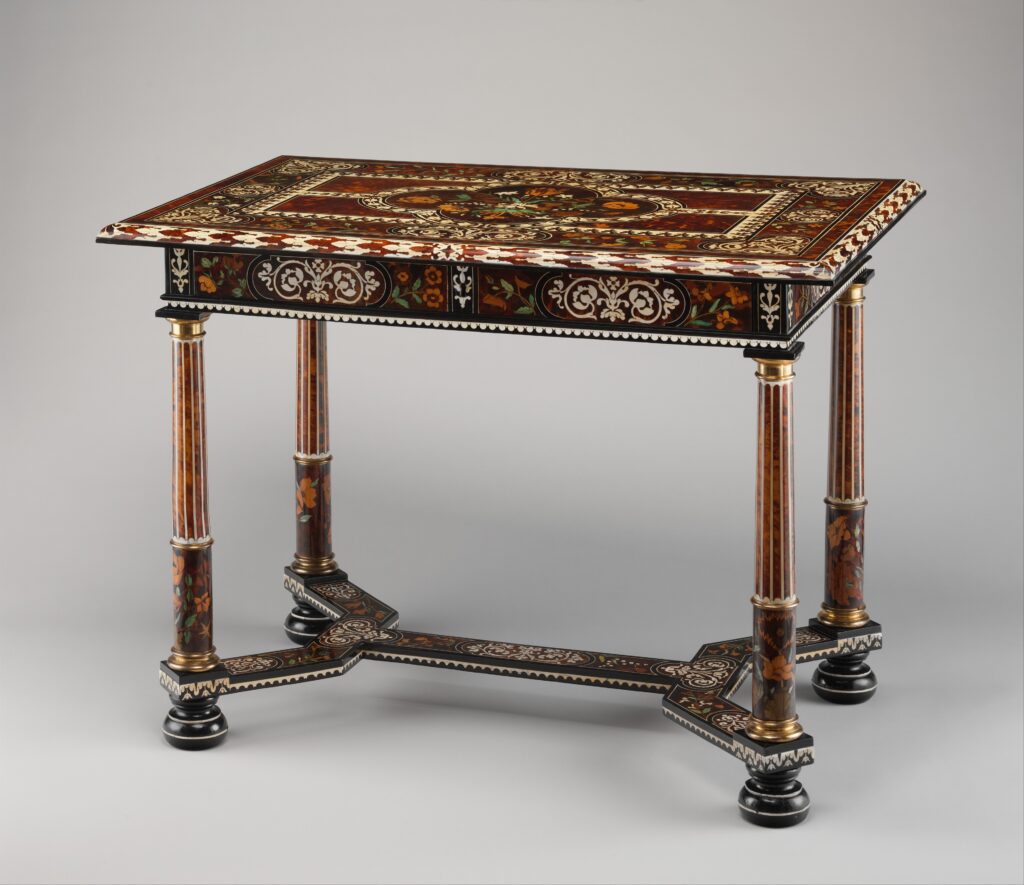
Marquetry is older than any single workshop. Britannica says it became popular in France in the late sixteenth century and grew with the demand for luxury furniture in the two centuries after. The Met’s account of floral marquetry in Paris is more specific, and it begins with a Dutch-born cabinetmaker. Pierre Gole, born near Alkmaar, went to Paris about 1643, was apprenticed to an ebony specialist, married his master’s daughter and took over the workshop. From the mid-1650s, the Met says, he specialized in floral marquetry, a new and colorful type of veneer decoration that put an end to the fashion for solemn ebony furniture. He may have introduced it to Paris.
The museum’s table, about 1660, is veneered with tortoiseshell, stained and natural ivory and ebony. It was sold in 1977 as in the manner of Leonardo van der Vinne, a Flemish or Dutch maker who worked for the Medici in Florence, and reattributed to Gole in the mid-1980s on documentary evidence and comparison with a few related pieces. A table can change makers without moving an inch.
The most famous method belongs to André-Charles Boulle. Britannica describes him gluing two sheets of identical thickness together, cutting the pattern through both and separating them, which gave two panels with the same design in contrasting materials, such as ebony and ivory. What that meant in practice is in the Met’s record of a Boulle cabinet, discussed in the guide to the antique French armoire: most of its outside is the cheaper of the two versions, the contre partie.
Pictures made of wood
David Roentgen took the picture furthest. His rolltop desk of about 1776 to 79, made at Neuwied on the Rhine, carries chinoiserie scenes the Met says have a painterly effect that Roentgen alone attained, using minute pieces of naturally colored exotic woods. The marquetry panel follows a design by Januarius Zick, the interior is in the restrained French classical style of the Louis XVI guide, and below the keyhole is an inlaid monogram, DR. The Met points out that his work is rarely signed, so the monogram is a rare sign of the maker’s satisfaction.
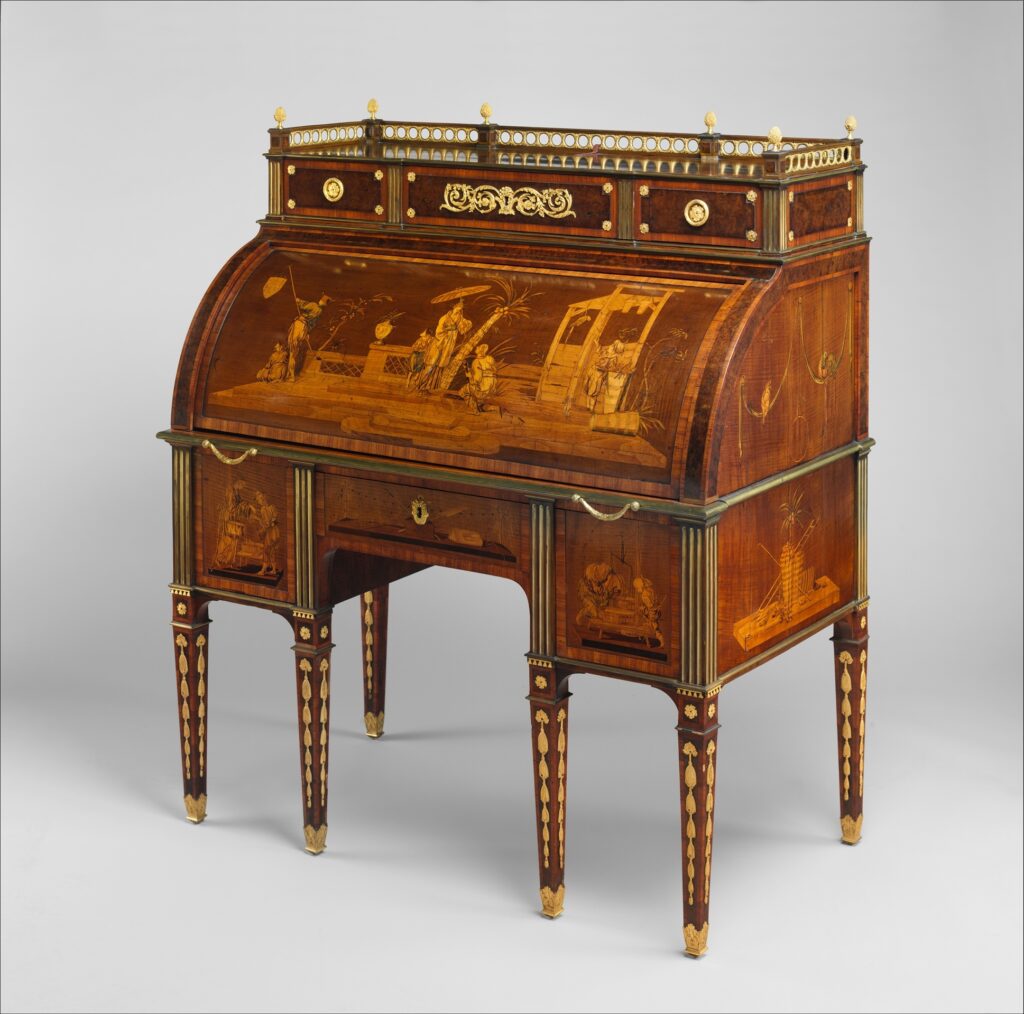
The Met’s record notes that the outside of the desk was once colorful: the scenes are set into maple panels that were perhaps stained gray, to suggest a silky fabric. The Met lists Roentgen’s woods as all partially stained, and the Dutch cabinet includes green-stained woods, so the color seen today may differ from the one the maker intended.
Marquetry also crossed the Channel with its makers. Peter Langlois, trained in Paris and a leading London cabinetmaker in the 1750s and 1760s, specialized in commodes in the French manner with floral marquetry and gilt-bronze mounts. The Met’s example, supplied to the sixth Earl of Coventry in 1764, was billed at fifty-five pounds and intended for storing clothing.
What to look at before you buy
Begin at the edges. Britannica notes that marquetry tends to splinter, and that makers protected vulnerable places such as outer edges and keyholes with bronze or other metal mounts. Mounts are therefore protection as well as decoration, and the guide to ormolu and gilt bronze shows how they were made. Look at how the pattern meets the mounts, and ask about losses and repairs to the veneer, and whether any patches match the surrounding wood. The wider timeline is set out in the guide to French furniture styles.
Then look at color, remembering the stained woods, and ask what the surface looked like before it aged. Treat any attribution with the caution the Met shows: Cressent signed nothing, Roentgen rarely signed, and the Gole table was sold under one maker’s name and now carries another’s. Where a lot says “by” a famous name, ask what the attribution rests on. The wider checks on condition are in the buying vintage furniture guide.
Sources
- Encyclopaedia Britannica, Marquetry and Veneer
- Merriam-Webster, marquetry
- The Metropolitan Museum of Art collection records: Cabinet on stand, attributed to Jan van Mekeren (1995.371a, b), Commode, Charles Cressent (1982.60.56), Table, attributed to Pierre Gole (1986.38.1), Rolltop desk, David Roentgen (41.82) and Commode from Croome Court, Peter Langlois (59.127)