Rococo style vs Baroque comes down to weight and line. Baroque furniture is heavy, symmetrical and built to impress. Rococo furniture is lighter, curved and deliberately asymmetrical. Between them sits a short transition, the Régence, and after them comes a nineteenth-century Rococo Revival that looks like the real thing but is heavier. This guide sets the first two side by side using pieces in the Metropolitan Museum of Art, then shows how to tell period Rococo from its revival.
Rococo style vs Baroque furniture at a glance
- Weight: Britannica says the heavy, monumental style of the earlier French reign was gradually replaced by a lighter and more fluent curvilinear style.
- Line: the French Rococo, which Britannica dates from about 1735 to 1765, was asymmetrical, light and full of movement, on sinuous and complicated lines.
- Ornament: the Rococo repertory included the C-scroll, scrolled foliage, floral motifs and ribbon, and the shell was one of its basic forms. The word comes from rocailles, the artificial grottoes and rock arrangements in the garden of Versailles.
- Setting: Baroque furniture was made for symmetry. The Met says large console tables were an obligatory feature of the parade rooms of aristocratic palaces, often ordered in twos or fours with matching mirrors and stools to give the stagelike interior its perfect symmetry.
Same object, two styles: a console table
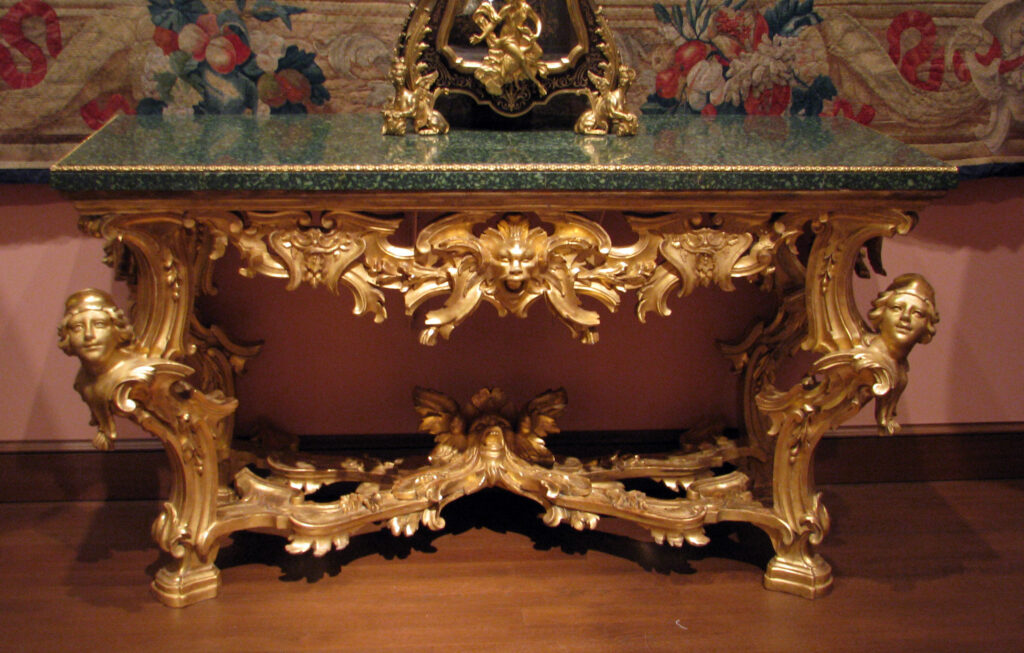
The clearest comparison is one form made twice. The Met’s Roman console table of about 1700 to 1725 (Met 1998.296) has boldly scrolled legs carved with female busts wearing tiaras, pierced apron friezes with theatrical demon masks, and a gilded base that gives the illusion of solid precious metal. Its original top is green porphyry in a gilt-bronze border. The museum calls it an embodiment of the dramatic and vigorous design of late Baroque Rome.
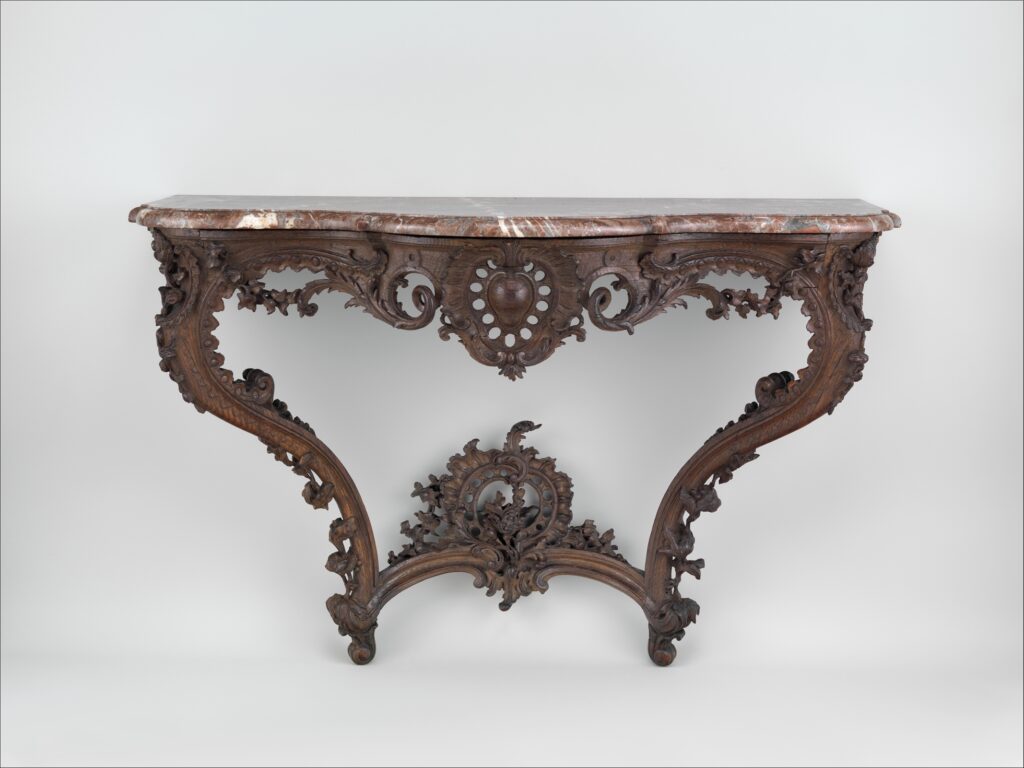
The Paris console table of 1735 to 1740 (Met 07.225.187a, b) is carved oak with a marble top. Its apron is serpentine and holds an openwork cartouche in an asymmetrical rocaille frame, flanked by scrolling acanthus and floral garlands, and the doubly curved legs end in an upward-curving stretcher. The Met compares the table with designs by Juste-Aurèle Meissonnier and calls the asymmetrical cartouches and rocaille decoration quintessential elements of the Rococo style prevalent in Continental Europe from the 1730s. It also notes that such tables were made by joiners who were not required to stamp their work, so the maker is rarely known.
Put the two together and the difference is not decoration alone. The Roman table is sculpture holding up a slab of stone. The Paris table is a curve that happens to hold one. For more on the Baroque side, see the guide to Baroque furniture.
The bridge: Régence and Charles Cressent
Britannica calls the transitional phase in French furniture from Baroque to Rococo the Régence, and names the cabinetmaker Charles Cressent as its leading exponent. In his work the ormolu mounts became as important as the marquetry on the carcass, and the curve moved from the legs into the case itself, in the bombé commodes that first appeared in this period.
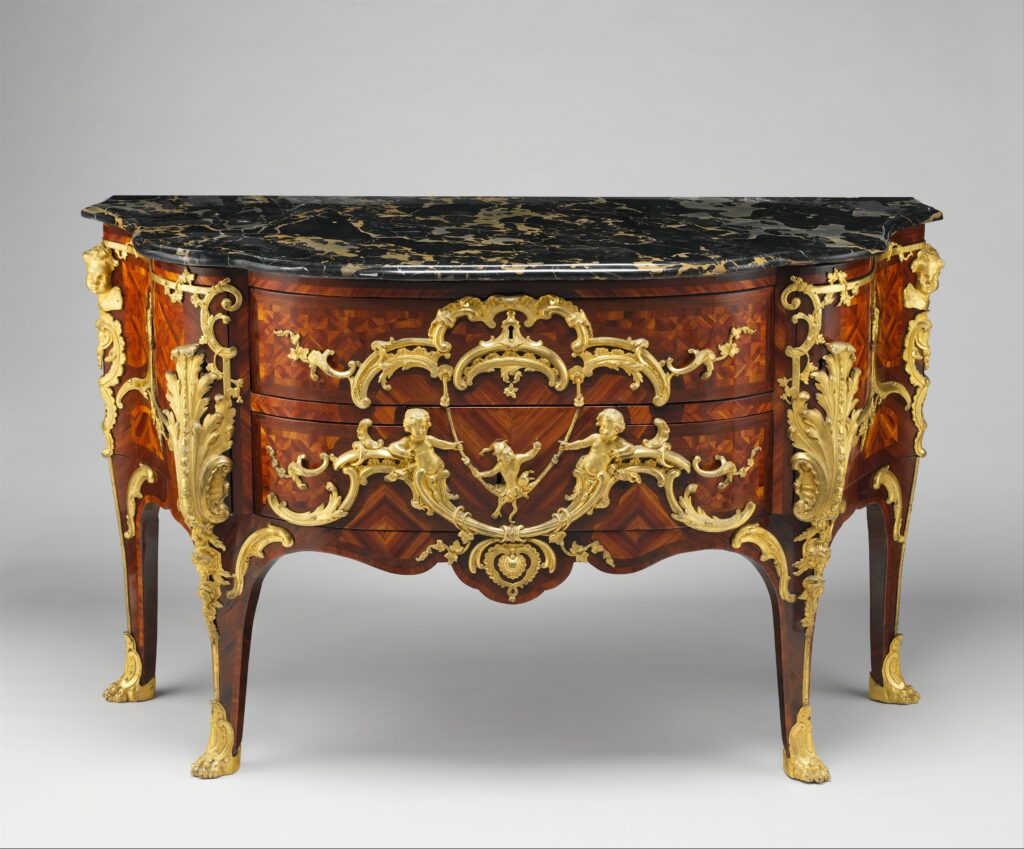
The Met’s Cressent commode of about 1745 to 1749 (Met 1982.60.56) shows this. The undulating outline of the front and sides is repeated in the marble top, the carcass is covered in a geometric parquetry veneer, and the gilt-bronze mounts include Zephyr heads, large scrolling acanthus leaves and a scene of two boys swinging a monkey on a rope. The museum notes that Cressent, trained as a sculptor, had the mounts cast and finished in his own workshop, and that he did not sign a single piece of furniture.
Rococo ornament in practice: C-scrolls and lacquer
Rococo ornament was often applied to imported materials. A pair of corner cabinets by Bernard II van Risenburgh (Met 1983.185.1a, b), also of about 1745 to 1749, are veneered with Coromandel lacquer and framed by what the Met calls sinuous Rococo-style gilt-bronze mounts incorporating C-scrolls and floral trails. The museum explains that Coromandel lacquer has designs incised and filled with colored lacquer, and that the doors were cut from a large multileaf screen, which is why the scenes are not continuous.
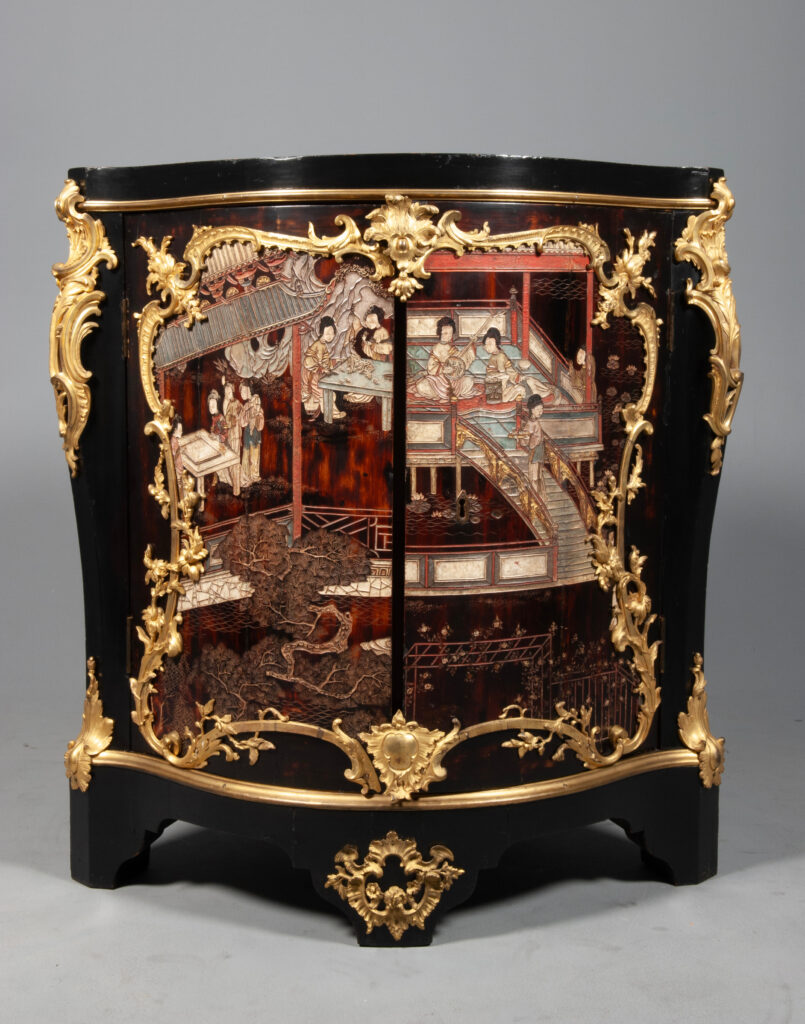
The same record shows how much this kind of furniture cost. The Met cites two pairs of corner cabinets sold by the dealer Lazare Duvaux in 1750 and 1751 for 580 and 650 livres, though it says the brief descriptions are too thin to identify them with this pair. For the French side of the story, see the guide to Louis XV furniture.
Baroque seating and beds
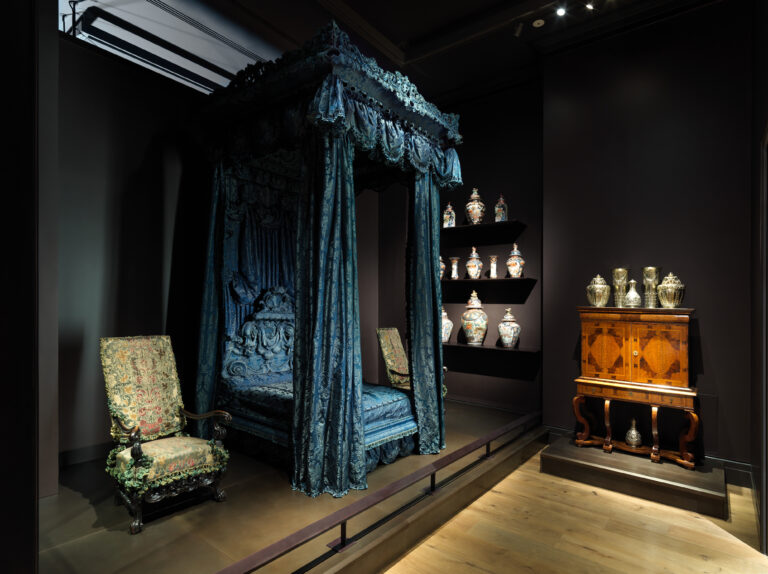
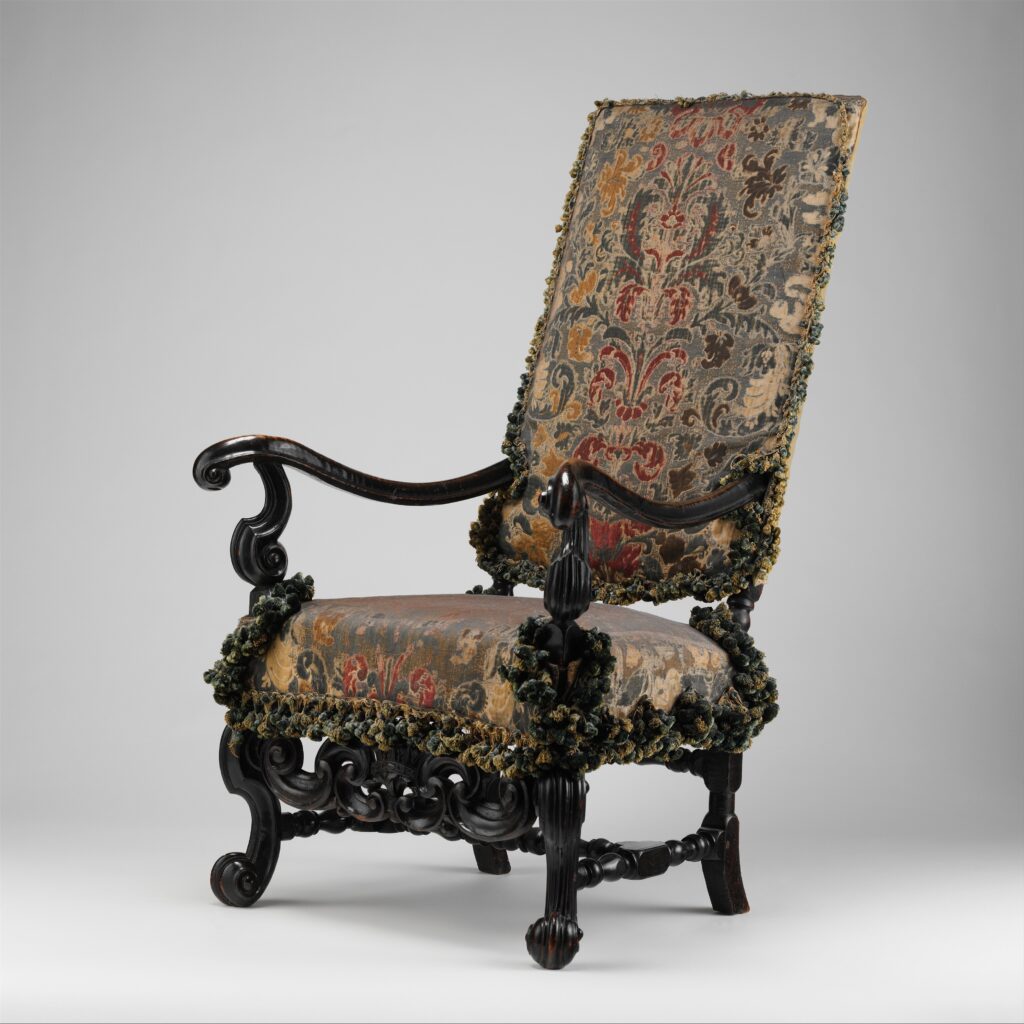
Baroque chairs and beds carry the same weight as the consoles. The Met’s armchairs from Burley-on-the-Hill, made about 1689 (Met 1998.297.1), have tall raked backs and scrolled arms and legs, and keep their original Genoese cut-velvet covers. A Venetian bedstead of about 1725 to 1735, carved and gilt limewood (Met 25.140.7a), shows the same love of gilded carving. Britannica sets against this the Rococo preference for asymmetry, lightness and movement.

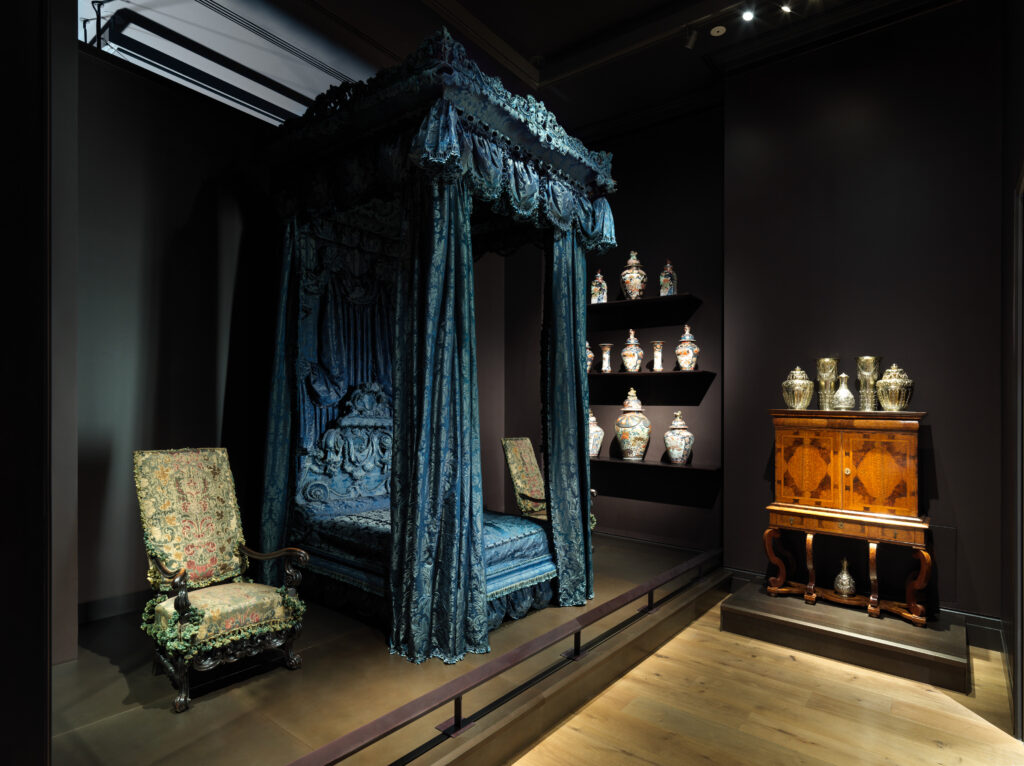
The Hampton Court state bed of about 1698 (Met 68.217.1a) is covered in blue silk damask. The Met notes that its curtains, counterpane, headcloth and some trims are modern copies of the originals, a reminder to ask what on a Baroque bed is original.
Period Rococo or Rococo Revival?
Much furniture that looks Rococo is not eighteenth century. Britannica describes the nineteenth-century Rococo Revival as borrowing the curvilinear elements of the French Louis XV style, especially the cabriole leg, and restating them in a heavier idiom. Whole suites were made in mahogany, rosewood and walnut, and the price depended heavily on how much carving the frame carried. Weight and carving on a curved piece are therefore the first thing to question.
The Met records give some period evidence to look for on French pieces. Gilt-bronze mounts of 1745 to 1749 carry a crowned C tax mark, struck under a royal edict that was in force from February 1745 to February 1749, so the mark helps date the mounts. The same records also show how pieces change over time: the marble tops on the corner cabinets may be replacements, and the cartouche-shaped mount on the central leg is a later addition. A single replaced part does not make a piece worthless, but it is a fact to ask about. The wider picture of the nineteenth-century revivals is in the guide to Victorian furniture.
Sources
- Encyclopaedia Britannica, Furniture: 18th century, the Rococo style (includes the 19th-century Rococo Revival)
- The Metropolitan Museum of Art: 1998.296, 07.225.187a, b, 1982.60.56, 1983.185.1a, b, 1998.297.1, 25.140.7a, 68.217.1a