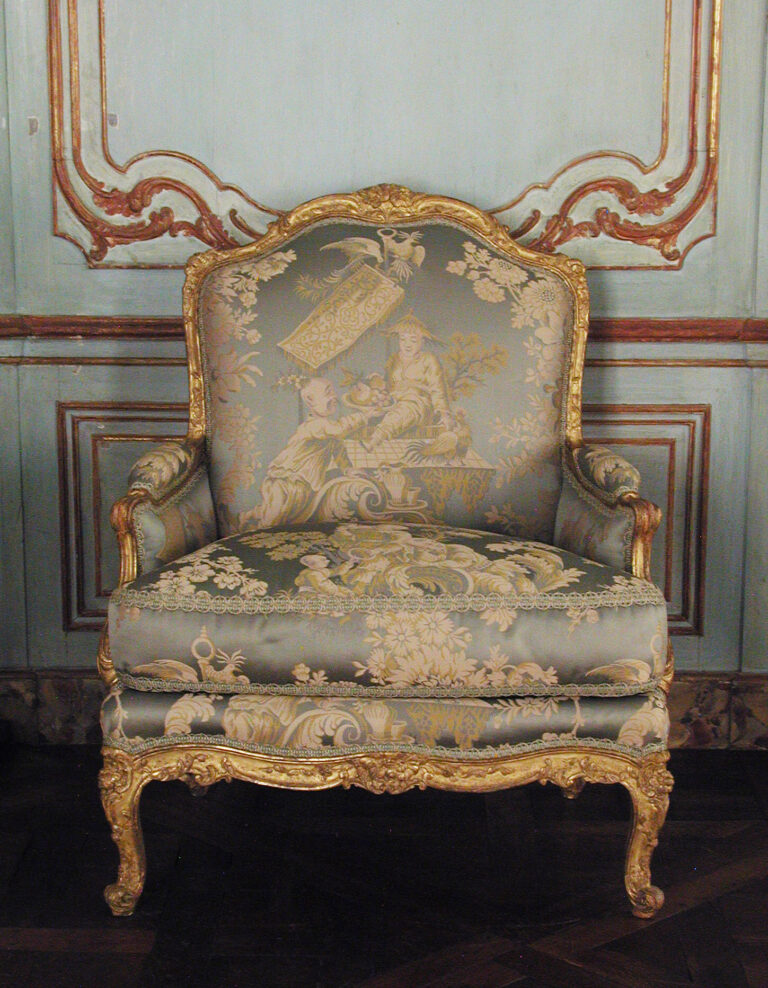
Louis XV furniture is French furniture made during the reign of Louis XV, from 1715 to 1774, and the name is most often used for its curving, carved and gilded Rococo look. The commode at the top of this page shows the idea: a bowed front, tall curved legs, a marble top and gilt-bronze mounts that follow the outline of the drawers.
The name also gets attached to later furniture, so it tells you about shape more than age. For the wider timeline of French periods, see French furniture styles from Louis XIII to the Belle Époque.
What “Louis XV style” and “Rococo” mean
Louis XV style is associated with the reign of the king, from 1715 to 1774, and it is better known elsewhere as Rococo. Britannica explains that rocaille is French for rubble or pebbles and first described the shell-covered rockwork of artificial grottoes; “style rocaille” is another name for Rococo, and the word Rococo comes from it. The shell was one of the basic forms of Rococo ornament. For the regional tradition, see the guide to French provincial furniture.
Sources give slightly different dates. The Met puts Rococo furniture at about 1730 to 1760, and Britannica at about 1735 to 1765, so “from the 1730s to the 1760s” is a safe way to say it. The Rococo grew out of the Régence (about 1710 to 1735), when the Met says the strict rectangular chair was loosened with symmetrical curves. Around 1760, a renewed interest in antiquity led to the straighter lines of Louis XVI furniture, covered below.
Characteristics of Louis XV style
The Met describes the Rococo frame as one that seems to dissolve into a continuous flowing, curving line. High-relief carving of twirling leaves, asymmetrical C- and S-shaped scrolls, flowers and shell- and rock-like forms hides the places where the curved legs meet the seat rail. The cabriole leg, which Merriam-Webster defines as a curved furniture leg ending in an ornamental foot, is a typical support. Britannica adds that the style was built on asymmetrical design, light and full of movement, and that a Chinese-inspired strand brought pagodas, exotic birds and Chinese figures into the repertoire.
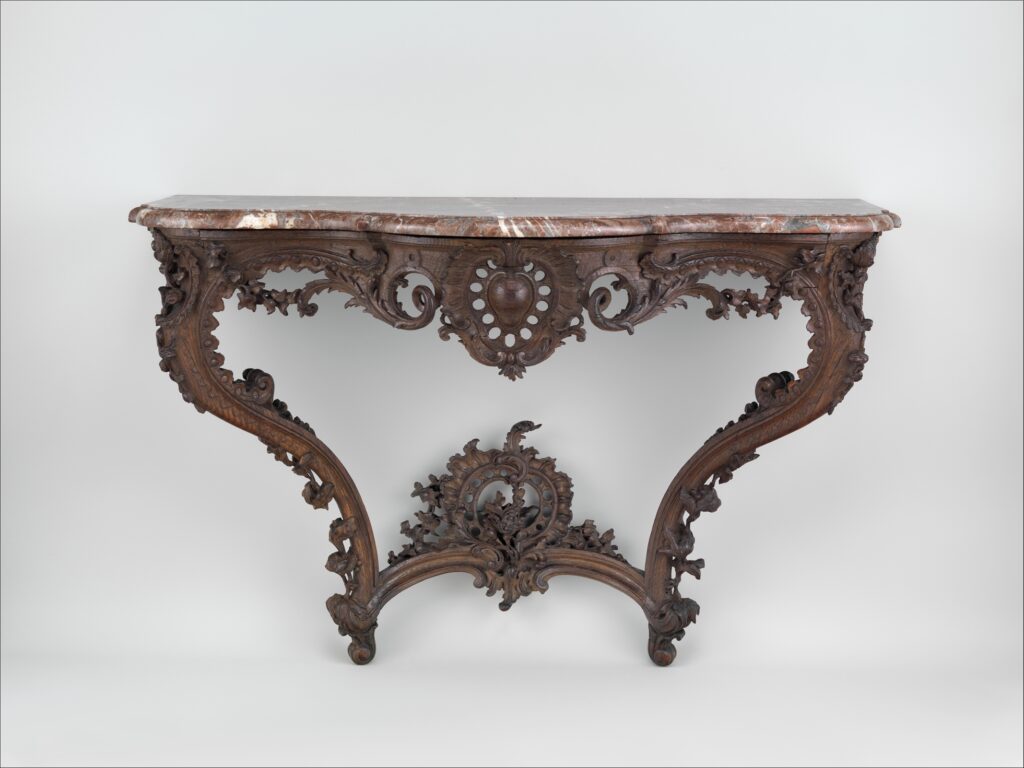
The console table above carries all of this in carved wood. Its serpentine apron holds an openwork cartouche with a heart-shaped boss, set in an asymmetrical rocaille frame with scrolling acanthus leaves and floral garlands, and its doubly curved legs meet in an upward-curving stretcher. The Met compares it with designs by Juste-Aurèle Meissonnier, whom Britannica names, as goldsmith to Louis XV, among the creators of the Rococo. Console tables were made by joiners responsible for the fixed elements of an interior, who were not required to stamp their work, so the makers of such pieces are rarely known.
The main forms of French Rococo furniture
The commode. The commode, a chest of drawers, first appeared about 1700 and became one of the principal pieces of the period. The Met identifies the standard Rococo commode by its serpentine outline, two drawers and shaped apron on tall cabriole legs. Britannica describes the bombé commode, with rounded sides and front, as often having a marble top, two or three drawers and finely modeled ormolu mounts.
The commode at the top of this page is stamped four times with the initials BVRB, for the cabinetmaker Bernard van Risenburgh II, and dates from about 1740 to 1745. Its scrolling mounts define the shape of the drawers and apron, and a central rocaille cartouche divides the front into three. The Met notes that the drawers have no handles, which it calls somewhat impractical.
The corner cabinet. Commodes were generally made in pairs and could be supplied with corner cabinets, called encoignures.
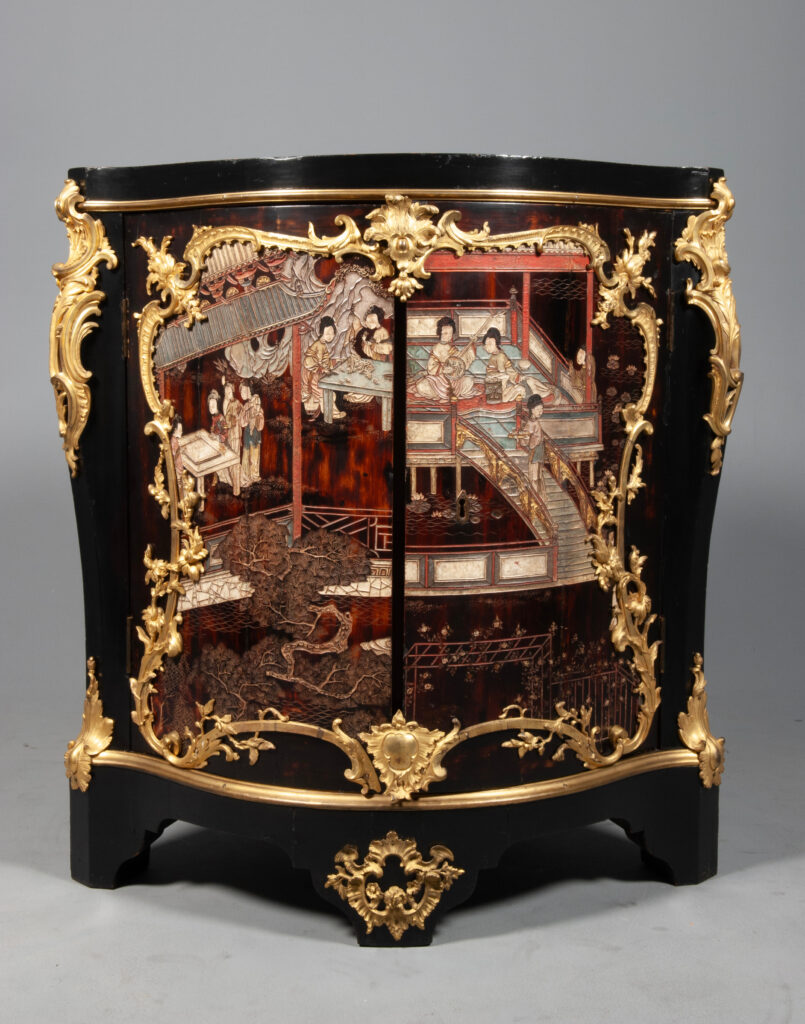
The Met records that in 1750 and 1751 the Parisian dealer Lazare Duvaux sold two pairs of similar lacquered corner cabinets for 580 and 650 livres, which gives an idea of how costly they were. He also sold such pieces to Madame de Pompadour. The doors of this pair use tall, narrow pieces cut from a large Coromandel screen, which is why the scenes on them are not continuous.
Small and mechanical tables. The Met notes that small tables for specific purposes multiplied in the French interior from the 1730s, among them dressing tables, bedside tables, work and game tables, guéridons and bonheurs-du-jour, or small desks.

The table above is a masterpiece by Jean-François Oeben, cabinetmaker to Louis XV, made for his most important client, Madame de Pompadour. Her coat of arms appears on the corner mounts, and the marquetry top shows trophies of her interests: architecture, music, painting, gardening and love. The Met points out that the undulating top and cabriole legs give it the curving outline of the Rococo, and that its main drawer is fitted with a writing surface that lifts to form a bookstand, with side compartments for toiletries. Britannica says Oeben was made ébéniste du roi, cabinetmaker to the king, in 1754.
Seating. The Rococo also produced new chairs, including the fauteuil en cabriolet with a concave back and overstuffed cushion, the marquise, an armchair big enough for two, and the duchesse, a long reclining chair. Those are covered in detail in how to tell a bergère from a fauteuil.
Lacquer, marquetry and porcelain
Louis XV furniture is as much about surface as shape. Case furniture was covered in marquetry, laid in geometric parquetry or in patterns such as trelliswork, flowers, trophies or figure scenes, and mounted with gilt bronze. Britannica names Jacques Caffieri and his son Philippe as the most celebrated makers of mounts under Louis XV.
Dealers called marchands-merciers acted as decorators and middlemen between craftsmen and clients. They supplied cabinetmakers with Asian lacquer panels, often cut from old chests and cabinets imported in the previous century, and had Sèvres porcelain plaques made for mounting on furniture. Van Risenburgh was known for furniture veneered with Asian lacquer and was one of the first cabinetmakers to use Sèvres porcelain. The Met notes that the lacquer on his commode is Chinese, most likely from a large folding screen shipped to Europe by way of the Coromandel coast of India, and that the narrow panels explain why unrelated figure groups appear side by side on its front.
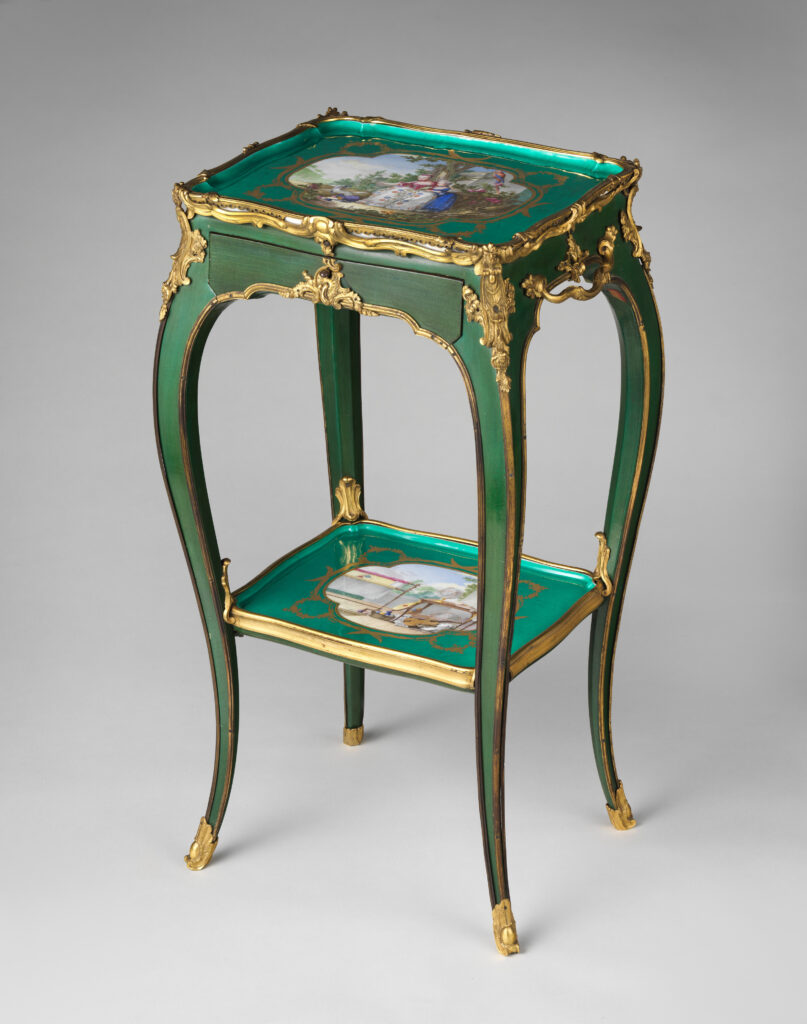
The small table above uses two Sèvres trays, of a shape introduced in 1761 and named for the marquis de Courteille, who administered the porcelain manufactory from 1751, as its top and lower shelf. The Met says the mother and child painted on the upper tray have been identified as Courteille’s wife and daughter.
Louis XV vs Louis XVI furniture
A quick way to tell the two apart is to look for curves or straight lines. According to the Met, the Neoclassical reaction that began around 1760 replaced the Rococo’s flowing outlines with geometry.
- Louis XV: curving, serpentine fronts; cabriole legs; asymmetrical shell, scroll and foliage ornament; writing tables that are serpentine.
- Louis XVI: square, rectangular or oval shapes; straight legs that are turned or spirally fluted; arm supports placed directly over the front legs; commodes that are more rectilinear, on short tapering legs; writing tables that are rectangular; plain mahogany veneer with mounts in antique motifs such as Vitruvian scrolls and palmettes.
- In between: transitional pieces keep a curving outline but are more restrained, with new ornament such as interlaced bands, urns or acanthus leaves.
How to recognize antique Louis XV furniture
Shape is not enough, because the Rococo came back. The Met describes how new veneering methods, advances in wood carving and the introduction of coil springs helped popularize a Rococo revival, which reached middle-class drawing rooms and boudoirs by the second quarter of the nineteenth century. Even under the Second Empire, the Met notes, the Empress Eugénie identified more closely with the Rococo than with the Empire style. Revival pieces ranged from exceptionally well made to poorly made, so a curved outline proves little on its own. Two clues help with Paris furniture.
- Stamps. From 1743 it became the rule in Paris to stamp every piece of furniture offered for sale with the maker’s name, and a second stamp, JME, was added once the guild’s inspectors approved the work. The Van Risenburgh commode carries four BVRB stamps. A missing stamp is not conclusive: royal cabinetmakers and independent craftsmen worked outside the guild, and joiners who made fixed items such as console tables did not have to stamp.
- Mounts. Gilt-bronze mounts can carry evidence. A crowned C tax mark, imposed by a royal edict of February 1745 and in use until February 1749, is how the Met dates a commode by Charles Cressent, whose mounts carry the mark.
Ask for clear photographs of the underside, the back and any stamps before you discuss price. The guide to buying vintage furniture covers what to inspect, and the complete guide to French vintage decor looks at living with French pieces.
Sources
- The Metropolitan Museum of Art, French Furniture in the Eighteenth Century: Seat Furniture
- The Metropolitan Museum of Art, French Furniture in the Eighteenth Century: Case Furniture
- The Metropolitan Museum of Art, The Golden Age of French Furniture in the Eighteenth Century
- The Metropolitan Museum of Art, European Revivalism
- The Metropolitan Museum of Art collection records: 1974.356.189, 07.225.187a, b, 1983.185.1a, b, 1982.60.61, 58.75.45 and 1982.60.56
- Encyclopaedia Britannica, Furniture: 18th century, the Rococo style and Rocaille
- Merriam-Webster, cabriole