The walnut daybed at the top of this page is French Provincial furniture in the strict sense. It was made in Provence in the second quarter of the eighteenth century and is attributed to the school of Toulon, a long way from the Paris workshops. The name describes furniture of this kind: made in the provinces of France rather than in Paris, in local woods, and in versions of the capital’s fashions that provincial makers often took up decades later.
The same two words also name something much later: the painted, gilt-edged bedroom and living-room suites that American factories turned out in quantity from the 1950s to the 1970s, and which fill most of the listings when you search for the term today. Both are legitimately called French Provincial. They are not the same furniture, and they are not worth the same money.
What “French Provincial” means
French furniture of the seventeenth and eighteenth centuries falls into two broad worlds. One is the furniture of Paris, made for the king, the court, the aristocracy and the richest households by a highly specialised trade. The other is everything made elsewhere. Wikipedia’s survey of French furniture describes provincial furniture as the work of provincial cities and towns, many of which, like Lyon and Liège, “retained cultural identities distinct from the metropolis”.
The word provincial describes where a piece was made, not how well. Some provincial furniture is rustic, built by a village joiner for a farmhouse. Some, like the Toulon daybed above, is carved as ambitiously as anything in Paris. What unites it is distance from the capital, and the choices that distance produced: local timber instead of imported veneers, solid wood instead of marquetry, carving instead of gilt-bronze mounts, and forms suited to the houses and habits of a particular region. The rooms around such furniture, with limewashed walls and faded colours, are the subject of The Beauty of French Provincial Interiors, and the complete guide to French vintage decor covers the wider tradition.
A short history: Paris first, the provinces later
New styles began in the luxury trades of Paris and travelled outwards. The Paris styles that provincial makers were following are laid out in French furniture styles from Louis XIII to the Belle Époque. Furniture made in provincial centres such as Blois and Orléans in the Loire valley, and at Lyon or Liège, “followed at some distance the design innovations that were initiated in the luxury trades of Paris, often with a time lag that could amount to decades”.
That time lag is the key to dating provincial pieces. The curving Rococo outline that Paris adopted under Louis XV, described in our guide to Louis XV furniture, became the lasting vocabulary of the provinces. Regional makers went on building cabriole legs and serpentine aprons long after Paris had moved on to the straight lines of Louis XVI furniture, and well into the nineteenth century. A provincial armoire in a perfectly good Louis XV style may therefore have been made under Louis XVI, Napoleon or later.
Alongside the town workshops ran an older and more conservative tradition. Wikipedia describes “a conservative artisanal rural tradition of French country furniture which remained unbroken until the advent of the railroads in the mid-nineteenth century”. Once railways could carry factory-made furniture cheaply into the countryside, the local joiner’s trade declined.
Paris and the provinces, side by side
The clearest way to see the difference is to compare two pieces from the same decades. The armchair below dates from 1735–40 and is attributed to the Paris menuisier René Cresson, who became a master in 1738. It is a fauteuil à la reine, a type explained in how to tell a bergère from a fauteuil, and like the Toulon daybed it is carved walnut with the same curving language: cabriole legs, a shaped seat rail, carved scrolls and flowers.

The difference is in the finish and the furnishing. The Paris chair is upholstered in tapestry woven at the Beauvais manufactory, and it belongs to a world of matched sets, specialist upholsterers and court fashion. The Provençal daybed is large, robust and carved all over its frame, with a pierced shell cresting flanked by animal heads. Both are walnut. Both are Rococo. One was made for the capital and one for a region with its own taste, and that is the difference the word provincial points to.

Characteristics of French Provincial furniture
Regional work varies enormously, but certain features recur. Wikipedia lists cabriole legs and simple scalloped carving as typical, notes that dining chairs often carry a carved wheat pattern “reflecting the country surroundings of the maker”, and calls the ladder-back chair with a woven rush seat “the typical French Provincial dining chair”.
- Solid wood. Provincial furniture is generally made of solid timber rather than veneered. Even the commode, a Paris luxury, had become so necessary before the mid-eighteenth century that it “might be made in menuiserie (carpentry), of solid painted oak, walnut or fruitwoods, with carved decoration, typical of French provincial furniture”.
- Carving in place of mounts. Where a Paris piece would carry gilt-bronze mounts, a provincial one is usually carved in the wood itself.
- The curving outline. Cabriole legs, shaped aprons and serpentine fronts persist long after Paris abandoned them.
- Big storage pieces. Armoires, buffets and dressers for linen, crockery and food are among the most characteristic regional forms.
- Age in the carving. Whatever the finish, Wikipedia notes, polish and grime accumulate in the carving over time, giving an aged patina and emphasising the carved detail whether the piece is painted or stained.
The armoire was the centrepiece of many provincial households, and each region built it its own way. The walnut armoire below, made in Provence in the eighteenth century and now in the Musée d’Art et d’Histoire de Provence in Grasse, is a typical example. The museum’s description notes that armoires of this kind were given to newly married couples, and that the tureen carved at its base, framed by olive branches, is characteristic of Provençal furniture. The long decorative steel hinges and lock plates are another regional signature.

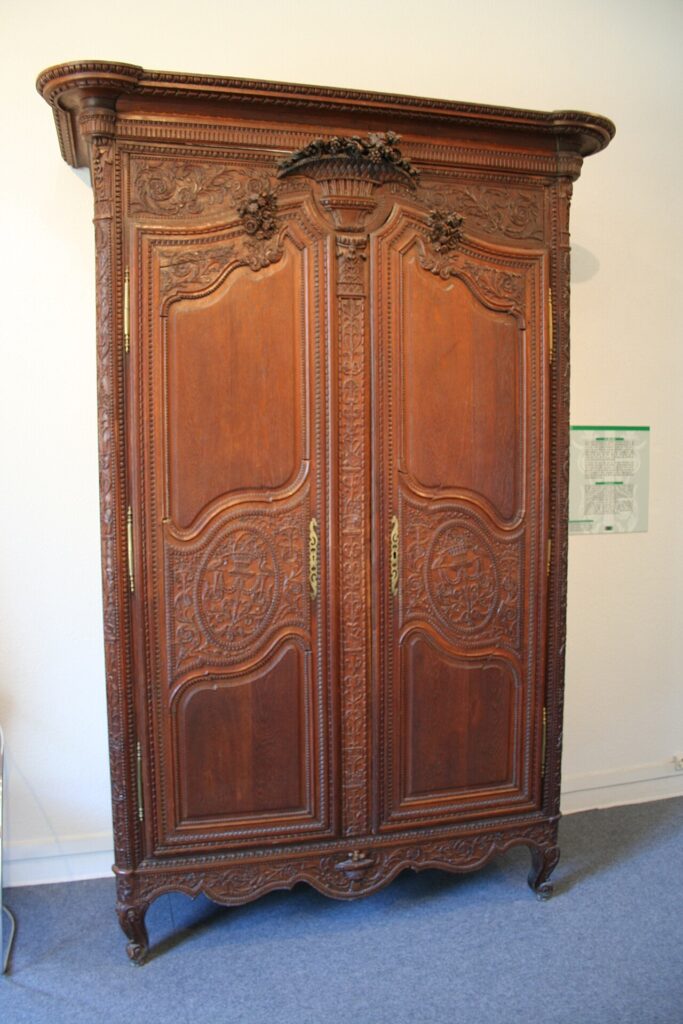
Normandy built the same piece differently. The armoire below, in the collections of the Musée de Normandie in Caen, is carved far more densely: a basket of flowers on the cornice, carved oval medallions on both doors, and a shaped apron that ends in scrolled cabriole feet.
The American “French Provincial” of the 1950s to 1970s
In the United States the term took on a second life. From the 1950s into the 1970s, American manufacturers sold French Provincial as a furniture style in its own right, made in volume and sold in complete suites, above all for bedrooms. The look borrowed the cabriole leg, the curving drawer front and the scrolled apron of Louis XV furniture, and it was most often finished in painted off-white with gilt edging and brass hardware. A 1964 advertisement for the Bassett Furniture Company’s “Provençaux” bedroom group is a typical example.
This is what most people now mean by a French Provincial dresser, nightstand or bedroom set, and it is what dominates the market: search results for the term are led by mid-century American pieces. There is nothing wrong with it. Much of it is soundly made, and it is a genuine period style of American domestic life. But it is a twentieth-century interpretation, made by factories, and it should not be described or priced as antique French furniture.
How to tell regional French work from a later factory piece
A few checks separate the two quickly. None is conclusive on its own, but together they rarely mislead.
- The form. Eighteenth- and nineteenth-century provincial furniture is dominated by armoires, buffets, tables and chairs. Matching suites of dresser, mirror, chest, nightstands and headboard are a modern way of selling furniture, and a sure sign of mid-twentieth-century manufacture.
- The wood. Old regional pieces are usually solid walnut, oak, chestnut or fruitwood. Factory pieces often use veneered panels, plywood backs and drawer bottoms, and sometimes moulded decoration in place of carving.
- The finish. An even off-white paint with crisp gilt lines is the signature of the American suites. Paint on old provincial furniture is worn, layered and uneven where hands have touched it.
- The construction. Look inside the drawers and at the back. Hand-cut dovetails, irregular saw marks, pegged joints and hand-forged nails point to early work. Machine-cut dovetails, staples, uniform plywood and centre-mounted drawer runners point to factory production. A maker’s label or stamp inside a drawer often names the company and the line.
- The hardware. Early provincial pieces have hand-forged iron or steel fittings. Stamped brass pulls in matching sets suggest a later date.
The wider checks in our guide to buying vintage furniture apply too: ask for photographs of the back, the underside and the inside of a drawer before you discuss price.
What is French Provincial furniture worth?
There is no single answer, because the name covers two different markets. Mid-century American suites are bought as practical furniture, as projects for painting and refinishing, or by collectors of the period, and their value depends on the maker, the condition and whether the set is complete. Antique regional French furniture is valued as antique furniture: by age, region, wood, quality of carving, originality of the finish and condition. For how auction houses describe age and condition, see reading an auction catalogue properly.
The practical rule is to establish which of the two you have before you think about price. A painted 1960s dresser described as antique French is overpriced however low the figure, and a worn walnut buffet with hand-cut joints, offered as “old French Provincial style”, may be underpriced.
Sources
- Wikipedia, French furniture (section “Provincial furniture”) and Commode
- Wikimedia Commons, Armoire provençale, MAHP (Musée d’Art et d’Histoire de Provence, Grasse, with the museum’s description) and Musée Normandie armoire normande (Musée de Normandie, Caen)
- The Metropolitan Museum of Art collection records: 22.144 and 07.225.42
- Click Americana, vintage gold-edged bedroom furniture sets from the 60s and 70s (Bassett “Provençaux”, 1964)