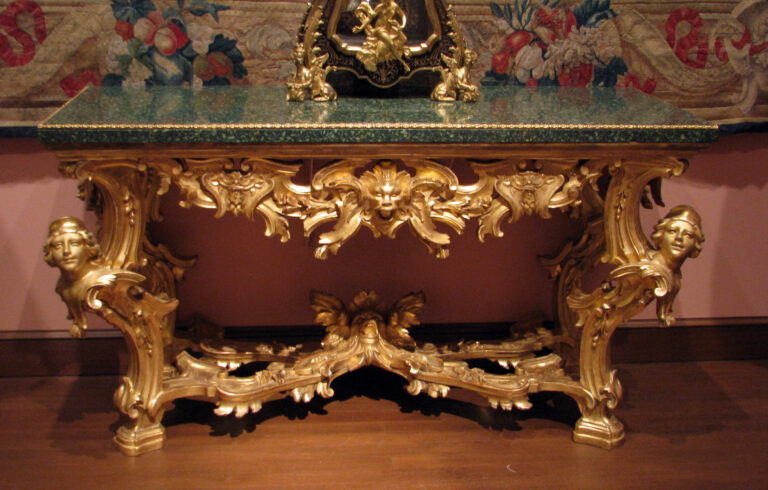
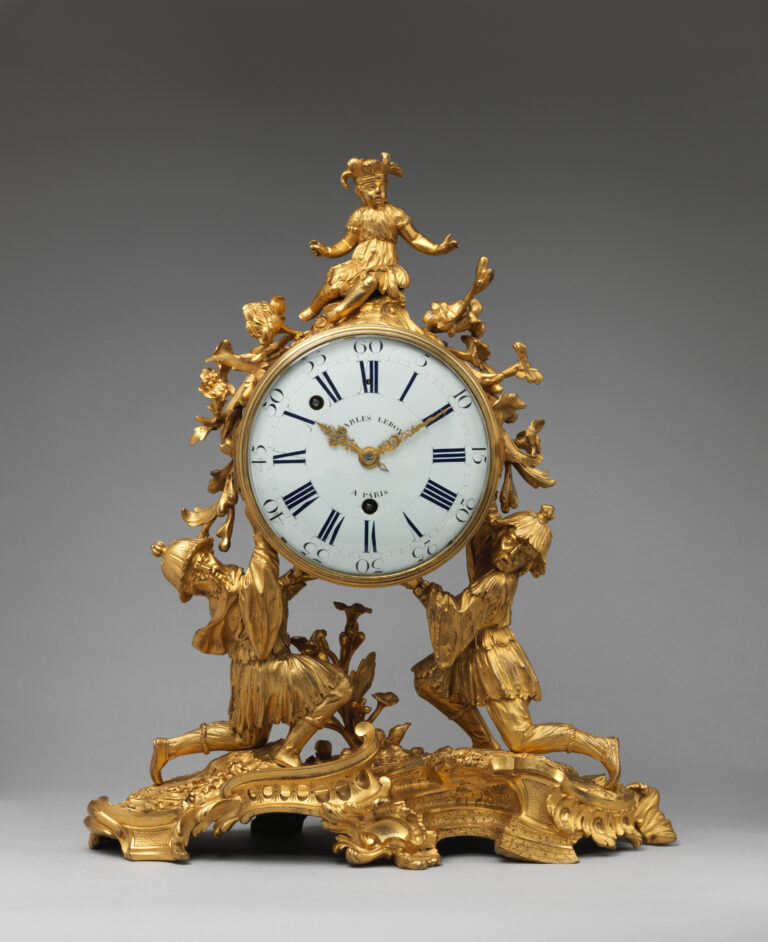
French furniture is named after kings, rulers and movements, not after centuries. “Louis XV” describes a look: curving, carved, often gilded. It does not promise that a piece was made while Louis XV was on the throne.
The dates of French furniture styles are approximate, and they overlap. Styles drifted into one another, and furniture makers kept working in an older manner long after a new one arrived. Treat the names as a way to read an object, not as exact boundaries. How such furniture is used in a room is the subject of the complete guide to French vintage decor.
French furniture styles at a glance
- Louis XIII (1610 to 1643): massive, solidly built, carved and turned.
- Louis XIV (to 1715): Baroque grandeur, ebony, brass-and-tortoiseshell marquetry, gilt-bronze mounts.
- Régence (about 1710 to 1735): the rectangle loosens into curves, and the legs angle out.
- Louis XV, or Rococo (about 1730 to 1760): one flowing line, cabriole legs, high-relief carving.
- Louis XVI, or Neoclassical (from about 1760): geometric shapes, straight legs, ornament borrowed from antiquity.
- Directoire (1795 to 1799): long, simple lines and sparse ornament.
- Empire (1800 to 1815): austere mahogany, gilt-bronze figures, imperial emblems.
- Second Empire (1850s to 1870): comfort, variety and the Rococo revival.
- Belle Époque and Art Nouveau (1880s to the First World War): plant forms and whiplash curves.
Louis XIII furniture (1610 to 1643)
Louis XIII was a child when he came to the throne in 1610, and his mother, Marie de Médicis, ruled as regent. Britannica notes that Italian and Flemish influences were so strong that a distinctly French style did not take shape in the arts until the second quarter of the century. The furniture of the period is typically massive and solidly built, and it is characterized by carving and turning, with cherubs, scrollwork, cartouches, swags of fruit and flowers, and grotesque masks.
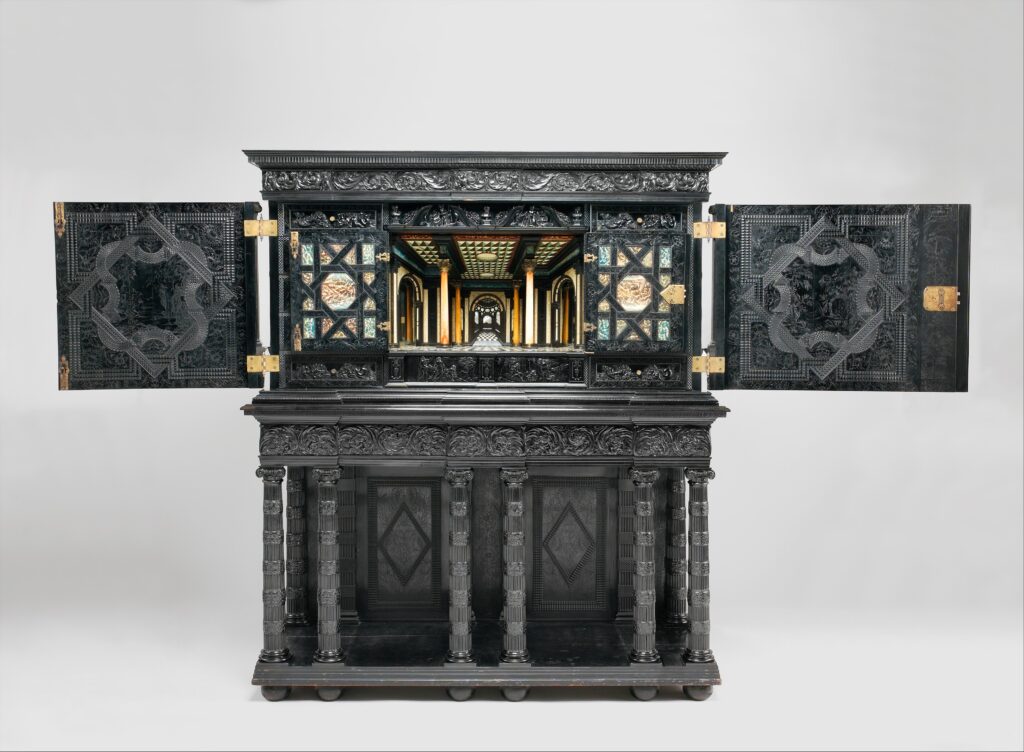
The cabinet above is a Paris piece dated to about 1645, a couple of years after the king’s death, with extensive later alterations. It shows why this was the age of ebony. In the seventeenth century, tropical timber became available to European cabinetmakers in quantity for the first time, but it was still costly in France. The Met notes that this maker layered the near-black veneer thinly on the upper part and used ebonized pearwood below eye level.
Behind the doors, the interior is brightly colored with marbleized and tinted ivory, bone and various woods, with mirror glass behind the central recess. The craftsmen who veneered furniture with ebony came to be called ébénistes, from the French word for ebony.
Louis XIV furniture (to 1715)
Louis XIV treated furniture as a statement of royal power. In 1663 he appointed a supervisor for the royal furniture, and the court commissioned cabinets, carved and gilded wood furniture and even tables, candlesticks, and chandeliers in solid silver. The Met’s essay on the period names the foremost cabinetmakers, among them Pierre Gole and André Charles Boulle, who was appointed royal cabinetmaker in 1672.

Boulle’s name is attached to the best-known technique of the age. In boulle work, a sheet of tortoiseshell and a sheet of metal, usually brass, are glued together, cut to a pattern and separated again, so the same cut gives one panel of tortoiseshell inlaid with brass and another of brass inlaid with tortoiseshell. The Met points out that Boulle did not invent the technique, which seems to have come from Italy and was established in France by the mid-1650s, and that the gilt-bronze mounts on his cabinets echo the inlay in three dimensions. The Met describes the contrast of color and surface, and the bold movement of the forms, as features of the Baroque.
The grandeur did not last the reign. The cost of Louis XIV’s wars led him to order his silver furniture destroyed in 1689, and the Gobelins manufactory closed between 1694 and 1699. By 1699 the king was asking for decoration that was graceful and airy rather than solemn. Oversize cabinets fell from favor, and the commode, which first appeared about 1700, began to replace the old chest. The Met sees the transition to the Regency as already under way in the last years of the reign.
French Regency furniture (about 1710 to 1735)
The Régence is easiest to see in a chair. A late Baroque chair is formal, with a high, straight, rectangular back, arm supports that meet the seat at the front edge, straight legs at the corners joined by stretchers, and upholstery fixed with brass nails. According to the Met, the Régence loosened that rectangle with symmetrical curves. The legs were now set at an angle, stretchers were gradually dropped, and the supports of the arms were set back to make room for hooped dresses. Carving became freer, with diaper patterns, shells and rosettes worked in flat relief.
Louis XV furniture and the Rococo (about 1730 to 1760)
The commode at the top of this page belongs to the next stage. In the Met’s description of Rococo seat furniture, the graceful movement that began in the Régence develops until the whole frame seems to dissolve into one continuous curving line. High-relief carving of leaves, scrolls, flowers and shell-like forms masks the joins where the curved legs meet the seat rail. The same curves run through case furniture. How to recognize the furniture itself is the subject of Louis XV furniture.
The commode is by Charles Cressent and is dated about 1745 to 1749. Its undulating outline is repeated in the marble top, and the carcase is covered entirely in marquetry laid in a geometric pattern known as parquetry. The gilt-bronze mounts include a scene of two boys swinging a monkey on a knotted rope.
Cressent was trained as a sculptor and had the mounts cast in his own workshop, which broke the guild rules and got him into trouble. The mounts also carry crowned C tax marks. A royal edict of February 1745 imposed that tax mark, and it stayed in use until February 1749, which is how the Met dates the piece. The Met adds that the shape, a serpentine outline with two drawers and a shaped apron on tall cabriole legs, became the standard Rococo commode.
New kinds of furniture arrived with the style. Small tables for specific purposes multiplied from the 1730s, and dealers called marchands-merciers acted as decorators and middlemen, supplying cabinetmakers with lacquer panels and Sèvres porcelain plaques. For the chairs of the same period, including the fauteuil with open arms and the bergère with closed ones, see how to tell a bergère from a fauteuil.
Louis XVI furniture and the return to the antique (from about 1760)
Around 1760, a renewed interest in antiquity prompted a reaction against the curves of the Rococo. The Met notes that the change was gradual, and that many chairs of the time are called transitional, still curving but more restrained and carrying new ornament such as interlaced bands, urns and acanthus leaves. By the Neoclassical period, backs were square, rectangular or oval, legs were straight and either turned or spirally fluted, and the arm supports sat directly over the front legs again. Commodes took a more rectilinear shape on short tapering legs, and a large writing table, which had been serpentine in the Rococo, became rectangular on straight supports. The forms, makers and marks are covered in Louis XVI furniture.
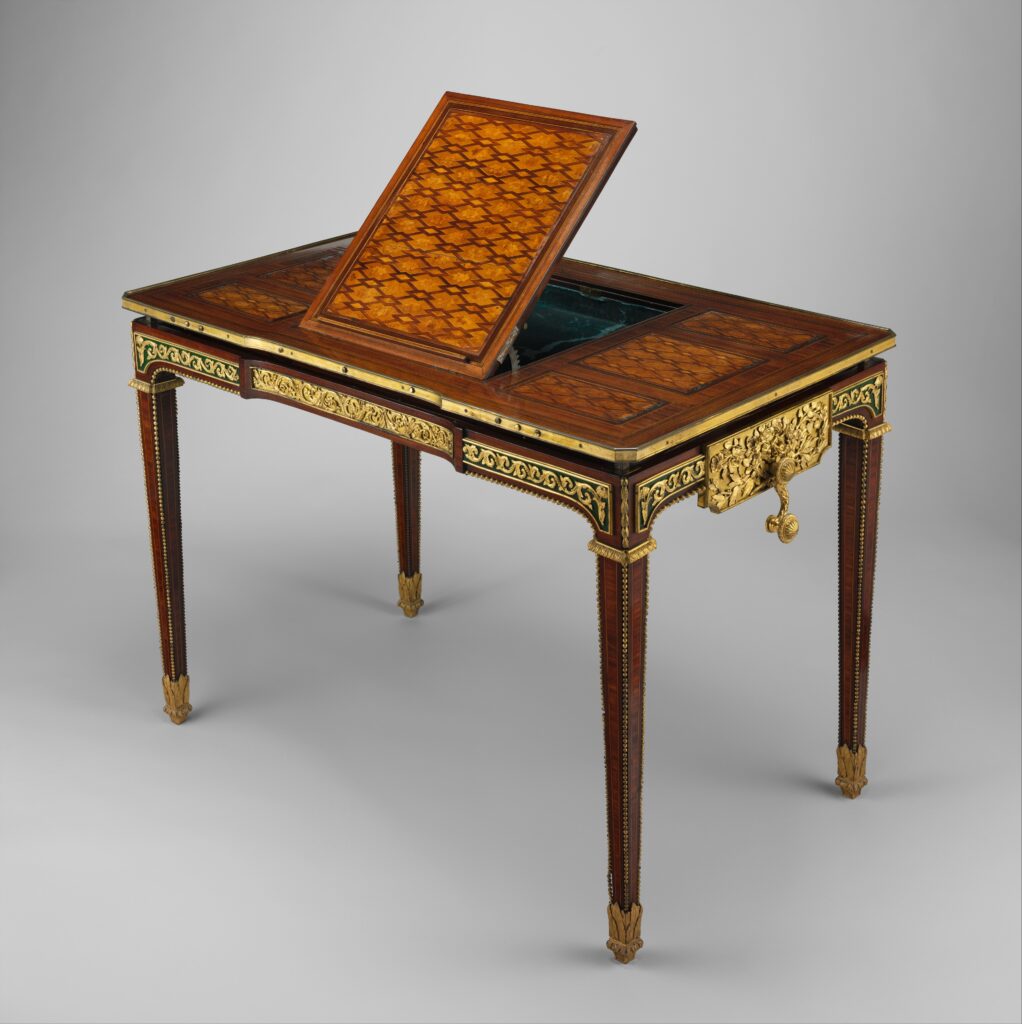
The table above was one of the first pieces Marie Antoinette ordered from her favorite cabinetmaker, Jean Henri Riesener. It was delivered to Versailles on December 12, 1778, and its restrained rectilinear lines are typical of the Neoclassical manner. A crank at the side raises or lowers the top, so she could use it seated or standing. The central panel lifts to form a lectern and reverses to reveal a mirror, and buttons release six compartments for toiletries and writing equipment. Plain mahogany veneer also became fashionable in this period, finished with mounts in antique motifs such as Vitruvian scrolls, fretwork, interlaced bands and palmettes.
Directoire style (1795 to 1799)
Directoire furniture takes its name from the Directory, the government that ruled France from 1795 to 1799. Britannica describes it as the last phase of the Louis XVI style, with elongated, simple shapes, clear lines and sparse ornament drawn mostly from ancient Roman objects excavated at Pompeii.
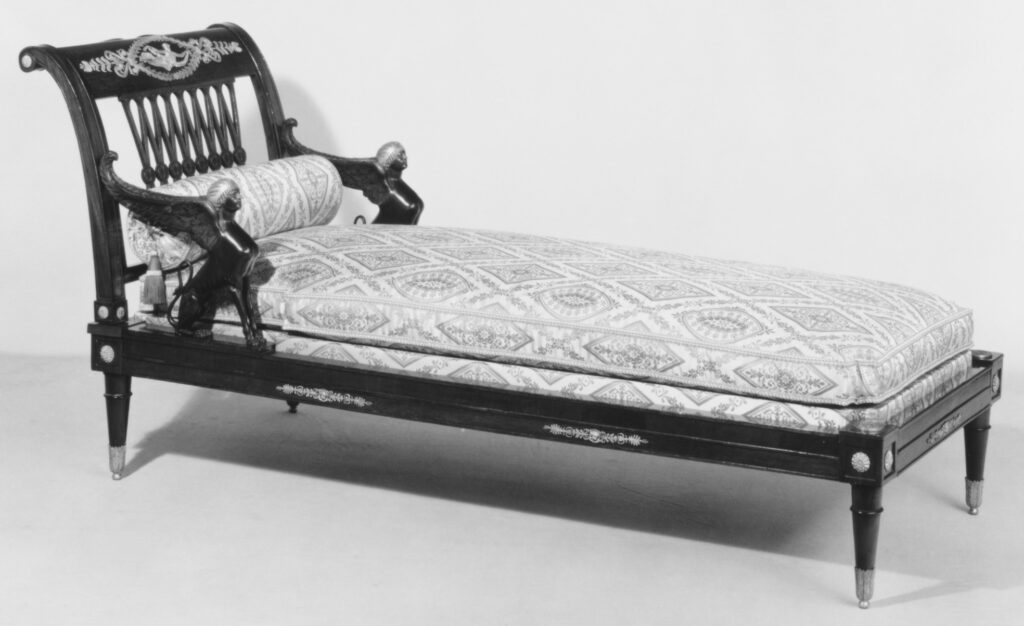
The daybed above shows how quickly the mood changed. Its sphinx-shaped arms point to a date soon after Napoleon’s Egyptian campaign, which fits the Jacob firm’s stamp, used only between 1795 and 1803. That span covers the Directory and the Consulate that followed, and the Met treats both as part of the same late Neoclassical story that leads into the Empire.
Empire style (1800 to 1815)
The Met’s essay says the Empire style blended the antique forms already seen under Louis XVI with Napoleon’s own symbols: the bee, the letter N within a laurel wreath, stars, the eagle, and hieroglyphic motifs taken from the Egyptian campaign. The architects Charles Percier and Pierre François Léonard Fontaine were its most influential designers, and their Recueil de décorations intérieures of 1812 was an essential handbook. Baron Dominique Vivant Denon, who traveled with the expedition, published drawings of Egyptian monuments in 1802 that fed the fashion.
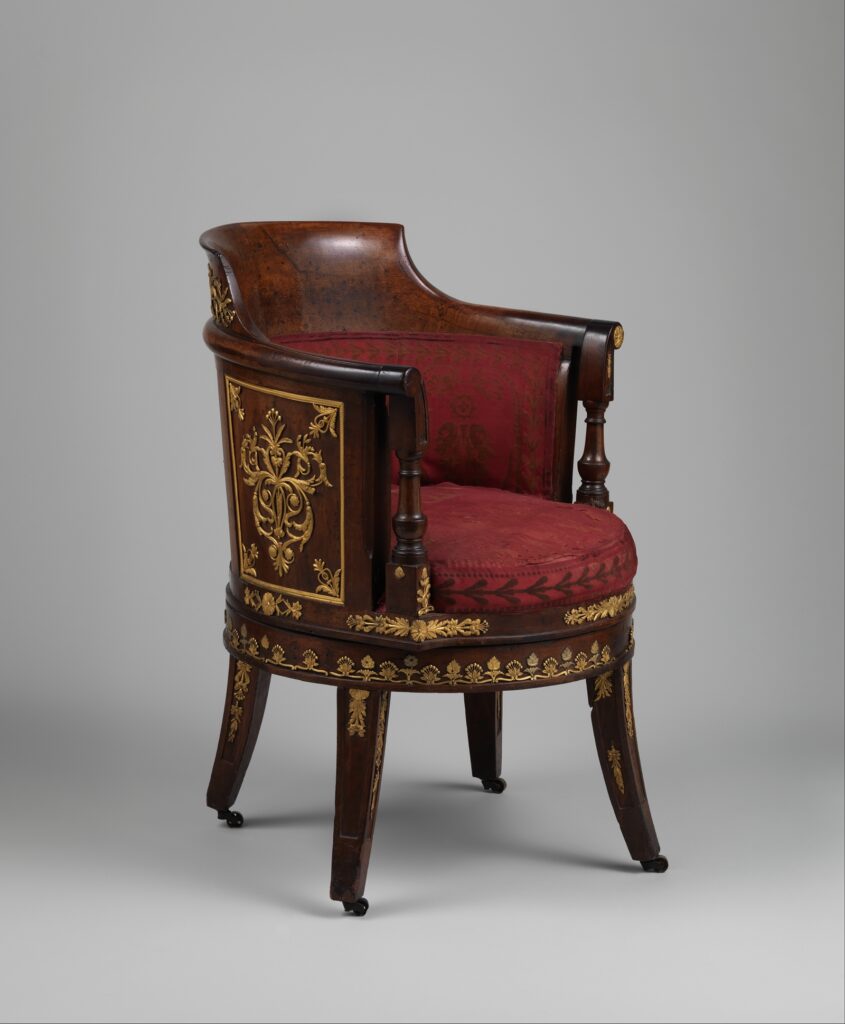
Empire furniture was usually made of mahogany from Cuba and the Antilles, which replaced the variety of precious woods used before, and it was fitted with brass and ormolu figures drawn from myth and history. It was largely austere and geometric. The desk chair above rotates, and the Met notes that it also has castors under the legs. It is decorated with gilt bronze, and the goldsmith Pierre Philippe Thomire was recognized as a skilled maker of bronze mounts for pieces of this kind.
Second Empire furniture and the revivals (1850s to 1870)
The Met’s essay on European revivalism describes the nineteenth century as a run of revival styles, among them the Gothic, the Renaissance, and the Rococo and Neoclassical styles of the century before. Taste for eighteenth-century French decorative arts never disappeared. Even under the Second Empire, the Met notes, the Empress Eugénie identified more closely with Marie Antoinette and the Rococo than with Empress Joséphine and the Empire style.
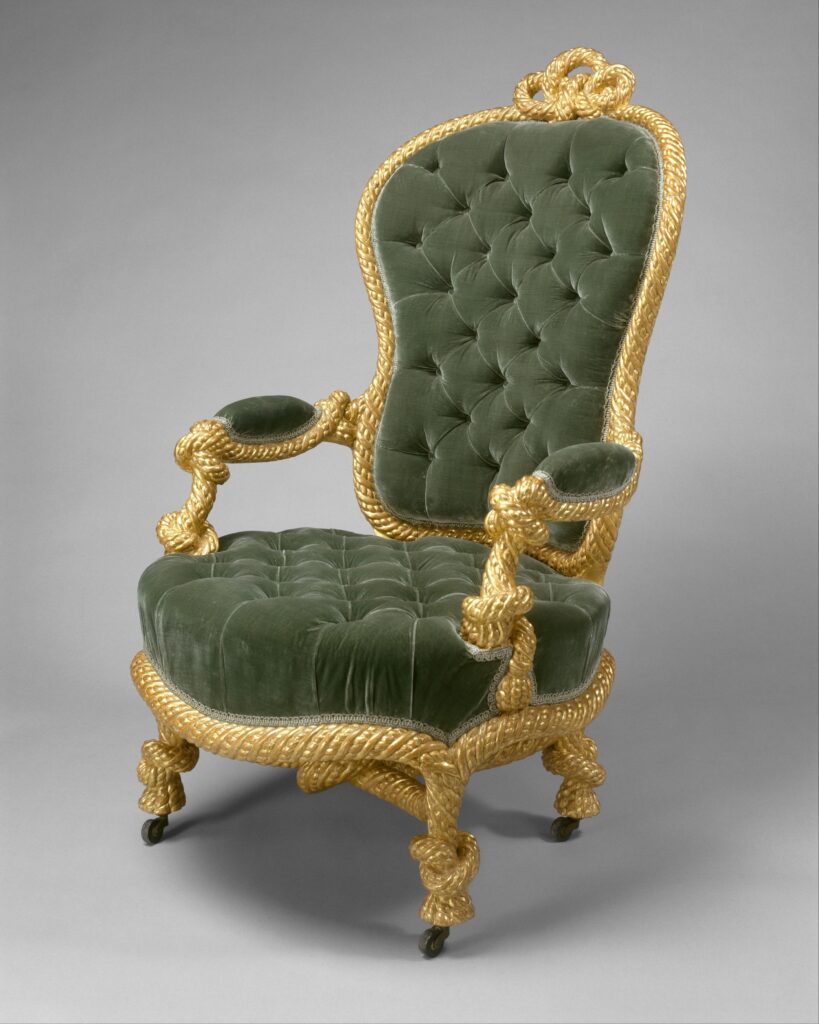
The Met says this deeply tufted armchair epitomizes the desire for originality and variety, combined with a concern for comfort, that was characteristic of the Second Empire. New veneering methods and advances in wood carving helped popularize the Rococo revival, and coil springs made seating more comfortable. The revivals also reached more buyers, because any style could be bought at a range of price levels, from pieces made for heads of state to poorly made goods for the less affluent. That is why a nineteenth-century “Louis XV” piece can be either impressive or ordinary. The guide to buying vintage furniture covers what to inspect before you buy.
Not everything was Rococo. A cabinet designed by Jean Brandely, whose prototype was shown at the Exposition Universelle of 1867 and drew mixed criticism, carries a plaque commemorating the Frankish leader Merovech’s victory over Attila. The Met owns a second, nearly identical cabinet that the maker commissioned for himself.
Belle Époque and Art Nouveau (1880s to the First World War)
Belle Époque is a name for an era, not for a ruler or a design movement. In furniture it overlaps with Art Nouveau, which the Met dates from the 1880s until the First World War, and the Met lists “Art belle époque” among the French names for that style. Art Nouveau drew on the natural world, with sinuous, whiplash curves that came partly from botanical studies. In Paris it reached a wide public at the 1900 Exposition Universelle.
The Met observes that the furnishings shown there shared elements of the French Rococo and its nineteenth-century revivals, such as stylized natural motifs, while keeping up the tradition of French craftsmanship. Leading cabinetmakers, among them Georges de Feure, Louis Majorelle, Edward Colonna and Eugène Gaillard, used luxury veneers and finely cast gilt mounts, and the Met points to the Neo-Rococo influence of François Linke.
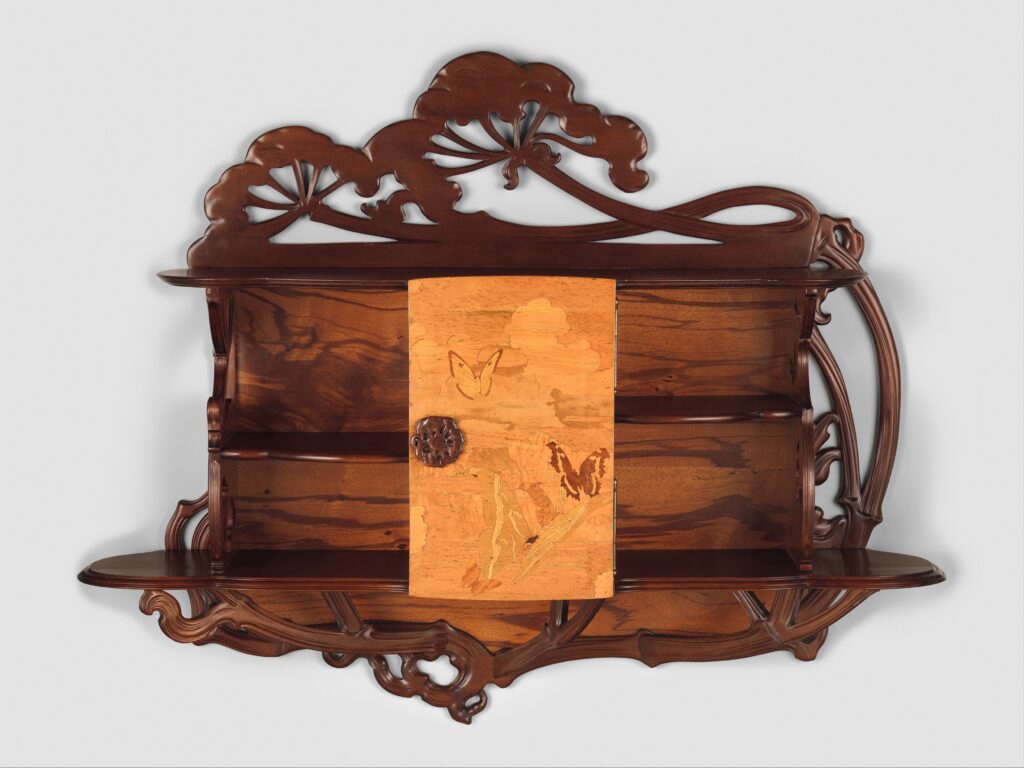
Émile Gallé worked in glass and furniture. The Met calls him the first major exponent of Art Nouveau to take nature as a guiding principle, and says he inspired artists in his native Nancy, the group now known as the École de Nancy, to give up historical styles. The cabinet above is a rare model, and the Met records only one other known version, in the Musée de l’École de Nancy.
Reading the label on a piece
Because the styles were revived so often, a name tells you about shape, not date. Two clues help, and both come from Paris in the eighteenth century. Individual forms and later styles have their own guides: French Art Deco furniture, the French armoire, the French console table and the bureau plat.
- Stamps. From 1743 it became the rule in Paris to stamp furniture offered for sale with the maker’s name, and a second stamp, JME, was added once the guild’s inspectors had approved the work. The guild was dissolved in 1791. Royal cabinetmakers and independent craftsmen worked outside its rules, so a missing stamp does not settle anything.
- Mounts. The crowned C tax mark on Cressent’s commode is a reminder that gilt-bronze mounts can carry their own evidence, and that the Met dated that piece partly from them.
Furniture made outside Paris in these styles, in regional workshops, has its own guide: French provincial furniture.
Sources
- The Metropolitan Museum of Art, Furnishings during the Reign of Louis XIV (1654 to 1715)
- The Metropolitan Museum of Art, The Golden Age of French Furniture in the Eighteenth Century
- The Metropolitan Museum of Art, French Furniture in the Eighteenth Century: Seat Furniture
- The Metropolitan Museum of Art, French Furniture in the Eighteenth Century: Case Furniture
- The Metropolitan Museum of Art, Empire Style, 1800 to 1815
- The Metropolitan Museum of Art, European Revivalism
- The Metropolitan Museum of Art, Art Nouveau
- The Metropolitan Museum of Art collection records: 31.66a, b, 59.108, 1982.60.56, 33.12, 1971.206.13, 07.225.53, 1998.382, 1989.197 and 1982.246
- Encyclopaedia Britannica, Louis XIII style and Directoire style