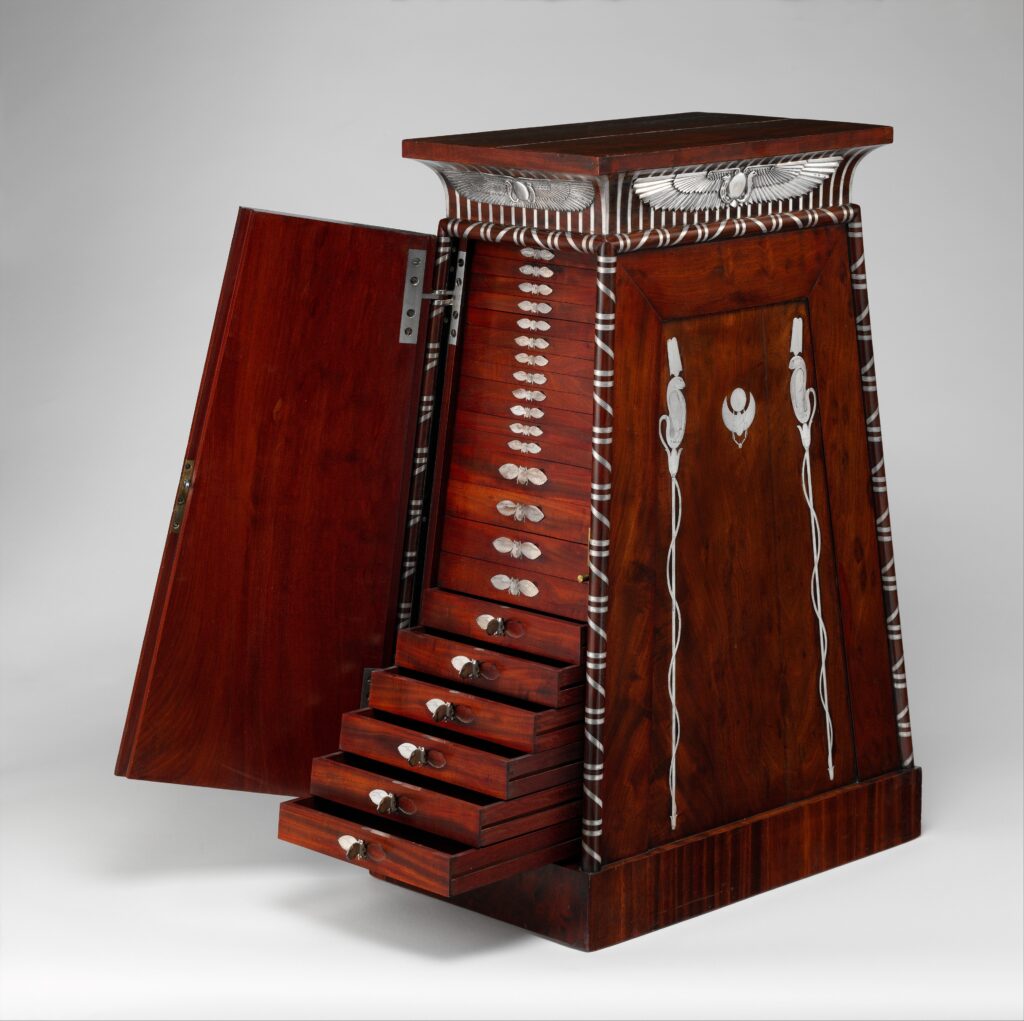
The silver cobras on one Empire cabinet are locks. The eye of each cobra is a catch, and when a silver stick that comes with the keys is pushed into the pupil, the snake’s body falls forward to reveal the keyhole. Above each keyhole the goldsmith Martin-Guillaume Biennais had his own name engraved, so that, as the Metropolitan Museum puts it, no one opening the doors could miss it. The cabinet was made in Napoleon’s last years to hold medals, and it is Empire style furniture at its most theatrical. Most pieces are plainer, but they share its habits: an architectural outline, a cabinetmaker’s veneer and metal applied like jewelry.
Merriam-Webster defines Empire, as an adjective, as a style of clothing or furniture popular in early nineteenth-century France, from le premier Empire, and dates that use to 1852. The Met’s own dates for Empire style furniture are 1800 to 1815. The order of French styles is in the guide to French furniture styles; this guide is about the pieces themselves, what they are made of and who made them, and how to look at one that is for sale.
Forms: the chest, the mirror and the secretary
The leading name in Empire style furniture is François-Honoré-Georges Jacob-Desmalter, whose firm employed as many as 350 specialist craftsmen in 1807, according to the Met. It describes his furniture as marked by superb quality, classical severity and functional perfection.
His cabinet in the form of a commode à vantaux, a chest with doors, dates from about 1813 to 25. It is oak veneered with thuya wood, with gilt-bronze mounts and a marble top, and the Met calls him the leading Empire furniture maker, noting that his handling of large proportions did not lessen during the Restoration. The form of stamp on it was in use from 1815 to 1826, which is the kind of detail that dates a piece more closely than its style does. What a stamp can and cannot settle is covered in the guide to the antique French commode.
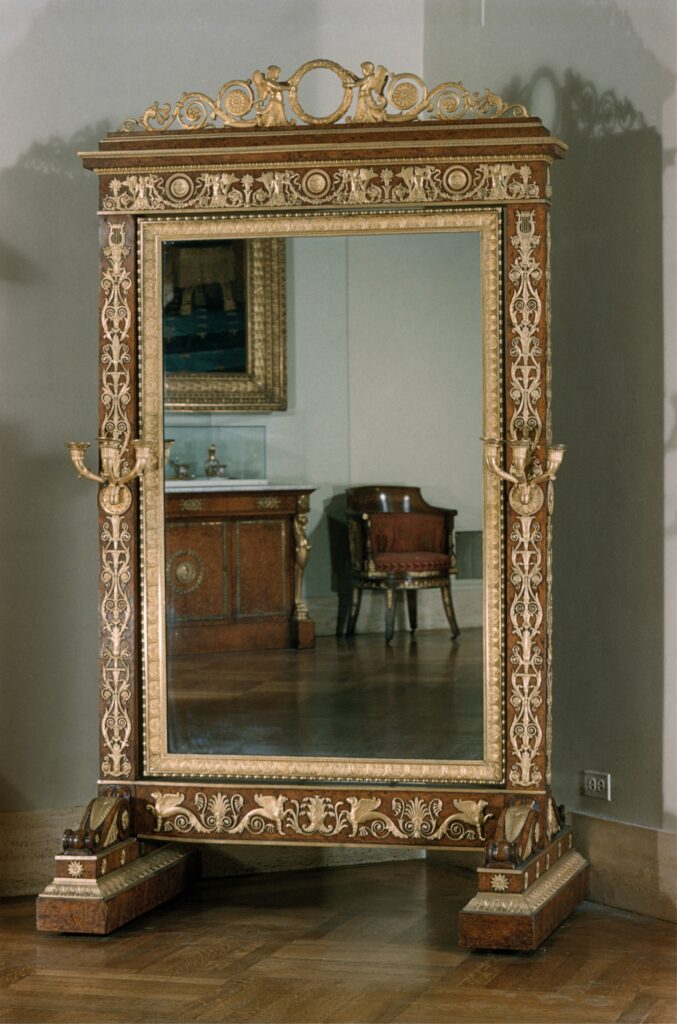
The psyché, a tall cheval glass, is a form of the period. The name comes from the heroine of La Fontaine’s Les amours de Psyché, who was said to have looked at a full-length reflection of herself, and the Met’s example refers to the myth in a frieze of butterflies, symbols of Psyche. An identical gilt-bronze frieze appears on a psyché made for Empress Marie-Louise in 1810. The two winged creatures on the crest hold a wreath that probably once enclosed a decorative motif or monogram, which is now missing.
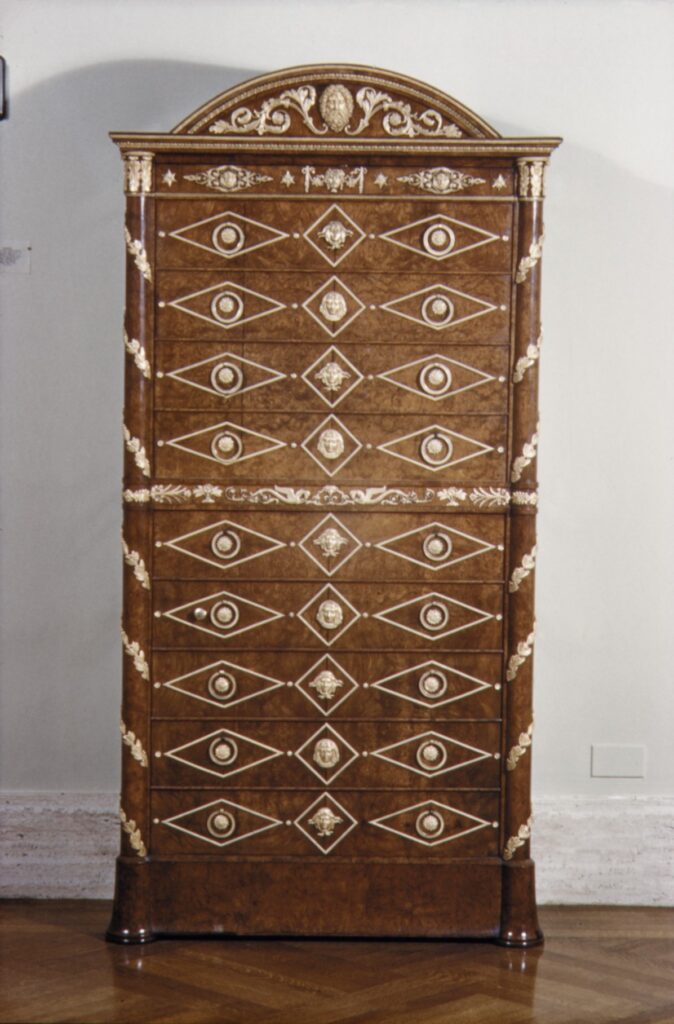
A secretary of about 1804 to 09 shows the period’s taste for disguise. Its handles and mounts are arranged to give the illusion of a chest of drawers, while the upper part is a fall front concealing a writing compartment. It is amboyna veneered on pine, and tradition has it that Napoleon presented it to Maréchal Lannes, who died in 1809. The museum’s own phrase is “tradition has it,” and it is a good model for repeating an imperial provenance.
Woods and surfaces
The Met’s timeline essay says Empire style furniture was usually made of mahogany from Cuba and the Antilles, which replaced the variety of precious woods used before, and that it was largely austere and geometric. Its own examples show how much room that leaves. The secretary and the psyché are veneered in amboyna, the commode in thuya wood, and the coin cabinet is mahogany. The carcases beneath the veneers are plain: oak for the psyché and the commode, pine for the secretary.
The metal matters as much as the wood. The Met notes that grand Empire furniture is decorated with applied and inlaid metal, usually gilded bronze. For the coin cabinet the patron wanted something out of the ordinary, and the fittings are of silver of 950 parts in 1,000, made in the workshop of Biennais, who put his maker’s mark on one wing of each winged disk.
The top section of the cabinet took its form from an Egyptian pylon, the gateway Baron Denon had recorded at Apollonopolis Parva in Upper Egypt. Biennais’s 1814 account for 3,600 francs describes it as a medal cabinet in the form of an Egyptian pedestal, with 44 mahogany drawers and silver mounts. The Met says Denon may have instructed Charles Percier on its details.
Mounts: where the maker’s hand shows
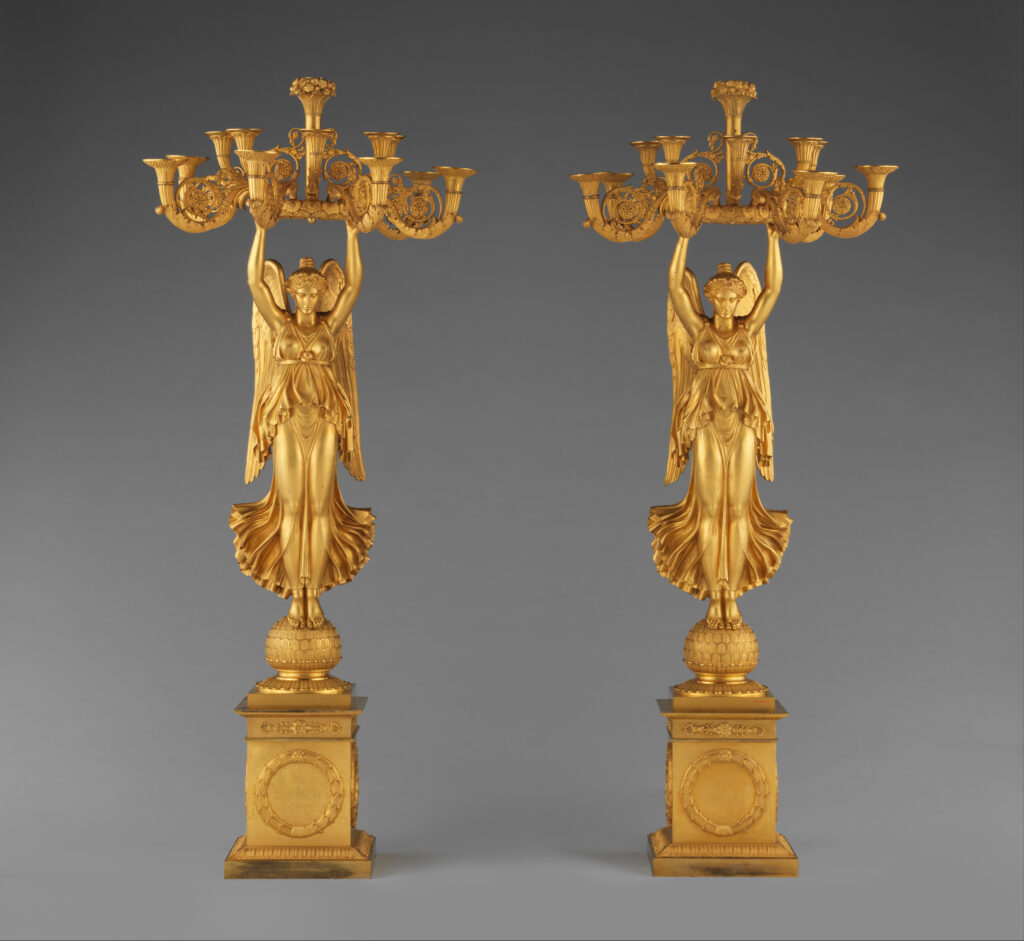
Pierre Philippe Thomire, the Met’s essay says, was recognized as a skilled maker of bronze mounts for Empire style furniture. The museum’s pair of candelabra of about 1810 to 15 are Winged Victories, which it calls a staple of Napoleonic decoration, each lifting a floral wreath that carries ten candle sockets. Charles Percier designed similar candelabra for Empress Joséphine’s boudoir at Saint-Cloud, where they are recorded in the inventories of 1805 and 1807, and his original drawing is in the Met’s collection.
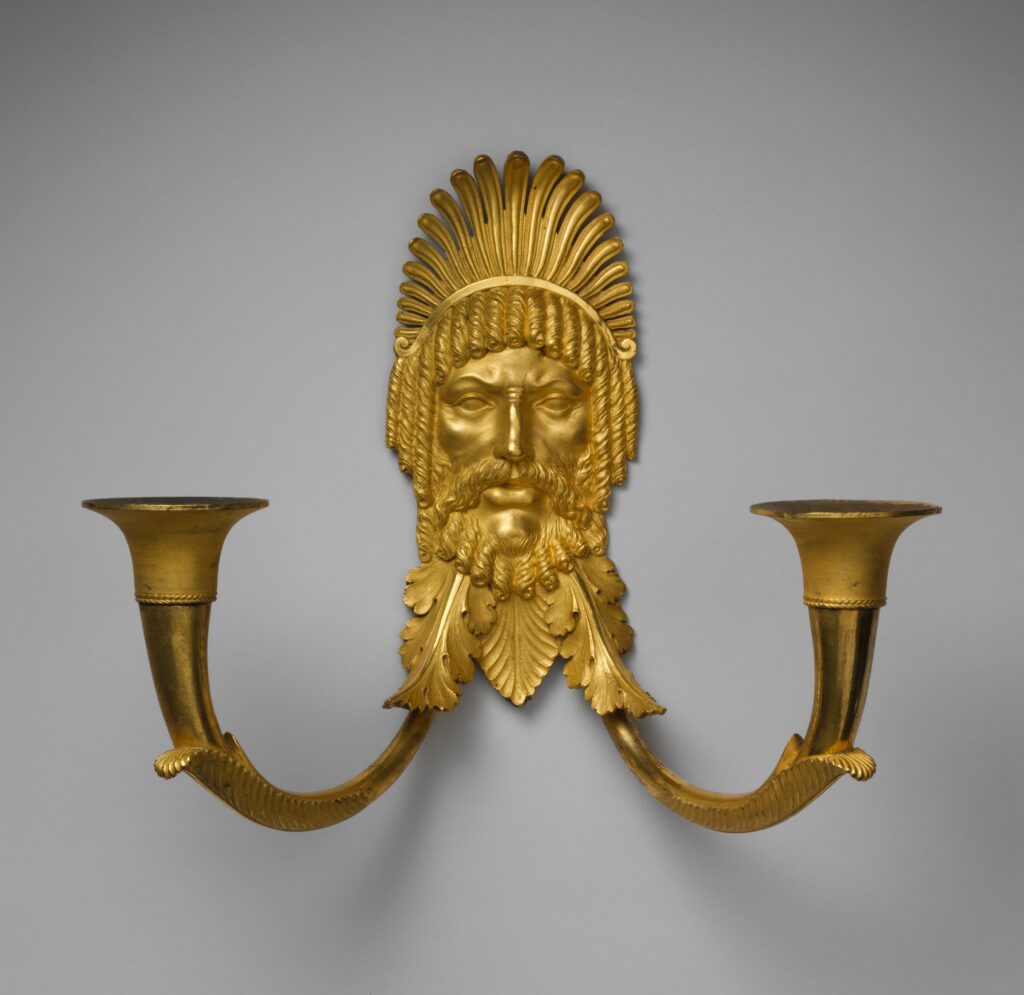
A two-light wall bracket attributed to Antoine-André Ravrio shows what a surviving mount can carry. It has a crowned and bearded mask, and an inventory number of the Palais des Tuileries. It is one of a pair, and in 1833 it hung in the apartment of the keeper of the palace.
The Met records that an elongated ornament pendent from the palmette between the two branches is missing, and that a similar wall light supplied in 1808 to the château de Fontainebleau by Ravrio still has it. Ravrio worked for the French court before the Revolution and later for Napoleon. For how wall lights of this kind fit into the wider trade, see the guide to antique wall sconces and the guide to ormolu and gilt bronze.
Telling Empire from its neighbors
The Met’s essay says the antique forms already seen in the Louis XVI style blended with Napoleon’s imperial symbols in the Empire, so a piece can look both ways, and the Louis XVI furniture guide describes the earlier half of that story. What the Met stresses is the imperial vocabulary, the bee, the eagle and the Egyptian motifs, and the metal figures fitted to austere, geometric furniture. The dates also overlap with the next reign. Jacob-Desmalter’s commode is Empire in manner but belongs at least partly to the Restoration, so style and date have to be read separately.
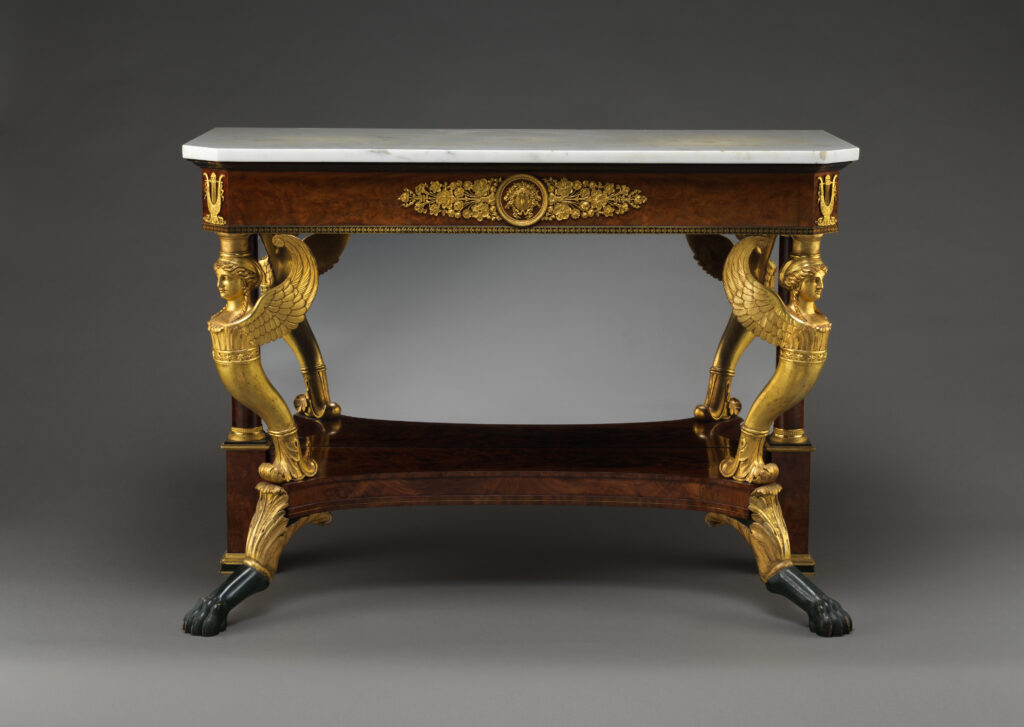
The word travels, and it is worth separating the American version. The Met catalogs a pier table of 1815 to 19 by Charles-Honoré Lannuier, a Paris-trained cabinetmaker who migrated to New York, as blending French neoclassical design with American traditions, with carved caryatids and gilt-brass mounts. It is made of mahogany, with marble, and it belongs to a separate American story, but it is one reason Empire style furniture needs a country in front of it.
What to check in Empire style furniture
- The mounts. Every one is a point of comparison. Ask which are present, which have been replaced and what is missing: the Met’s wall bracket lacks a pendant, and the psyché has lost whatever its wreath enclosed.
- The marks. Look for stamps, inventory numbers and makers’ names, and treat the form of a stamp as a dating clue. A stamp of a form used from 1815 does not belong to a piece said to be of 1805.
- The provenance. The museum writes “tradition has it” of a secretary said to have been given by Napoleon, and a seller should be as careful as the museum.
- The veneer and carcase. In the Met’s examples the veneer is on oak or pine. Look for lifting, patched areas and colour that does not match from one panel to the next.
- The metal. Gilt bronze is the usual material, so silver, gilded brass or later plating are questions to ask about, not signs of a fault.
For Empire style furniture as for any other piece, the questions to ask a seller in writing, and the repairs worth paying for, are in the buying guide.
Sources
- Merriam-Webster, “empire”.
- The Metropolitan Museum of Art, Cybele Gontar, “Empire Style, 1800 to 1815,” Heilbrunn Timeline of Art History, 2004.
- The Metropolitan Museum of Art, coin cabinet, about 1809 to 19 (26.168.77); cheval glass (psyché), attributed to Jacob-Desmalter (24.230); secretary, about 1804 to 09 (23.147.1); cabinet (commode à vantaux), Jacob-Desmalter (19.182.5).
- The Metropolitan Museum of Art, pair of candelabra with Winged Victories, Thomire (26.256.2, .3); two-light wall bracket, attributed to Ravrio (07.225.495); pier table, Charles-Honoré Lannuier (2018.30a, b).