Turn a French mantel clock around and it starts answering questions the front never will. The dial often carries a name and the words A PARIS; the back plate of the movement may carry an engraved signature, a number or a round stamp naming a medal; the case can be stamped by a different hand altogether. Reading those marks is the practical way into identifying an antique French clock, and the records at the Metropolitan Museum of Art show how much they can say.
The first lesson is that there is often no single maker. A pendule de cheminée, the French term that turns up in the Met’s titles, is a case, a dial and a movement, and in the most lavish clocks each came from a different trade.
Three makers in one clock
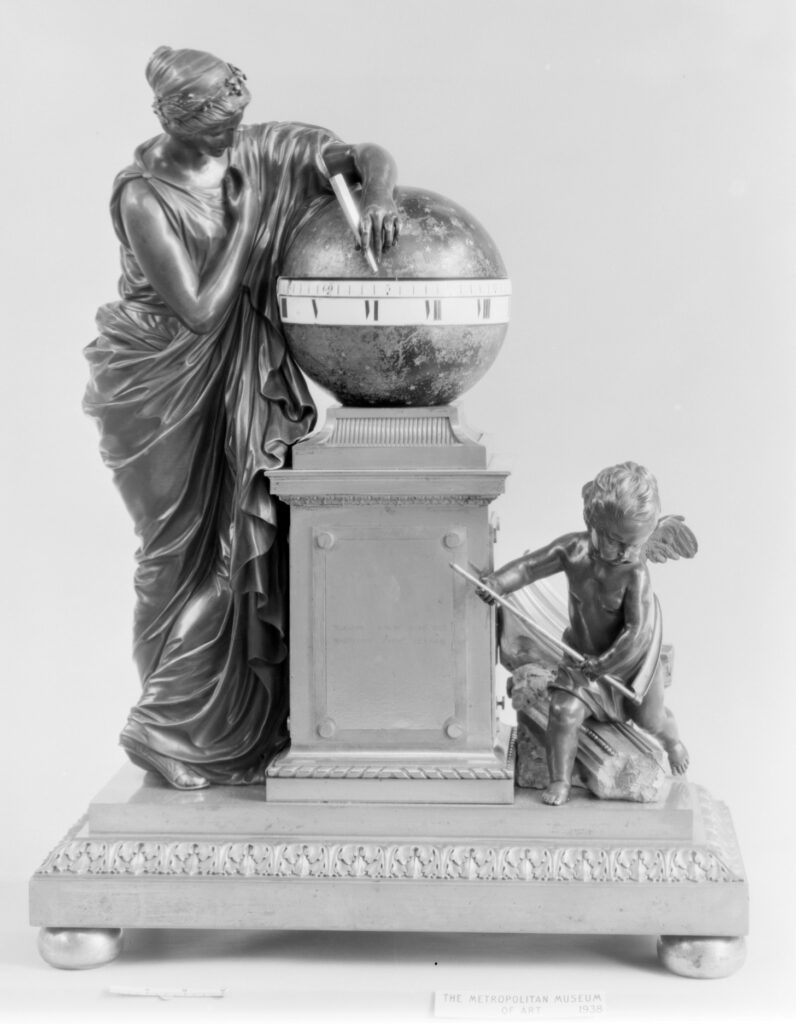
The Met puts it plainly in its record for the “Pendule Clio”: eighteenth-century French clocks are among the most lavish ever made, and they needed clockmakers, bronze founders, gilders and others working together. Jean-André Lepaute, the clockmaker, worked with the sculptors Clodion, Augustin Pajou and Jean-Antoine Houdon, who probably made the models for this one, and the model is described in a 1766 publication by Lepaute himself.
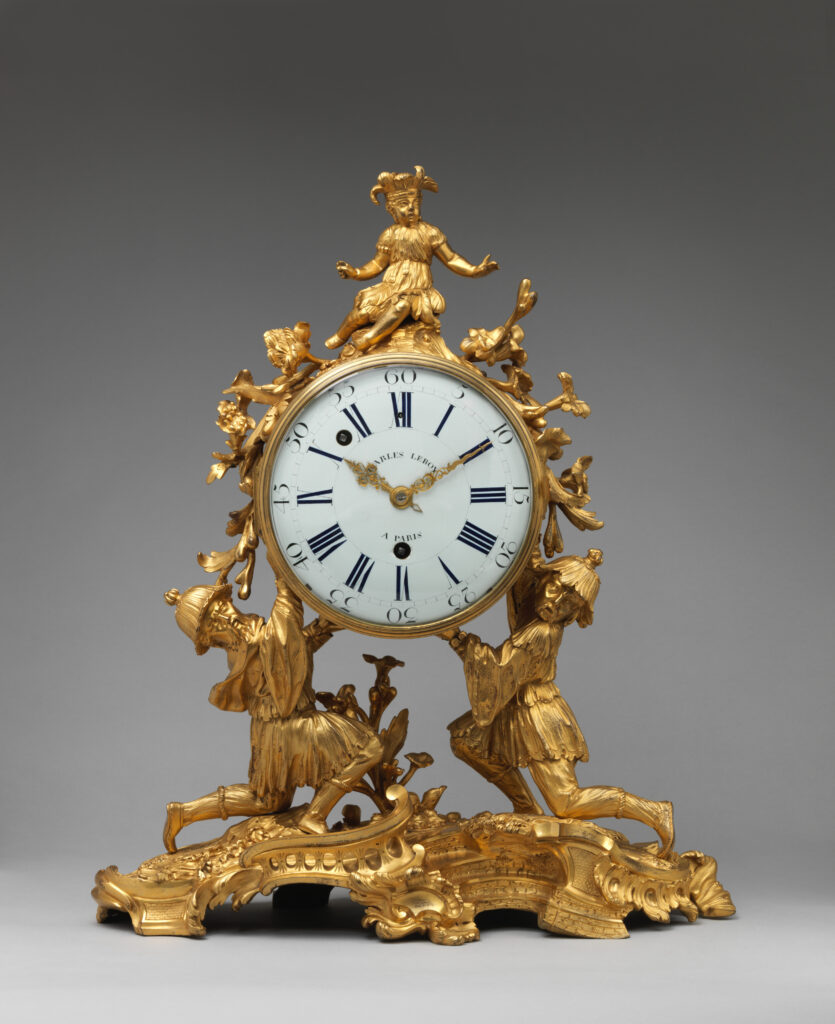
The Saint Germain clock shown first has the same division on a smaller scale. The Met credits its case to Jean-Joseph de Saint Germain, one of the most admired bronziers of his day, and its movement to Charles Leroy, of the Le Roy family of clockmakers. Saint Germain made and signed several cases of this model with variations, and Leroy made a number of movements for his cases. A second Met clock in a Saint Germain case carries Gosselin’s name on its dial and movement instead, so the same case maker can turn up with different clockmakers.
Read the dial first
Start where the clock invites you to. On the Saint Germain clock the dial reads CHARLES LEROY / A PARIS, and Etienne Le Noir’s clock is signed ETIENNE LE NOIR / A PARIS on its face. Julien Le Roy signed the face of his clock, and Drouot signed his “à Paris.” Signatures move around, though: Lepaute signed the dial of the Pendule Uranie but the front plate of the movement on the Clio, so a clock without a name on the dial may still carry one inside.

Some dials name a second specialist. The Drouot clock above is signed by Drouot on the dial and by Dubuisson at its base, and the Met lists Dubuisson as the enameler. Read a dial signature as the clock’s name rather than as proof of who made every part. The Met’s record for Le Noir gives his dates as 1675 to 1739 and the clock’s as about 1745 to 1749, a gap that is a good reason to ask who actually made this particular clock.
What the case can tell you
A good case can carry its own marks. “St. Germain” is stamped on the back of the base of the Saint Germain clock, and on the other clock in his case it is signed on the back of a leg and impressed again. The gilt-bronze mounts matter here too; the guide to ormolu and gilt bronze explains the metal behind those mounts. On two clocks of the 1740s, Julien Le Roy’s and Etienne Le Noir’s, a crowned C is struck on the gilt bronze, and for the Le Roy clock the record gives the period of the mark as 1745 to 1749.
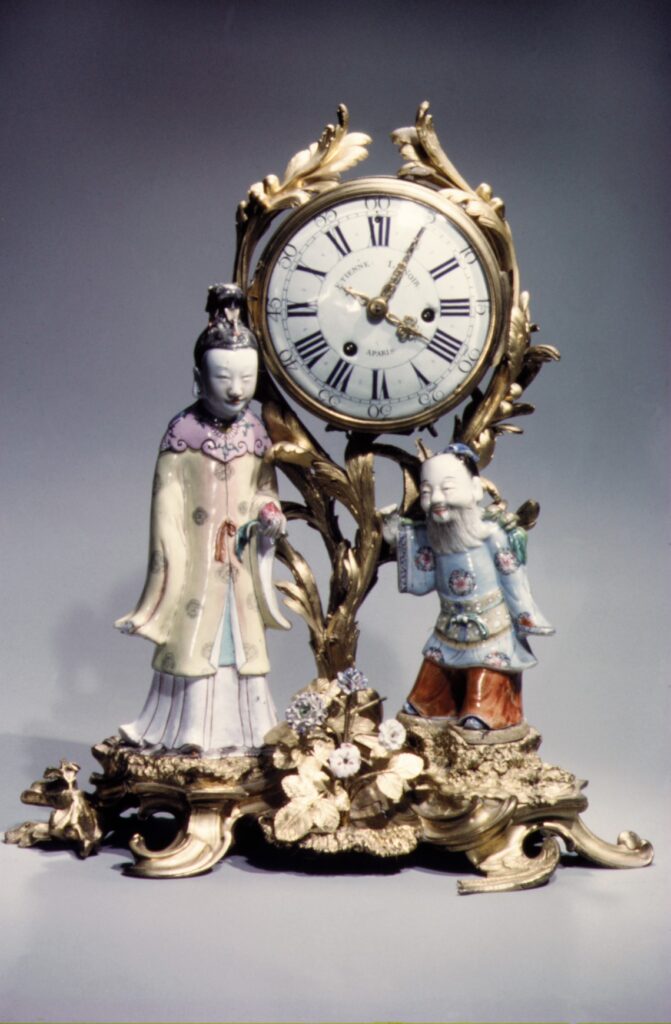
Materials point to the maker’s ambitions. Le Noir’s clock combines gilt bronze with porcelain figures; Julien Le Roy’s clock has Chantilly porcelain in its case, including a figure copied from a Chinese blanc de chine model. The Saint Germain clock’s asymmetrical scrolling base and exotic figures belong, the Met says, to the chinoiserie then fashionable in France. Anyone who knows the curves of Louis XV furniture may recognize the mid-century taste.
Turn it over: back plates, numbers and medal stamps
The back plate of the movement is where a clock keeps its paperwork. Le Noir’s name is engraved there in script. The Gosselin movement is numbered 994, and a clock the Met catalogs under the name Rinquet-Leprince is stamped RINGUET / A PARIS on its face and carries numbers on the works; a stamp can spell a name differently from the museum’s record, so search for both.

The most useful stamp to understand is the medal. The Pons movement above carries one, a circle reading MEDAILLE D’OR 1827 / Pons, yet the museum dates the clock itself to 1840 to 1850. A stamp of this kind names a medal and a year, and the year belongs to the medal: on the Pons clock it cannot be the date of the clock, and on any clock it is a prompt to ask when the movement was made. The Marti clock below carries a similar stamp, MEDAILLE D’ARGENT / 1889 / SAMUEL MARTI et Cie, on a movement the Met dates to about 1860 to 1890.
When case and movement are a century apart
The Marti clock is also the best argument for looking twice. Its gilded wood case is dated to about 1770 and called Italian, while the enameled dial and movement are put at about 1860 to 1890 and made by the Paris firm of Samuel Marti. The record lists the clock as “French, Paris with Italian case,” and it is cataloged openly that way. A reader should know what the Met knows: the parts of a clock do not always share a birthday.
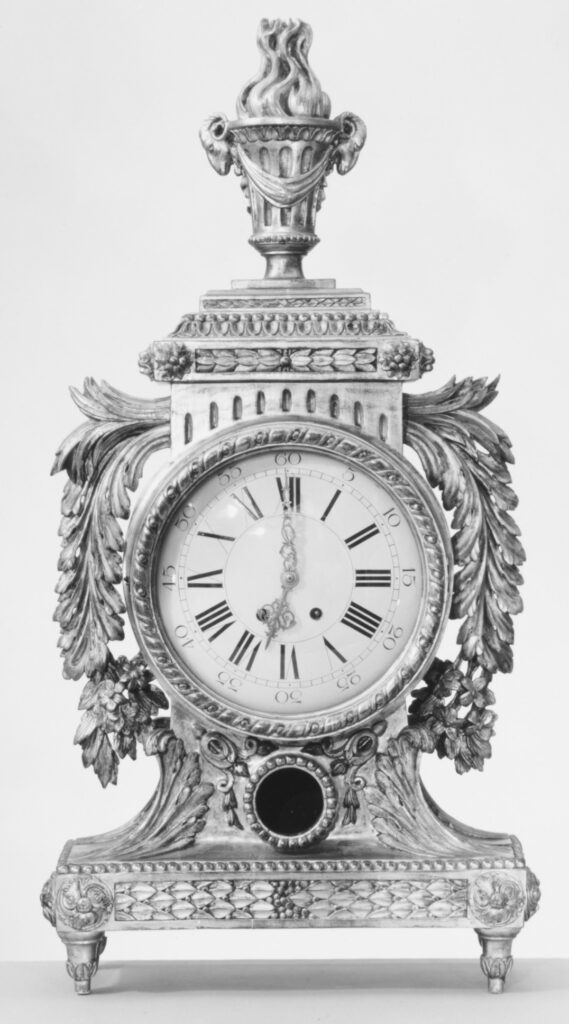
None of this makes a combined clock worthless or dishonest. It makes it a different object from the one a casual look suggests, and a different object from one whose case and movement carry the same date, as on the Saint Germain clock. The question for a seller is simply which one this is.
Periods in the Met’s own dates
The dates give a rough map. Around 1745, scrolling asymmetry, porcelain and Chinese figures: the Saint Germain, Le Noir and Chantilly clocks. In the later 1760s, the Clio, a draped muse leaning on a globe with a small winged figure at her feet, on a stepped base. Furniture was turning in those years too, and the Journal’s guide dates the shift from curves toward straight lines and classical ornament to about 1760.
The nineteenth century brings marble and gilt bronze in the first quarter (Drouot), a gilded and patinated bronze group on a marble base around 1840 to 1850 (Pons), and a gilded, porcelain-mounted clock of about 1860 that the museum calls typically French in its ornate design. The Met adds that French clocks have been prized for elaborate cases since the mid-seventeenth century and, from the reign of Louis XV, for their movements as well. More of that wider French story sits under the French style pages.
The Brocot suspension and the visible escapement
A name worth knowing from the nineteenth century is Achille Brocot (1817 to 1878), who invented what Museums Victoria calls the Brocot suspension, an adjustable pendulum spring that let the clock be regulated by changing the length of the suspension. He also introduced a jeweled deadbeat escapement, sometimes called a visible escapement because it was often mounted in the middle of the dial. At the 1880 Melbourne International Exhibition, the official record said all the clocks Paul Brocot exhibited had the Brocot patent suspension.
That makes a small, visible escapement in the dial a possible clue for a later French clock, and only a clue. It says nothing by itself about the case, the date or the maker of the whole.
Before you buy an antique French clock
A few questions cost nothing:
- Where are the signatures: on the dial, on the front or back plate of the movement, on the case?
- Does any stamp carry a year, and what does the seller say the year refers to?
- Are the case and the movement described as the same date? If not, who says so, and on what record?
- Can you see photographs of the back plate, with any numbers and stamps in focus?
- Does the written description name any part that has been replaced or restored?
- What is the date in the listing based on: a signature, a stamp, the style of the case, or something else?
Photographs of the back plate answer several of these questions before anyone travels to see the clock.
Sources
- Mantel clock (“Pendule Clio”), Lepaute, 37.160.10.
- Mantel clock (“Pendule Uranie”), Lepaute, 29.180.2 (signature record).
- Mantel clock (horloge de cheminée), Saint Germain and Leroy, 2019.283.70.
- Mantel clock (pendule à console), Gosselin and Saint Germain, 37.160.9.
- Mantel clock, Etienne I Le Noir, 65.179.1.
- Mantel clock, Julien Le Roy, with a Chantilly case, 1982.60.68.
- Clock, Drouot, 41.190.61.
- Mantel clock, Honoré Pons, 1999.253.
- Mantel clock (pendule), Samuel Marti et Cie, 69.292.8.
- Clock, 68.165.9a, b.
- Museums Victoria Collections, Mantel Clock, Ormolu, Japonisme, Achille Brocot, France circa 1880, item HT 22697.1.
- Related guides on this site: Ormolu and Gilt Bronze, Louis XV Furniture, Louis XVI Furniture.