In 1770, at Madame du Barry’s pavilion at Louveciennes, a series of Rococo paintings by Fragonard was removed almost as soon as it was installed and replaced with a series commissioned from the Neoclassical painter Joseph-Marie Vien. Fragonard’s paintings had a very short run. Britannica describes the episode in its account of Neoclassicism taking over from the Rococo.
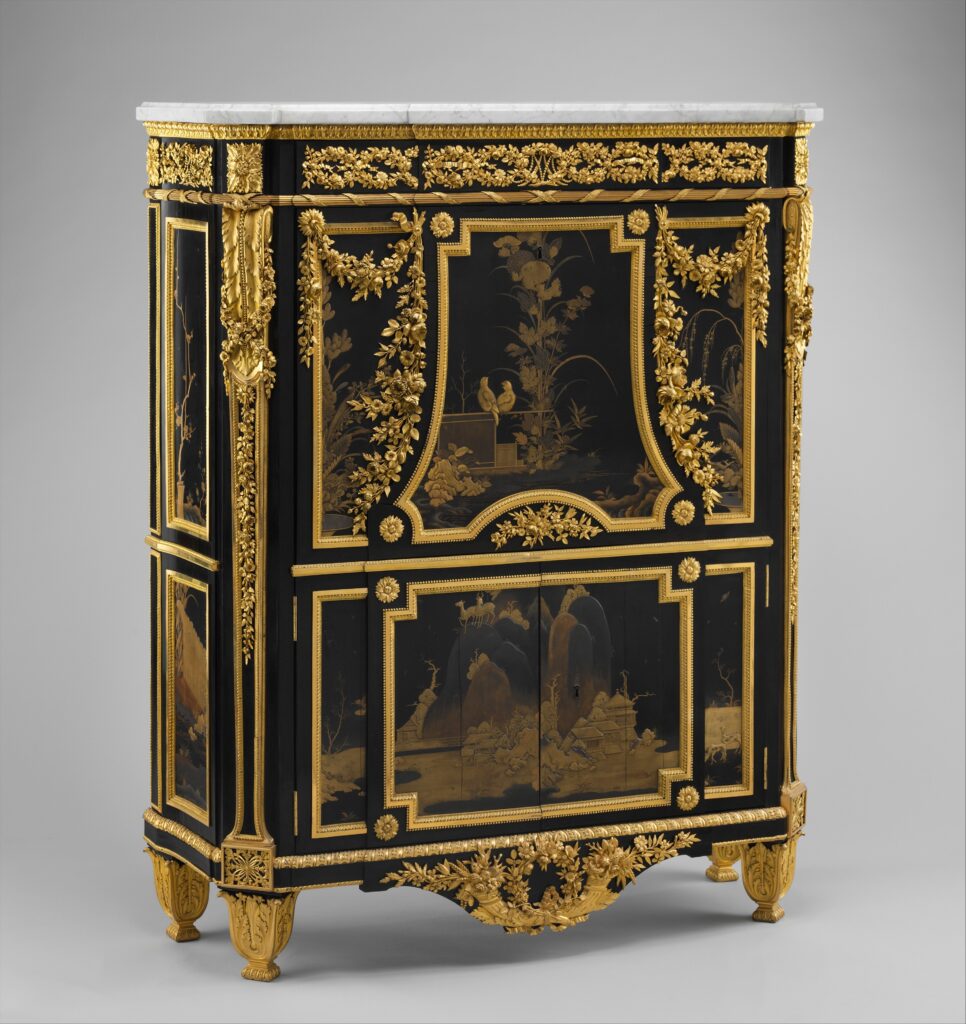
Louis XVI did not come to the throne until 1774, but what is now called Louis XVI furniture was already taking the same turn: straight lines, slender tapering legs, classical ornament and fine veneers in place of curves. The secretary at the top of this page, made about 1790, is a rectangular case on a slim stand, with lacquer panels and crisply modeled gilt-bronze mounts.
The style is also written Louis 16 and Louis Seize, and it was not a clean break. Britannica calls it both a last phase of the Rococo and a first phase of Neoclassicism, so many pieces called Louis XVI were made before 1774. For the whole sequence of French periods, see French furniture styles from Louis XIII to the Belle Époque, for the curving style that came before, see Louis XV furniture, and for how French pieces of any period are lived with, see the complete guide to French vintage decor.
What “Louis XVI style” means, and a short history
Britannica says Neoclassicism came into its own during the last years of Louis XV’s life, mainly as a reaction to the excesses of the Rococo, partly through the excavations at ancient Herculaneum and Pompeii, and partly through Jean-Jacques Rousseau’s call for “natural” virtue.
For furniture the dates vary slightly. Britannica places the start of Neoclassicism in the 1750s and its first use on French furniture in the 1760s, while the Met says the reaction against the Rococo took place around 1760, so “from about 1760” is a safe way to say it. At first, Britannica explains, classical motifs were applied sparingly to furniture of unchanged form, and only slowly did the curved line give way to a simpler, more severe rectilinear design. The Met calls the pieces in between transitional. Britannica describes the Directoire furniture that followed as the last phase of the Louis XVI style.
Characteristics of Louis XVI style furniture
The Met describes Neoclassical chairs as geometric, with square, rectangular or oval backs and straight legs that are turned or spirally fluted. The arm supports sit directly over the front legs again, the frames are usually molded or carved with a continuous pattern, and a medallion or wreath of flowers sometimes tops the crest rail. Britannica adds that chair legs became straight, tapered and fluted, and that commodes and other storage furniture were no longer bombé.

The armchair above is attributed to Georges Jacob, who supplied seat furniture to Marie Antoinette and other members of the royal family. Its medallion back is topped with a rippled bowknot, and its columnar uprights end in finials shaped like flaming cassolettes. The Met notes that it seems to appear in two paintings by Adélaïde Labille-Guiard, one of Madame Adélaïde, an aunt of Louis XVI, shown at the Salon of 1787 and another of the prince de Bauffremont three years later. No other armchair of this model is known, so it may once have belonged to her. For how open-armed fauteuils differ from closed-armed bergères, see how to tell a bergère from a fauteuil.
Louis XVI vs Louis XV furniture
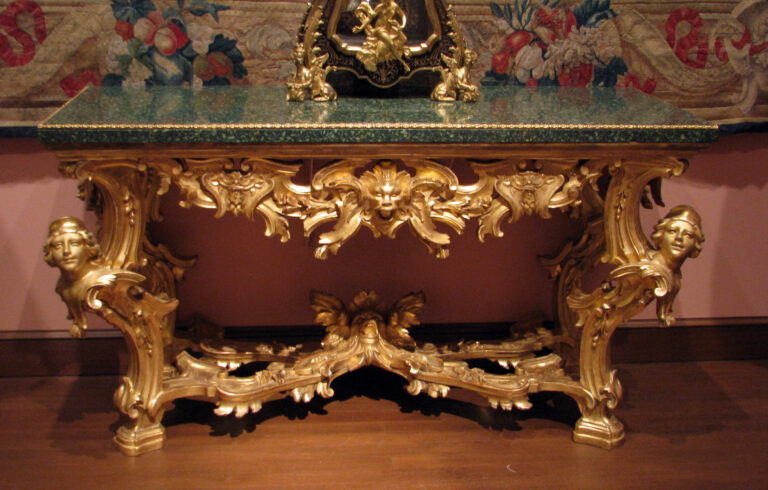
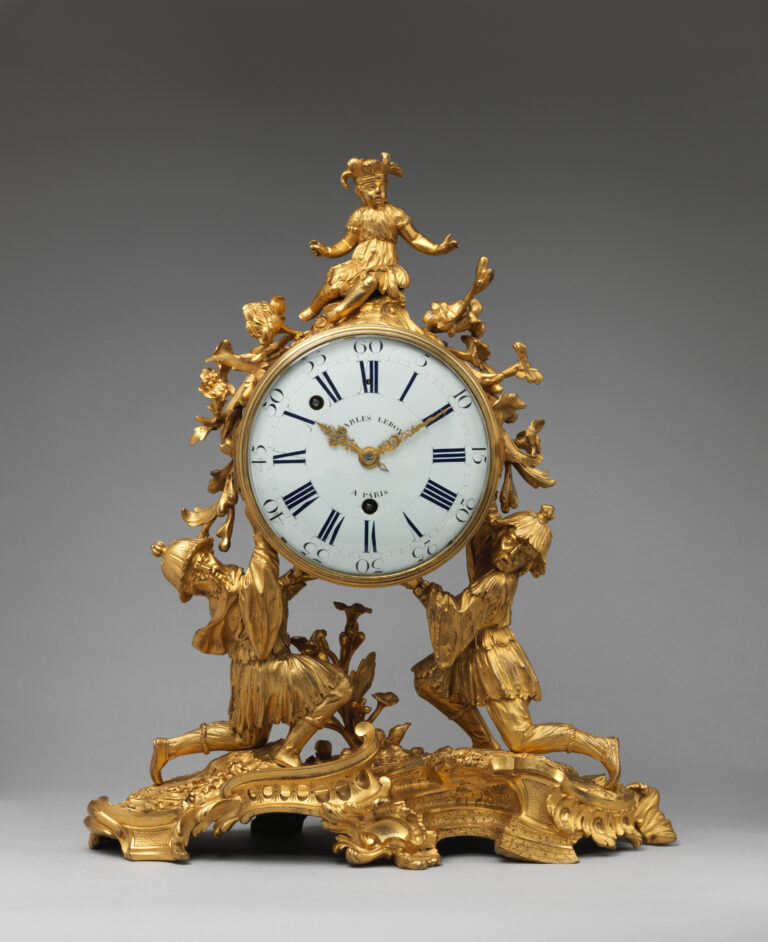
The quickest test is whether the lines curve or run straight. The Met places the change around 1760, and the differences show up in each type of piece.
- Outline: flowing, serpentine fronts under Louis XV; geometric shapes under Louis XVI.
- Legs: cabriole legs under Louis XV; straight, tapered legs, turned or fluted, under Louis XVI.
- Commodes: bombé or serpentine on tall legs under Louis XV; more rectilinear on short tapering legs under Louis XVI, often with a projecting center section (breakfront) or doors in place of drawers, known as a commode à vantaux.
- Writing tables: serpentine under Louis XV; rectangular on straight supports under Louis XVI.
- Ornament: shells, scrolls and asymmetry under Louis XV; classical motifs such as Vitruvian scrolls, palmettes, interlaced bands and wreaths under Louis XVI.
- Emphasis: Britannica notes that under the influence of the cabinetmaker Charles Cressent the mounts predominated in the Rococo, while later in the century marquetry decoration gained first importance.
The main forms of Louis XVI furniture
The drop-front secretary. The secrétaire à abattant, a writing cabinet with a fall front that opens to form a desk, is one of the signature pieces. The one at the top of this page is by Adam Weisweiler and is one of a pair, part of a set. The Met records that the Paris dealers Dominique Daguerre and Martin-Eloi Lignereux took it, or its pair, to Frankfurt in October 1790, when European royalty gathered there for the coronation of Leopold II, and offered it for sale. Ferdinand IV, king of Naples, bought it, and in 1792 he ordered a further secretary and a matching rolltop desk for his study at Caserta. Weisweiler stamped the back.
The commode. The Met describes Neoclassical commodes as more rectilinear, on short tapering legs, with a facade often divided in three by a projecting central section. If doors enclose the drawers, the piece is a commode à vantaux. Mahogany veneer became fashionable, and the mounts drew on antique motifs such as Vitruvian scrolls, fretwork, interlaced bands, palmettes, columns and caryatids.
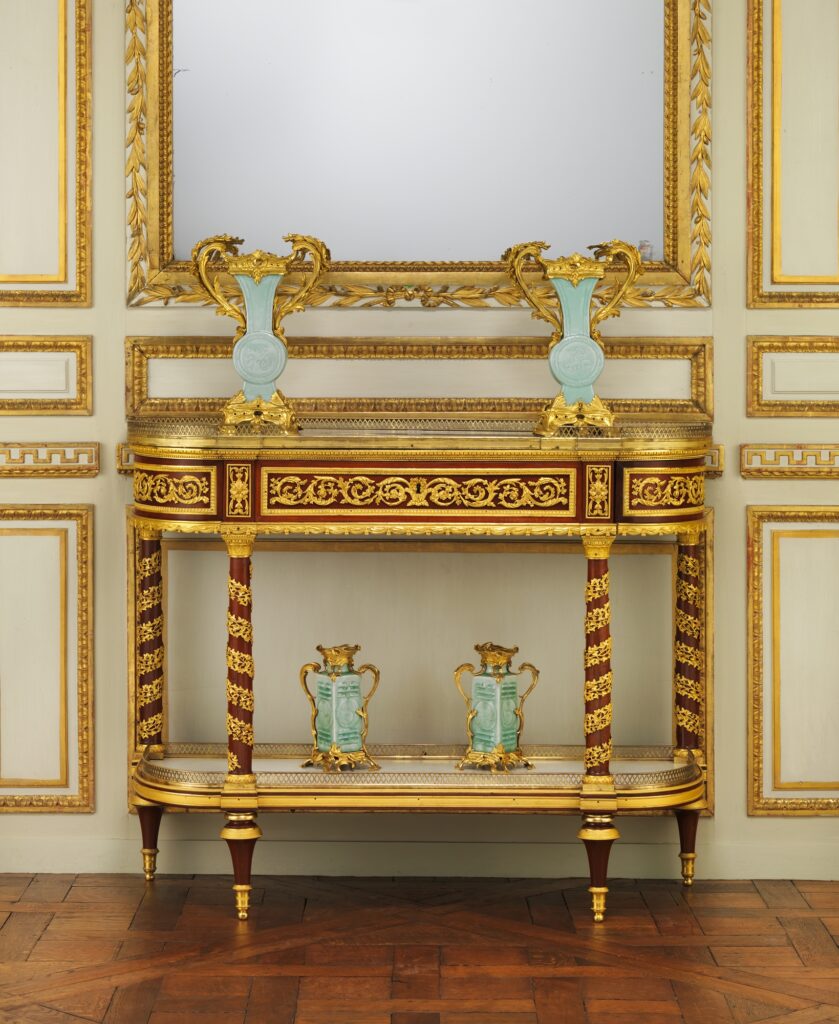
The side table. The commode servante, or commode desserte, shown above, appears to have grown out of a wish for privacy: the Met explains that clean plates and the dessert course could be set on its marble shelves, so the host and guests could dine without servants present. This one is stamped by Jean Henri Riesener. Mahogany makes a quiet background for gilt-bronze mounts in the form of almost lace-like ivy tendrils that spiral up the slender legs, and paper labels underneath show that it was once at the Anichkov Palace in Saint Petersburg.
Tables and writing furniture. A large writing table, which had been serpentine in the Rococo, became rectangular on straight supports. One of the first pieces Marie Antoinette ordered from Riesener was a multipurpose mechanical table delivered in 1778, which is shown on the French furniture styles page.
Royal cabinetmakers and Marie Antoinette
Britannica names Jean-Henri Riesener, Martin Carlin and Jean Saunier among the leading cabinetmakers of the period, and notes that several German craftsmen moved to France for the royal patronage, among them Abraham and David Roentgen, Adam Weisweiler and Guillaume Beneman. Many worked directly for the crown from workshops in the cellars of the Louvre, where labor was divided so that one craftsman specialized in construction and another in lacquering. Britannica adds that the craftsmen and the shop were licensed by the government.
Riesener made this secretary, with a matching commode, for Marie Antoinette in 1783, for her Grand Cabinet Intérieur at Versailles, where she kept the collection of Japanese lacquer boxes inherited from her mother, Empress Maria Theresa. To harmonize with the boxes, fragments of seventeenth-century Japanese lacquer were reused as veneer. The gilt-bronze mounts are swags and interlaced garlands of naturalistic flowers that include the queen’s initials, and the handles are shaped like rippling ribbons. Behind the fall front, hidden drawers sit under the floor of the central compartment, and a strongbox could be locked separately.
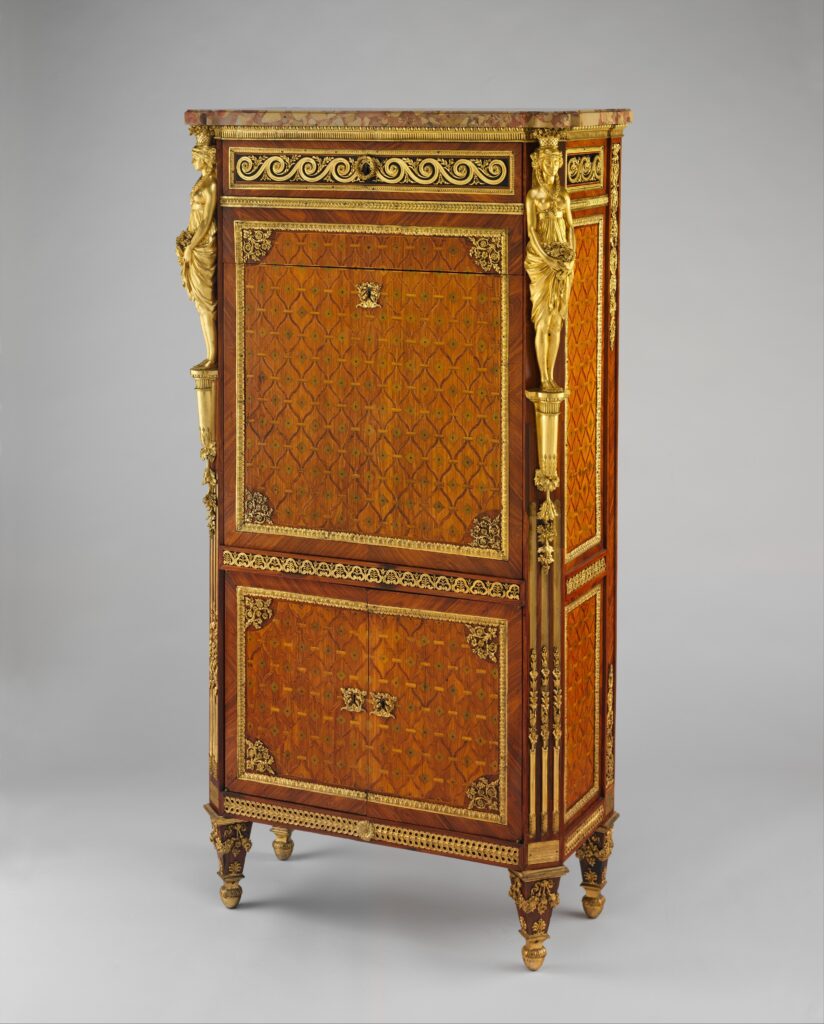
The secretary above shows how collaborative royal furniture was. It was made for the Cabinet Intérieur of Louis XVI at the Palais de Compiègne. The cabinetwork was supervised by Guillaume Beneman, and the gilt-bronze mounts were modeled by Louis-Simon Boizot and others, chased by Pierre-Philippe Thomire among others, and gilded by Galle. The work was coordinated by Jean Hauré, an official contractor for the crown’s furniture. The Met adds that the “eyes” of the marquetry were originally set with gilt-bronze rosettes.
Lacquer, marquetry and mounts
Louis XVI furniture inherited the richness of the previous reign. Britannica notes that marquetry was still widely used, that some cabinets were made of ebony inset with panels of Japanese lacquer, and that boulle work, which had not been used under Louis XV, returned to fashion. The Weisweiler secretary at the top of this page combines Japanese and French lacquer panels with veneers of ebony, amaranth, holly and satinwood, and the Benneman secretary uses tulipwood, kingwood and holly stained green. In every case the gilt-bronze mounts do much of the work of decoration.
How to recognize antique Louis XVI furniture
Shape alone is not enough, because the style came back. Britannica describes the nineteenth-century reintroduction of the Louis XVI style in suites of furniture with round tapering legs, oval backs and elaborate upholstery, and notes that the Louis XVI leg was often used on comfortable upholstered furniture built on a flexible metal “Turkish” frame. Three clues help with Paris furniture. For what to inspect on any second-hand piece, see the guide to buying vintage furniture.
- Stamps. Britannica says signing had become compulsory in Paris, and the Met explains that from 1743 every piece offered for sale carried the maker’s stamp, with a second stamp, JME, added after the guild’s inspection. The guild was dissolved in 1791. Royal cabinetmakers worked outside its rules. Both the Weisweiler secretary and the Riesener side table above are stamped.
- Royal and provenance marks. Marie Antoinette’s mechanical table by Riesener has a number painted underneath that matches an entry in the Journal du Garde-Meuble de la Couronne, the ledger of new furniture for the royal residences, and the side table above carries paper labels that trace it to a Russian palace. Marks like these can document a piece.
- Construction and upholstery. Compare the frame, the veneers and the mounts with the museum examples on this page, and ask whether the upholstery is original. The Met records that the silk on the Jacob armchair is not.
Several of the marks on this page are on the back or underneath: Weisweiler stamped the back of his secretary, the side table’s paper labels are underneath, and the number on Marie Antoinette’s mechanical table is painted underneath. That is why photographs of the underside, the back and any stamps are worth asking for before you discuss price.
Sources
- The Metropolitan Museum of Art, French Furniture in the Eighteenth Century: Seat Furniture
- The Metropolitan Museum of Art, French Furniture in the Eighteenth Century: Case Furniture
- The Metropolitan Museum of Art, The Golden Age of French Furniture in the Eighteenth Century
- The Metropolitan Museum of Art, European Revivalism
- The Metropolitan Museum of Art collection records: 1977.1.13, 07.225.106, 1977.102.8, 20.155.11, 1971.206.17 and 33.12
- Encyclopaedia Britannica, Louis XVI style, Furniture: 18th century, the Neoclassical style and Directoire style