An antique French commode, in the sense this guide uses, is a low chest of drawers. Merriam-Webster lists that meaning first, ahead of the boxlike seat that holds a chamber pot and the toilet, which is why a listing needs “French” and “chest of drawers” beside the word. Britannica describes the French commode as a type resembling the English chest of drawers, in use in France by the late 17th century, with a marble top on most examples and a pair of doors on some.
The commode is a good object for learning to read a period, because the same chest was redrawn in every style: sarcophagus-shaped under Louis XIV, curved under Louis XV, rectangular under Louis XVI and plainer after that. The broader sequence of styles is in the timeline of French furniture styles.
From bureau to commode: Boulle and the tombeau
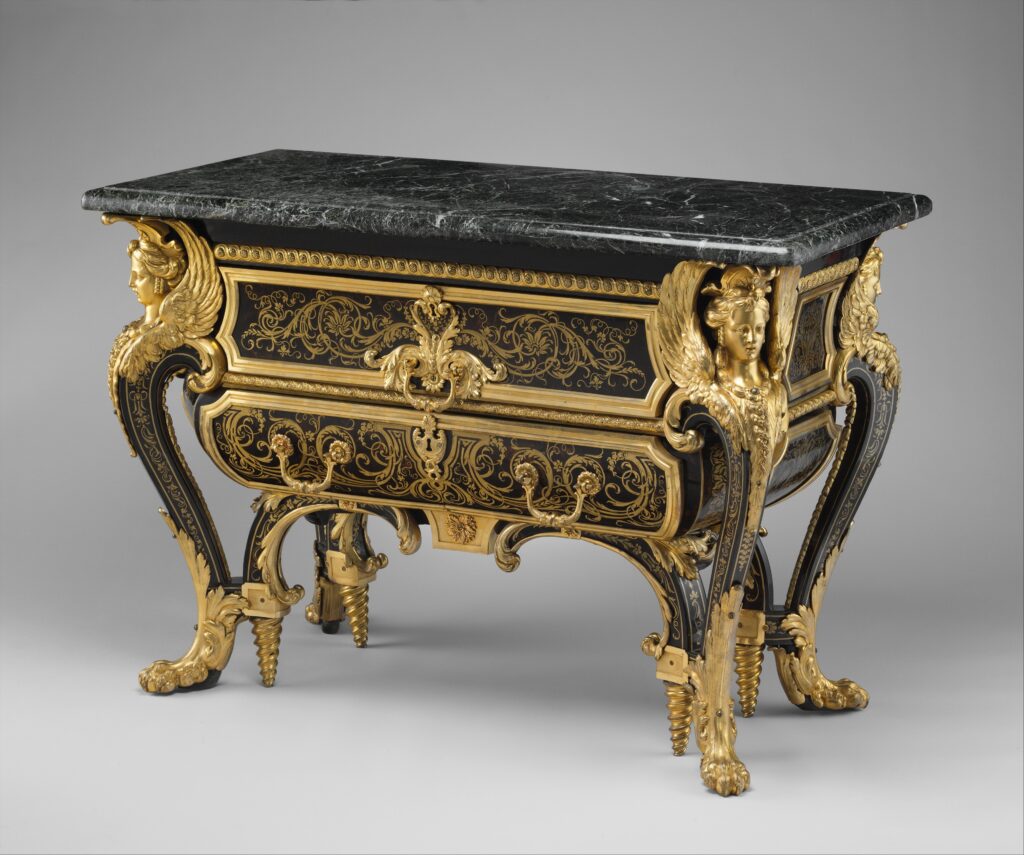
The Metropolitan Museum’s commode by André-Charles Boulle began life under another name. In 1708 Boulle delivered the prototypes to the Grand Trianon as a pair of bureaux, and not until the Trianon inventory of 1729 were the pieces described as commodes, the Met says. They are also called commodes Mazarines, because in the nineteenth and early twentieth centuries they stood in the Bibliothèque Mazarine in Paris. A trade name can describe where a piece stood, not what it was first called.
Britannica calls these early forms commodes-tombeau, since they resembled sarcophagi, and names Boulle among the first to make commodes. The Met points to four extra spiral legs, needed to carry the weight of the bronze mounts and the marble top, and to at least five other examples from the Boulle workshop. It dates this one to about 1710 to 20 instead of the traditional 1710 to 1732.
The antique French commode, period by period: the Rococo chest
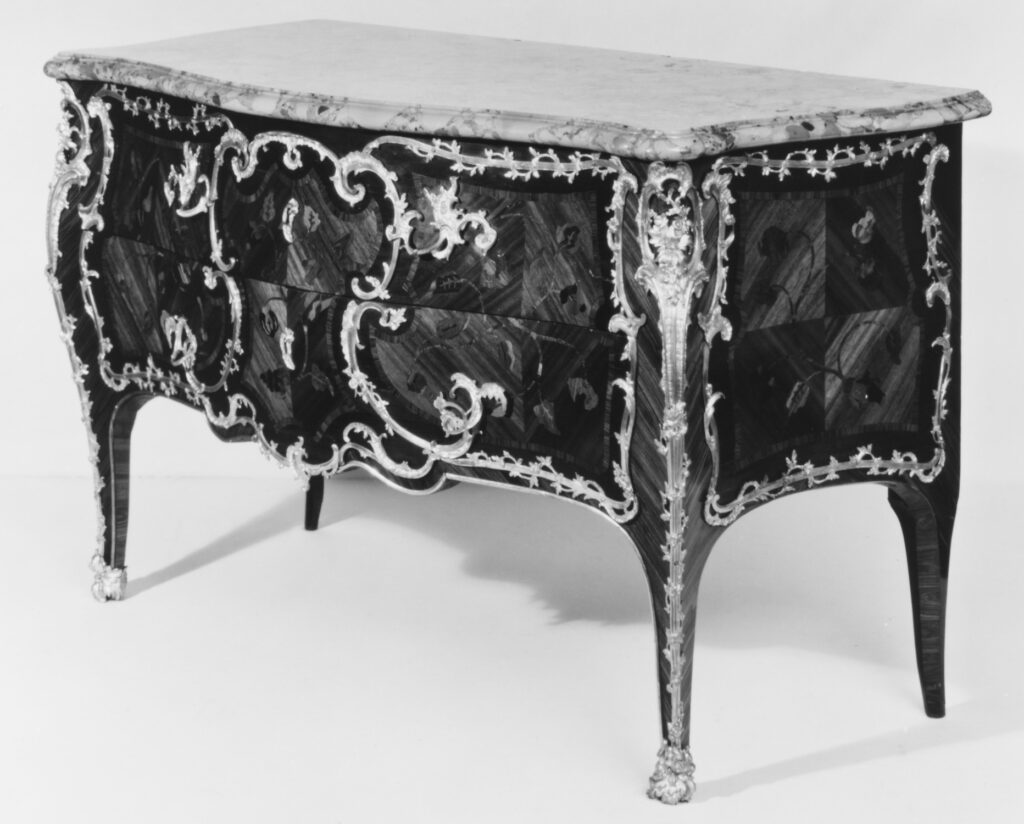
Britannica traces what happened next. Outlines became gently curved, the sides slightly convex or bombé and the front serpentine, usually on long cabriole legs. Marquetry, parquetry or japanned lacquerwork covered the carcase and the legs, and ormolu fittings protected the vertical edges, followed the curves and often hid the edges of the drawers. Under Louis XV, in Britannica’s account, the Rococo curves became extravagant and the ormolu more flamboyant.
The Met’s pair of antique French commodes by Jacques Dubois, about 1755, shows the type. The front is serpentine and bombé, treated as one surface with no horizontal division between the two drawers (sans traverse), and veneered with quartered tulipwood inlaid with sprays of stylized flowers. A purplewood border foreshadows where the mounts sit, and the Met says their shape and placement emphasize the curving outline. The mounts and the veneer were planned together, which is a point to remember when reading a piece: the ormolu and gilt-bronze mounts are part of the design, and the Louis XV furniture guide covers the style around them.
Louis XVI and later: rectangles, doors and plainer finishes
The Louis XVI period brought more restrained forms, Britannica says. The carcase became more rectangular and the legs only slightly curved, breakfronts and rectangular panels of marquetry or parquetry became common, and later the legs turned straight, tapering and reeded. Some commodes were fitted with doors, the form the French call a commode à vantaux. By the nineteenth century, it adds, the commode was more subdued still and had become a purely functional piece.
The Met’s commode by Jean Henri Riesener, about 1786, is mahogany veneer with gilt-bronze mounts and a marble top. The museum thinks it was one of three commissioned in 1786 for the Comtesse de Provence at Montreuil, but only on the basis of Riesener’s bill, because no special stamp was used for her household. Even at a museum, a link to a royal commission can rest on documents, not marks. Of a cabinet by Jacob-Desmalter, a commode à vantaux of about 1813 to 25, the Met notes that the form of its stamp was in use only from 1815 to 1826. More on the period is in the Louis XVI furniture guide.

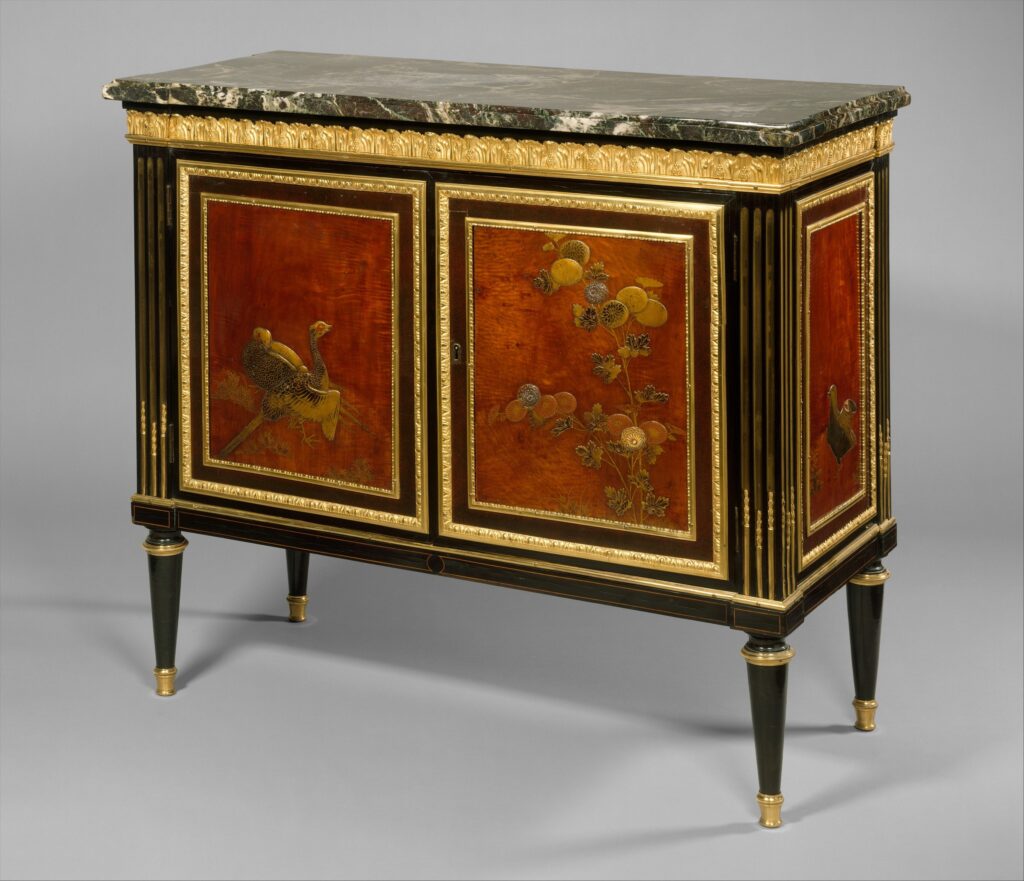
Plainer did not mean dull. Claude-Charles Saunier’s commode of about 1780–90 at the Met is a plain rectangle on tapering legs, with two doors and straight sides, but its panels are Japanese lacquer in red and gold, with birds and flowers, framed in gilt bronze under a dark marble top. The shape is calm. The decoration is where the effort went.
The words on the label
- Commode-tombeau: the sarcophagus-shaped early form, as with Boulle’s.
- Commode à vantaux: a commode with doors.
- Commode en console and commode servante (or desserte): the Met’s titles for pieces that work as a side table or serving table.
- Bombé and serpentine: a convex side and a wavy front, the shape of the Rococo.
- Sans traverse: a front with no horizontal rail between the drawers.
Listings often substitute “French dresser” or “French chest”. Those words name the use, not the style, so the shape and the mounts still have to be read.
Copies, English commodes and later revivals
The French commode was copied with variations throughout Europe, usually with less fine results, Britannica says. In Venice the bombé outline was carried to extremes and the decoration was gaily painted and lacquered. English versions followed after 1740, much more restrained, with little or no ormolu; Thomas Chippendale illustrated several in his Director of 1754. In England the word also came to cover curved chests and low cupboards, and from the late eighteenth century it was a term for a cupboard holding a chamber pot.
A curved “antique French commode” with thin mounts may therefore be an English, Venetian or later version, not a poor French one. Nineteenth-century makers revived the Rococo curves too, in a heavier form, which is the Rococo Revival described in the Victorian furniture guide. A revival piece is honest furniture in its own right; the question is whether the label is.
What to check before you buy an antique French commode
None of this authenticates an antique French commode, and these are questions for the seller and for a specialist, not tests.
- Stamps. From 1743 it became the rule in Paris to stamp furniture offered for sale, and a missing stamp does not settle anything, as the Louis XV guide explains.
- Mounts and veneer. If the mounts follow the pattern of the veneer, as Dubois’s do, they were probably planned with it. Mounts that ignore the veneer layout are worth a question; this is an inference, not a rule from the museum.
- The top. The Met’s records name the marble (verd antique on Boulle’s, brèche d’Alep on Dubois’s). Ask which marble the top is and whether it belongs to the piece; the notes on marble tops cover what to look for.
- Shape and legs against date. A rectangular carcase on straight tapering legs is Louis XVI or later; long cabriole legs belong to the Rococo.
- Drawers and construction. The general inspection points are in the buying vintage furniture guide, from drawers to repairs.
Where to look
Search results for an antique French commode are mostly dealer and marketplace listings, with an auction price guide among them, and few editorial explanations of what the piece is. Specialist dealers who state what has been replaced, and auction houses that publish condition reports, are the usual sources of period commodes. The museum records cited here are free to read before any purchase, and the Met’s give dimensions and materials.
Sources
- Encyclopaedia Britannica, Commode
- Merriam-Webster, commode
- The Metropolitan Museum of Art collection records: Commode, Boulle (1982.60.82), Commode, Jacques Dubois (1972.284.3), Commode, Jean Henri Riesener (1982.60.51) and Cabinet (commode à vantaux), Jacob-Desmalter (19.182.5)