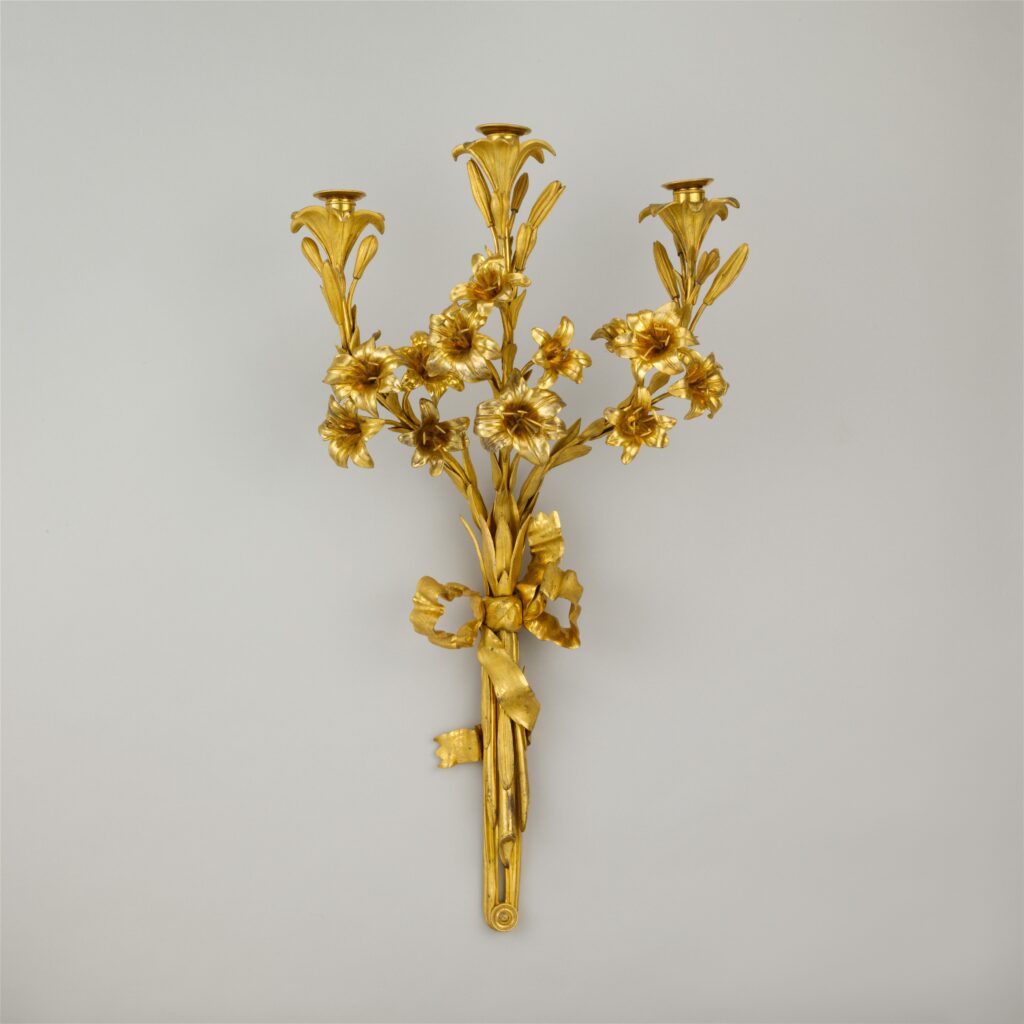
The Metropolitan Museum’s pair of gilt-bronze lily sconces from about 1775 arrives with a warning attached: it is not a proper pair. The ribbons tying the stalks do not complement each other but flow in the same direction, which leads the museum to think the two were part of a larger set. Anyone buying antique wall sconces is buying into the same problem. Sconces were often made in sets, and what reaches the market is often a stray, or a pair that was never quite a pair.
A sconce, in Merriam-Webster’s definition, is a bracket candlestick or a group of candlesticks, and the dictionary adds the electric fixture patterned on one. The word goes back to Middle English, from an Anglo-French term for a screened candle or lantern, and was in use by the fifteenth century. What follows concerns the older generation, made for candles and then gas: what the names mean, what the pieces are made of, and which parts of a surviving sconce can be trusted.
Sconce, bras de lumière, girandole
The names overlap, and sellers use them loosely. Sconce is the English umbrella. The Met catalogs its French gilt-bronze lily pair as bras de lumière, literally arms of light, and describes them in plain words as wall lights. The metalwork behind them is covered in the guide to ormolu and gilt bronze. Fixtures that hang from the ceiling belong to the chandelier guide, and the French ones to the French chandeliers page.
Girandole is the slippery one. Merriam-Webster defines it as an ornamental branched candlestick and traces the word through French and Italian to a Latin root for a circular motion; its earliest English uses were for a kind of firework. The Met uses it for a particular wall piece, a round gilded frame with convex glass and candle arms. It also catalogs a set of three Boston candlesticks, made after 1852, as girandoles, and those stand on marble bases. A listing that says girandole may therefore be a wall mirror, a branched bracket or a table piece, and the photographs have to settle which.
Gilt bronze, silver and gesso
The lily sconces show what the best French metalwork could do with a plain job. The Met says they are shaped with great naturalism as lily stalks tied with a large bow, and that the unknown chaser and gilder set highly burnished blooms against matte buds. Lilies were strongly scented and very popular in the Neoclassical period, and the museum notes that contemporary references to lily-spray sconces exist.

The bronze worker Pierre Gouthière, it says, made a pair composed of three lily branches for Madame du Barry and charged 2,500 livres. Horace Walpole, writing in September 1775, described the Grand Cabinet of Madame de Mirepoix’s Paris hôtel as lit by “four branches of lilies of ormolu.” The date falls in the first years of Louis XVI’s reign, the period described in the Louis XVI furniture guide.
Earlier English work is quieter and heavier. The Met’s pair by Isaac Liger, made in London in 1709 to 10, is silver gilt, with satyrs’ masks chased on the backplates. The museum calls them the work of a gifted master, most likely one trained abroad, and adds that sconces of this kind were often made in large sets for the private rooms of a great house, perhaps a bedroom.

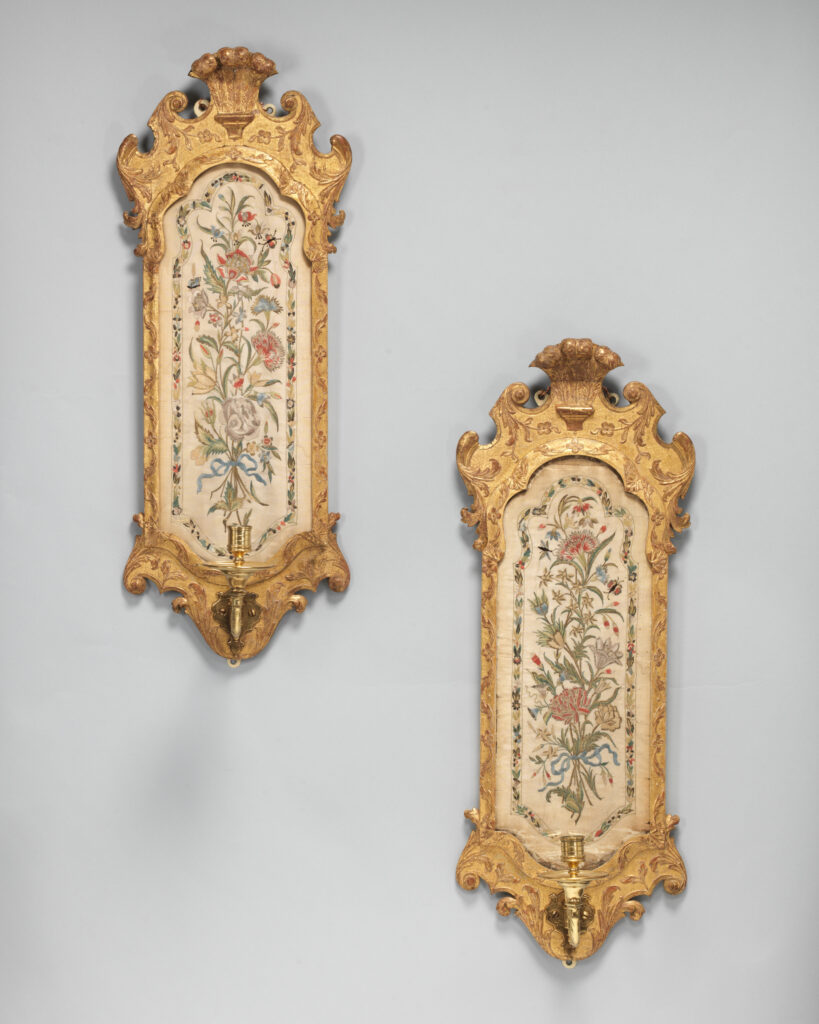
Around 1730 the Met’s British pair takes a different route: gilt gesso on pine, with gilt-bronze fittings and panels of silk embroidery. Gesso is the plaster-like ground that is carved and gilded, so the frame is wood in disguise, and the embroidery means this sconce carries a textile that has to survive as well as a candle.
Tin, paper and mica
The modest end of the trade is more instructive for dating. The Met’s tin wall sconce of 1700 to 1730 comes with a frank note: tin sconces were probably used most often in public places, where a broad spread of light suited better than the concentrated light needed at home for reading or sewing, and dating them is difficult because they seldom show stylistic features that point to a period or a region.
Quillwork goes the other way. The museum’s American example of 1720 to 40 is built from narrow strips of paper rolled into tiny scrolls and glued side by side in a shadow-box frame, and the mica on the paper magnified and reflected the candlelight. It is possibly the work of Ruth Read of Redding, Connecticut. It also lost something along the way: it originally held silver candle arms by Knight Leverett, and those are now at the Winterthur Museum.

Girandole mirrors
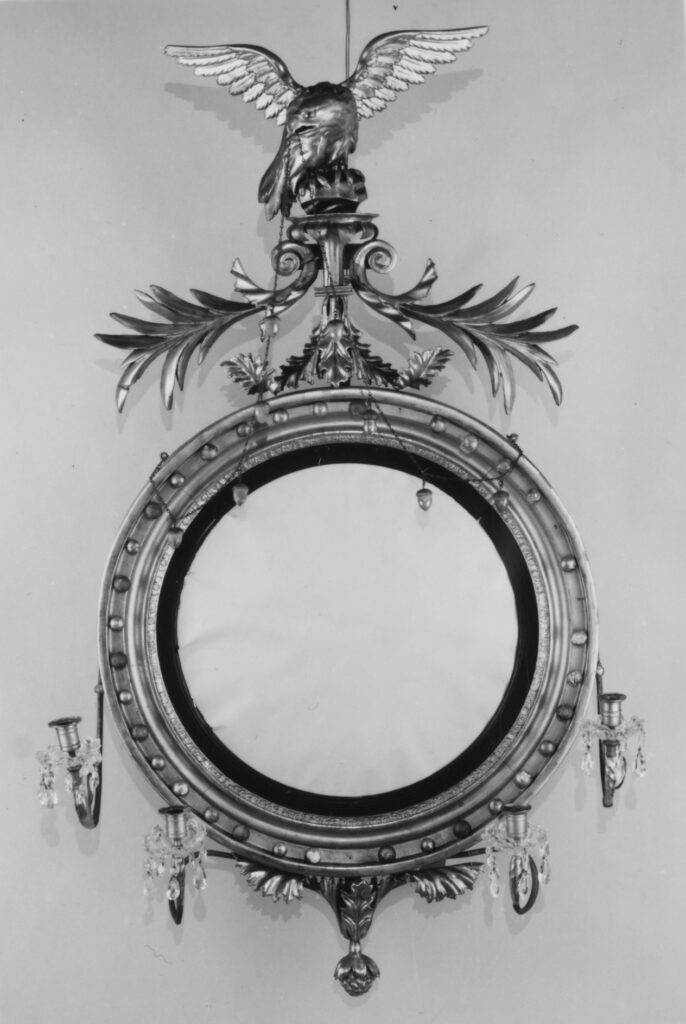
A girandole mirror is the sconce and the looking-glass in one piece. The Met’s English example of 1800 to 1820 combines a gilded frame with convex silvered glass and cut-glass branches, and the museum’s point is that the convex shape, the gilding and the cut glass all increase the throw of the light. Its American pair of 1815 to 20 was made for the Albany townhouse of Stephen Van Rensselaer IV. The Met says girandole mirrors were popular in the Federal period, often topped with eagle finials, and that the name comes from the candle arms that stand out from the frame.
After candles: gas and electricity
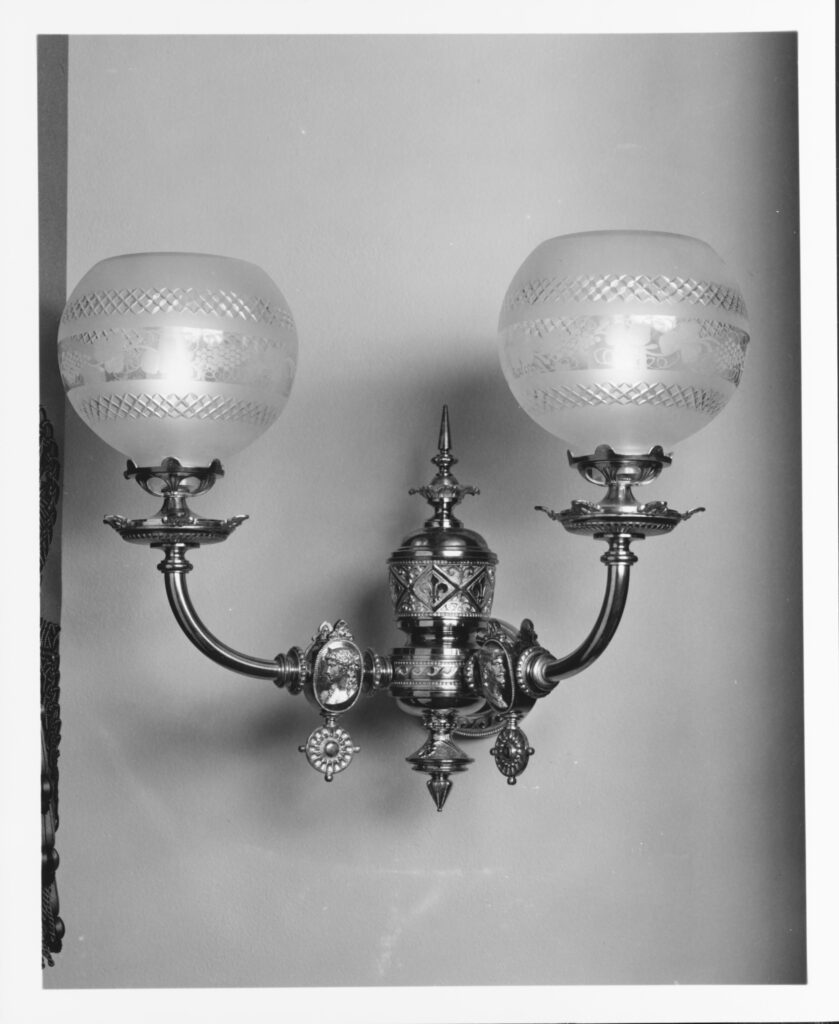
Candles were not the end of the story, and the Met’s records show the later stages. Its brass sconce attributed to Mitchell, Vance & Co. (1868 to 70) is one of four from the rear parlor of a mansion in Meriden, Connecticut, and a twelve-light chandelier came from the same room. The fixture had been fitted for gas and was electrified for use in the museum. Its Néo-Grec decoration, with stylized palmettes, fleurs-de-lis and portrait medallions above the gas keys, coordinates with the room’s suite of seating furniture, the kind of room described in the guide to Victorian decor.
A later American Wing example, a brass bracket of 1881 to 82 from the New York house that Arabella Worsham had decorated by George A. Schastey & Co., has panels inlaid with mother-of-pearl and glass shades. The museum records that it was first lit by gas and electrified later, under the Rockefeller family’s ownership. For oil lamps rather than wall fixtures, the antique lamps guide picks up the story.
What may be original, replaced or restored
The museum records above show where change usually lies in antique wall sconces. Some of it is about the set: the lily sconces are not a true pair, and Liger’s are of a kind often made in large sets, so a single sconce is probably one of several. Some is about parts: the quillwork sconces’ silver arms are in another museum, so a bracket can be separated from the piece that lit it. Some is conversion: gas and electric fittings are later than the frame they sit in. And some is surface, where a gilder’s contrast between burnished and matte areas is easily lost to cleaning or regilding.
The same records give a few anchors for dating. Shaw’s label, with its Boston address, suggests his girandoles were made after 1852, when he moved there. A decorative vocabulary such as Néo-Grec belongs to a period. A material like tin tells you almost nothing, and that is worth knowing before paying for a date.
What a buyer should examine in antique wall sconces
- Whether it is one of a set. Ask what else was sold with it, and whether the other pieces survive.
- The arms, cups and drip pans: whether they match each other in metal and wear, and whether any look newer than the backplate.
- The gilding or finish on the high points, and whether it has worn the way hands and dusting would wear it or looks suspiciously fresh.
- Glass: the silvering of a girandole mirror, and chips or replacements among cut-glass branches and shades.
- Any maker’s label, stamp or inscription, read as evidence of a date, not a guarantee of one.
- The wiring and sockets. These will be later than a candle-era or gas-era sconce, and should be checked by a qualified electrician before the fixture is switched on.
The seller’s account of each point matters as much as the object, and the questions are the same ones set out in the buying guide. A seller who can say which parts are original, which were replaced and when the wiring was done is telling you more than the label on the listing.
Sources
- Merriam-Webster, “sconce” and “girandole”.
- The Metropolitan Museum of Art, pair of three-light sconces (bras de lumière), French, about 1775 (1973.315.10, .11).
- The Metropolitan Museum of Art, pair of sconces by Isaac Liger, 1709 to 10 (68.141.218, .219); pair of wall sconces, British, about 1730 (1974.28.65, .66); wall sconce, tin, 1700 to 1730 (33.114.1).
- The Metropolitan Museum of Art, quillwork sconce (52.195.19); girandole, English, 1800 to 1820 (66.108.3); girandole, American, 1815 to 20 (1974.363.2); girandole by William F. Shaw (1983.97.1).
- The Metropolitan Museum of Art, sconce attributed to Mitchell, Vance & Co. (68.143.15); sconce, possibly by George A. Schastey & Co. (2009.226.14.1).