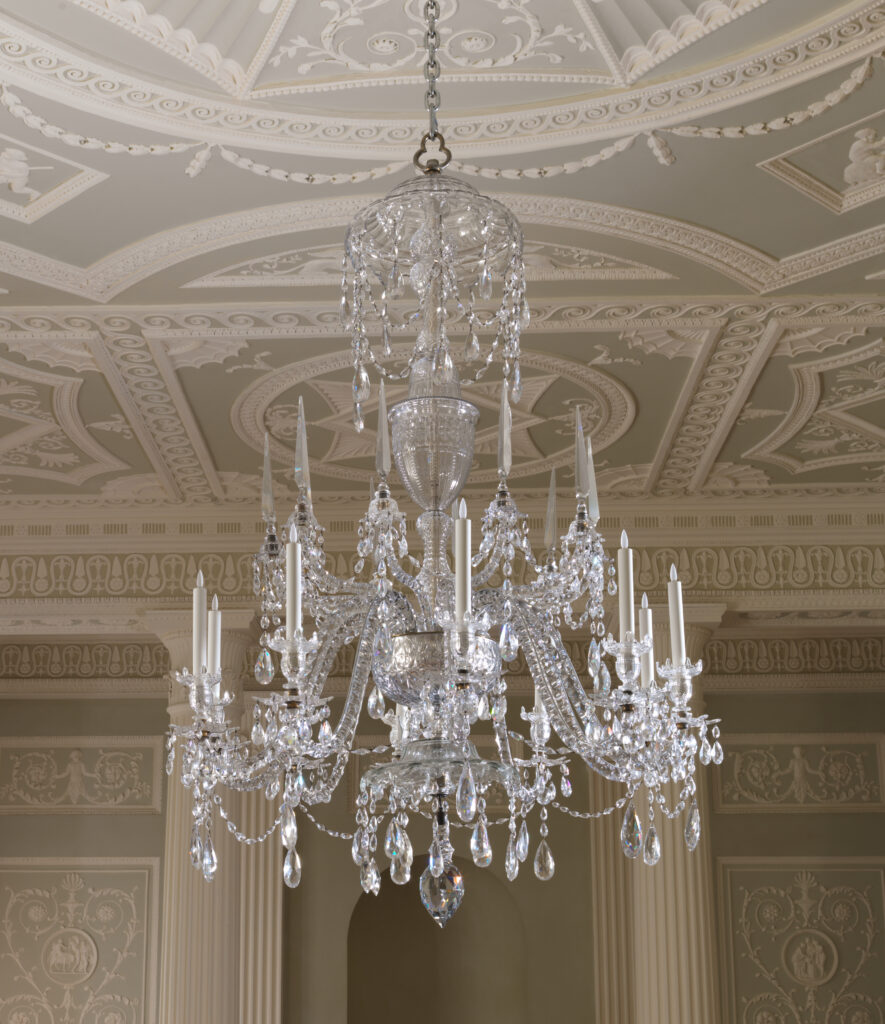
The Metropolitan Museum of Art catalogues a cut-glass chandelier made about 1787 for Somerford Park in Cheshire as probably Irish or possibly British. Its own note says the piece is said to be of Irish origin, then adds that it is not at all improbable that it was made in England. A museum with the object in hand will hedge about where a chandelier was made. A buyer is usually asked to be more certain.
A chandelier, in Merriam-Webster’s words, is a branched, often ornate lighting fixture suspended from a ceiling. That covers an iron crown of candles, a gilded-wood showpiece, a cascade of cut glass and a gas fixture from a Victorian parlor, and many surviving examples have been altered since they were made. Three questions sort one out: what is it made of, which period is its form from, and what has changed since.
Reading the form
The Met’s description of the 1787 chandelier doubles as a parts list. A central shaft is concealed by a series of vase- and baluster-shaped enlargements, with canopies at the top and bottom. Ten large arms carry the candles, and ten smaller arms, purely decorative, end in slender obelisks. All the arms have concave prismatic cutting, strings of crystals of various sizes hang between them, and a large crystal drop sits at the base of the shaft.
Britannica traces how that form changed in England. The earliest glass chandeliers, from the 1720s, were plain, with a heavy ball at the base of the shaft, like the brass chandeliers of the time. Pendants and cutting followed. In the 1770s the ball gave way to an urn, pear drops hung from the branches and glass spires took the place of candles in the upper tiers. Later came icicles around the shaft and long cascades of pear drops. The shape of the shaft, the base and the drops are therefore clues to a date, even if the Met’s note shows how often the place of origin stays open.
Periods and materials
LAPADA, the trade association of art and antiques dealers, describes wooden beginnings in its guide to antique chandeliers, then iron and brass with crown rings and tiers, and polished brass or silver chandeliers with baluster stems and large spherical globes that appeared around the lower Rhine in the 15th century. From the late 16th century, it says, chandeliers were dressed with rock crystal, a transparent form of quartz. The Corning Museum of Glass adds that before the 18th century most chandeliers were made of metal, with rock crystal for sparkle.
Glass then took over the sparkle. LAPADA says imitation of rock crystal in glass began in Venice in the 15th century, and that George Ravenscroft’s lead crystal of 1676 was easily cut, highly refractive and even more transparent than rock crystal. The Corning Museum notes that glass chandeliers were made in France, Bohemia, Venice and England in the 18th century. Britannica adds that Venetian chandeliers were made of varicolored glass with floral ornament, and that porcelain chandeliers were produced at the larger European factories but are so fragile that few have survived.
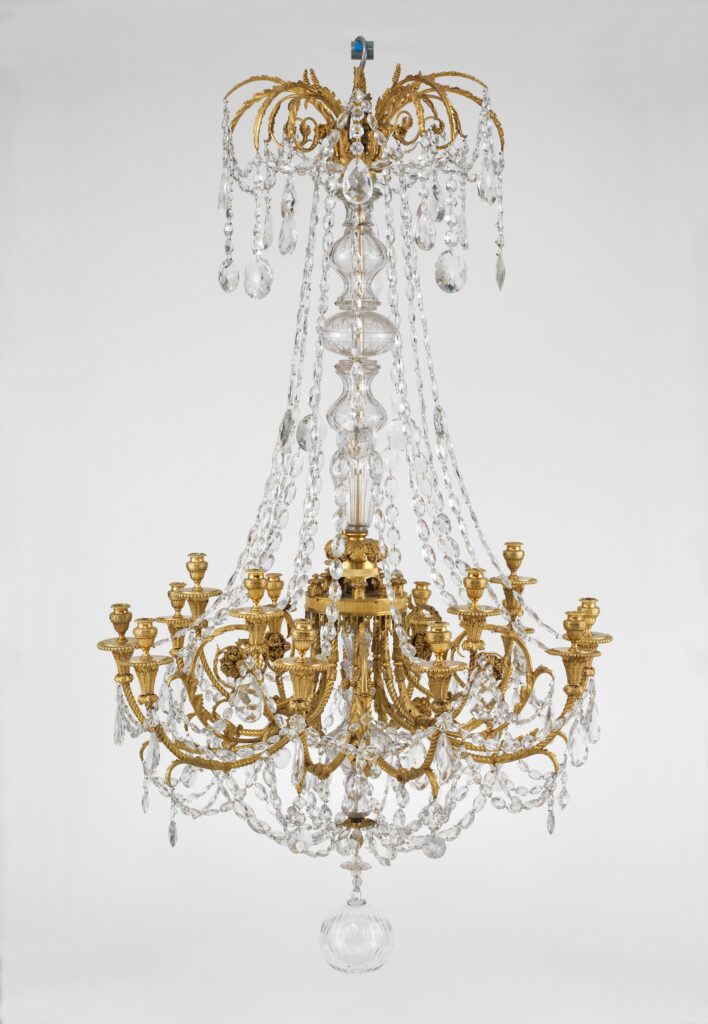
Metal never went away. Britannica says some of the finest 18th-century French chandeliers were made of ormolu, the richest of them cast and chased in bronze with Rococo designs, and the Met’s French chandelier of about 1790 in gilt bronze and Bohemian glass shows the two materials used together. The metalwork is explained in the guide to ormolu and gilt bronze, and the taste of the same years in the notes on Louis XVI furniture.
Wood is the surprise. The Met’s chandelier attributed to John Gumley and James Moore, about 1710 to 15, is gilded wood and gesso with gilded metal mounts, made in the French arabesque manner as one of a pair for the State Apartments at Holme Lacy in Herefordshire.

Venetian and Murano glass, French bronze and Victorian gas fittings are each large enough to deserve their own guides, and table and floor lamps, which share part of this history, are a related but separate subject. The best-known of those lamps is covered in the guide to Tiffany lamps.
Glass, crystal and the words
The trade word crystal does not mean rock crystal. LAPADA describes the glassmakers’ crystal as glass combined with potassium, silicon, manganese and lead oxide, heated to between 1200 and 1500 degrees. Cut is another word to check. Britannica says the mitre cut predominates in older cut glass, and that the diamond pattern prevailed on the chandeliers made by English and Irish glasshouses in the early 18th century. From the middle of the 19th century, pressed glass closely resembled cut glass at low cost, and today much cut glass is partly molded and finished at the wheel. Whether facets were cut or molded is one of the first things to look at, and telling them apart by eye is a job for a specialist.
Names do less than they seem to. Britannica says Baccarat was acquired by a Belgian lead-crystal manufacturer in 1817 and has specialized in lead crystal since, which makes it a name worth knowing and not a date. The label Maria Theresa is more elusive. Search results for it are mostly manufacturers’ product pages and retailers’ listings that describe an ornate cut-crystal style, so it is best treated as a retail label, not as evidence of age.
Candle, gas and electricity
Many chandeliers have been converted, and the conversion is part of the history. Merriam-Webster defines a gasolier as a gaslight chandelier and dates the word to 1849. The Met’s glass and brass gas chandelier of about 1850 was designed, probably, by Henry N. Hooper and Company, with the glass attributed to the Boston and Sandwich Glass Company. The Met’s twelve-light brass chandelier of 1868 to 70, attributed to Mitchell, Vance and Company for a mansion in Meriden, Connecticut, was previously outfitted for gas lighting, the Met says, and has been electrified for use in the Museum. A seller can reasonably be asked what the fixture was made to burn, what it burns now and who made the change.
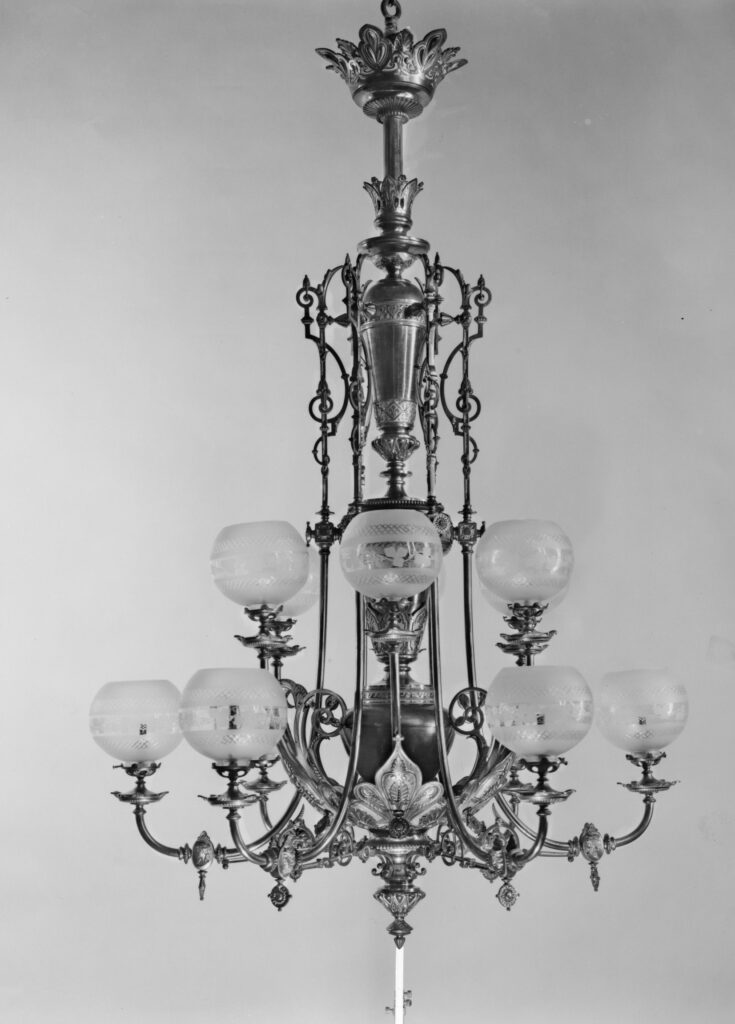
Copies, revivals and replaced parts
LAPADA makes the central point for buyers: chandeliers of 18th- and 19th-century design are still manufactured, so authenticity and age need to be established. It lists the quality of the glass, the weight and quality of the casting, and whether the gilding or the drops are original as factors to consider, and it recommends professional advice and a dealer who belongs to a recognised trade association. LAPADA is itself an association of dealers, so that advice also serves its members. The checks stand either way.
A revival is a second trap. LAPADA says French bronze designs of the 17th and 18th centuries were often revisited in the 19th century and produced to a very high standard, so a revival piece can be a genuine antique of its own period without being a period piece of the style it follows. Search results for the term also include sellers of chandeliers described as authentically reproduced and as antique-inspired, next to dealers, so the wording of a listing matters.
Condition: what to check, and what the room needs
A chandelier is a structure as well as an ornament. The Corning Museum of Glass recounts that several large glass arms fell from Jonathan Collet’s five chandeliers for the ballroom of the Assembly Rooms in Bath shortly after installation, and that they were replaced. Arms and their joins are therefore the first place to look. After that:
- The drops: are they complete, of matching glass and original to the piece? LAPADA treats originality of the drops as a factor in authenticity.
- The metal: the weight and quality of the casting, and whether the gilding is original or has been refreshed.
- The wiring and fittings: have them checked by a qualified electrician before the fixture is used, whatever its age.
- The fixing: a chandelier is heavy, and the ceiling and the fixing need to carry it.
Then there is the room. LAPADA says one of the most common mistakes is a chandelier too small for its space, which can look like a token gesture toward grandeur. Ceiling height and head clearance are practical limits, and simple neoclassical chandeliers can feel lighter and smaller than rococo or Gothic ones of the same dimensions. And a chandelier is rarely the only light in a room: how photographers light a room covers the lower levels.
Where to look
LAPADA’s own dealer listings include firms that specialize in antique chandeliers and in restoring antique lighting, and specialist dealers are a natural place to start when the question is what has been replaced. Architectural salvage sellers and online marketplaces also appear in search results for the term, and chandeliers turn up at auction. There, the wording of the lot matters more than the photograph, and a guide to reading an auction catalogue covers it. The checks that apply to any old piece, from condition to what a repair should cost, are in the buying guide.
Even sound old chandeliers rarely stay as they were made. The Corning Museum of Glass notes that William Parker’s chandeliers in the Assembly Rooms at Bath, which replaced Collet’s, still hang there, now lit by electricity instead of candles.
Sources
- LAPADA, Guide to Antique Chandeliers
- Encyclopaedia Britannica, Candlestick: the 18th century, Cut glass and Baccarat glass
- The Corning Museum of Glass, Do you have information about early glass chandeliers?
- Merriam-Webster, chandelier and gasolier
- The Metropolitan Museum of Art collection records: Chandelier (29.112.1), Fifteen-light chandelier (1971.206.42), Chandelier (1995.141), Gas Chandelier (1970.196) and Chandelier (68.143.5)