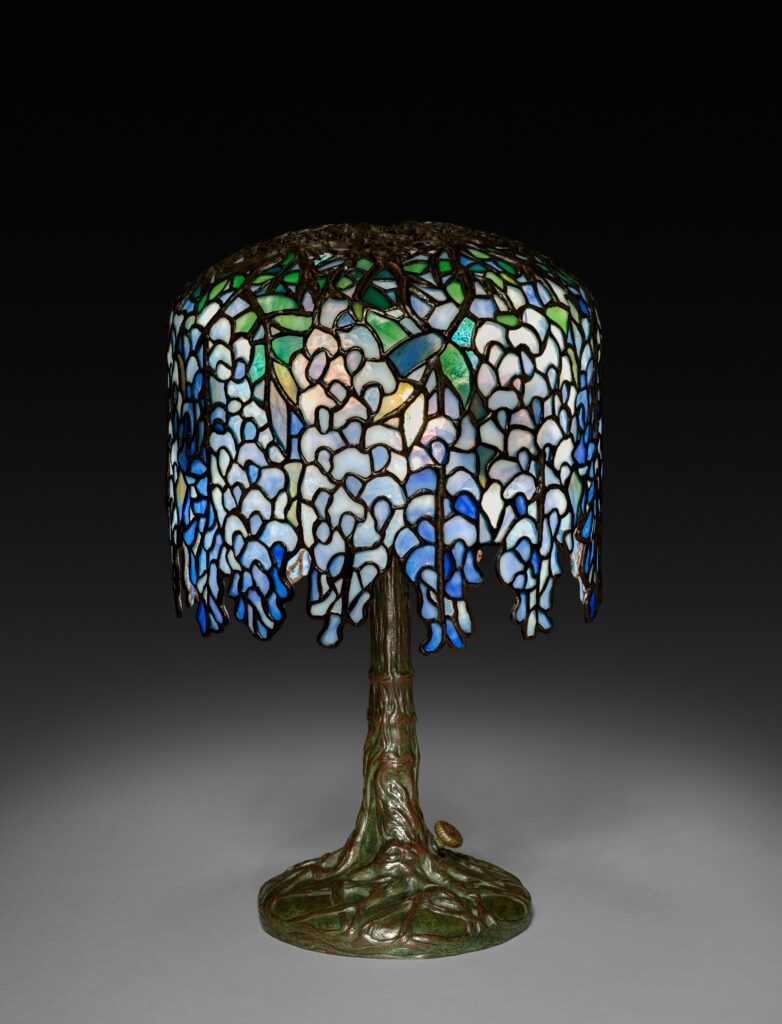
A Tiffany lamp, as museums and auction houses use the term, is a lamp made by Tiffany Studios, the New York firm of Louis Comfort Tiffany: usually a cast-bronze base carrying a shade built from many small pieces of colored glass, made in the early years of the twentieth century. The Cleveland Museum of Art catalogues its Wisteria lamp, designed by Clara Wolcott Driscoll, as made about 1902 to 10, with the base impressed TIFFANY STUDIOS/NEW YORK/7002.
Search results for it are mostly shops selling Tiffany-style lamps, a phrase that describes a look and says nothing about age. The firm’s own records were destroyed after it closed in the early 1930s, according to the National Gallery of Victoria, so there is no ledger to check a lamp against. A lamp has to be read from the object.
Who made a Tiffany lamp
Louis Comfort Tiffany (1848 to 1933) was the son of Charles Lewis Tiffany, who founded the jewelry house Tiffany & Co., and the two should not be confused. Christie’s specialists make the point themselves, and it matters in practice, because an eBay category that turns up in the search results is titled Tiffany & Co. glass lamps. Louis began as a painter, moved into interiors and then glass, and, the Met’s essay says, built a glasshouse at Corona, Queens, by late 1892 or early 1893. The blown glass from its furnaces he called Favrile, a trademark meant to signal hand-made work.
The Met’s essay says Tiffany and his studios turned to lighting in 1898. Britannica places his move into lamps after the firm was reorganized in 1900. The Met’s object record dates a lamp to about 1895 to 98 and calls it among the earliest the studios produced, made before the floral leaded shades that the firm is known for. Cleveland dates most of the leaded lamps in its group between about 1902 and 1913. The Cleveland Museum of Art credits the firm as the Tiffany Glass & Decorating Company from 1892 to 1902 and as Tiffany Studios from 1902 to 1932, and one small Cleveland lamp is stamped with both names.
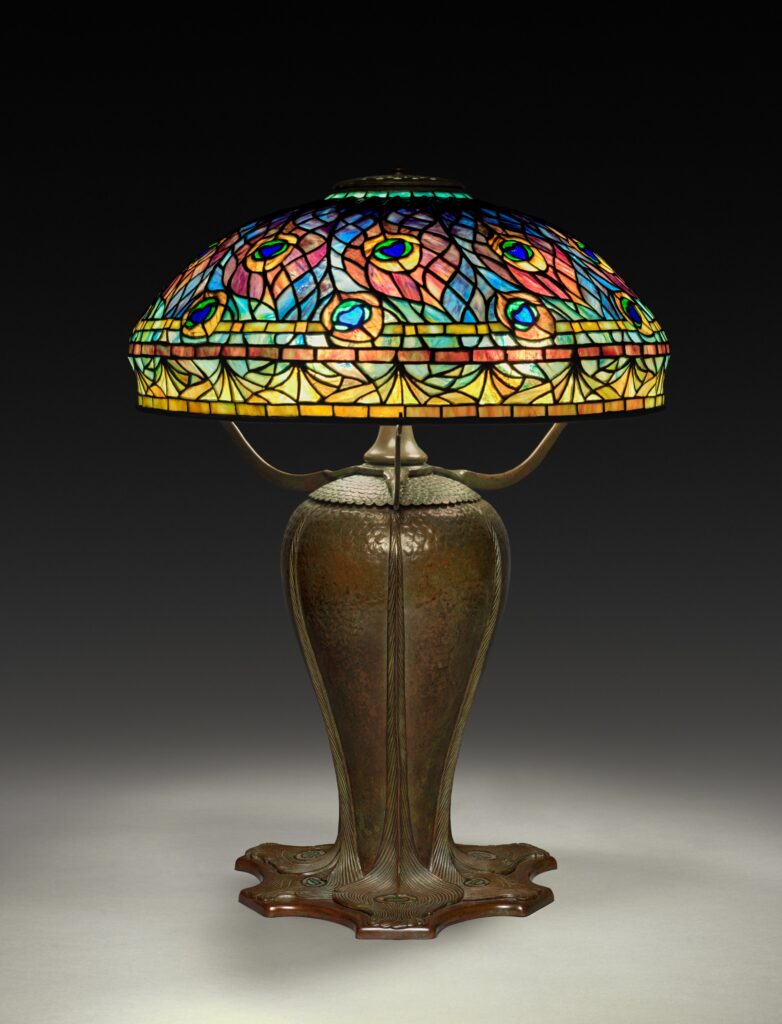
The designer behind many of the best-known models was not Tiffany. Letters discovered in the early 2000s by the scholars Martin Eidelberg, Nina Gray and Margaret Hofer showed that Clara Driscoll (1861 to 1944) was one of the studio’s key designers and was responsible for around thirty lamps, among them the Wisteria, Dragonfly and Peony. She also ran the Women’s Glass Cutting department, which employed up to fifty women, the NGV reports. Tiffany himself, it says, appears to have rarely taken part in the first design work, though he kept a close watch on the results. Cleveland credits Driscoll with its Wisteria and Peacock lamps.
Reading the form: shades, bases and models
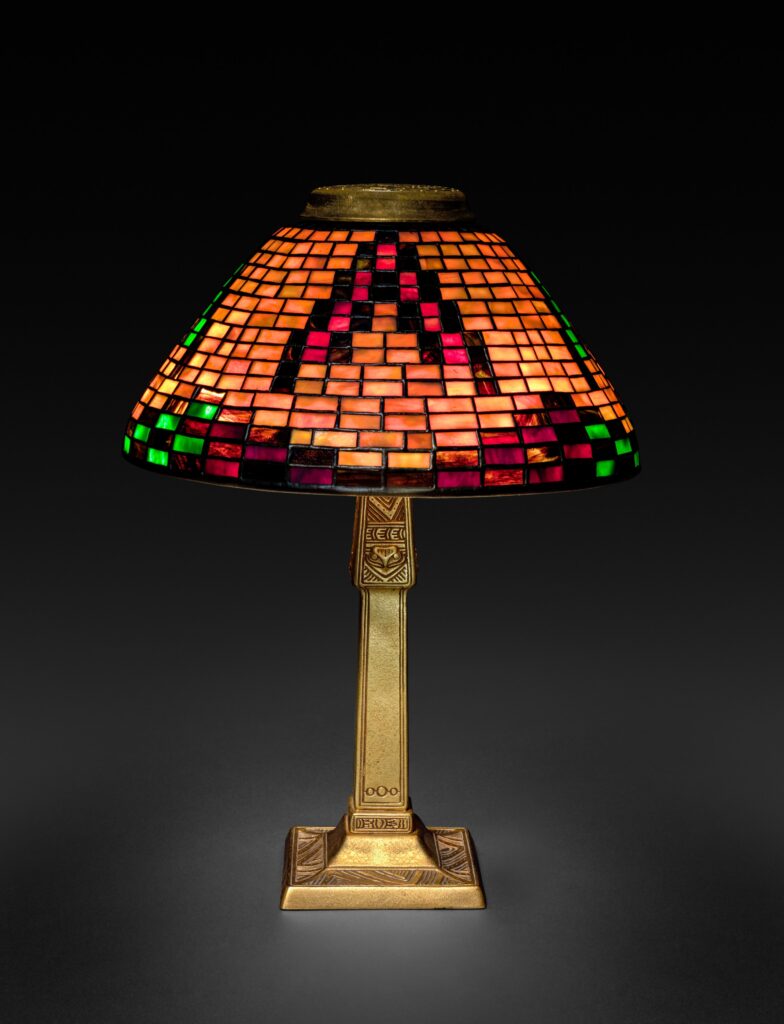
A Tiffany lamp came in two parts, a base and a shade, the NGV notes, and the base was usually bronze. The shade was built from a pattern, but the glass was chosen piece by piece, so the Met describes each shade as unique even where a pattern repeated. The patterns divide roughly into natural and geometric. At Cleveland, the Wisteria lamp’s base rises as a trunk and branches into the vine that holds the shade, while its note on the Indian Basket lamp says Tiffany re-created the geometric grids of Native American basket weavers. Cleveland’s text for the Bamboo and Daffodil lamps adds that Driscoll’s team of women designers made the floral and leafy patterns, and the NGV says the geometric designs were given to men.
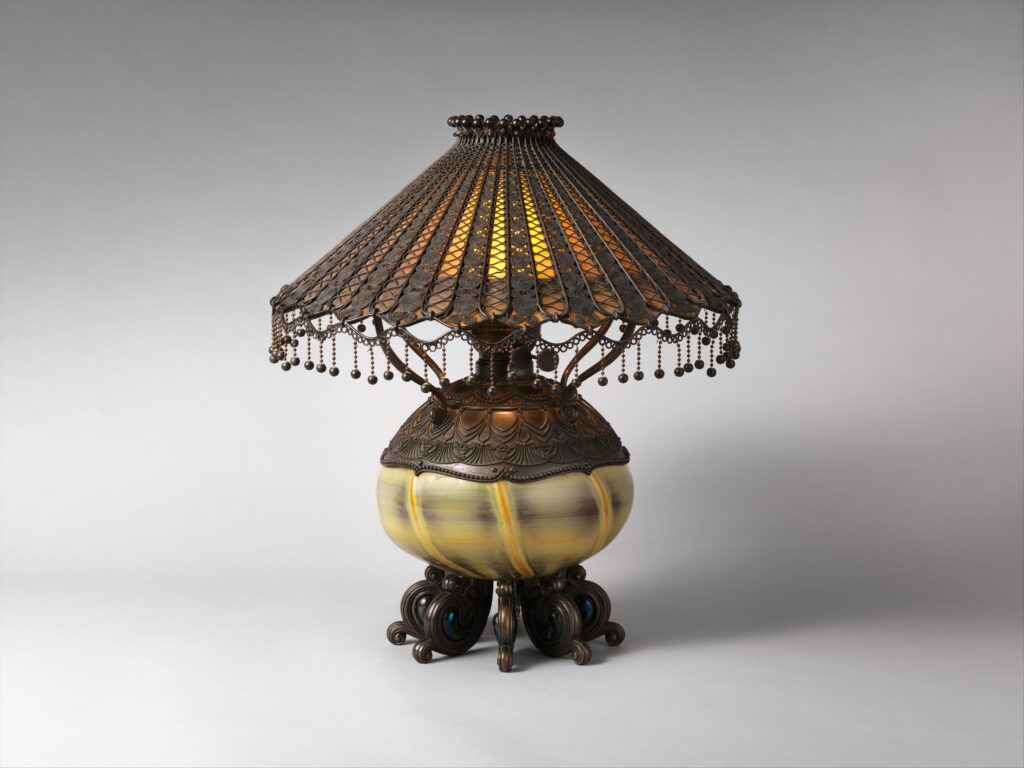
Not every Tiffany lamp is a dome. The early Met lamp above has a conical shade and a blown Favrile glass oil font, with a bronze collar the Met describes as Islamic-inspired. Cleveland shows the other end of the range: small desk lamps such as its Turtleback and Nautilus lamps, which belong to the fancy goods the firm expanded into by 1900 as smaller and more affordable luxuries. There are historical styles too. Cleveland’s note on its Empire lamp, with abstracted neoclassical swags and medallions, says Tiffany kept historical styles in his showrooms because many customers favored them.
Lamps that hang from the ceiling belong to a longer history, which the guide to antique chandeliers follows from candle crowns to gas and electric conversions. Cleveland’s Peacock lamp still has its original kerosene burning apparatus as well as an electric bulb armature, because, the museum explains, most households were not yet wired for electricity and Tiffany designed his lamps with both before moving to all-electric designs. A lamp with both fittings is therefore not necessarily altered.
Glass, copper foil and bronze
The Met’s essay explains what made the glass different. Traditional stained glass used flat panes with details painted on and fired. Tiffany and his rival John La Farge each patented an opalescent glass by 1881, and Tiffany’s Favrile glass was colored through with varied shades, so that tonal gradations, lines and textures came from the material and not from paint. A practical consequence follows, which is an inference and not the Met’s claim: the variation in a shade should come from the glass itself, so a color that looks applied to the surface is worth a question.
The NGV describes how shades were made, quoting Driscoll’s letters. Her department drew a design, modeled it in clay and plaster, and built a wooden prototype on which pieces of colored glass were cut and placed. Pieces were wrapped in copper foil and set against the cartoon, then fastened together with metal and given a copper plating in an electric bath. The NGV’s own Wisteria lamp has about two thousand individually cut pieces. Christie’s specialists, describing how they examine a lamp, name the leading, the patina, the pattern, the casting of the bronze base and the type and quality of the glass, which they call the most important of all.
Most bases were cast in bronze at Tiffany’s foundry in Queens, Christie’s says, while some were enameled or made of mosaic. The base can be as important as the shade, and the two are not always married. Christie’s notes that bases can be interchanged between shades, that a good hybrid should not compromise the design, and that some models demand a particular partner: a Wisteria shade belongs on the Tree base, while many Dragonfly shades sit comfortably on several.
Marks and numbers
The clearest evidence about marks comes from museum catalogue records, which note them as seen. Cleveland’s records describe the shade of its Indian Basket lamp as marked inside the bottom rim, Tiffany Studios New York 1586, and the base as stamped underneath, Tiffany Studios New York 536. The Spider and Web lamp is marked on the shade with the same wording and 1424 and on the base with 337. The Bamboo lamp’s shade reads 1443-14 and its base 480. In each case the shade and the base carry their own number, and the museum does not explain what the numbers stand for.
The same group shows variations. The Wisteria record lists only the base impression. The Turtleback reading lamp is stamped TGD Co, Tiffany Studios and a number, which carries the firm’s change of name on the object. The shades of Cleveland’s lily lamp (2018.285) are etched L.C.T., initials that Britannica says appear on some Favrile pieces, along with L.C. Tiffany. And the Peacock and Empire records list no inscription at all. That may only reflect how the record was written, but it is a reminder that a missing mark is a question to ask and not a verdict.
Marks are also easy to overrate. Christie’s says that a lamp marked Tiffany Studios is no guarantee of originality, and that fakes of varying quality exist. A shade and a base can each be right and still not belong together.
Real, later or Tiffany-style
A lamp sold under the name can be one of three things. It can be a lamp made by Tiffany Studios. It can be a copy or a close relation: Christie’s says the firm’s rivals made similar designs, and that reproductions become more common from the 1970s. Or it can be a new lamp sold as Tiffany-style, which is a retail description of a look and not a claim of age.
Christie’s is candid that it can be very hard to tell a good fake from an original, that some reproductions are easy to spot and that often a trained eye is needed. Short of a specialist, a buyer can at least ask these questions:
- Do the shade and the base belong together? The pairing is a design decision, and a published reference or a specialist can say whether a model was made in that combination.
- What do the marks say, where are they, and are they on both parts? Several of Cleveland’s records list a mark inside the shade’s rim and a separate stamp under the base, though not every record lists both, and Christie’s cautions that the name alone proves nothing.
- Does the color live in the glass? The Met’s account of Favrile glass makes this a reasonable first look, and Christie’s calls the glass the most important factor.
- Is the shade built as the NGV describes, from many individually cut pieces joined together, and does the bronze base show the casting quality a specialist expects?
- Is there any sign of repair or replacement? Christie’s says to look, and warns that good restoration can be hard to see.
None of this authenticates a lamp; it sorts the questions for someone who can answer them.
Condition, restoration and wiring
A lamp of about a century cannot be expected to be perfect, Christie’s says. A few cracks are typically acceptable, and a fallen shade or missing glass is more serious. Restoration is worth looking for, since older repairs are less neat than recent ones, and good restoration may not affect value, though the more original parts a lamp keeps the better. Rewiring is acceptable, Christie’s says, if it is done sensitively, with care for the original patina on the base and the choice of new sockets.
Safety is a separate matter from collecting. Old wiring that has not been checked is a job for a qualified electrician before the lamp is used, however rare the lamp. Costs of repair can change what a good price is, and the buying guide explains what repairs cost.
What the prices say, and what they do not
Christie’s gives sale facts that explain the lamp’s reputation. A Pond Lily lamp of about 1903, one of only fourteen thought to exist, sold for $3,372,500 in New York in 2018, from a model Christie’s says retailed at $400 when new. The Pink Lotus lamp reached $2.8 million at Christie’s in 1997. At the other end, Christie’s says more common leaded glass models can be found from around $5,000 for an attractive geometric lamp.
Those are auction results for lamps that specialists had examined, and they are not a valuation of a lamp with the name on it. They do suggest one conclusion. On Christie’s figures, a lamp described as a Tiffany that is offered for a small fraction of even the lowest of them is much more likely to be a Tiffany-style lamp than a bargain, and the name in the listing does not change that.
Where to look
The firm’s lamps are at home with specialist auction departments, and Christie’s guide is written by the department that sells them. Dealers who attribute a lamp in writing, and say what has been replaced, are the other route. The museum records cited here are free to read and worth using before any purchase, since the Cleveland and Met records give dimensions and materials, and Cleveland’s list the inscriptions too. Reading an auction listing well is its own skill, covered in how to read an auction catalogue.
The name Tiffany belongs to a larger movement. The firm’s naturalistic glass stands in the Art Nouveau tradition, and Britannica says Tiffany was overwhelmed by Émile Gallé’s glass at the Paris exposition of 1889; the French side of the style is covered in the guide to French furniture styles.
Sources
- Christie’s, Collecting guide: 10 things to know about Tiffany lamps
- The Metropolitan Museum of Art, Louis Comfort Tiffany (1848 to 1933) and the collection record for the Tiffany Studios table lamp (2011.99.2)
- The Cleveland Museum of Art Open Access collection records for lamps 2018.261, 2018.262, 2018.263, 2018.264, 2018.265, 2018.276, 2018.277, 2018.281, 2018.282, 2018.285, 2018.287 and 1997.298, at clevelandart.org
- National Gallery of Victoria, Tiffany Studio: Clara Driscoll
- Encyclopaedia Britannica, Louis Comfort Tiffany