Someone, in the spring of 1782, had to keep the candles going at Versailles. The baronne d’Oberkirch, describing a concert for the visiting Grand Duke Paul of Russia, remembered a palace “brilliantly illuminated”, with a thousand chandeliers hanging from the ceilings. The Metropolitan Museum quotes her on one of its own, which is a fair introduction to the French chandelier: a piece of furniture meant to be looked at while it did its work, and one that needed constant attention to keep doing it.
A French chandelier is not one object. Over the eighteenth century it was a bronze casting, a frame hung with crystal, a metal tree in flower and, near the end, a vase hung from chains. The differences matter to anyone buying one, because each type fails in its own way. This guide follows the main types through museum examples and ends with what a seller should be able to tell you. For chandeliers in general, glass and metal terms included, the guide to antique chandeliers comes first.
Bronze, gilded and heavy
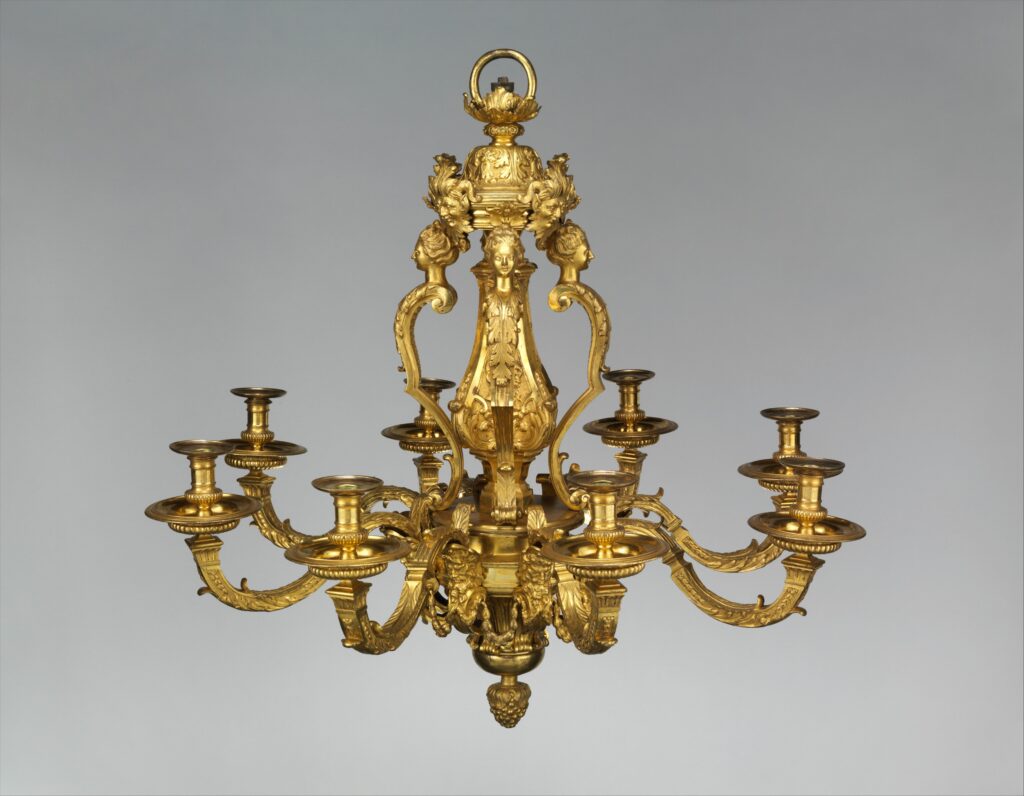
The earliest chandeliers in this guide are bronze, and the Met’s eight-light chandelier of about 1710 is a good one to start with. It is richly ornamented with satyr masks and female busts, and the museum says this type has often been associated with André-Charles Boulle, though it only gives it as “possibly” his. Boulle was made cabinetmaker and sculptor to Louis XIV in 1672 and worked in gilt bronze as well as the tortoiseshell and brass he is known for. Several of his chandelier designs are known, the Met adds, but none matches this model exactly. “Possibly” is the word to keep.
The Britannica entry on candlesticks says the finest eighteenth-century French chandeliers were among the best work in ormolu, with mid-century examples cast and chased in bronze to Rococo designs. How the gilding was done, and what the word covers, is in the guide to ormolu and gilt bronze.
A tree of porcelain flowers
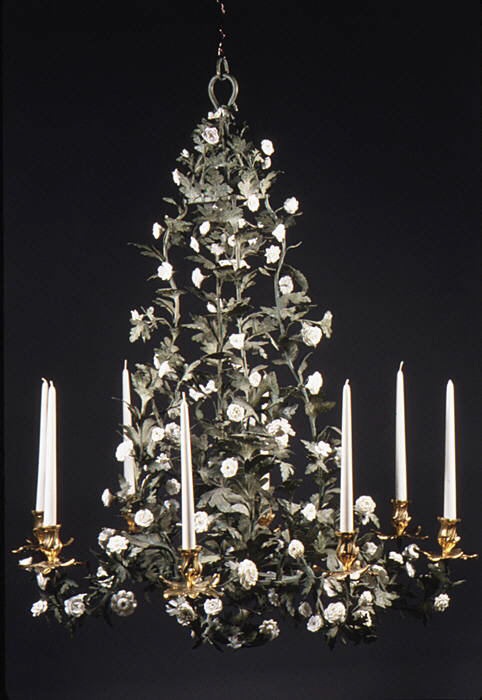
One of the Met’s more surprising chandeliers looks like a small tree. Its leaves are painted iron, and its flowers are white soft-paste porcelain, possibly from the Vincennes manufactory, with candles held in gilt-bronze sockets. It is documented in the audience chamber at Schloss Seehof, which was furnished in 1767 and 1768 for the Prince Bishop Adam Friedrich von Seinsheim with seat furniture made locally in the French fashion, and the museum thinks the porcelain flowers were bought in France at the time.
The catalogue entry describes it as probably German, assembled with French porcelain, and says some of the flowers are missing. That is worth keeping in mind next time a chandelier is called French on the strength of its look. A French fashion could be built abroad from French parts, and any piece that has lost its flowers has also lost the evidence that it was meant to carry them.
Late eighteenth-century restraint
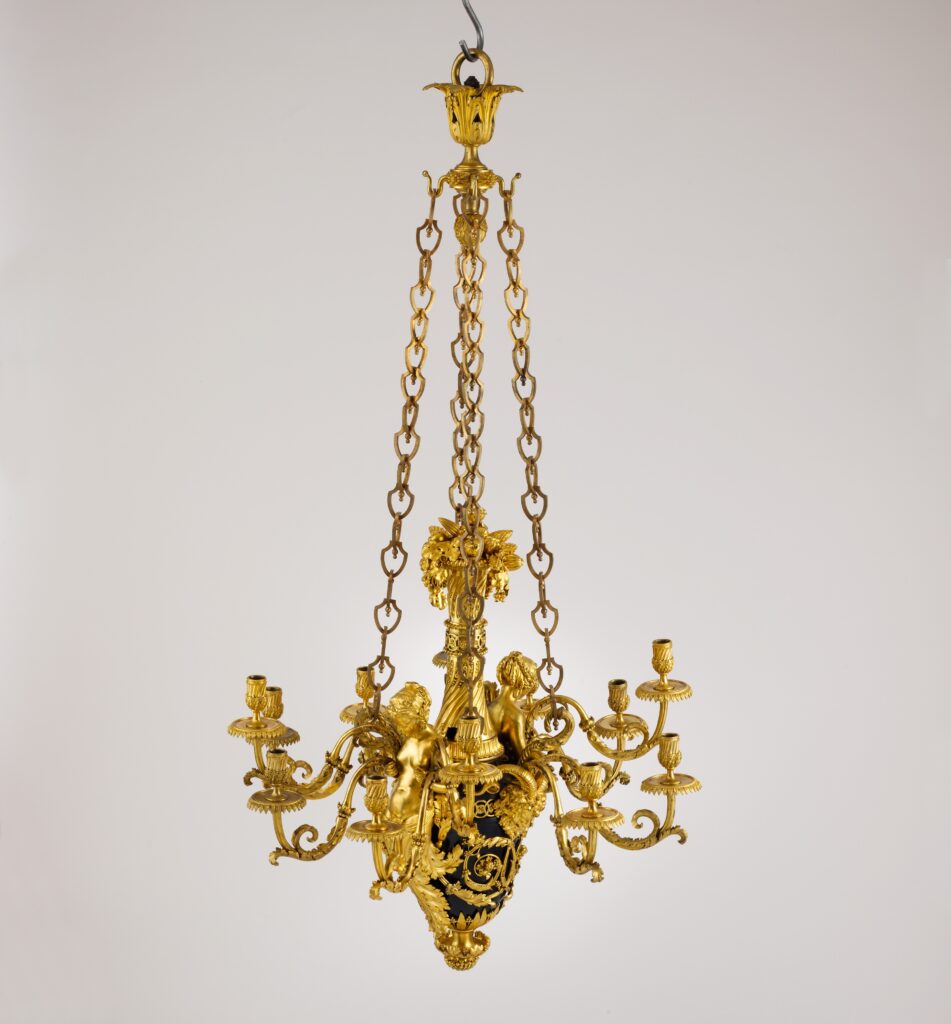
By the 1780s the bronze chandelier had lost some of its weight. The Met’s nine-light chandelier of about 1785 has a vase-shaped body of patinated bronze, a fluted neck of gilt bronze and nine S-shaped branches with acanthus scrolls, hung from gilt-bronze chains. The museum points to the contrast between dark metal and gilding as the kind of effect late eighteenth-century taste preferred. The museum adds that the number of candles lit signaled the owner’s wealth, since beeswax burned cleaner and smelled better than tallow but cost more.
A related twelve-light chandelier at the Met, attributed to Rémond and dated about 1785, sets two pairs of S-shaped branches on female half-figures that grow out of acanthus leaves, with extra branches springing from the horns of two satyr masks, and a vase of varnished copper alloy topped with fruit. Rémond is recorded as working for the dealer Dominique Daguerre and for the comte d’Artois and Marie-Antoinette. The museum notes that several variants of the model are known, and that a closely related chandelier is in the Musée Nissim de Camondo in Paris.
For this style of furniture and decoration, the Louis XVI furniture guide has the wider picture; the Rococo chandeliers that came before are in the Louis XV guide.
Crystal, and the dealer who took it apart
The grandest chandeliers pair gilt bronze with crystal, and the Met’s pair of twenty-four-light chandeliers of about 1790 is a clear example, made of gilt bronze and rock crystal, with three tiers of rope-twisted and scrolling branches and drops and balls falling from the arms. It is also the most useful record to read before buying, because of one detail. The marchand-mercier Lazare Duvaux, whose account book for 1748 to 1758 survives, did not only sell and install chandeliers. He took them apart for cleaning and repair, reassembled them, and supplied crystal drops, finials and globes to replace those that were missing or broken.
The Met suggests that this practice may explain why the late eighteenth-century frames of these chandeliers include earlier crystal pendants. Replaced drops, then, are not a modern sin: a chandelier of this kind may carry a service history inside it, and the useful question is which parts are original, which are old replacements and which are recent.
When French means in the French taste
LAPADA, the dealers’ trade association, warns that chandeliers of eighteenth and nineteenth-century design are still made today, so authenticity and age need checking, and its guide adds that French bronze chandeliers were often revisited in the nineteenth century. Both points are practical. A bronze chandelier of eighteenth-century design may be a nineteenth-century revival, which is a legitimate object with its own history, and one sold as earlier is a different matter.
What makes a French chandelier antique? Age, replaced parts and later copies
How old is an antique French chandelier?
Museum examples give fixed points. The Met dates a twelve-light chandelier attributed to Pierre Rémond to about 1785 (Met 1972.242) and a pair of twenty-four-light chandeliers to about 1790 (Met 1971.206.40), the years of Louis XVI taste. Note the wording on the first: it is an attribution, which the museum bases on similarities with documented work, and several variants of the model are known. A maker and a date on a label can be a judgment as well as a fact, so ask what they rest on.
Are replaced parts a sign of a later copy?
Not by themselves. The Met says the dealer Lazare Duvaux, in an account book for 1748 to 58, sold, installed, took apart and repaired chandeliers, and supplied crystal drops, finials and globes to replace missing or broken ones. The museum suggests this may explain why the late eighteenth-century frames of the pair carry earlier crystal pendants. Crystal older or newer than its frame can therefore belong to a chandelier’s working life. These records describe period pieces, so the checks for telling them from later copies stay in the section below.
Before you buy a French chandelier
Ask what has been replaced. Drops, finials and globes are what Duvaux supplied to make up losses, and a seller should say what is known of the piece’s history, even if the honest answer is that little is. LAPADA lists the weight and quality of the casting and whether the gilding or the drops are original as the things to examine, and recommends buying from a dealer who belongs to a recognized trade association. The wider timeline is set out in the guide to French furniture styles.
Measure the room as well as the chandelier. LAPADA notes that a chandelier too small for its room is a common mistake, and that a simple neoclassical design can look lighter than a heavier Rococo one of the same size. The Met’s crystal pair is 62 inches tall and the Rémond 55, which is a good deal of ceiling. Wiring is a separate question. A candle chandelier can be converted, and the converted wiring is the part to have checked by a qualified electrician whatever the age of the bronze. The general points on condition, repairs and price are in the buying vintage furniture guide.
Sources
- The Metropolitan Museum of Art collection records: Eight-light chandelier, possibly by Boulle (2013.238.2), Eight-light chandelier (1974.356.150), Nine-light chandelier (1977.83), Twelve-light chandelier, attributed to Rémond (1972.242) and Twenty-four-light chandelier (1971.206.40)
- Encyclopaedia Britannica, Candlestick
- LAPADA, Guide to Antique Chandeliers