An antique French armoire can be a courtly parade cabinet or a chapel’s cupboard for vestments. The Metropolitan Museum’s armoire of about 1710 to 20 came from the sacristy of the chapel of the Château de Bercy, where it may have contained liturgical vestments. It stands 118 1/2 inches, about 3 meters, tall.
Britannica defines an armoire as a large two-door cupboard, usually movable and containing shelves, hanging space and sometimes drawers, and says it was originally used for storing arms. The same word covers a Louis XIV showpiece, an eighteenth-century carved oak wardrobe and, in American listings, freestanding wardrobes of any age, which is why a seller’s “French” and “antique” need support.

From arms cupboard to parade piece
Britannica says the word was probably first used in the 16th century, when detailed carving based on Flemish design marked the finer examples, and that in the 17th century geometric designs in high relief became more common and the name was extended to wardrobes and clothespresses. By the end of that century the form had reached the court. The Met’s record for its Boulle cabinet notes that in 1688 Auburtin Gaudron delivered a large cabinet for Louis XIV’s apartment at Marly, and calls such armoires, closed cabinets or wardrobes, “ostentatious parade objects” meant to stand grandly in a public room.
Boulle was not the only maker, the Met says, but his workshop is distinguished by sculptural details of unusual quality on the carcase. The record is also candid about economies. The expensive ebony gives way to ebonized fruitwood in the top quarter, above eye level, the insides of the doors are veneered with local burl, probably stained to imitate tortoiseshell, and most of the outside is the cheaper contre partie marquetry, about 20 percent less costly than première partie.
The three shelves are lost and the feet are later. Even a museum armoire has been altered, and that is worth remembering when one is offered for sale. The gilt-bronze corner mounts belong to the story told in the guide to ormolu and gilt bronze.
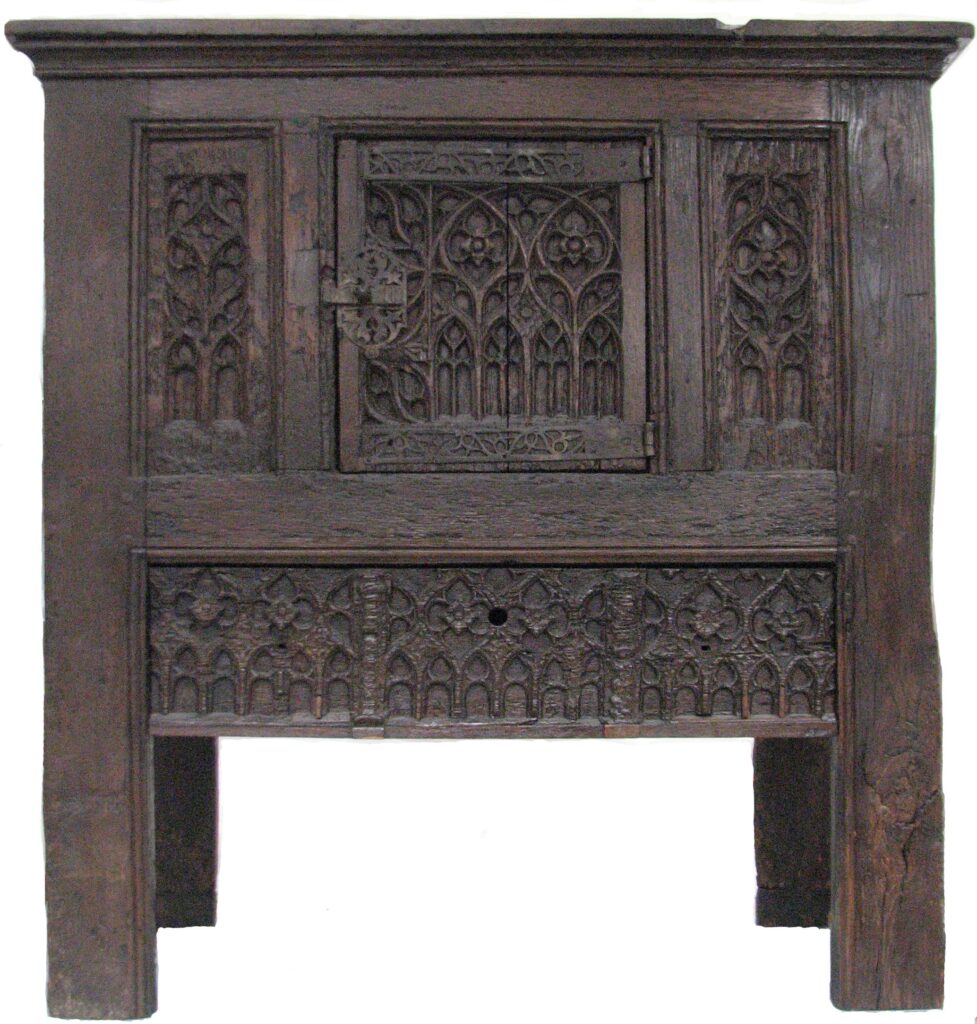
The Met also holds a much older French cupboard to compare. Dated about 1460 and made of oak, it is only 43 inches high and stands on tall end supports. Its carving is Gothic tracery: pointed arches in the small door and the side panels, repeated in a long frieze below. Set beside the armoires in this guide, it shows how far the form travelled from a small, tracery-covered cupboard to a tall parade piece.
The Rococo armoire in Paris and the provinces
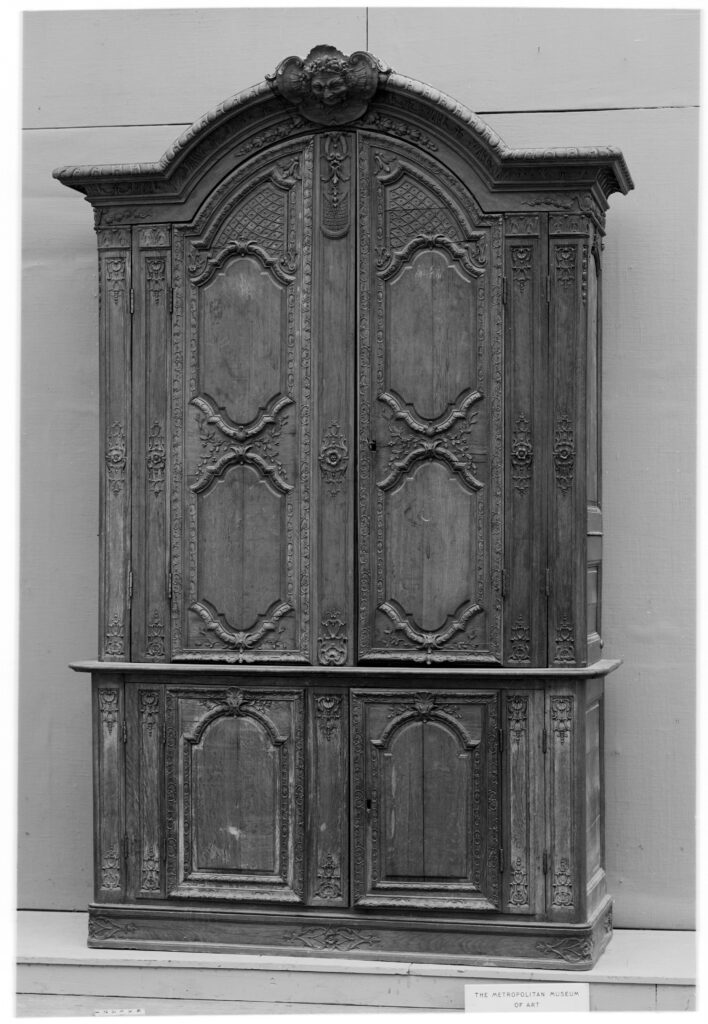
The Met’s armoire of the first half of the 18th century is carved oak, 96 inches high, with two doors divided into shaped, carved panels.
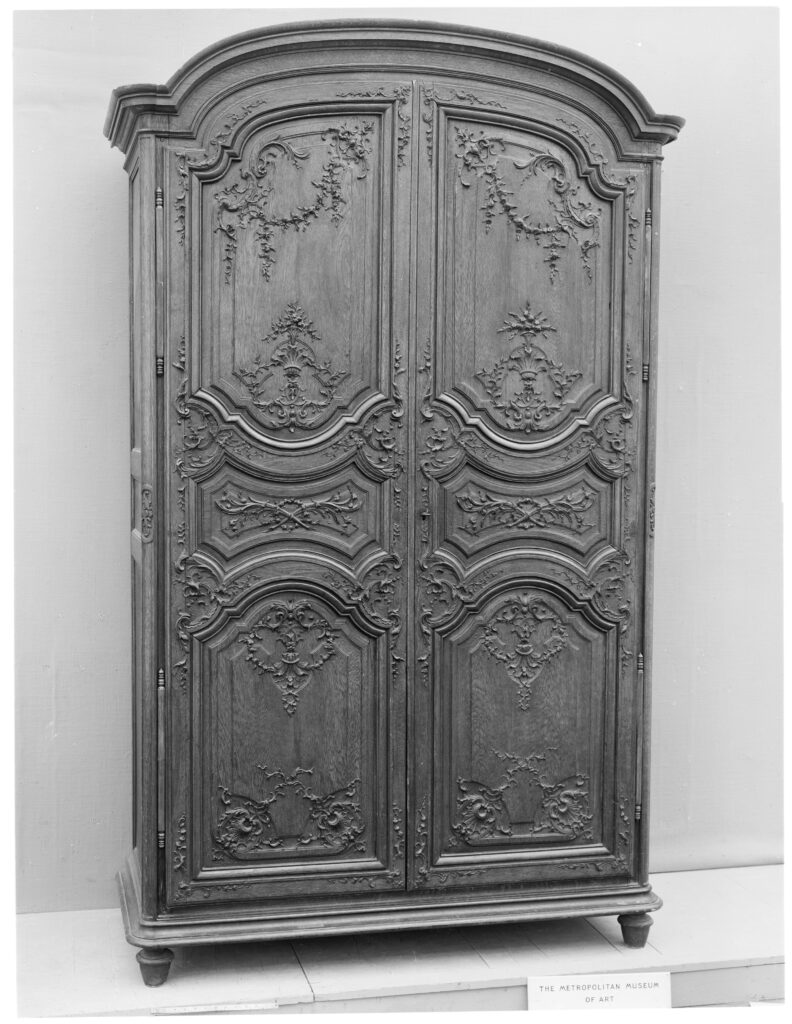
The Rococo curve of the Louis XV style was copied well beyond Paris and kept for a long time. The guide to French provincial furniture makes the point directly: a provincial armoire in a perfectly good Louis XV style may have been made under Louis XVI, Napoleon or later. Style narrows a date but does not fix it.
Regional armoires: Provence and Normandy
Regional work shows how differently an antique French armoire was built from one province to the next. A walnut armoire made in Provence in the eighteenth century, in the Musée d’Art et d’Histoire de Provence in Grasse, is, the museum notes, the kind of armoire given to newly married couples, with a tureen carved at its base framed by olive branches, a motif it calls characteristic of Provençal furniture. The guide adds that its long decorative steel hinges and lock plates are another regional signature. An armoire in the Musée de Normandie in Caen is carved far more densely: a basket of flowers on the cornice, oval medallions on both doors and a shaped apron ending in scrolled feet.
The French provincial guide shows both. The lesson for a buyer is that regional pieces differ in their carving and hardware, and a seller who says “Provençal” or “Norman” should be able to say why.
What to check on an antique French armoire
These are questions to put to the seller of an antique French armoire and to a specialist. None of them proves age.
- Size. The Met’s recorded armoires range from about 92 to 118 1/2 inches tall, from a parade cabinet to a chapel cupboard. Measure the ceiling, the stairs and the doorways before the piece, not after.
- Style against date. A curved outline can be from the 18th century or the 19th, as the provincial guide explains. Ask what else supports the date.
- Region and wood. The Grasse armoire is walnut, and the Met lists its carved examples as oak, one with a query. Wood alone does not place a piece; ask what it is and whether it fits the place and date claimed.
- Hardware. Long steel hinges and lock plates are called a regional signature in the provincial guide. Hardware that looks too new or too uniform for the piece deserves a question.
- Alterations. The Met’s Boulle armoire has lost its shelves and has later feet. Ask what has been replaced, cut down or added, especially the interior, the shelves and the feet.
- Construction. Dealers often describe French armoires as built to come apart for moving, with pegs. No museum record read here says so, so treat it as a point to ask about, not as a test.
The general inspection points, from drawers to repairs, are in the buying vintage furniture guide. The armoire’s companion among the great French case pieces is the antique French commode, and the wider sequence of styles is in the timeline of French furniture styles.
Reading the listing
Search results for an antique French armoire are mostly dealer collections and marketplace categories, so “French armoire” in a listing tells you the form and a claim about origin. The date, the region and the originality still have to be established piece by piece.
Sources
- Encyclopaedia Britannica, Armoire
- The Metropolitan Museum of Art collection records: Cabinet attributed to André Charles Boulle (59.108), Armoire (19.101), Armoire (07.225.140) and Armoire (07.225.141)
- Musée d’Art et d’Histoire de Provence, Grasse, and Musée de Normandie, Caen, as described in the Patina guide to French provincial furniture