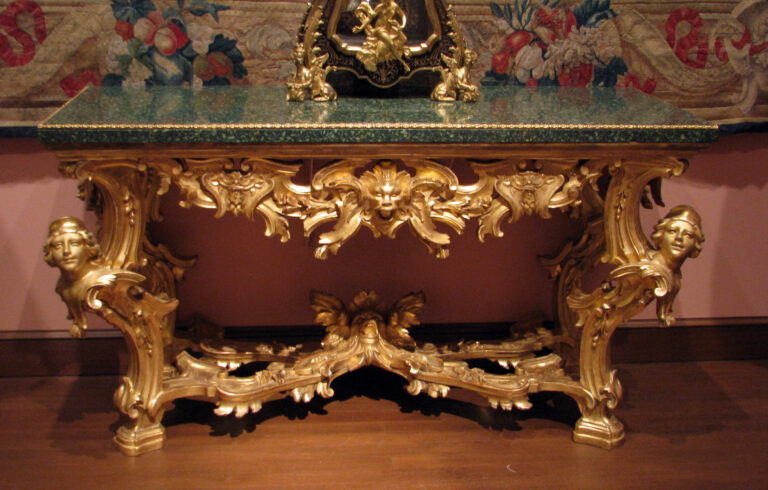
In 1982 a Belgian dealer showed a gilded console table in Paris and dated it to the time of Louis XIV. In 2005 it sold at auction as work of 1730 to 35, linked to the studio of the sculptor François Roumier. A year later it was on show again, this time attributed to the Société pour les Bâtiments du Roi.
The Cleveland Museum of Art bought it in 2008 without knowing its origin, and French scholars then traced it: a 1724 appraisal described a large, richly carved table made for the grand salon of the hôtel d’Évreux, now the Élysée Palace, and the carver was Michel II Lange. The history of that one antique French console table is a fair warning about the whole category.
A console table, in the Metropolitan Museum’s account, has to be fixed to the wall for stability, and it counted as part of a room’s decoration rather than as loose furniture. In France it was made by the menuisiers en bâtiments, literally building carpenters, who also made paneling and pier glasses. Unlike other members of the joiners’ guild, they were not required to stamp their work, and for that reason the Met says it is rarely known who made one. That single fact explains most of what follows.
Built for the wall, carved by a sculptor
A console was commissioned, not bought off a shelf. The Met describes a pair of about 1725 as usually custom made and delivered directly to the customer rather than sold on the open market, with the basic frame made by a joiner and the sculptural decoration carved by a specialist.
The Cleveland table shows how far that went. The appraisers added 1,110 livres for it, because it had been made to support the pier glass in front of the fireplace and was not in the original agreement, and they described its carving as finely worked to imitate bronze. The museum bought it to stand beside a Régence mirror, and the pairing is not a coincidence: a console and its glass were designed as one scheme.
The same logic means a piece can survive in part. The Met owns only a stretcher fragment from a console made about 1730 for Queen Marie Leszczynska’s bedchamber at Versailles, the one element that appears to have survived. Part of the center leg is still visible on its plinth, and tenons at either end show where the other two legs were attached. The Cleveland table has lost its own cross-strut, the section with two children and their heraldic symbols, probably after the comte d’Évreux’s death in 1753.
From Régence to Louis XVI: reading the carving
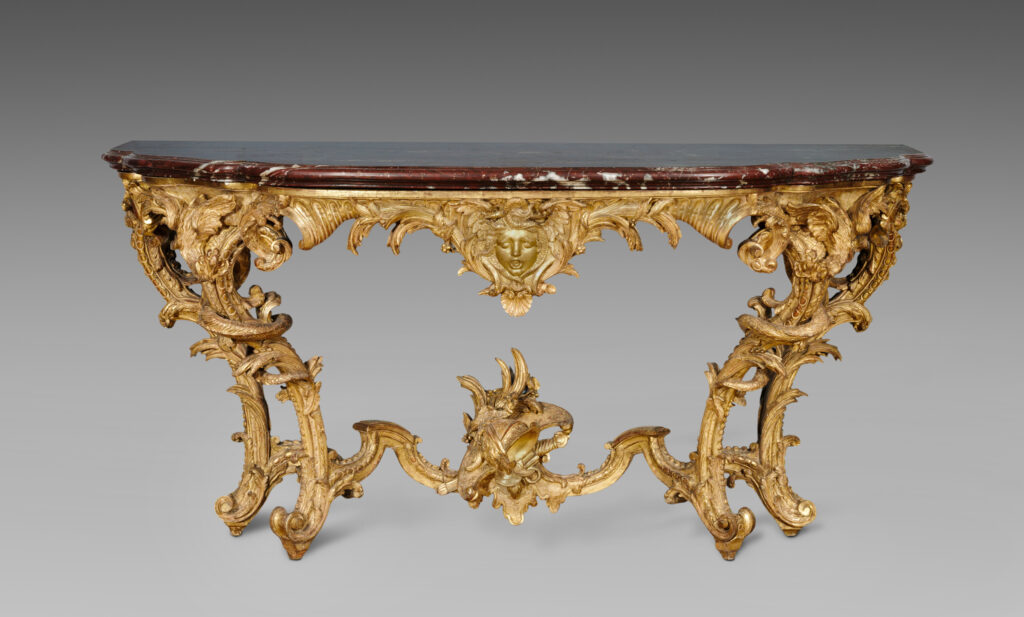
The Met treats 1715 to 1723, the regency for the young Louis XV, as the Régence, and its consoles of the time bridge the Baroque of Louis XIV and the Rococo of Louis XV. Of a pair made about 1725 it says the decoration is still strictly symmetrical, with bold carving and exaggerated curves in the supports. A related table, 1710 to 20, centers its apron on a rosette framed by acanthus leaves whose tips touch the wings of two scaled dragons.
Roumier, sculpteur ordinaire du roi from 1721, worked in the same vein: the Met dates a pair to about 1740, catalogs it as possibly by him, and calls it emblematic of the Régence and the start of Louis XV’s reign, with a heart-shaped cartouche and four dragons. His masterwork, the museum says, was a carved table supplied in 1737 for the Cabinet doré in Louis XV’s private apartments at Versailles, and a book of his designs for table legs and consoles appeared after his death in 1750.
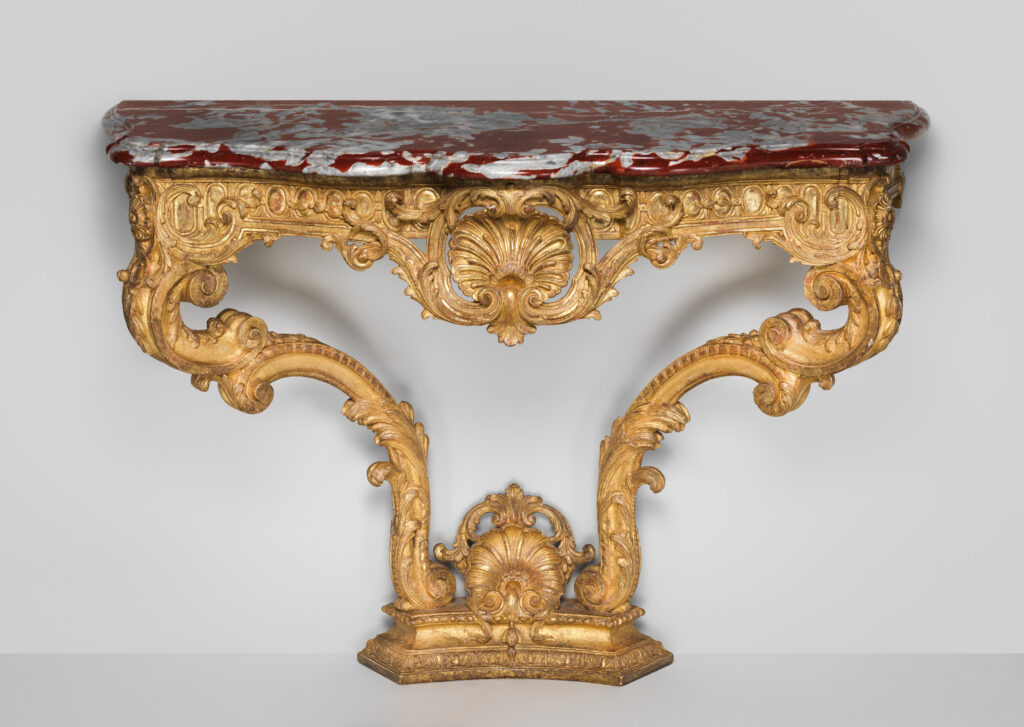
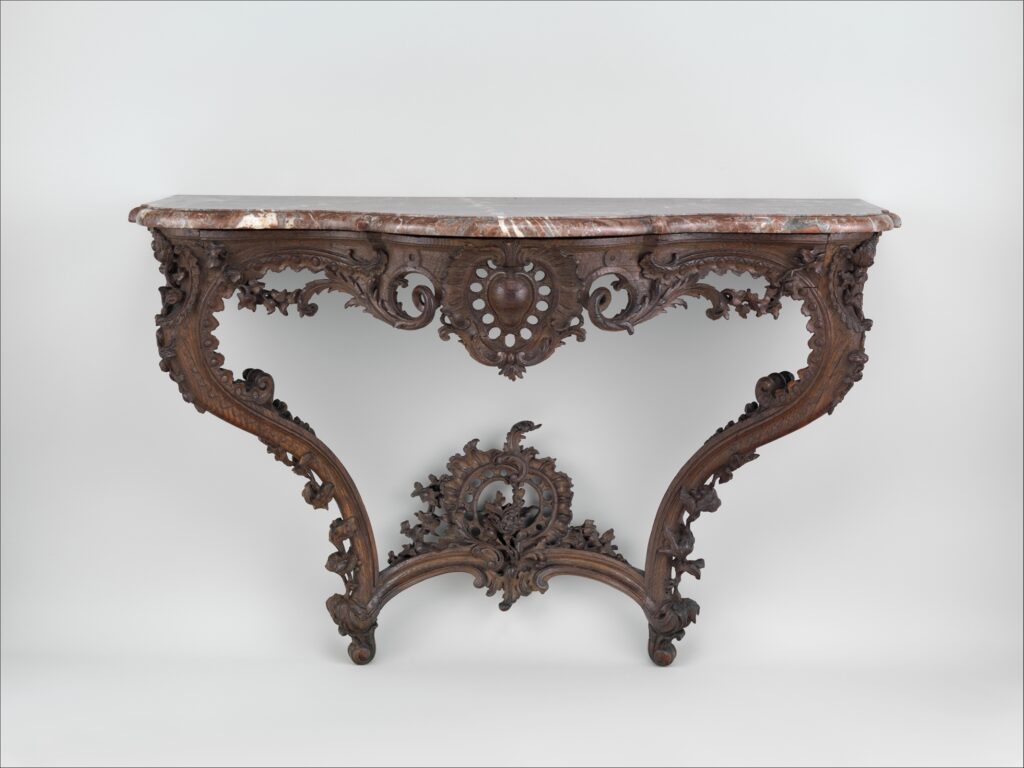
Rococo carving breaks the symmetry. The Met’s oak console of 1735 to 40 has a serpentine apron with an openwork cartouche inside an asymmetrical rocaille frame, doubly curved legs trailing flowers, and an upward-curving stretcher. The museum compares it with the designs of Juste-Aurèle Meissonnier, the leading pioneer of the style. Another small console, about 1745 to 50, has an asymmetrical cartouche, C scrolls and rocaille decoration, which the museum calls quintessential elements of the Rococo style prevalent in Continental Europe from the 1730s. The wider period is in the Louis XV furniture guide, and the sequence of French styles in the guide to French furniture styles.
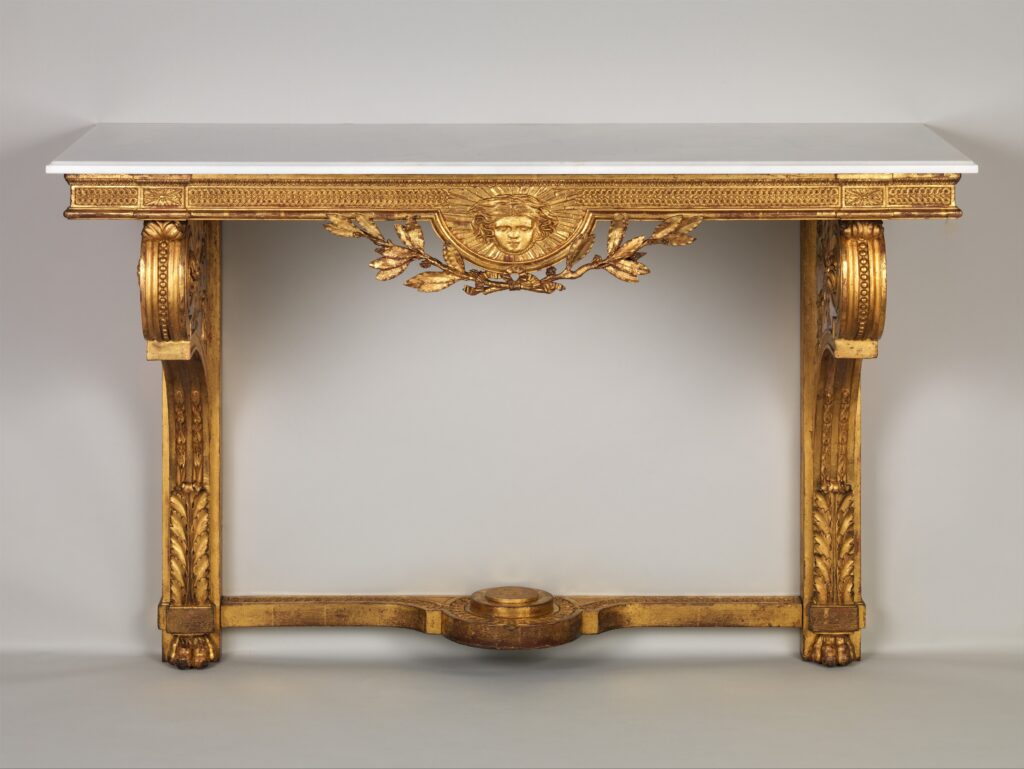
By the 1770s the shapes calm down. The Met describes a pair of about 1775 to 80, identical in design but different in size, as among the few neoclassical consoles in the decorator Maison Leys’s model collection.
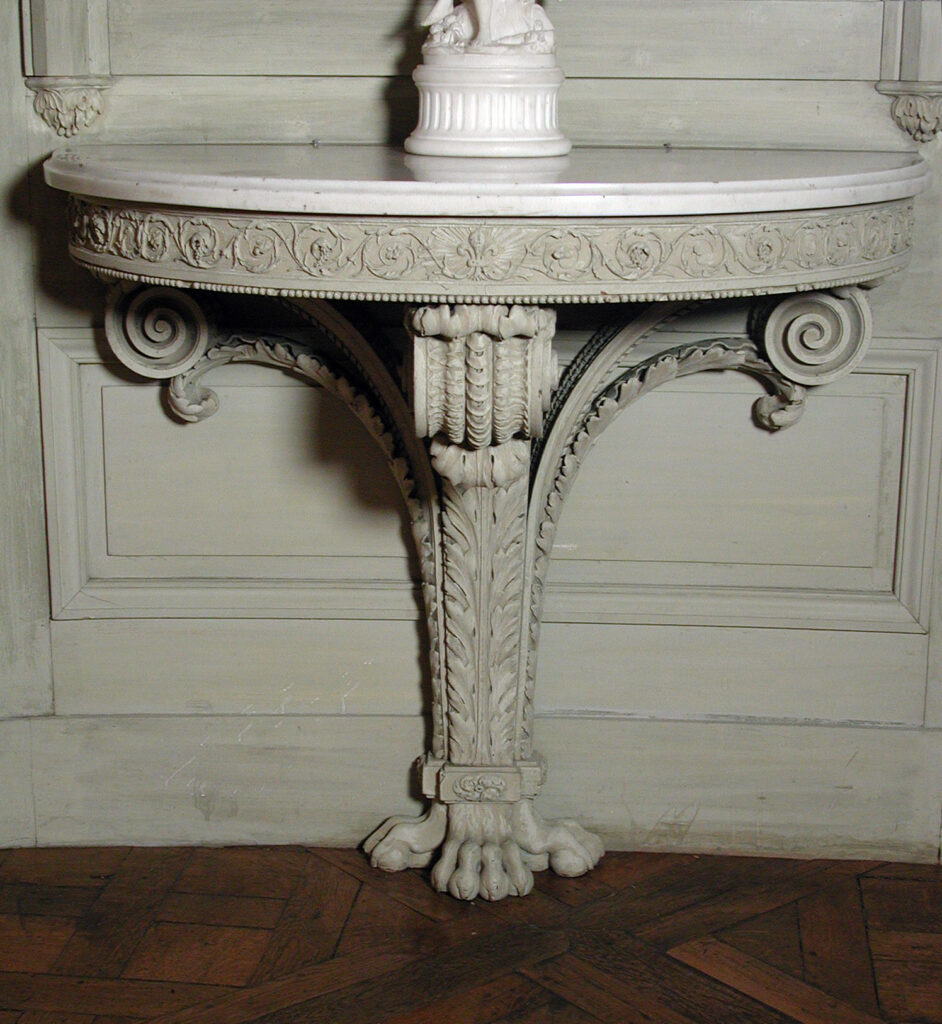
A later one, of 1780 to 90, follows a design by Richard de Lalonde, a decorator-designer who worked for the Menus Plaisirs and then the Garde-Meuble de la Couronne. It has a half-round top, a frieze carved with trailing foliage and pearls, and three pierced, scrolling supports ending in claw feet. The museum adds that several consoles of this design are known, which is a useful caution: a form can be right and still be one of several. The Louis XVI furniture guide covers the style.
Console, side table and console cabinet
A drawer in the frieze moves the piece toward the chest of drawers, and sellers may list the result as an antique console cabinet. The Met’s name for the eighteenth-century hybrid is the commode en console. Its example by Bernard II van Risenburgh, about 1755 to 60, has one drawer in the frieze, cabriole legs and Japanese lacquer on the drawer front.
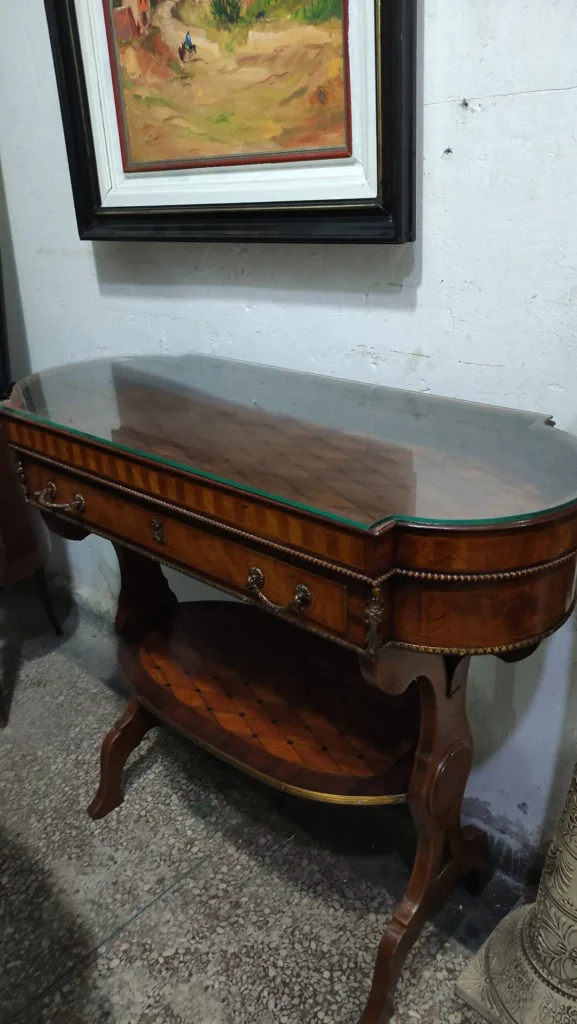
The museum says only a small number are known and that they seem to have been in vogue for a short time in the mid-century. The dealer Lazare Duvaux’s records list five between 1753 and 1757. Four were veneered with tulipwood, and the fifth, mounted with lacquer, was by far the dearest, sold in May 1756 for 1,150 livres.
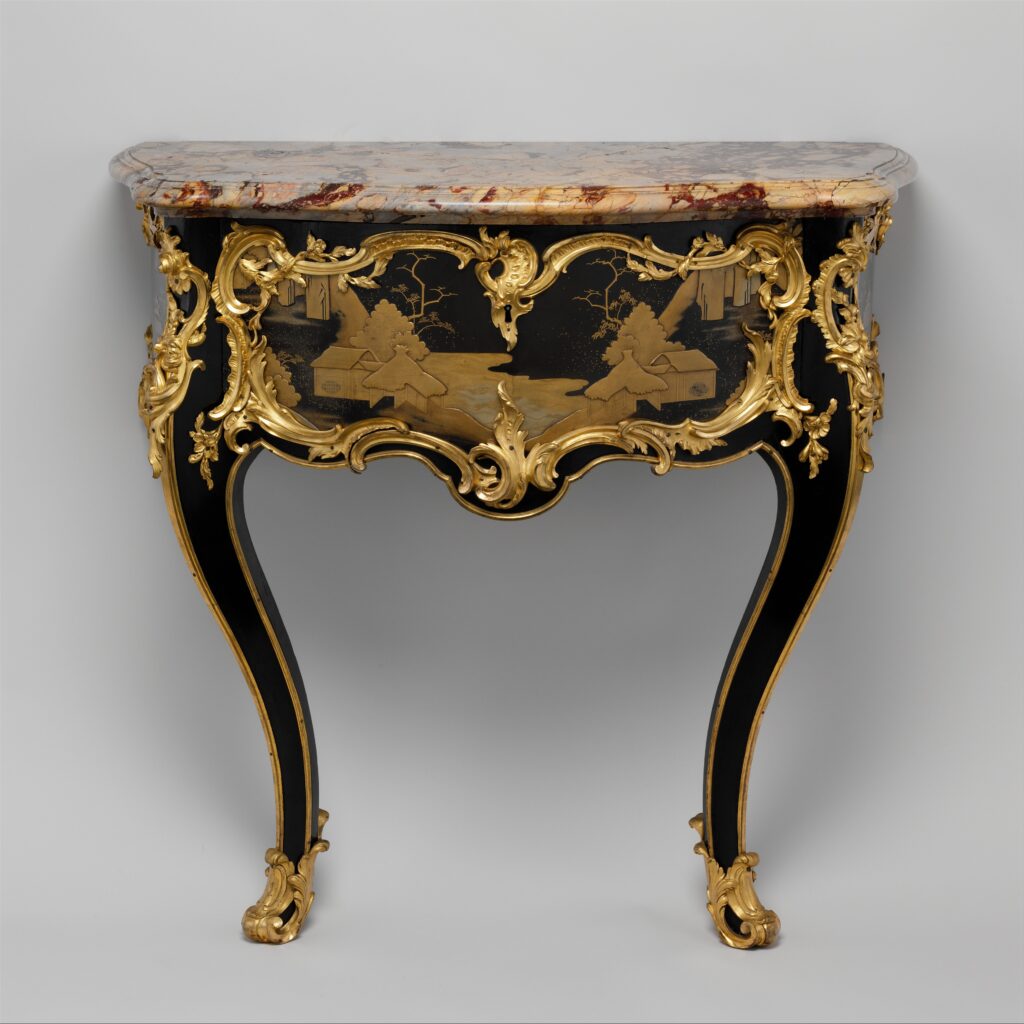
It is also the clearest case of why stamps do not apply evenly. Most console tables were assembled by joiners and carvers who were not required to stamp them. This one was the work of an ébéniste, a cabinetmaker: its carcase is stamped twice with Van Risenburgh’s initials and the guild monogram JME, and from 1743 it was mandatory for guild members to mark their work. The Patina guide to the antique French commode covers what a stamp can and cannot settle, and on a carved and gilded console a missing stamp is the normal state of affairs, not a warning sign.
What to examine in an antique French console table
- The documents. Cleveland’s identification came from a 1724 appraisal, and before it turned up the table was dated or attributed three different ways between 1982 and 2006. Ask what paper, inventory or old photograph exists, and treat a style attribution as an opinion.
- The stretcher and legs. These are the parts that go missing. Look at how the stretcher joins the legs, whether the carving runs on across the joints, and for patches or newer carving where a section may have been replaced.
- Symmetry against the date. The Met’s Régence consoles are strictly symmetrical and its Rococo ones are not. A table that mixes the two is worth a question, since styles overlapped and the answer may be innocent.
- The gilding or paint. The museum records give carved and gilded oak, painted oak, or simply gilt wood. Ask whether the surface is original or has been regilded or repainted, and how much of the original is left.
- The marble. The Met and Cleveland name the stones: Languedoc, griotte de Campan, rouge royal, sarrancolin, among others. A seller should be able to say which one it is and whether it belongs to the table. The piece on marble tops explains how to tell a replacement.
- The back. A console stood against a wall, so its back is the least finished part. It is where fixings, repairs and old marks show, and it is the first place to look.
Where it ends up is a separate question. Patina’s hallway essay is wary of the console as a default hall piece, and an antique entry table carved for a salon pier, designed with its own mirror, was not designed as a default for anything. Questions about sellers, condition and when to walk away are in the buying guide. For the armchairs of the same French salon, see the guide to the bergère and the fauteuil.
Sources
- Cleveland Museum of Art, Console Table, about 1725 (2008.6); Christian Baulez and Stéphane Molinier, “A Grand Console Table,” Cleveland Art, July/August 2011.
- The Metropolitan Museum of Art, console table, one of a pair, about 1725 (2023.126.1a, b); console table, 1710 to 20 (07.225.181a, b); console table, one of a pair, possibly by François Roumier, 1735 to 40 (1972.284.4).
- The Metropolitan Museum of Art, console table, 1735 to 40 (07.225.187a, b); console table, about 1745 to 50 (07.225.200a, b); stretcher from a console table from the Queen’s bedchamber at Versailles (07.225.192a).
- The Metropolitan Museum of Art, console table, about 1775 to 80 (07.225.183a, b); console table after Richard de Lalonde, 1780 to 90 (07.225.479); side table (commode en console), Bernard II van Risenburgh (1976.155.101).