A Baroque bed is mostly staging. The frame, the fabric and the gilding all work to make the place where someone sleeps look like a ceremony. That is the look of the bedroom the Italian maker Vimercati Meda sells as its Roman Baroque style of the seventeenth century, catalogue article 2012, and it is a useful reference, set beside museum beds, for seeing how Baroque furniture handles a bed.
One caution first. This is a current catalogue set, not an antique. The maker’s page gives no named 17th-century model and no list of woods, and the “2012” in the name is an article number, not a year. So this page reads what the maker’s page shows and says, and keeps that apart from museum evidence. For the French sequence that follows the Baroque, see the French furniture styles guide.
The Baroque bed: a tall headboard and a small canopy
The maker describes the bed as having golden carvings and a capitonné headboard, which is the French term for buttoned, or tufted, upholstery. In the maker’s photograph the headboard is a tall, shaped panel with the buttoning inside and a carved, gilded outline around the edge. A crown-like ornament sits above it, and fabric falls from the crown down both sides of the wall behind the bed. The maker’s own caption for another photograph calls this a wall tester, a half canopy fixed to the wall instead of carried on posts.
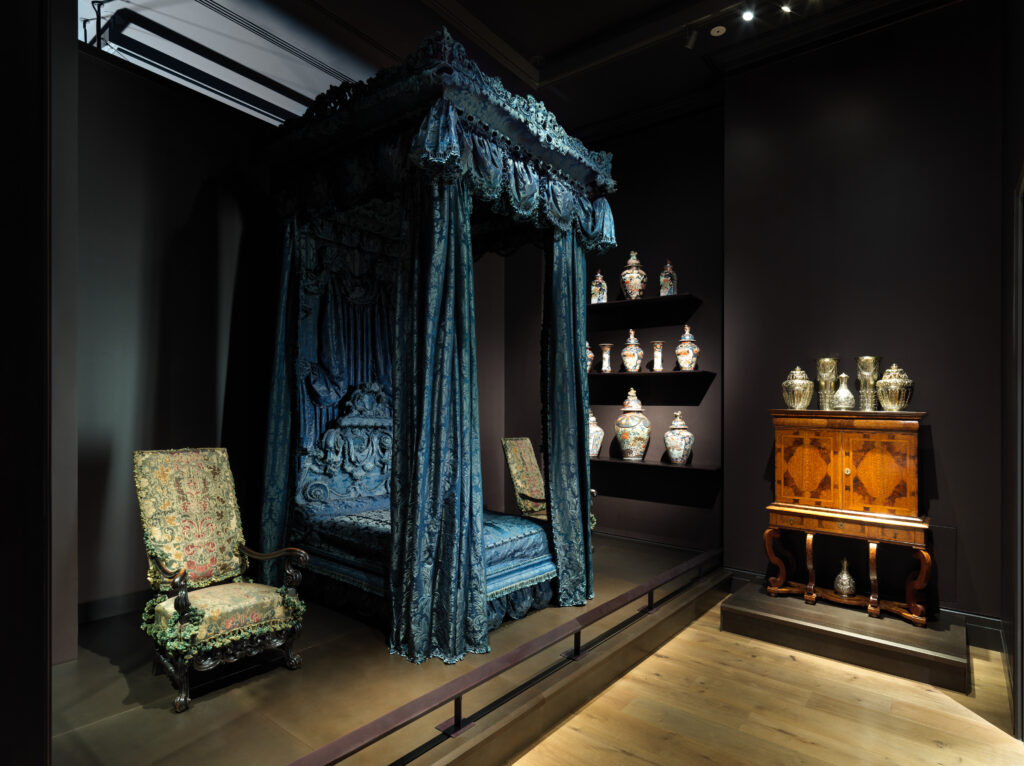
For comparison, the Met’s state bed made for Hampton Court in Herefordshire, about 1698, is hung with blue silk damask under a tall canopy. The museum says it is in the style of Daniel Marot, was made for Thomas, Baron Coningsby, and that the curtains, counterpane, headcloth and some of the trims are modern copies of the originals. It is English, not Roman, but it shows how much of a grand Baroque bed is fabric.
The rest of the room is matched to it. The bench at the foot of the bed is curved and buttoned to echo the headboard, the two bedside tables are identical, and the lamps repeat the gilding. The maker’s page lists a dressing table, an armchair and a wall mirror in the same line, and describes the cushions as all silk lampas with luxury trimmings. The palette stays narrow: one soft, pale color for the fabric and one metal for the carving.
A bedroom made as a set is itself an old idea. The Met records an English suite of about 1689 made for the state bedroom and dressing room of Burley-on-the-Hill in Rutland, comprising a bed, eight armchairs, four side chairs and a pair of stools. In that case the bed was one piece of a matched suite.

Carved gilding on an Italian bed frame can be seen in the Met’s bedstead from the Sagredo Palace in Venice, about 1725 to 35, in carved and gilt limewood. It is Venetian and a generation or two later than the Roman showcase below, and the museum record gives no further description, so treat it as a comparison for the shape and the gilding only: a tall headboard with scrolled, carved ornament along its crest.
Gilding against wood: the dressing table
The dressing table, which the maker calls a toilette, shows the second Baroque habit, contrast between surfaces. It has a kidney-shaped top with a dark, inlaid surface and a warm wooden body, and gilded carving of scrolling leaves breaks across the front and corners. A gold band runs round the edge of the top. The maker says the inlays are made by hand. The maker’s photographs cannot confirm that, though the flowers on the dark top look inlaid rather than painted. For how inlay of this kind is done, see the marquetry guide.
The bedside table repeats the idea at a smaller scale. It has a dark top inlaid with a spray of flowers, a gilded edge, and a support carved as a mass of gilded scrolls. The maker lists these tables as inlaid and carved, and the match between the table, the dressing table and the bed is what holds the room together.
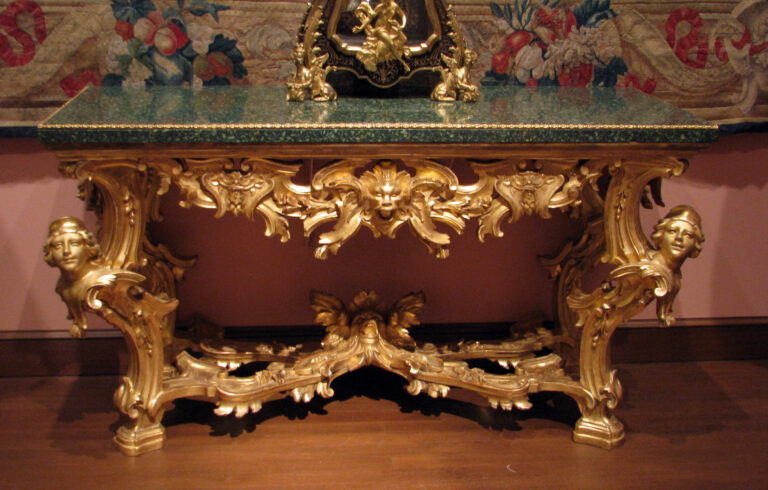
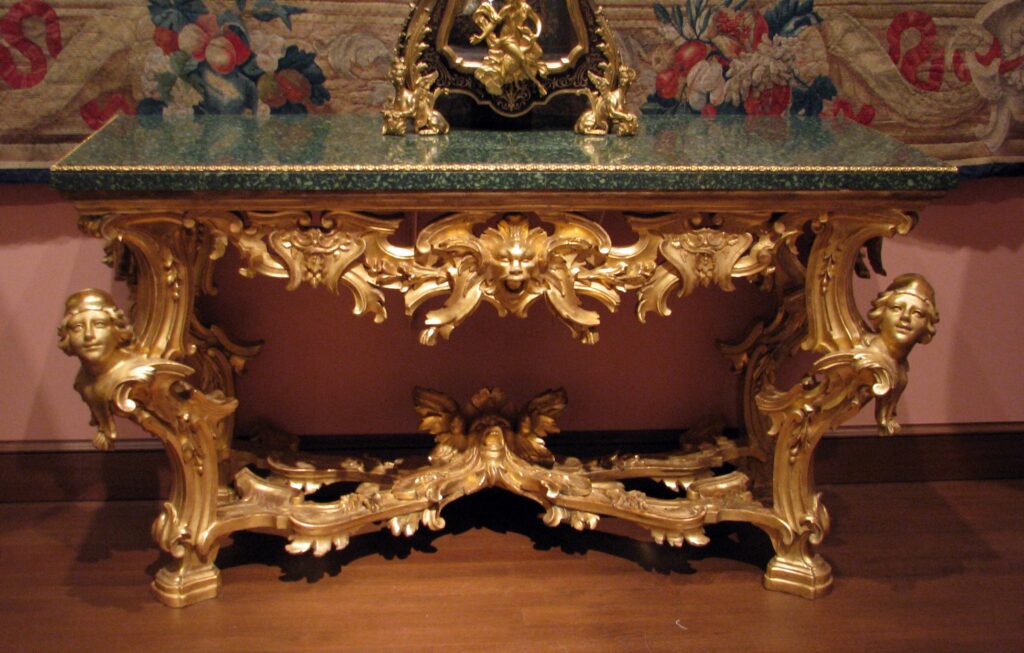
Gilding is easy to see on a console table the Met dates to about 1700–1725. The wood is linden and poplar, carved into scrolling legs, a mask at the center of the apron and a female head at each front corner, then gilded all over and topped with green porphyry. Almost nothing on it is plain surface. The structure has turned into ornament, which is the Baroque habit in a single object.
Why it is called Roman Baroque
The label comes from a real tradition. The Met calls a late 17th-century Roman showcase, a scarabattola, a beautiful example of Roman Baroque furniture, with a strong sculptural character and striking theatricality. It links the contrast between the walnut and the gilded and painted surfaces to the influence of Gianlorenzo Bernini on Roman decorative arts. Carved gilding against a darker ground, curved outlines and a sense of movement are the same ingredients in this bedroom.
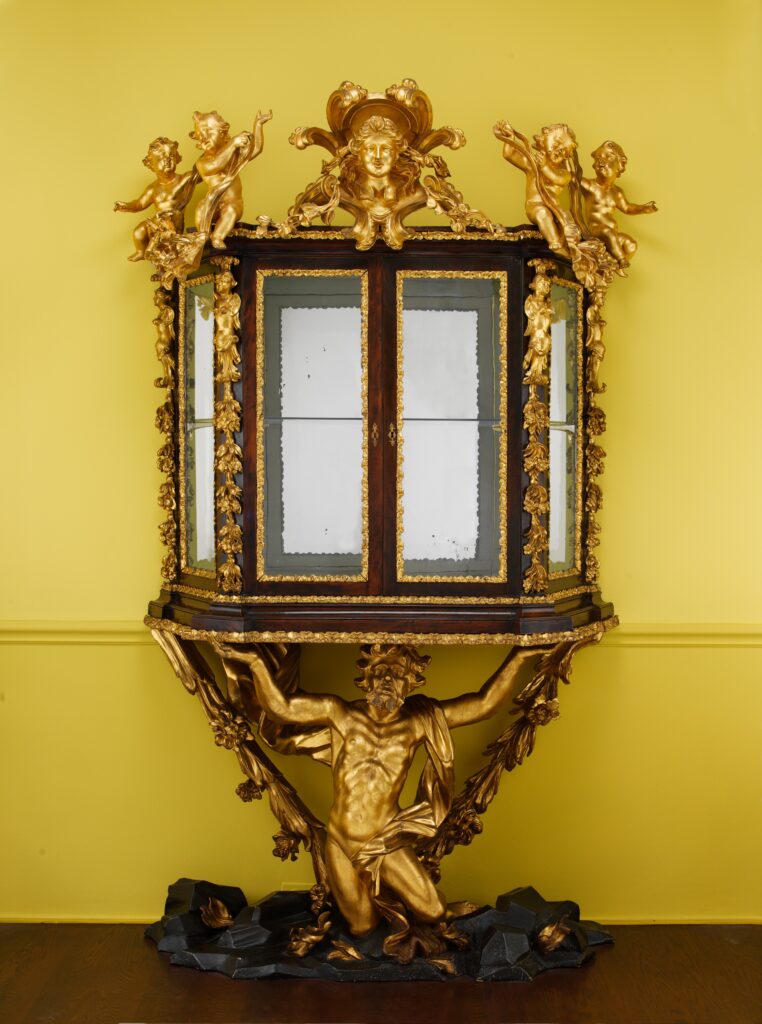
What the bedroom leaves out, at least in the maker’s photographs, is the figure. The Met showcase is carried by a kneeling gilded atlas and topped with putti and a mask. The bedroom keeps the gilding and the scroll but sticks to leaves and curves, which makes it quieter than its models.
Baroque style chairs and armchairs: the English suite of 1689
The Met’s armchairs from Burley-on-the-Hill show what a Baroque chair could be at the top of the market. They belong to a suite made about 1689 for Daniel Finch, second earl of Nottingham, for the state bedroom and dressing room of his country house in Rutland: a bed, eight armchairs, four side chairs and a pair of stools. The museum attributes the armchairs to Thomas Roberts, a prominent London chair maker, and says their tall raked backs and sinuously scrolled arms and legs reflect the style of Daniel Marot, the French architect and designer who worked for William and Mary. The frames are ebonized beechwood, and the chairs keep their original, exceedingly rare Genoese cut-velvet covers (Met 1998.297.1). Because the chairs were made as part of a suite, a single Baroque chair in a sale may once have had company. For more seating on this site, see chairs and armchairs.
Baroque style by country: Roman, Venetian and English examples
The Met’s collection shows how the Baroque looked in three places. In Rome, a console table of about 1700 to 1725 has scrolled legs carved with female busts wearing tiaras, a gilded base and a top of green porphyry in a gilt-bronze border, which the museum calls an embodiment of the dramatic and vigorous design of late Baroque Rome (Met 1998.296). In Venice, a bedstead from the Sagredo Palace, made about 1725 to 35, is carved and gilt limewood (Met 25.140.7a). In England, the state bed from Hampton Court in Herefordshire, about 1698, is in the style of Daniel Marot and covered in blue silk damask; the Met notes that the curtains, counterpane, headcloth and some trims are modern copies (Met 68.217.1a).
The Roman Baroque bed described above belongs with the Italian examples, though it comes from a maker’s catalogue and is not a period piece. For the French sequence that follows the Baroque, see the French furniture styles guide, and for English furniture the English styles pages.
Reading a Baroque bed, new or old
These are questions to put to any Baroque-style bed before judging it. None of them dates a piece on its own.
- Is it sold as a date or as a line? A collection name and a catalogue number, as here, point to a current range, not a period piece.
- What is the gilding? The maker’s page says golden carvings and does not say whether that is gold leaf or another finish.
- Are the woods named? Here they are not, which limits what can be said about the build.
- Does the set match too well? Matching bedside tables, a bench that echoes the headboard and lamps in the same gilding point to a set made together. That is true of period suites too, so it settles nothing alone.
- Is it a revival? A Baroque look does not prove a 17th-century date. Victorian makers revived earlier forms, as the Victorian furniture guide explains.
- Do you want the look or the age? They are different purchases, and the buying guide covers the questions to ask a seller of either.
Sources
- Vimercati Meda, Roman baroque bed art. 2012, Baroque bedroom furniture, product page and image captions, read October 11, 2026.
- The Metropolitan Museum of Art object records: state bed from Hampton Court, ca. 1698 (68.217.1a); bedstead from Sagredo Palace, ca. 1725 to 35 (25.140.7a); showcase on stand (scarabattola), Italian, Rome, late 17th century (1972.73); upholstered armchair, attributed to Thomas Roberts, ca. 1689 (1998.297.1).