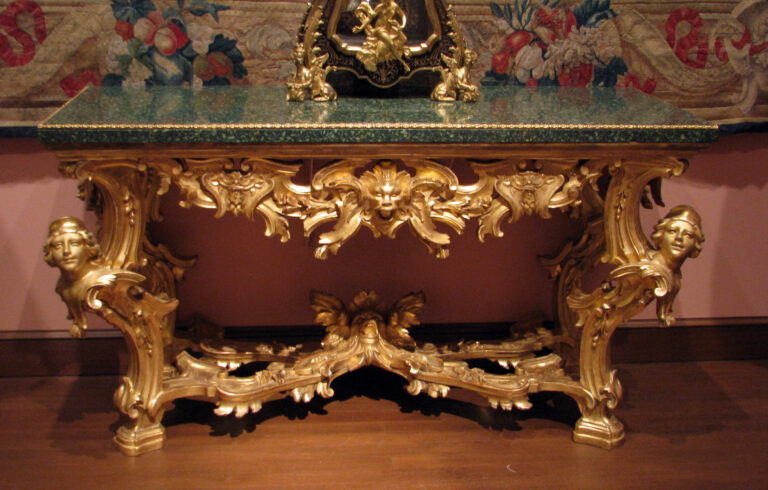
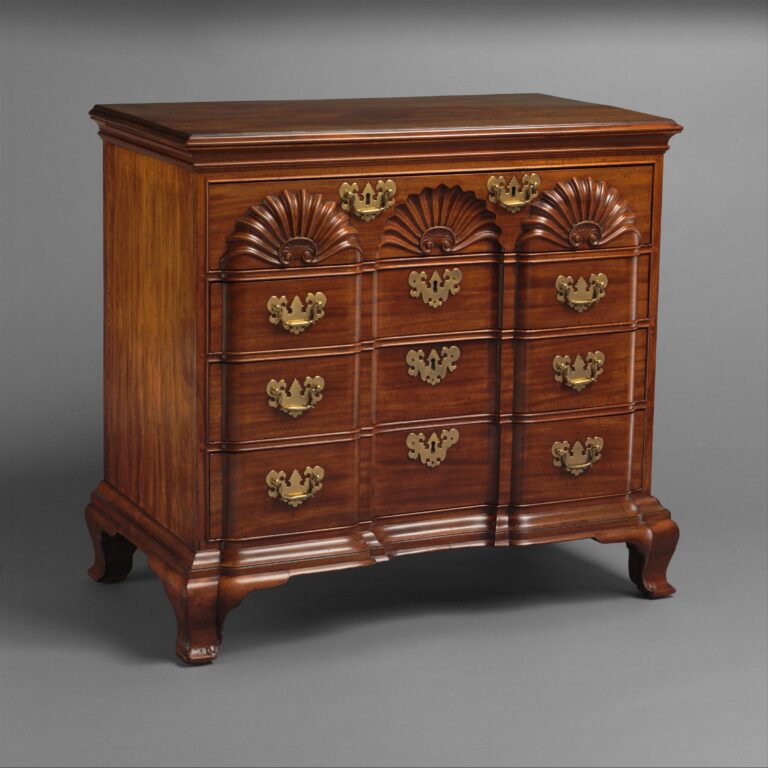
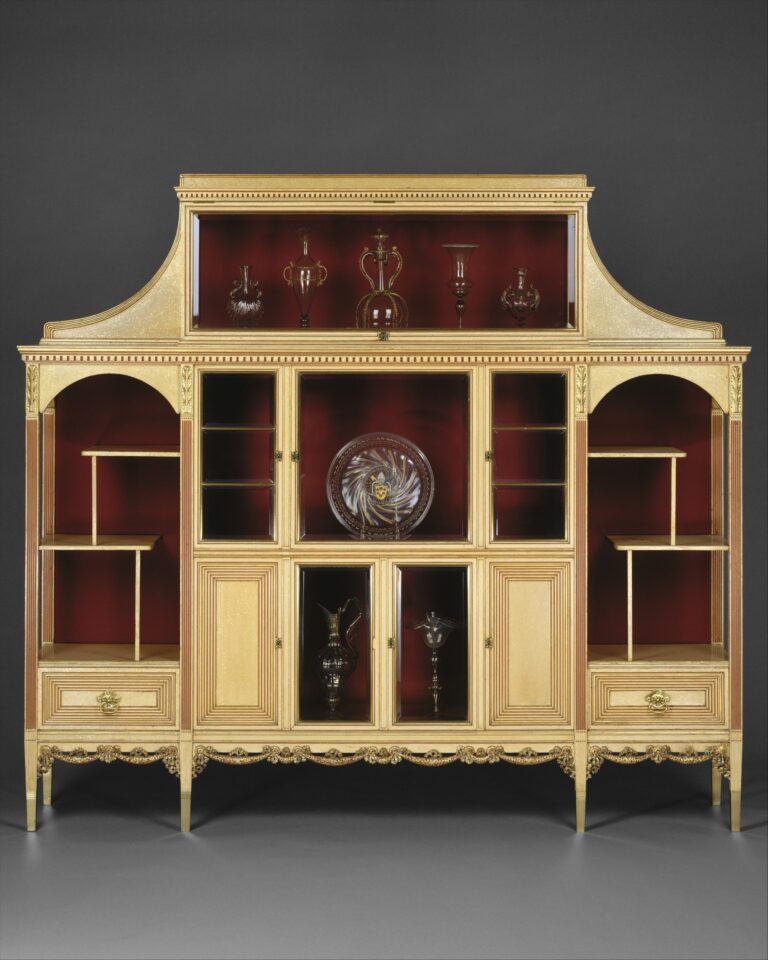
A secretary desk is a cupboard that turns into a desk. Britannica’s entry boils it down to a drawered desk whose front tips down to make a level place to write. That short definition covers a wide family: French pieces about as high as a table, and English and American cabinets that reach from nearly seven feet to more than eight.
What is a secretary desk, then, if the name stretches that far? The label alone does not settle it. Britannica lists escritoire and secretaire as other names for the same piece. The Met titles its French examples secrétaire à abattant and secrétaire en pente, and its English and American records say desk and bookcase, secretary and bookcase or gentleman’s secretary. How the piece opens, and what sits on top of it, tells you more than the name on the tag.
Why is it called a secretary?
Merriam-Webster traces the word to Middle English secretarie, from Medieval Latin secretarius, a confidential employee, from Latin secretum, a secret. It dates the word to the fifteenth century in its first sense, a person, and lists the writing desk, with escritoire as a synonym, as a separate sense. The dictionary does not say why the furniture took the name.
The obvious guess is that this was where private papers were kept, which is an inference rather than a documented fact. What the form does offer is easy to confirm: a writing surface that appears when it is wanted and, behind it, the pigeonholes, drawers and recesses that Britannica lists for ink, paper and documents.
What is a secretary desk used for?
For writing, and for keeping what you write with. Britannica describes the early French form, which it dates to the first half of the eighteenth century, as a single piece in two sections. Below was a cupboard closed by solid or sliding doors, which sometimes concealed a set of drawers. Above it was a drop front that, once lowered, gave the writing surface and revealed the fitted interior. Close the lid and the desk becomes a cabinet, which is the whole idea: the work disappears and the room goes back to being a room.
The French desk: small and curved, or tall and ornamented
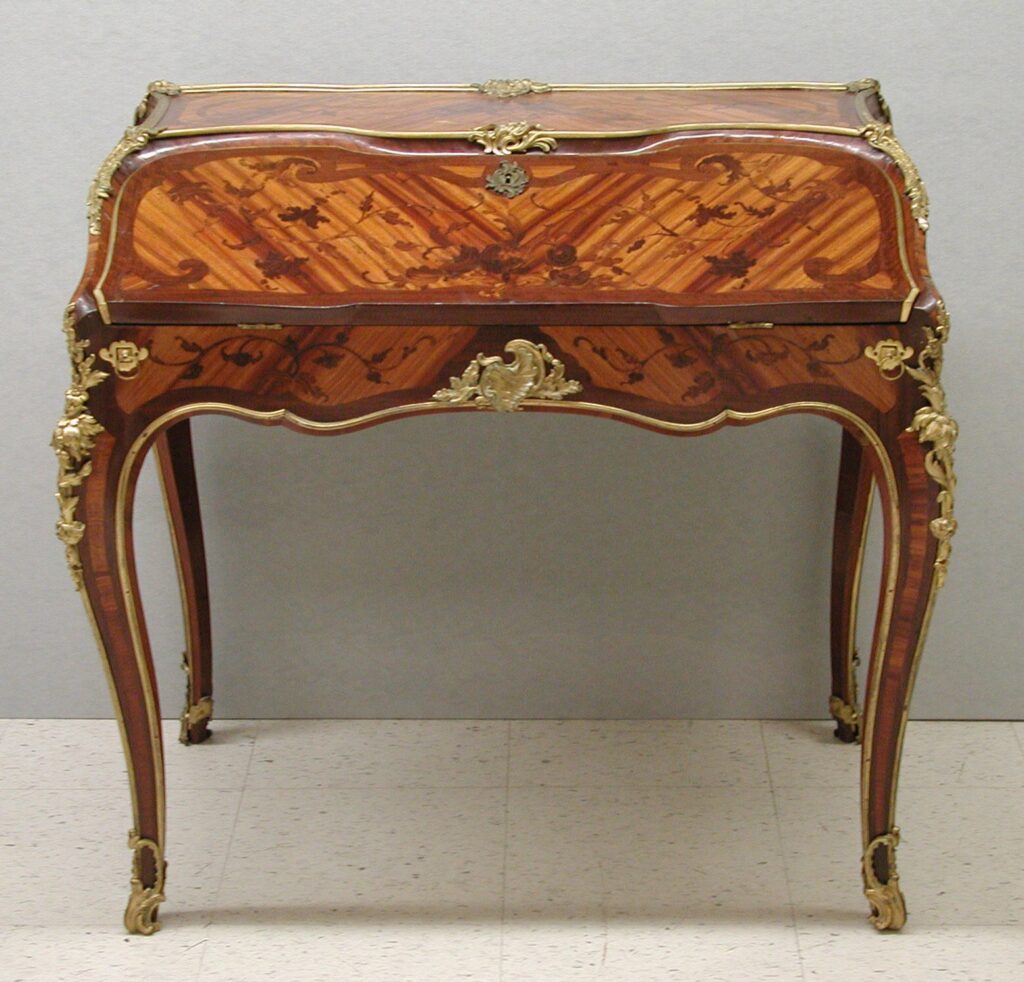
French makers found other ways to build one. The Met’s slant-top desk of about 1745–49 by Bernard II van Risenburgh is just over 31 inches high: in the Met’s photograph, a small desk on curving legs, veneered in bois satiné and end-cut wood, trimmed with gilt bronze and fitted with leather. Under the lid there is no cupboard at all, only open space for the writer’s knees, the kind of change Britannica records when it says later versions made room for the writer’s knees.

Martin Carlin’s drop-front desk of about 1773 goes the other way and stays tall and narrow, 47 inches high and under 32 wide. Its doors and sides carry ten soft-paste porcelain plaques, and the Met’s record notes that the velvet is not original. The Met’s essay on French case furniture mentions a royal example: the fall-front secretary (secrétaire en armoire) that Marie Antoinette commissioned from Jean Henri Riesener, veneered like its matching commode with panels of black and gold Japanese lacquer.
French desks that stayed flat, and the one that closed up like a cupboard, are compared in the guide to the bureau plat and other French writing desks. The Neoclassical secretaries, including those stamped by Adam Weisweiler, belong to the story told in the Louis XVI furniture guide.
The English and American way: put a bookcase on top
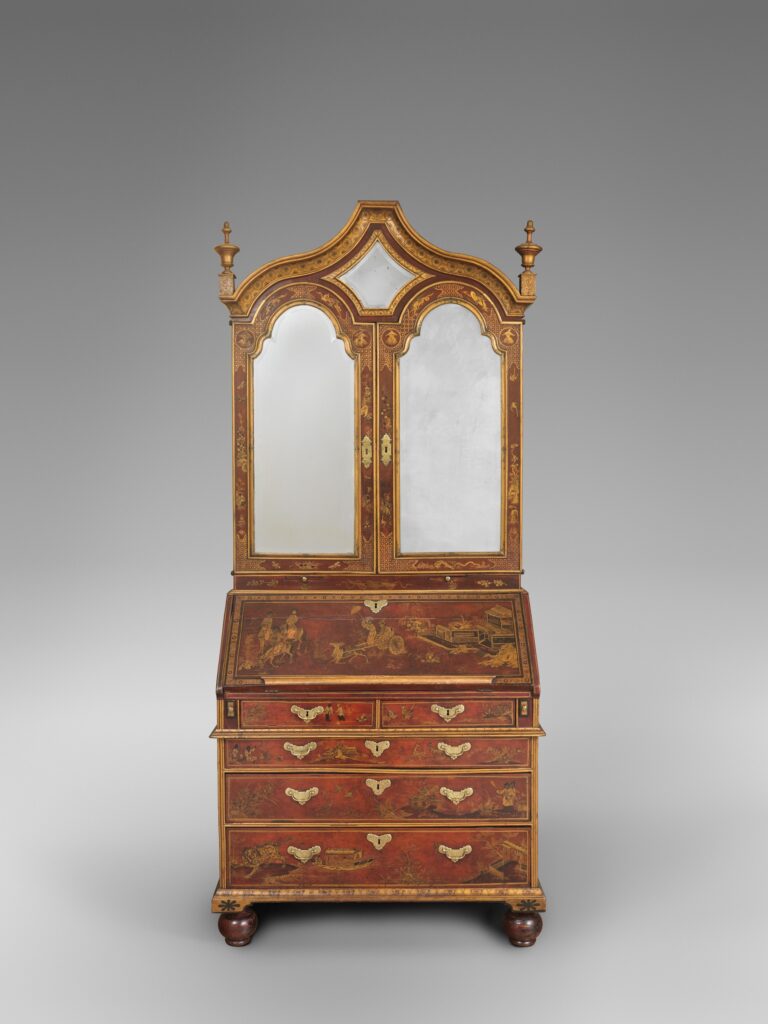
The English and American secretaries at the Met put a cabinet on top of the writing section. Britannica notes the addition of mirror doors above the drop-front section, and its own photograph shows an English secretary bookcase in mahogany from the second half of the eighteenth century. The Met’s British desk and bookcase of 1700–1720 is just over 81 inches high, with two arched mirrored doors over a sloping lid and four drawers, decorated with gold figures on red. The Met records it as two parts, a and b.
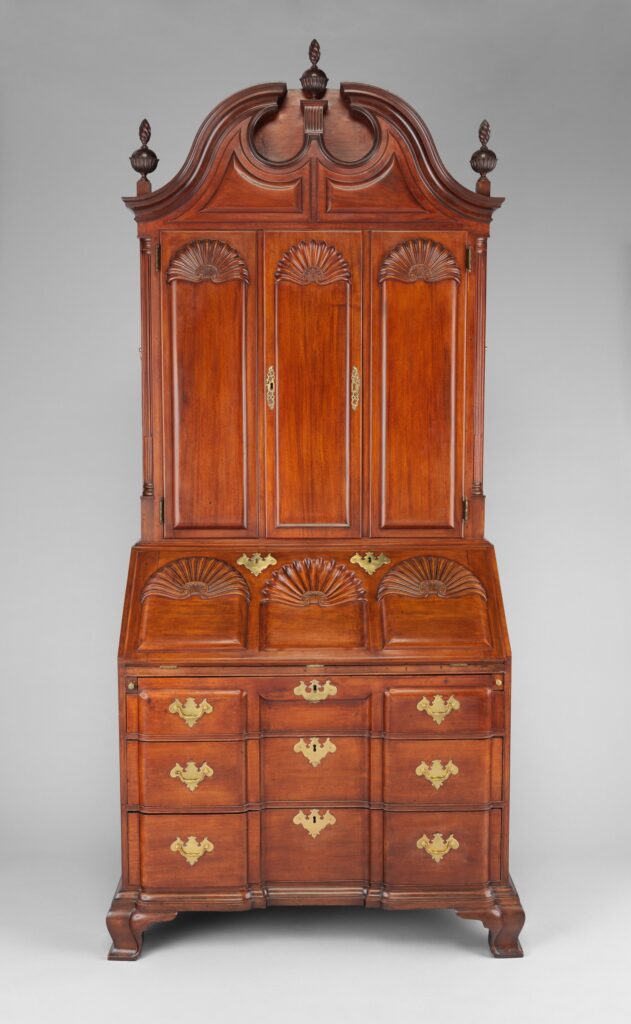
The American example is bigger. The Met’s desk and bookcase of 1760–90 stands just over 99 inches high, in mahogany with chestnut, white and yellow pine, yellow poplar and cedar among the other woods, and a scrolled pediment crowns the doors. The fan-carved shells are the showy part; the working part is the writing section below the doors, above three tiers of drawers.
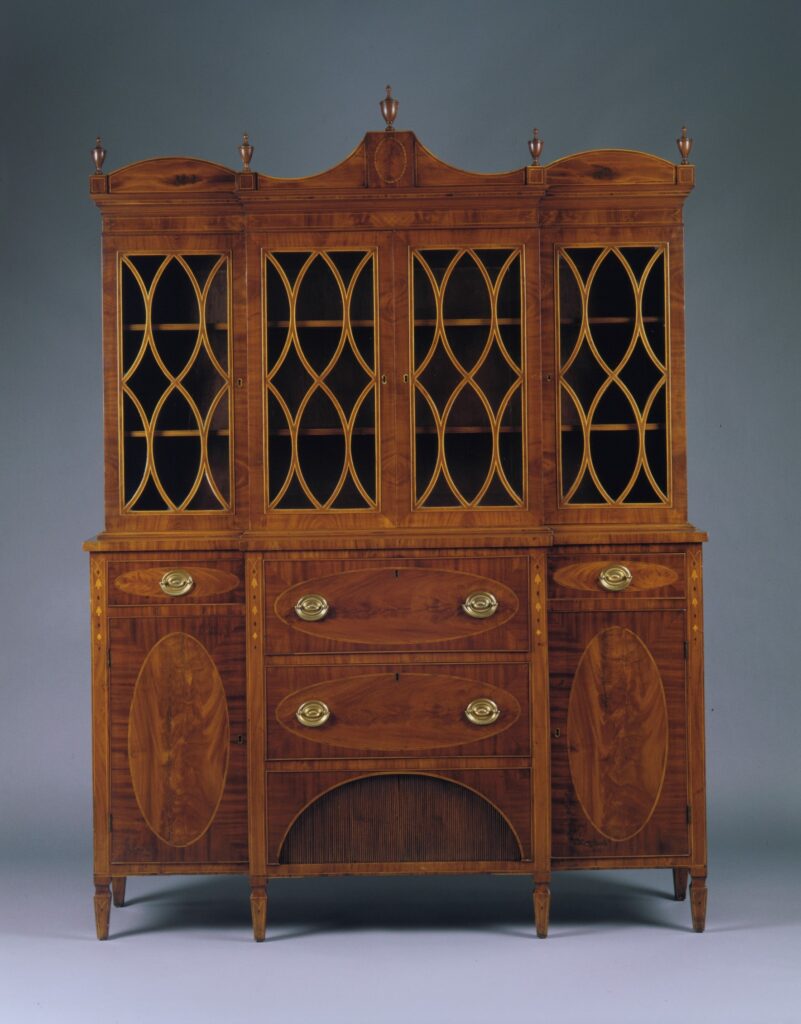
Nehemiah Adams’s secretary of 1800–1810, which the Met calls a gentleman’s secretary, shows how far the label can drift from the form. It is 96 inches high and 68 wide, in mahogany, mahogany veneer and satinwood, with four glazed doors on top and a lower case of drawers and cupboards. The title does not use the word desk at all, and the glazed bookcase is a large part of the piece. Same family, several names in one museum.
From cupboard to table: how the form lightened
By the early 1800s, according to Britannica, the secretary had slimmed down. Makers swapped the heavy cupboard base for legs (in the wilder Regency designs, legs carved to imitate an animal’s), and the piece began to read as a table with a cabinet on it rather than a chest. Above, a tambour shutter often hid the drawers and pigeonholes. Britannica adds that lavish ormolu and other metal mounts went with the idea that would dominate the century: that a secretary was a woman’s piece, made for the boudoir.
The French Empire style had its own take on the secretary, covered in a section of the guide to French Empire furniture. The practical point is that two secretaries a century apart can share a name and almost nothing else: the early one is a cabinet that opens, the late one a table with a cabinet on it.
How to identify an antique secretary desk
Start with how it opens. A fall front that drops flat, a lid that slants down and a tambour that rolls back are different mechanisms, and the Met’s titles keep them apart (drop-front, slant-top). Then look at the base: solid cupboard, open knee space or legs.
Ask whether the top and the bottom have always been together. A desk with a bookcase on it is two pieces of furniture stacked, and the Met records the British example as two parts (39.184.1a, b). Whether the two parts have always belonged together is a question about construction and wear, which a photograph rarely settles, so it is worth putting to the seller in writing.
Open the front and look inside. Pigeonholes, drawers and writing surface should look as old as the case. The Met’s own record for the Carlin desk says its velvet is not original, and a good seller can tell you what in the interior has been replaced.
Measure. The pieces in this guide run from just over 31 inches to more than eight feet, and a secretary that looks modest in a photograph can be wider than a doorway. For the questions that apply to any antique, see the buying vintage furniture guide; the wording of a sale description is explained in reading an auction catalogue properly.
Finally, ask to see it open. A secretary photographed only closed is a cabinet in a picture, and the desk, which is the part that makes it a secretary, is the part you cannot see.
Sources
- Encyclopaedia Britannica, secretary (furniture), read October 14, 2026.
- Merriam-Webster, secretary, read October 14, 2026.
- The Metropolitan Museum of Art, essay French Furniture in the Eighteenth Century: Case Furniture, read October 14, 2026; records for the secretary cabinet (2014.186a, b), the featured image, the Van Risenburgh slant-top desk (2007.90.7), the Carlin drop-front desk (58.75.44), the British desk and bookcase (39.184.1a, b), the American desk and bookcase (15.21.2) and the Adams gentleman’s secretary (1971.9). The six images are public domain under the Met’s Open Access policy. The descriptions of the photographs are the editor’s own reading of the images.