An antique display cabinet is a piece of furniture built to be looked into as much as looked at: a cupboard with a glazed front, or glazed doors, so that what is inside can be seen without opening anything. Merriam-Webster defines the vitrine, the word for the glazed case, as a glass showcase or cabinet especially for displaying fine wares or specimens. The history of the form is older and odder than shop listings suggest, because the cabinet began as a room rather than a cupboard.
Search results for the term are mostly dealers and furniture shops, which is fair enough: that is where most people meet these pieces. This guide comes at it from the other end. Four objects from the Metropolitan Museum of Art, two cabinets and two drawings, trace how the idea of showing things off took shape, and what the museum’s own wording can teach you about the one in front of you.
What is an antique display cabinet?
The names overlap, and nobody has ever policed them, so it helps to see what each one actually claims. Cabinet on its own does not mean glazed: Britannica’s cabinet began as a room and became a piece with drawers behind doors, and the Doomer cabinet below has no glass at all. Vitrine is the glazed case; Merriam-Webster traces it through Old French vitre, a pane of glass, to Latin vitrum, glass, and defines it as a glass showcase or cabinet.
China cabinet names the job: Britannica’s entry on Chippendale uses it, alongside china shelves, for cabinets with glazing bars made for showing china. Display cabinet is the shop and search term for the same job, and none of the sources used here defines it as a separate type. Search suggestions and dealer listings add curio cabinet and glazed bookcase. The Met’s own titles for the objects in this guide say cabinet, china case and vitrine.
So treat the name as a description of function rather than a type. A display cabinet shows things. Whether a label calls it a vitrine, a china cabinet or simply a cabinet depends on the country, the period and who wrote the label. The rest of this guide is about how the showing part developed.
From a room for treasures to a cabinet with doors
Britannica’s account starts with the word itself. In furniture design, a cabinet was originally a small room for displaying precious objects, and only later a piece of furniture made up of small drawers, usually enclosed by a pair of doors. Cabinets were first used in Italy in the late Renaissance. By the early sixteenth century they were in use in France and England, and in many parts of Europe cabinets became the most sumptuous pieces of furniture, with marquetry, carving, inlay and gilding. They were themselves objects of art, and they were popular for storing collections of china, coins, shells and curiosities.
The same entry puts glass into the story later. In the eighteenth century and afterward, it says, many cabinets were fitted with glass shelves to display china. That is a useful corrective to the picture of a glass-fronted cabinet as the original form. The first cabinets kept a collection behind doors and drawers; the glazed front is one answer, among several, to the wish to show a collection off.
A stage with a mirror: an Amsterdam cabinet of about 1640–50
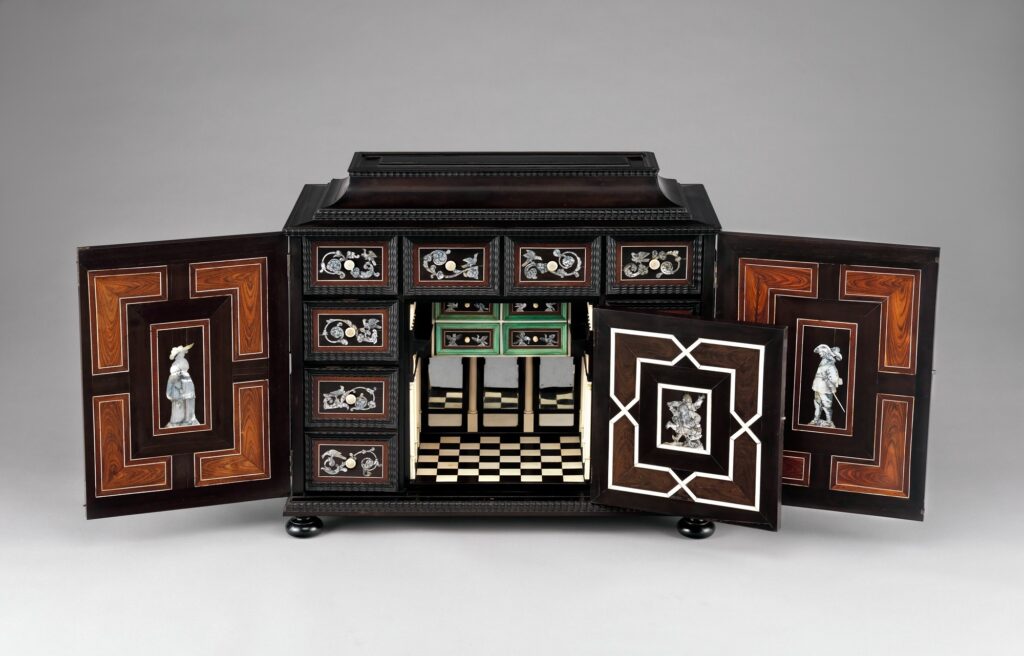
The Met’s cabinet of about 1640 to 1650, attributed to Herman Doomer of Amsterdam, shows the display idea without a pane of glass in sight. The outside is severe black ebony with ripple moldings. Open it and the interior comes alive: other tropical veneers, inlays of mother-of-pearl and green-stained horn, multiple drawers, and a compartment with a mirror-lined “stage” for showing a treasured artwork, as the museum describes it. The Met adds that Amsterdam was the foremost European market for such exotic materials, and that Doomer is known to many people through the portrait Rembrandt painted of him, which is also in the museum’s collection.
The lesson for anyone looking at the category is that a display piece does not need a glass front. It needs a designed place to show something. Here the mirror and the checkered floor do the showing that a glass front does in other pieces, and the whole cabinet is only about 27 inches high. For another storage piece that doubled as a stage, the credenza guide follows a Renaissance cupboard that held silver for show.
Chippendale’s china case: glass in a pagoda frame
When the glazed cabinet gets a precise description in the sources used here, it comes through a pattern book. Britannica’s entry on Chippendale identifies The Gentleman and Cabinet-Maker’s Director, published in London in 1754, as the book of furniture designs that gave the style its name. Its Chinese Chippendale designs, the entry says, were applied to china cabinets, or china shelves, which had glazing bars in a fretwork design and a pagoda-style pediment.

The Met holds Chippendale’s preparatory drawing for one of those china cases. The record says the design was published in reverse as plate CV in the 1754 and 1755 editions of the Director, and renumbered plate CXXXII in the 1762 edition. On the right the case stands on a table-like base, under a pagoda crown, with its front divided by a lattice of bars. On the left are what look like profiles of the moldings that would shape it.
Be clear about what this is. A drawing of a design is not a surviving cabinet, and a preparatory sheet is not evidence that any particular piece was made to it. What the sheet gives you is vocabulary. When a dealer says “Chippendale-style china cabinet,” the lattice of glazing bars and the pagoda crown are the features the phrase points back to. Whether the cabinet in front of you was made in the 1750s, in the nineteenth century or last year is a separate question, and the glazing pattern alone cannot answer it.
The Victorian showpiece: a drawing room on legs
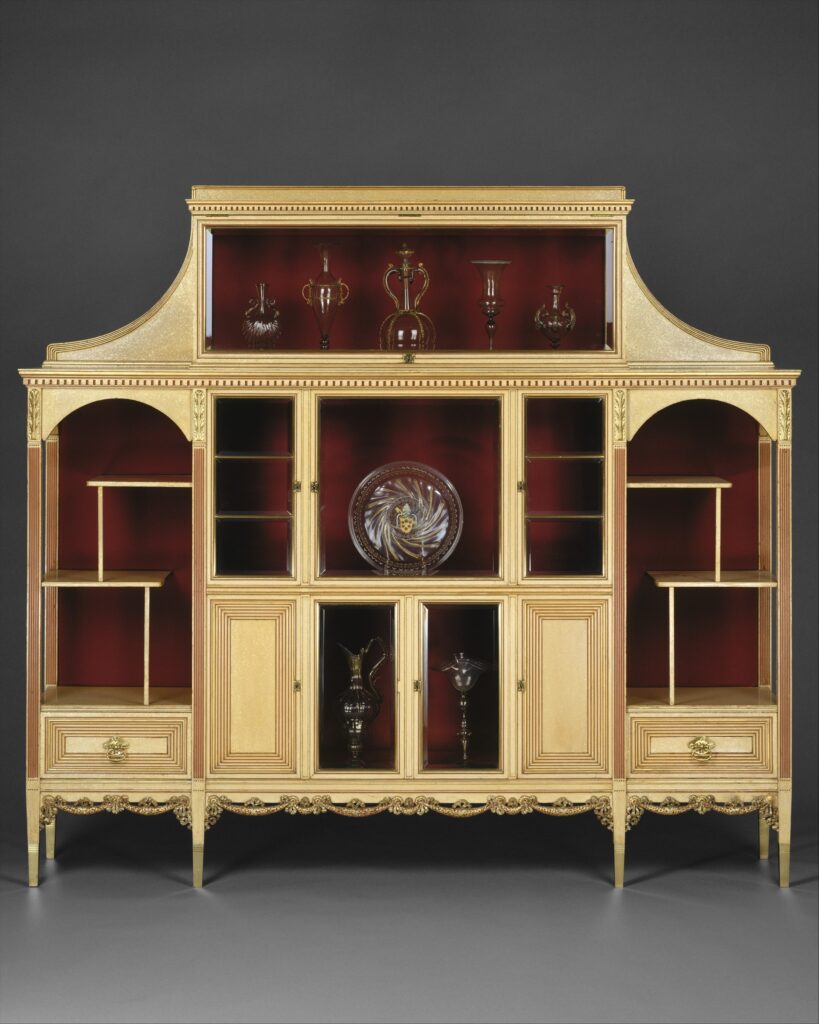
By the 1880s a display cabinet could be the star of the room. The featured image at the top of this page is the Met’s drawing-room cabinet attributed to Herter Brothers, made in New York about 1883 for Oliver Ames, the industrialist and governor of Massachusetts. The museum calls it typical of the ivory-and-gold palette Herter Brothers favored in drawing rooms, and a sophisticated amalgam of sources: reeded columns, dentil moldings and carved swags from eighteenth-century Neoclassicism, alongside references to Japan in the asymmetrical side shelves and in a gold-flecked surface inspired by lacquerware. The materials are maple with a painted and gilded surface, bevelled glass, silk velvet and brass.
In the museum photograph the glazed center and the open end shelves are set out with small vessels, which is the point of the piece: it is a frame for a collection, and the shelving works as hard as the cabinetmaking. The Japanese references show how widely the 1880s drawing room borrowed; the Japonisme guide looks at that exchange.

The word vitrine appears in the Met’s title for a French design of the same decades. A. Damon et Cie., a firm active about 1870 to 1900, left a drawing in graphite, ink, watercolor and gouache titled Design for a Cabinet with a Vitrine. The title seems to name the glazed section as the vitrine, a reminder that the word can describe a part of a cabinet as well as a whole piece. For the wider French background, see the timeline of French furniture styles.
How to read an antique display cabinet
Museum records are a good model for the questions to ask, because they keep what is known apart from what is attributed. Use the points below as a checklist, not as a promise that a shop piece will answer them all.
- Ask what the glass is doing. A pagoda crown and a lattice of glazing bars point back to a particular design tradition; a single plain pane, a mirror back or open shelves tell a different story. Compare what you see with the drawings and photographs above before you accept a label.
- Read the inside as carefully as the front. The Doomer cabinet’s mirror-lined compartment and the red-lined shelves of the Herter piece show interiors designed for display. Ask whether the shelves, linings and any mirrors look planned together with the case.
- Count the parts. Britannica notes that cabinets were placed on stands or on chests. The Met’s own date line for one seventeenth-century cabinet (31.66a, b) reads about 1645 “with extensive later alterations,” which is the kind of candor worth asking a seller for. A cabinet and a stand that were not made together is a question of description and price, not always a defect.
- Read the attribution words. The Met writes “attributed to” for both the Doomer and Herter pieces. If a listing states a maker flatly, ask what documents it.
- Treat style labels as family resemblance. The Herter cabinet mixes Neoclassical and Japanese sources; a one-word label would have been tidy and wrong. The Victorian furniture guide makes a related point: a piece that mixes unrelated motifs is not necessarily a later alteration, because the period itself was eclectic.
The general questions to put to a seller are in the buying guide for vintage furniture, and the guide to reading an auction catalogue covers the description and condition notes in a sale. A related piece of storage furniture is covered in the sideboard guide. None of these questions will date a piece by themselves; for that you need the object in your hands, or a specialist who has it in theirs.
Sources
- Merriam-Webster, vitrine, read October 13, 2026.
- Encyclopaedia Britannica, cabinet (furniture) and Chippendale, read October 13, 2026.
- The Metropolitan Museum of Art, records for the Herter Brothers cabinet (1999.79), the featured image, the Doomer cabinet (2011.181), the Chippendale China Case drawing (20.40.2(83)) and the Damon design (62.600.615); the date line of the cabinet (31.66a, b). The four images are public domain under the Met’s Open Access policy. Read October 13, 2026. The descriptions of the photographs and drawings are the editor’s own reading of the images.