An antique chest of drawers began as a chest with drawers added at the bottom, and the history of the form is mostly the drawers taking over. Britannica dates the chest of drawers to the middle of the seventeenth century. By the 1680s, it says, the whole piece was drawers: three long ones of different depths, topped by two short ones side by side.
That origin explains most of what you see in a museum or a dealer’s showroom. Feet, handles, woods and outline all changed with fashion, and each change is a clue to date and place. It also explains what to ask before you buy, because a piece that has been in daily use for two or three centuries will have lost and replaced some of its parts.
From a chest with drawers to a chest of drawers

The Met’s chest with drawers by Peter Blin, made in America between 1675 and 1700, sits at the beginning of that story. It is white oak with yellow pine and white cedar, about 40 inches high and 48 wide, and the museum’s title still calls it a chest. Britannica notes that early chests of drawers stood on bun or ball feet, or on stands with legs joined by stretchers, and that their pulls were first turned wood and only later brass with decorative escutcheons, which changed with fashion.
The high chest: the same idea, stood on end
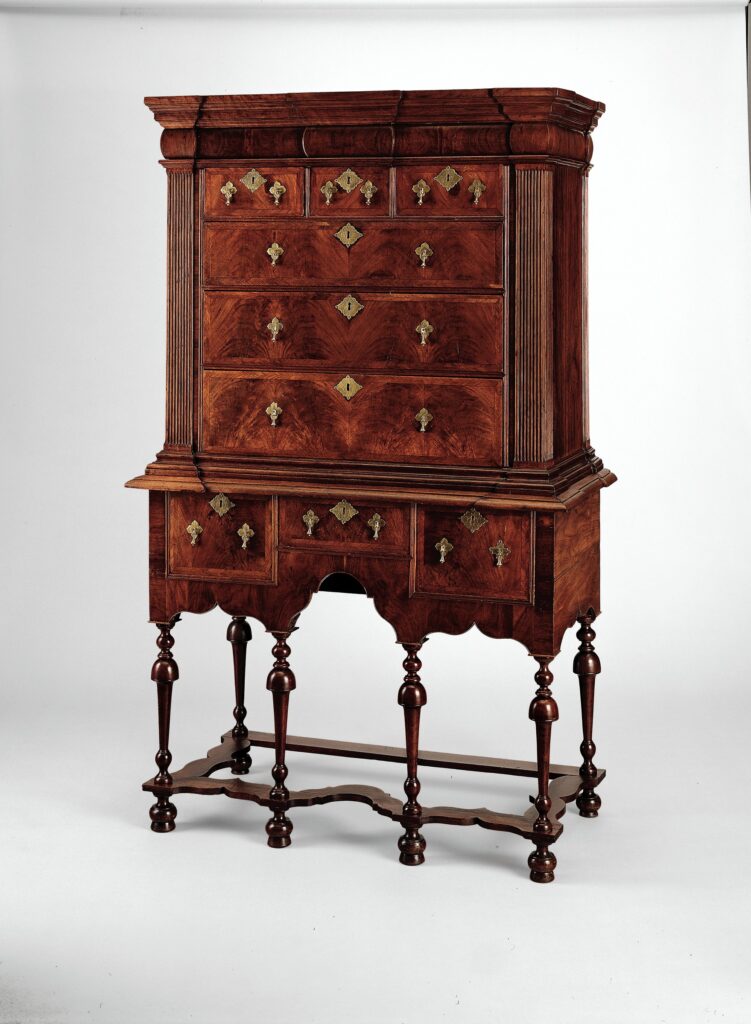
Britannica adds that double chests, chest-on-chests, were once called tallboys in England and highboys in America. The Met’s American high chest of drawers of 1715–30 is black walnut and white pine, nearly 70 inches high, and the museum records it in two parts, a and b. That small detail matters when you shop: a tall chest is two pieces of furniture, and each part needs to be checked.
Mid-century shapes: mahogany, curves and veneer
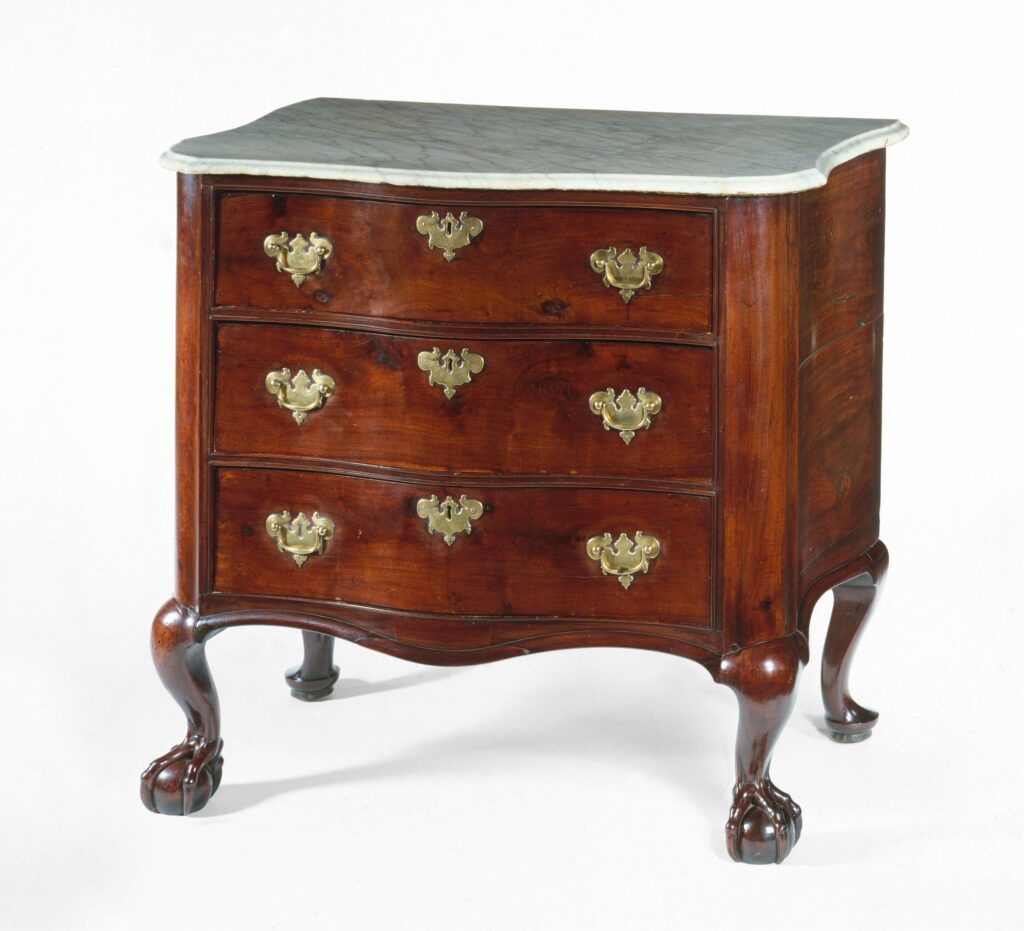
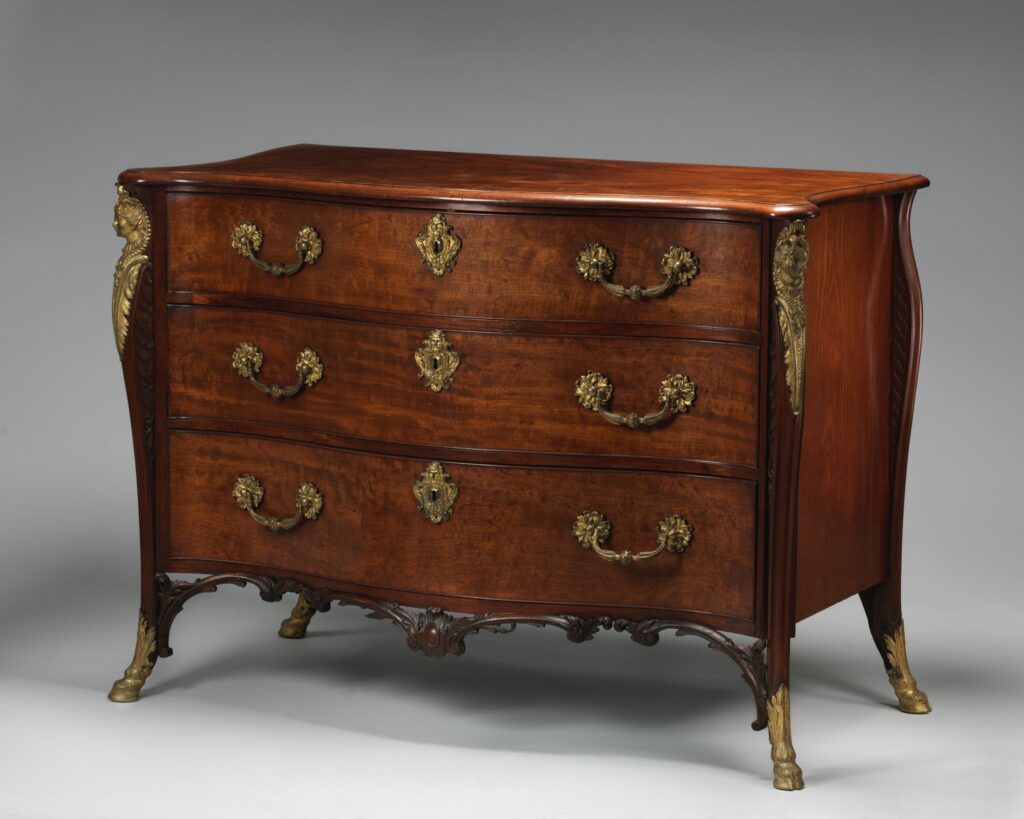
By the middle of the eighteenth century, Britannica says, the plain rectangular front was often modified: bevelled corners with Chinese-style fretwork, serpentine fronts and bowfronts all became popular. Two Met pieces show mahogany taking over. John Goddard’s American chest of drawers of 1755–85 is mahogany with white pine and chestnut, about 35 inches high. The English chest by William Vile, about 1750, is pine veneered with mahogany and mounted in gilt bronze, a reminder that a mahogany surface can sit on a much humbler wood.
John Townsend’s chest of 1765, the featured piece at the top of this page, is mahogany on tulip poplar, pine and chestnut. The secondary woods are the part a catalogue rarely mentions and a specialist checks first, because they can point to where a piece was made.
After 1800: inlay, pilasters and turned handles
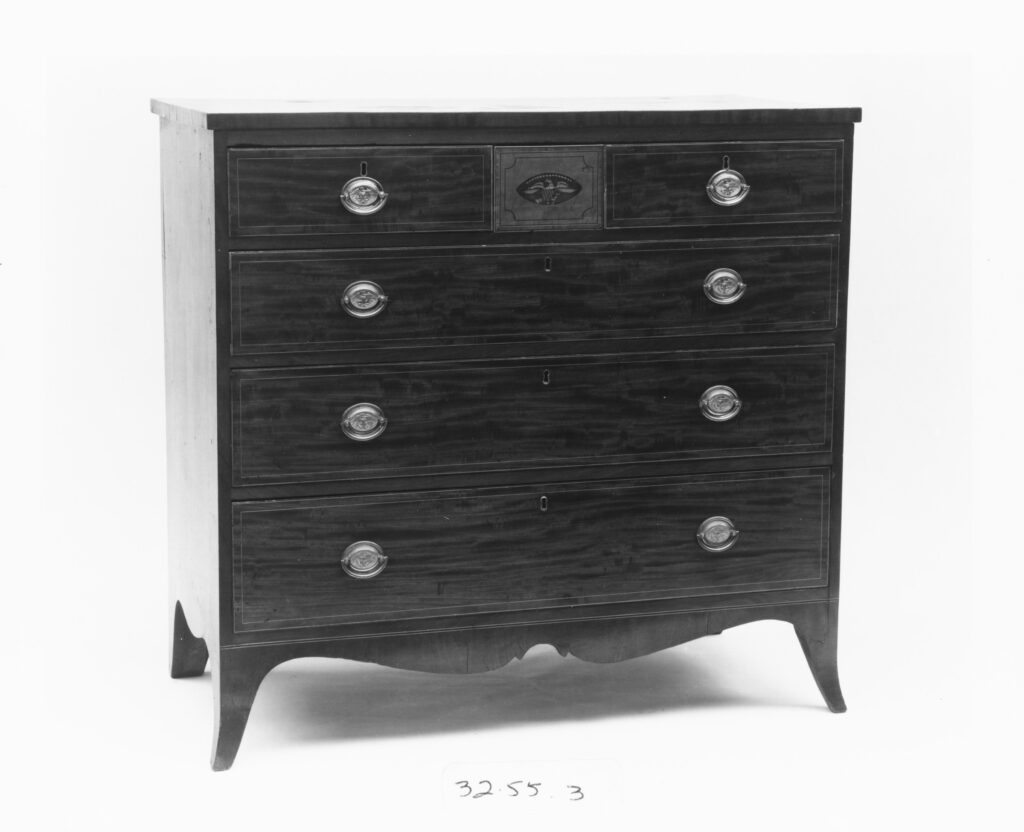
Michael Allison’s American chest of 1800–1810 is mahogany with satinwood and ebony, about 41 inches high, with white pine and tulip poplar as secondary woods. Britannica describes the next steps in England: a heavier version with corner pilasters in the Regency period, and the return of turned wooden handles under Victoria. The Victorian furniture guide covers that later period, and the guide to the antique French commode covers the French chest of drawers, which followed a different path.
How to identify and date an antique chest of drawers
Start from the outside and work in. Feet first: bun and ball feet, or a stand with legs joined by stretchers, are what Britannica describes on early chests, so a later outline standing on early-style feet deserves a question. Then the top: Britannica mentions a flat slide with two small pull handles, fitted at the top to extend the table space, which is worth looking for on an early piece.
Count the drawers and read the front. The early arrangement Britannica describes is three long drawers of different depths under two short ones side by side. A straight front suits the earlier pieces here. Britannica says bevelled corners with fretwork, serpentine fronts and bowfronts became popular in the middle of the eighteenth century, and that a heavier build with corner pilasters arrived in the Regency period. An outline that does not match the date a seller gives is a reason to ask more.
Read the handles last, not first. Britannica says pulls began as turned wood and moved to brass, with escutcheons whose design followed fashion, and that turned wooden handles came back in the Victorian period. A pull can be changed in minutes, so it shows which fashion a piece has reached, not when it was made. A practical check, which is advice rather than a museum finding: look inside the drawer front for old screw or bolt holes that do not match the handles now on it.
Open a drawer and read the wood. The Met records the woods for every chest above, and the pattern is instructive. Goddard’s is mahogany with white pine and chestnut. Townsend’s is mahogany with tulip poplar, pine and chestnut. Allison’s is mahogany, satinwood and ebony with white pine and tulip poplar. Blin’s early chest is white oak with yellow pine and white cedar, and the high chest is black walnut with white pine. William Vile’s English chest is the reverse: pine veneered with mahogany. A seller should be able to name the show wood and the lesser woods inside, and a surprise is a question rather than a verdict.
Count the parts and ask what has been replaced. A tall chest is two pieces, which the Met records as parts a and b, so check that both belong together. On any chest, ask about the hardware, the feet, the top and the backboards. Have the joinery checked by a specialist before you commit: drawer construction and tool marks are best judged in the hand, and a dealer or auction house that knows the period can tell you what a description cannot.
Then measure. The Met’s low chests above run from about 34 to 41 inches high, and the tall one is nearly 70 inches. For the questions that apply to any antique, see the buying vintage furniture guide; the wording of a sale description is explained in reading an auction catalogue properly.
Sources
- Encyclopaedia Britannica, chest of drawers, read October 15, 2026.
- The Metropolitan Museum of Art, records for the Townsend chest of drawers (27.57.1), the featured image, Blin chest with drawers (66.190.1), American high chest of drawers (1975.132.1a, b), Goddard chest of drawers (1972.130a, b), Vile chest of drawers (61.242.1), Allison chest of drawers (32.55.3). The six images are public domain under the Met’s Open Access policy. Image descriptions are written from the museum records.