What is a credenza? The word began as a way of trusting a meal. Italian credenza means belief or confidence, and Merriam-Webster links the name to the Middle Ages and Renaissance, when a noble or royal household had a servant sample the food and drink before it reached the table. Poison was a standing risk, and the sampling happened at a dining room sideboard, the piece the Italian word came to name.
Today the word usually means something else. Search results for it are dominated by furniture shops and decorating pages that describe a long, low storage cabinet. Merriam-Webster’s definition looks back: a sideboard, buffet or bookcase patterned after a Renaissance credence, “especially one without legs.” Museum pieces from the fifteenth and sixteenth centuries show how much the form changed in between.
What is a credenza? A word for trust
Credenza is a cousin of the English credence. Merriam-Webster traces credence through Anglo-French or Medieval Latin credentia to the Latin credere, to believe or trust, and records its first English use in the fourteenth century, in the sense of credibility. The same dictionary gives credence two furniture senses: a Renaissance sideboard used chiefly for valuable plate, which it derives from Old Italian credenza by way of Middle French, and a small table where the bread and wine rest before consecration.
The poison story is how the dictionary explains the name, and a V&A gallery text repeats it: credenza means “trust,” a reference to the practice of testing food for poison. Neither the dictionary nor the V&A says when the furniture sense first appeared or which household first used it, so the story explains the name without dating it.
A cupboard, or a stage for silver?
Early credenze were not always cupboards. A V&A gallery text on an Urbino vase of about 1570 describes how a host advertised his wealth at a banquet by setting out valuable silver, glass or ceramics on a makeshift tiered structure. Italians called that arrangement a credenza, the text says; in France and England it was a buffet. Food and working objects might fill the lowest tier, and after the meal the tiers came apart and the valuables went under lock. In that text the word covers a way of displaying wealth as well as a piece of furniture.
The Met’s note on its Cloisters credenza describes the form’s own change. It began, the text says, as a working sideboard for preparing and serving food, and by the late Middle Ages had become a display for costly plates and vessels, often hung with rich fabrics. A Met essay on Italian Renaissance marriage customs gives a scene. When Annibale Bentivoglio, son of the ruler of Bologna, married Lucrezia d’Este in 1487, the main hall of the Palazzo Bentivoglio was dressed with, among other things, “a grand credenza covered with precious vessels of silver and gold.”
Four credenze in two museums
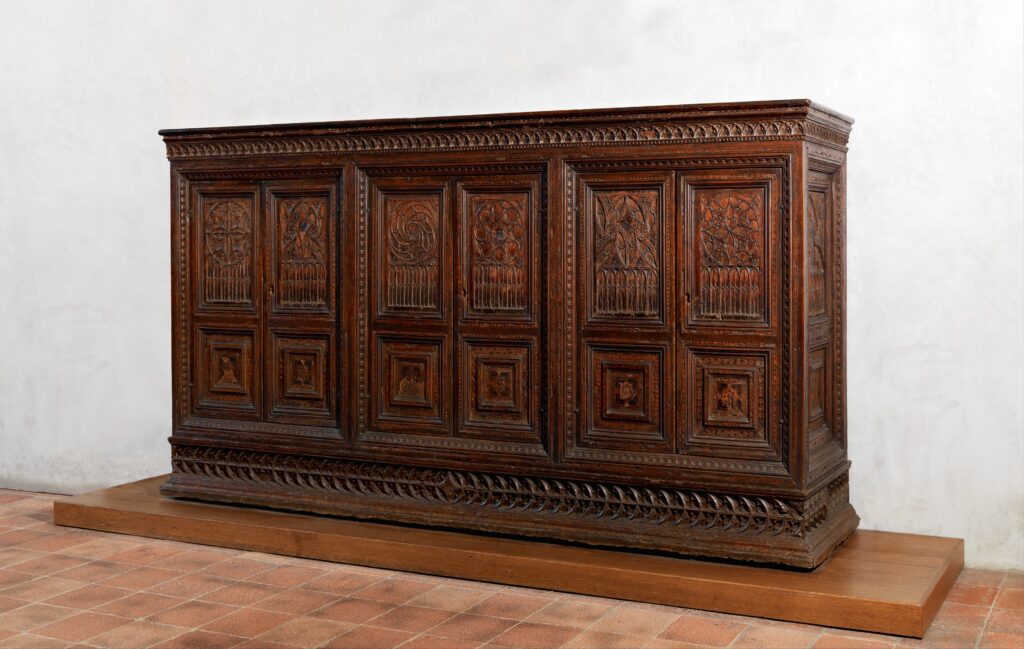
The Cloisters piece, dated 1440 to 1450, is walnut with intarsia and 125 inches (about 3.2 meters) long. The Met calls it unusually well preserved for medieval furniture. Eight panels decorate it: in the upper part of each, a round form like a rose window sits over a row of pointed lancets, and below is a square field of geometric inlay. Across the front, six of the panels make three pairs of doors, and each pair opens on a two-shelf interior for dishes. The Met attributes it to the brothers Lorenzo and Cristoforo Canozi of Lendinara, in northern Italy, and associates it with their early style.
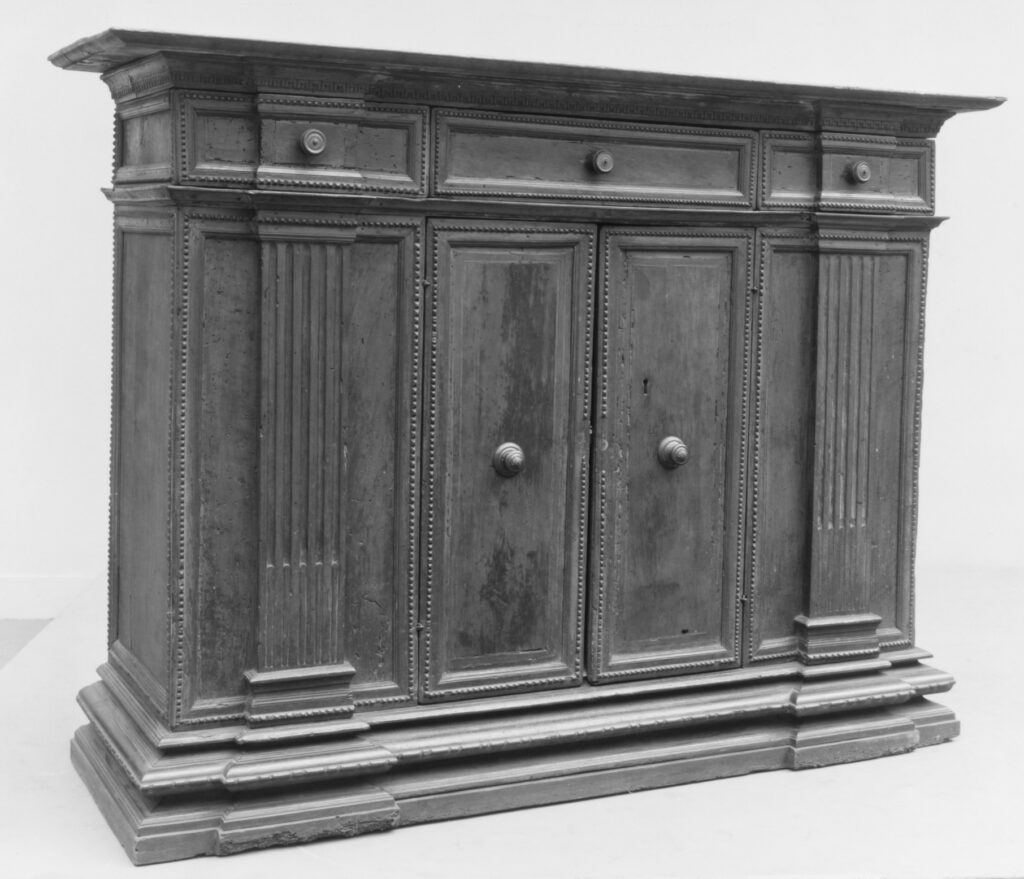
A Tuscan cupboard of about 1500 to 1550, which the Met catalogues as a “cupboard (credenza),” is walnut with poplar, ebony, ebonized wood and maple, about 47 inches high and 140 inches long. In the photograph below the manner is plainer: three panelled doors with round wooden knobs, each flanked by a narrow panel, angled end sections and a slim band of small repeating pattern under the top. The rose windows and lancets of the earlier piece are gone.

Two other pieces add a row of drawers above the doors. The Met’s “cabinet (credenza)” of the second half of the sixteenth century, in walnut and about 53 inches high, has three drawers under a projecting cornice and two panelled doors between fluted pilasters, on a stepped plinth. The V&A’s carved walnut credenza, dated 1550 to 1600 and set on lion-paw feet, has a lower cupboard with fluted pilasters and two side-hinged doors flanking a fixed central panel, under three wide drawers alternating with four narrow ones.
Credenza, cupboard, sideboard or buffet?
The V&A’s record for that walnut piece shows how unsteady the names are. Its gallery label from before 2006 reads Armadio (Cupboard) and says the piece was previously described as a credenza or sideboard, adding that it is of similar dimensions to the armadi in the Medici family’s inventories of the middle of the sixteenth century. An earlier label, from 1967, read Sideboard (Credenza). The current record is titled Credenza. One object has been a sideboard, a credenza and a cupboard in the same museum’s words.
Merriam-Webster’s definition explains some of the drift: a credenza is a sideboard or buffet patterned after a Renaissance original. The V&A’s vase text treats credenza and buffet as one arrangement in two languages. Where that text puts the buffet in France, the French Provincial furniture guide lists buffets among the region’s characteristic storage pieces. None of these sources gives a modern rule by height, legs or storage. The story of the English word is in What Is a Sideboard?; a shop’s line between the two is that shop’s usage.
Old, or old in parts?
Credenza is also a label that later furniture carries. The Met’s Robert Lehman Collection catalogues a small walnut, iron and bronze “cabinet (credenza),” about 64 centimeters high and 100 wide, and dates it to the nineteenth or first half of the twentieth century, with Renaissance parts. The museum’s own date wording marks the difference between a Renaissance piece and a later one built with older parts.
The V&A’s record keeps the paper trail for its walnut credenza: bought in 1904 for 38 pounds from Manifattura di Signa. A note in the record says the firm was a famous ceramic manufacturer that also offered good-quality reproduction goods. That is provenance context, not doubt: the V&A dates the piece 1550 to 1600, and adds that a great many credenze of this basic type exist, generally of wider proportions. The general questions to ask a seller are in the buying guide for vintage furniture. A label that says credenza tells you which Italian form the name comes from; the date wording tells you how old the piece itself is. Individual forms and later styles have their own guides: secretary desk and antique display cabinets.
Sources
- Merriam-Webster, credenza and credence, read October 12, 2026.
- The Metropolitan Museum of Art, Credenza, Italian, 1440–50 (53.95), the featured image, and the records for the Tuscan cupboard (credenza) (1993.354), the cabinet (credenza) (26.260.10) and the Lehman cabinet (credenza) (1975.1.2014). The three images are public domain under the Met’s Open Access policy. Read October 12, 2026.
- The Metropolitan Museum of Art, Art and Love in the Italian Renaissance, Timeline of Art History, read October 12, 2026.
- Victoria and Albert Museum, the record for the credenza (1375-1904) and the gallery text on the Urbino vase, read October 12, 2026. The descriptions of the photographs above are the editor’s own reading of the images.