What is a sideboard? Merriam-Webster defines it as a piece of dining-room furniture with compartments and shelves for holding articles of table service, and dates the word to about 1663. Britannica adds the job it did: holding plates, decanters, side dishes and other accessories for a meal, often with cupboards and drawers built in.
The definition is short because the piece changed a great deal. It began as a table, grew pedestals and drawers, and by the 1850s had become a carved monument. This page follows that change through Britannica and four pieces in the Metropolitan Museum, and says honestly where the words sideboard and buffet overlap. It is a history of the form, not a buying guide; the buying questions are in the vintage furniture buying guide.
What is a sideboard? From side table to storage
Britannica says the word first appeared in the Middle Ages as an alternative to side table, and described a stepped structure for displaying valuable eating utensils. The piece kept a basic table shape, sometimes with eight legs, until the 18th century.
The first innovation, Britannica says, was to substitute hollow storage pedestals, and drawers for napkins, cutlery and the like were then added under the main surface and between them. Britannica also lists a serpentine front, popular in the later 18th century, a marble top, and a brass rail at the back that protected the wall and propped up large plates. Some examples built in a wine cooler, and there were often spaces for chamber pots, which says something about how long a dinner could run.
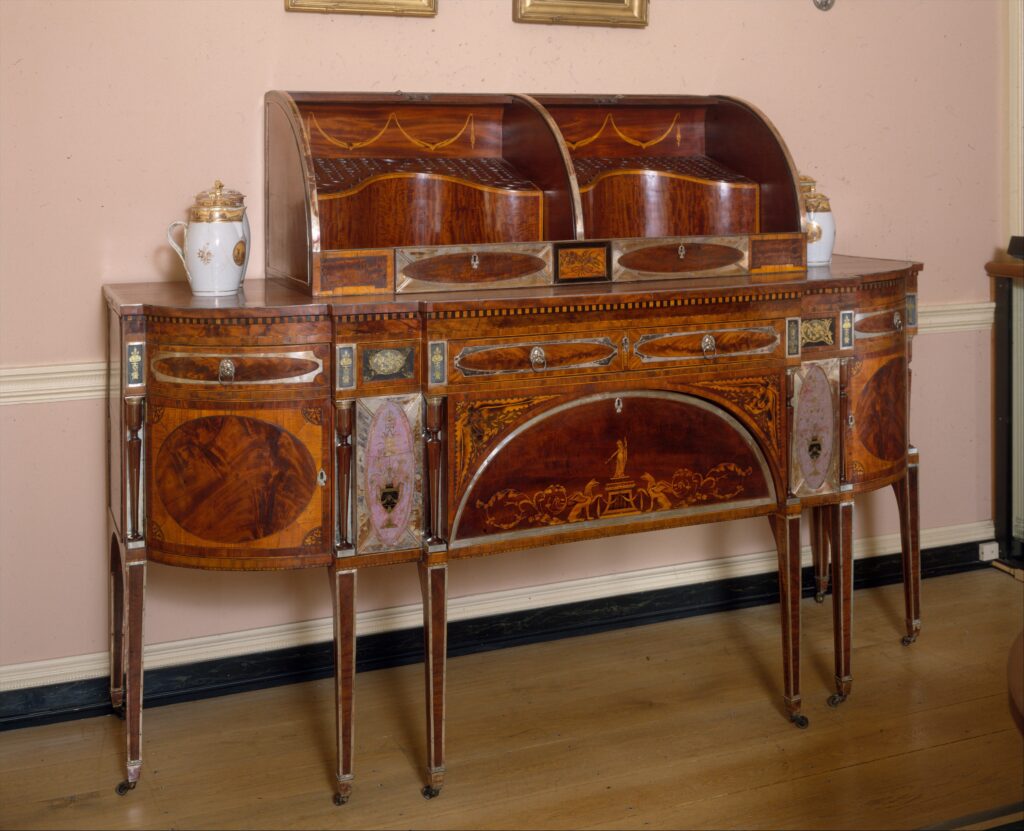
The Met’s American examples show the form arriving. Its curators write that the sideboard was unknown in American homes before the 1790s and quickly became an essential part of the fashionable dining room, where it held and displayed silver flatware, porcelain and glassware. The museum’s bow-fronted example of about 1795 to 1805, with its accompanying knife box, carries inlaid panels of mahogany veneer, marquetry and silver-plated copper, and reverse painting on glass, the technique called verre églomisé. The marquetry is the same craft discussed in the marquetry guide.
Another American piece, from the shop of Thomas Seymour, shows the English precedent. The Met says its form does not follow any published design exactly, but the general shape has many English precedents, and the tambour doors are veneered in alternating strips of light and dark wood, a pattern associated with desks and sideboards from the Seymour shop. The tambour doors are the slatted sliding doors in the centre of the photograph.
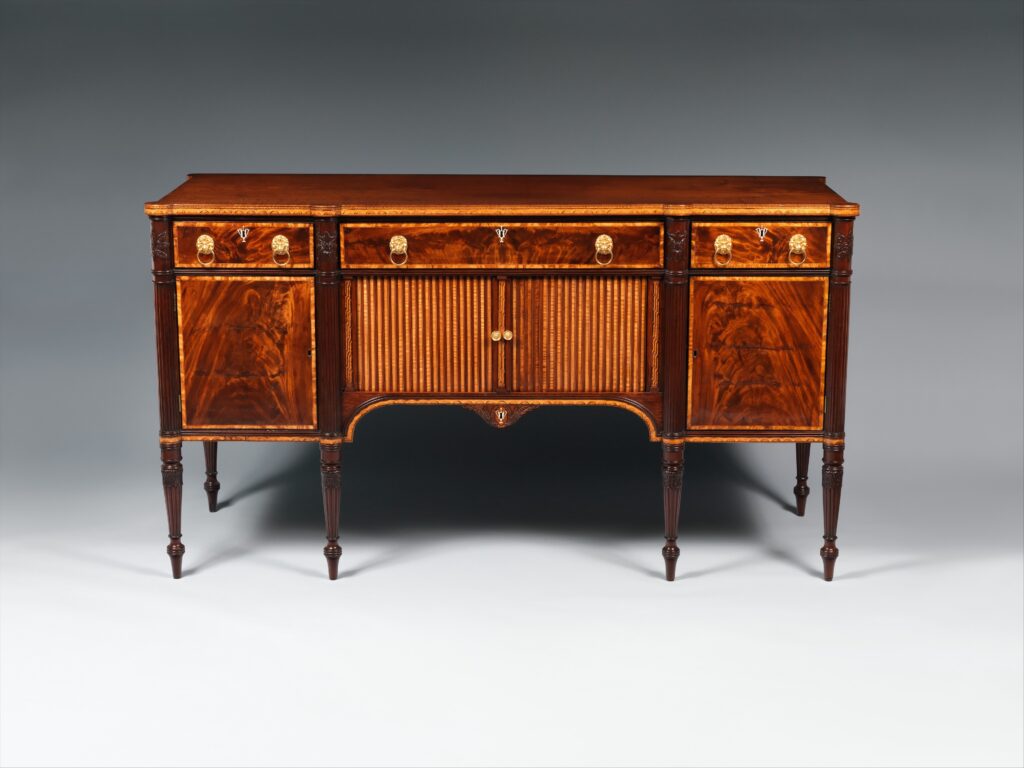
The sideboard gets heavy
A different pattern appears around 1810. The Met describes a sideboard from the shop of the Parisian émigré cabinetmaker Charles-Honoré Lannuier as a massive architectural piece, with flame-grain mahogany veneers against straight-grain crossbanding. It calls this the “French” sideboard, first made in the United States around 1810, and says it became the predominant dining-room storage and display form in American homes in the first half of the 19th century. The name, the museum says, reflects its close relationship to the French Empire desserte, a similarly massive piece with four cupboard doors, a frieze of drawers and columns ending in lion’s-paw feet.
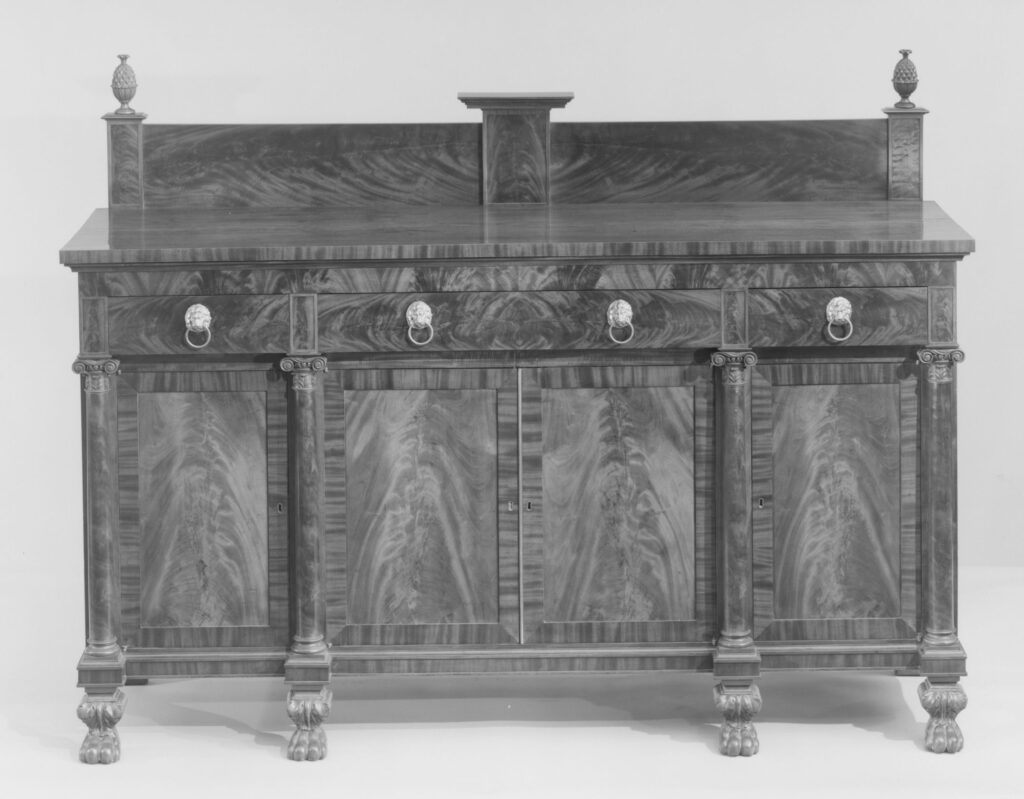
The photograph is a black-and-white record shot, but the arrangement is clear: a row of drawers above four tall cupboard doors, with columns between them. Britannica describes the same drift in general terms. In the early 19th century sideboards became an established part of mass-produced dining-room suites and grew much heavier, the whole lower section divided into cupboards reaching to the floor, the metal rails at the back replaced by large panels, and carving over the whole piece.
The sideboard at the top of this page is that history at full volume. Alexander Roux was a French cabinetmaker who built a reputation in New York for masterfully carved high-style furniture. The Met says he showed the prototype at the 1853 New York Crystal Palace exhibition, which led to a commission from the Astor family for a pair, this one and its mate now at the Newark Museum. Reform furniture of the 1860s took a different line, including a sideboard in the V&A made after one of Charles Eastlake’s designs; it is covered in the Eastlake furniture guide. The wider period is in the Victorian furniture guide.
Sideboard or buffet?
The two words overlap, and the sources do not give a firm line. Merriam-Webster defines one sense of buffet as a sideboard. Britannica’s furniture history, in its passage on the later Middle Ages, lists credence tables as “sideboard or buffet” tables used to store plate and to serve at banquets. The Met, for its part, calls the American pieces above sideboards or sideboard tables, and titles two French 19th-century design drawings buffets (59.608.105 and 59.608.107). That is as far as the museum evidence here goes.
Shops and decorating guides often draw sharper distinctions between a sideboard, a buffet and a credenza, usually by height, legs or storage. Those lines may be useful to a buyer, but they vary from seller to seller and none of them is established by the museum sources here. Treat a firm distinction as that seller’s usage, not as a rule of the form.
Reading an antique sideboard
The sources give a short vocabulary for looking at one. These are questions to ask a piece, not a way to date it by a single feature. A related guide: antique chest of drawers.
- Is it a table or a cabinet? Britannica traces the move from a table on legs to hollow pedestals, drawers, and later cupboards to the floor.
- How is the front shaped? Britannica names a serpentine front as popular in the later 18th century; the bowed front on the early piece above is a close cousin.
- What is on the top and back? Marble tops, brass rails and, later, heavy carved back panels, all named by Britannica.
- What are the doors and drawers made of? Veneers, crossbanding, tambour strips and inlay are recorded on the Met pieces and are worth looking at under light.
- Does the weight match the date? A very heavy, carved form fits the mid-19th century, but a later maker could copy it.
- Is anything original to a set? The Met’s Roux sideboard had a mate made for the same client, and the early example comes with a knife box: a sideboard may have been one of a group.
Sources
- Encyclopaedia Britannica, “Sideboard” and “Credence”, which quotes the later Middle Ages passage of its furniture history.
- Merriam-Webster, “sideboard” and “buffet”.
- The Metropolitan Museum of Art: sideboard, Alexander Roux, ca. 1853 (1993.168); sideboard, ca. 1795 to 1805 (45.77); sideboard table, Thomas Seymour, 1805 to 10 (65.188.1); sideboard table, Charles-Honoré Lannuier, 1812 to 19 (1972.235.1).
- The Metropolitan Museum of Art, design drawings titled buffets, French, 19th century (59.608.105 and 59.608.107), records read by title and date only.