In 1878, in the preface to the fourth London edition of his best-known book, Charles Eastlake complained about American furniture sold under his name. American tradesmen, he wrote, were advertising what they called “Eastlake” furniture, which he had had “nothing whatever to do” with and whose taste he would be sorry to be held responsible for. The Victoria and Albert Museum quotes the passage in its record of a sideboard made after one of his designs.
The label outlived the objection. Eastlake furniture now means the plain, rectilinear, lightly decorated furniture of the 1870s and 1880s that took its cue from his book, and the name covers more kinds of pieces than he was willing to answer for. Museum records show how far apart those pieces can be, and what they share.
Who Charles Eastlake was, and what his book argued
Charles Locke Eastlake (1836 to 1906) was, in the words of the Metropolitan Museum of Art, a British design reformer; its record of his book lists Plymouth as his birthplace and London as his place of death. Hints on Household Taste in Furniture, Upholstery, and Other Details appeared in England in 1868. The V&A says it was reprinted twice by 1872, and the first American edition, published by James R. Osgood & Co. of Boston, came out in 1872; a seventh American edition followed by 1886.
What he argued was plain furniture, honestly built. The V&A describes his designs as simplified Gothic Revival, with a strong emphasis on constructional honesty and practicality. A Met record quotes him wanting no “extravagant contour or unnecessary curves”, and another says he thought oak by far the best wood for both appearance and durability. The pieces that follow include walnut and cherry as well as oak. The Gothic Revival he simplified was one of several revivals competing for Victorian parlors, and the other Victorian revivals are covered in the guide to Victorian furniture.
He drew, and others built. A V&A sideboard of about 1868 follows one of the plates in the book almost exactly, apart from an inscription along the top rail and some shaped brackets, down to the shelves Eastlake suggested for displaying china. The museum can say only that the Art Furniture Company possibly made it. That firm advertised furniture to his designs in 1867, and the V&A records another London firm, Jackson and Graham, making pieces after them in the 1870s.
Three things sold as Eastlake
A dealer’s listing uses one word for three different things, and sorting a piece into one of them does most of the work of recognizing it.
Furniture after his own designs
The closest thing to an original is a piece made after a design in the book, like the V&A sideboard. That piece is English, and the museum’s own label presents it as evidence of the book’s effect on contemporary taste, not as a standard against which other pieces are measured.
The New York reform makers
In America the style arrived through firms working in what the Met calls the Modern Gothic, also known as Reform Gothic. The Met credits the partnership of Anton Kimbel and Joseph Cabus with popularizing it in America. Their display at the 1876 Centennial Exhibition in Philadelphia, which the V&A says included an entire drawing room of ebonized cherry, was widely admired, and the V&A adds that the style was known in America as “Eastlake” after the English writer.
The Met’s Kimbel and Cabus desk of about 1875 shows what the label meant in practice: oak, mortise-and-tenon construction, a trestle base with stiff diagonal front legs, shallow incised ornament, linenfold panels, chamfered edges and metal strap hinges. The Met says Eastlake would have approved of the oak.
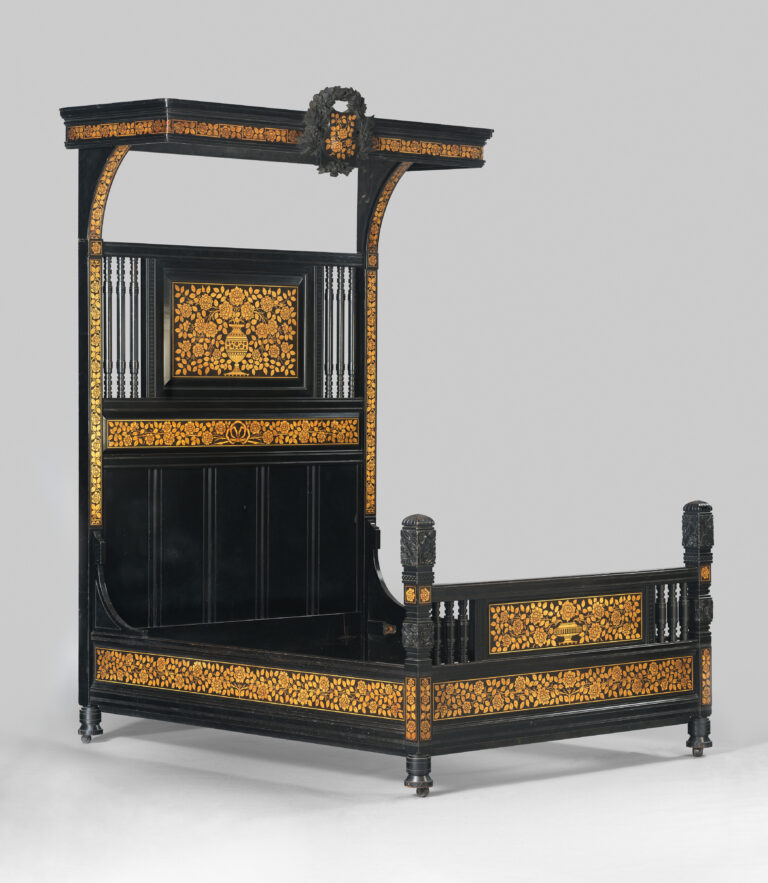
Herter Brothers, the New York firm of Gustave and Christian Herter, took reform ideas in a richer direction. The Met describes its wardrobe of 1875 to 1883 as spare and rectilinear, in line with what Eastlake espoused, yet the marquetry is among the most remarkable in the firm’s work and the form refers to Ming-dynasty cupboards.
A Herter secretary of 1882, made for the financier Jay Gould’s Fifth Avenue house, is in what the Met calls a simplified Eastlake, or reform, style, with marquetry that shows the influence of Eastern lacquerware. A reform frame did not require a plain surface. For the rooms such pieces were made to furnish, see how Victorian rooms were put together.

Factory and carpenter versions
Much of what turns up in shops under the name is neither of those. The Illinois State Museum notes that Eastlake style furniture turns up in antique shops all over the United States, especially in the east and the midwest, made by factories in the east that had branch offices in midwestern cities. Carpenters also built pieces from patterns, for their own homes and for customers. The museum’s table of about 1880, in walnut and marble, is an example. Marble has its own inspection points, set out in the notes on marble tops and cane backs.
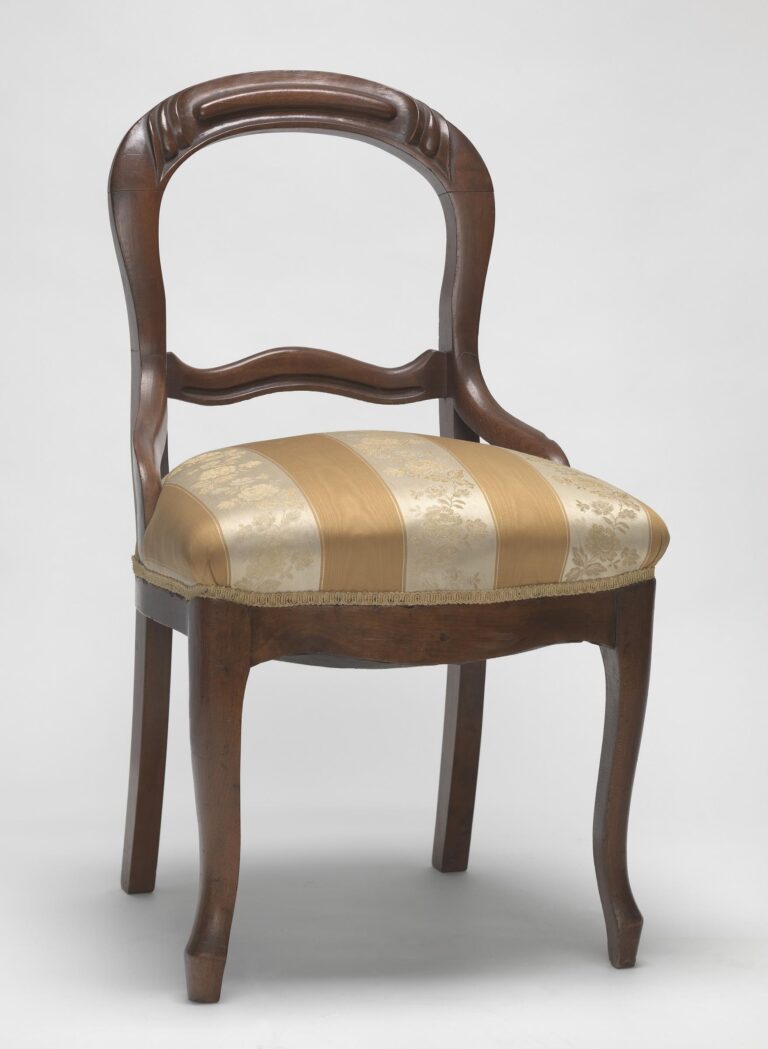
Treatment varied. According to the Illinois museum, some versions were more ornately carved than Eastlake’s idea and others were incised only lightly, perhaps with nothing more than reeding and chamfered corners. What survived was the concept of simple, affordable cottage furniture.
How to recognize Eastlake furniture
No single feature settles it. The signs that count come as a group, and the group is clearest in the museum pieces:
- A rectilinear frame, with flat or lightly shaped parts, in place of the elaborately carved Rococo Revival suites that the Met describes in its essay on American revival styles.
- Shallow incised lines and geometric patterns. The V&A says incised linear decoration and geometric patterns appear on almost every Kimbel and Cabus cabinet.
- Chamfered edges and trestle feet and, on the Gothic-leaning pieces, pointed gables and strap hinges.
- Oak, walnut or cherry, sometimes ebonized, meaning finished black in imitation of ebony.
- Inset tiles or painted panels, and sometimes marquetry, on cabinets; the V&A says tiles and painted panels were frequent on British furniture of the time and rarely used on American pieces.
- Metal fittings that belong to the design: nickel-plated brass on the Met desk, coppered brass hinges on the V&A cabinet.
Chairs show the principle most clearly, and the Met’s Kimbel and Cabus side chair shows its limit. Its form and prominent mortise-and-tenon joints, the Met says, epitomize the “honest” construction promoted by British designers, yet some of those visible joints are simulated. Its angled stiles and rear legs follow designs published in 1872 by the German architect Edwin Oppler. A joint that looks structural is not proof that it is, and a loose one on a chair like this is usually a repair job; the method is in repairing a loose chair joint.

Dressers, beds and the rest of the set
The forms in the museum records are the ones a household needed: the sideboard, the desk and the cabinet, and the bedroom. Herter’s chest of drawers of about 1880 belongs to a suite of five pieces, 69.146.1 to .5, that the firm made for Jay Gould, and the 1882 secretary was commissioned to match the existing bedroom suite. For the Gould rooms, at least, the pieces were designed as a set, so a search for an Eastlake dresser or bed may be a search for part of one. For parlor seating in the other Victorian styles, see the Victorian sofa and settee forms.
What the look cannot tell you
Reform firms, factories and carpenters all used the same vocabulary of straight lines and incised ornament, so the look alone cannot say who made a piece, when, or whether it follows Eastlake’s drawings. The Illinois museum’s remark that the style differed from the original concept applies to a great deal of what survives.
The museum records read for this article give no test for separating a period piece from a later reproduction, so none is offered here. They do show where to look: how each joint is made rather than how it looks, what the wood and fittings are, and whether a piece carries a maker’s name or a documented history. A seller who calls something original should be able to say whether that means made in the period or made after Eastlake’s own design, which of the three kinds it is, and what supports that.
A catalogue entry that says only “Eastlake style” is describing a look, not attributing the piece, and reading an auction catalogue properly covers the wording. A seller’s answers belong alongside the general checks on drawers, veneer and repairs in how to inspect and price an old piece.
It helps to know what these pieces cost when they were new. The V&A notes that a cabinet closely resembling its Kimbel and Cabus example appears in the firm’s own records at $75, in 1876.
Sources
- The Metropolitan Museum of Art, American Revival Styles, 1840–76
- The Metropolitan Museum of Art collection records: Hints on Household Taste (1977.553.1), desk, Kimbel and Cabus (2000.58), side chair, Kimbel and Cabus (2001.67), wardrobe, Herter Brothers (69.140a, b), secretary, Herter Brothers (69.146.3) and chest of drawers, Herter Brothers (69.146.2)
- Victoria and Albert Museum collection records: sideboard after a design by C. L. Eastlake (W.12:7-1972) and cabinet, Kimbel and Cabus (W.50-1984)
- Illinois State Museum, Eastlake Style Table, circa 1880