A Victorian bedroom was a room that had to be serviced. In Isabella Beeton’s household manual of 1861, the housemaid goes upstairs once breakfast is served. She throws up the sashes, pulls up the blinds, throws back the curtains and opens the beds by taking off the clothes, then empties the slops, rinses the basin and washes the ewers and water-jugs. Only after that does she make the bed.
This guide is about the Victorian bedroom as a room, what stood in it and how it worked, not about furniture styles, which have their own pages: the Victorian furniture guide covers the revivals and Eastlake furniture the reform movement. Two British writers supply most of the evidence here, Beeton on the household and the design reformer Charles Eastlake on the furnishings, and a few American museum pieces show the same room at the expensive end of the market. The sources differ in country and class, and the text says where.
A room that carried water
In these accounts the bedroom is where people washed, and the washstand was its workhorse. Eastlake, in the chapter on the bedroom in Hints on Household Taste (the London edition of 1878 is used here), describes the common type found in the upper bedrooms of a moderately sized house. It was made of deal or birch, usually painted in imitation of oak or bird’s-eye maple. It had two shelves, the upper cut to receive the basin and the lower boxed to take a drawer, a splash-board to protect the wall and four turned legs. He thought the shape reasonable and put the price at 40 to 50 shillings.
The expensive version, in his account, was “superior Spanish mahogany” with carved standards and a marble top on castors, at six to eight guineas, and French polish that grew shabby with every drop of spilled water. Beeton adds the evening routine: in winter the night things are aired before the fire, with a tin can of hot water if the mistress is in the habit of washing before going to bed. Both writers describe a room provisioned with jugs and basins, and a household that carried the water.
The bed in a Victorian bedroom
Eastlake traces the sequence. A huge four-poster, in his words, was once thought indispensable to every sleeping apartment, and it was followed by the wooden canopied bedstead, called a half-tester in the shops, and the French bedstead, with head and foot alike. The half-tester and the French bedstead, he says, were still in use when he wrote, though iron and brass were fast displacing mahogany and rosewood, a change he thought for the better, especially in large towns.
He was less kind about the ironwork. Makers concealed the joints where tie rods cross with a lumpy ornament that he said resembled a friendly group of garden slugs, repeated a dozen times on a bedstead and thousands of times across the trade. Iron beds, he advised, should not be allowed to shine: Venetian red, chocolate and sage green were his colors. His own design for an iron bedstead with a canopy appears as Plate XXVII.
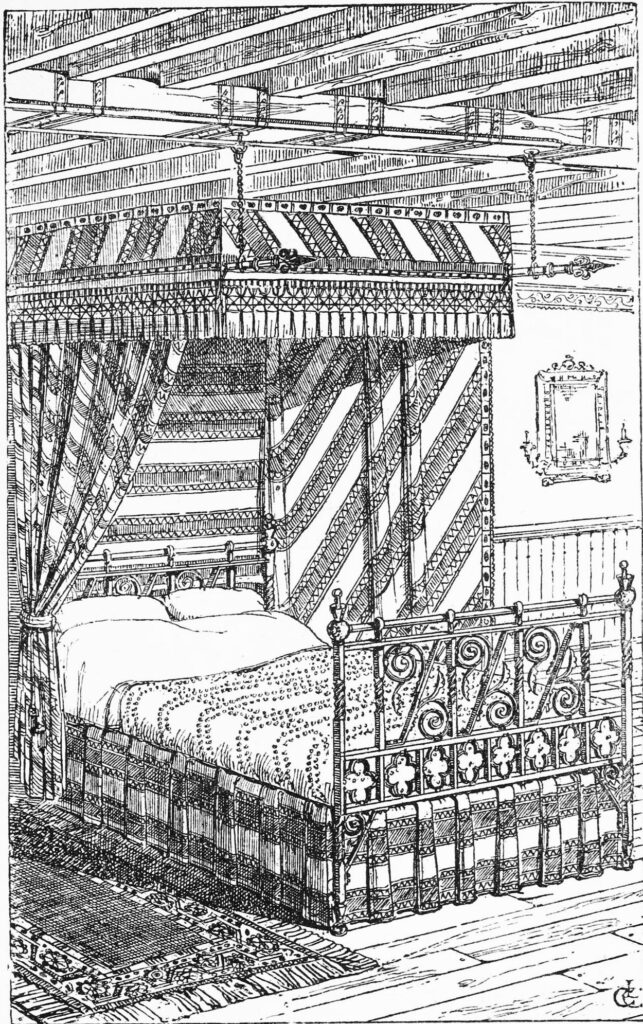
Whether to have hangings at all was a live argument. Eastlake notes that many people now preferred, on sanitary grounds, to sleep in beds without hangings of any kind, but he could not see why curtains and a canopy would harm a well-ventilated room. White dimity, he thought, looked well against a wall of decided color, though white curtains soiled quickly in London, so he suggested cretonne, chintz or printed cotton. They should hang within two or three inches of the floor, he said, and be tied back when not in use.
Under the sleeper, Beeton describes a stack. Some people slept on the mattress, which usually lay on a feather bed, resting on a second mattress, with a straw paillasse at the bottom. Once a week a bedroom was thoroughly cleaned: the housemaid brushed the mattresses, shook the curtains and lay them smoothly on the bed, and pinned up the valance so that she could sweep beneath.
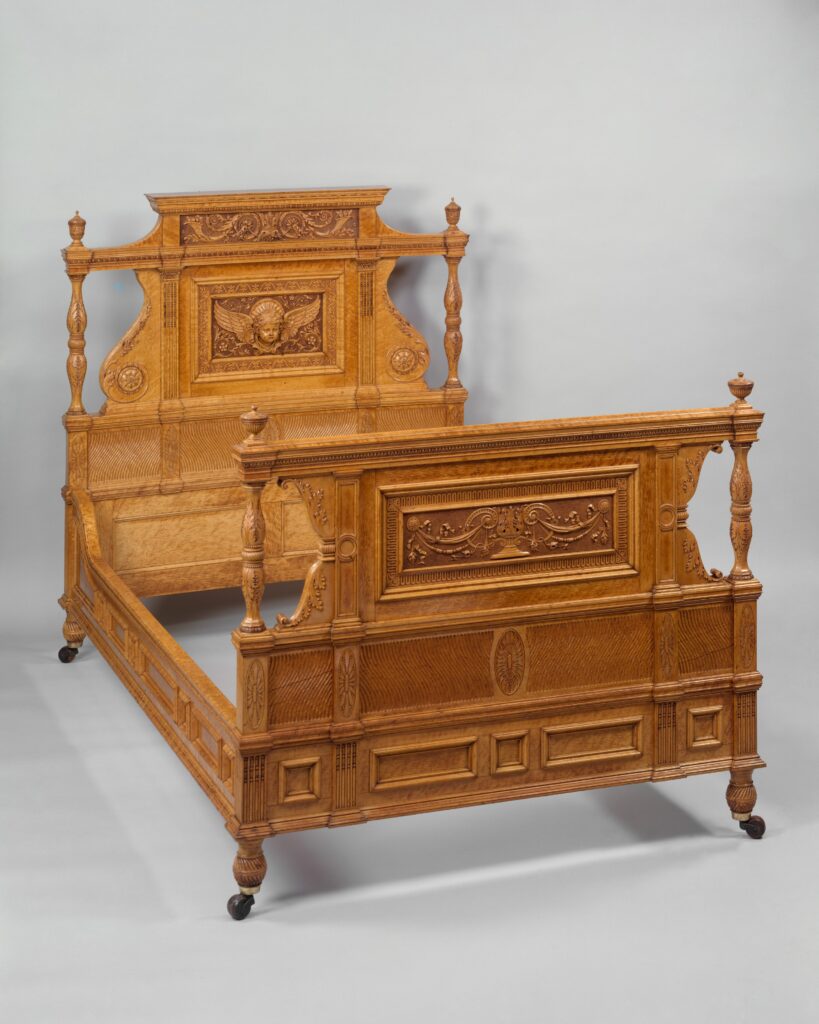
The Metropolitan Museum’s American beds show the grand end of the same piece of furniture. A cherry bedstead by Herter Brothers of New York, about 1880, belonged to a suite made for the financier Jay Gould, and the Met gives it a height of about three meters.
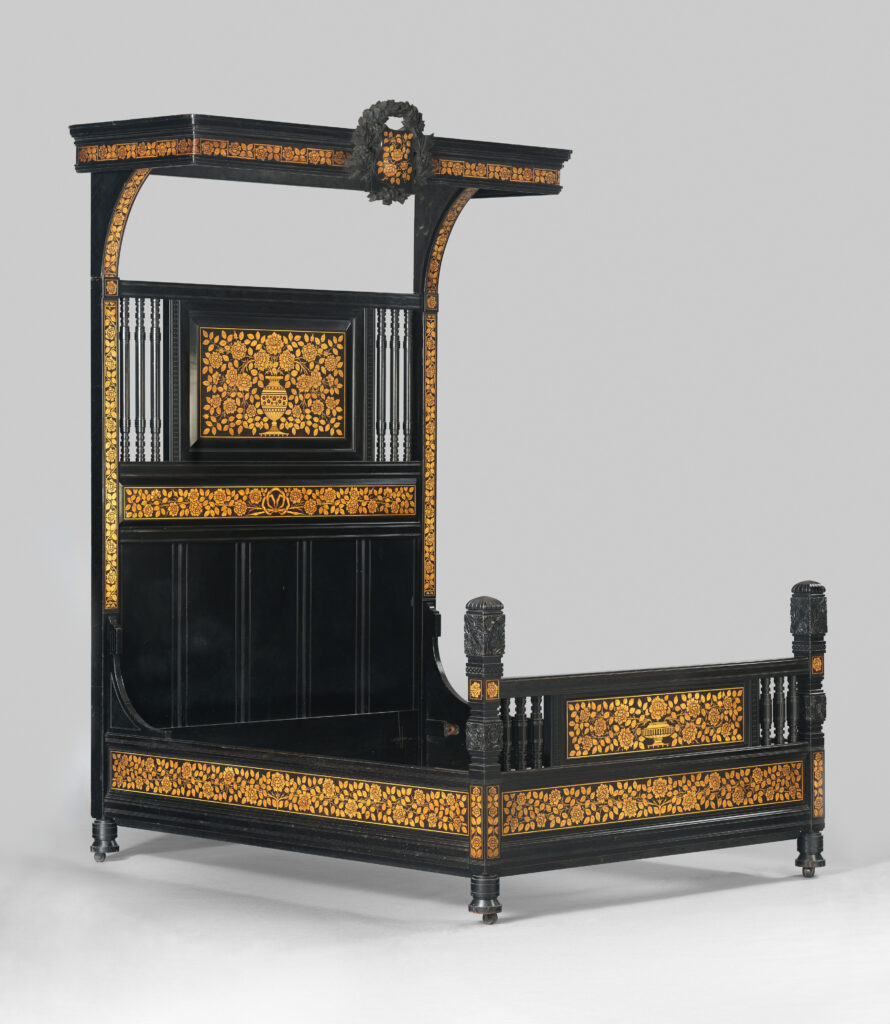
Another, from the Henry Gurdon Marquand house in New York, was made between 1881 and 1884 as part of a suite for Elizabeth Love Marquand. The museum says it is made of American woods, that its Renaissance-style carving suggests a foreign-born craftsman, and that richly carved furniture of this kind became fashionable about 1880, in contrast to the flat surface decoration of the 1870s. These are rich New York bedrooms, not British ones, and the fashion described belongs to American taste.
Dressing, storage and the problem of fuss
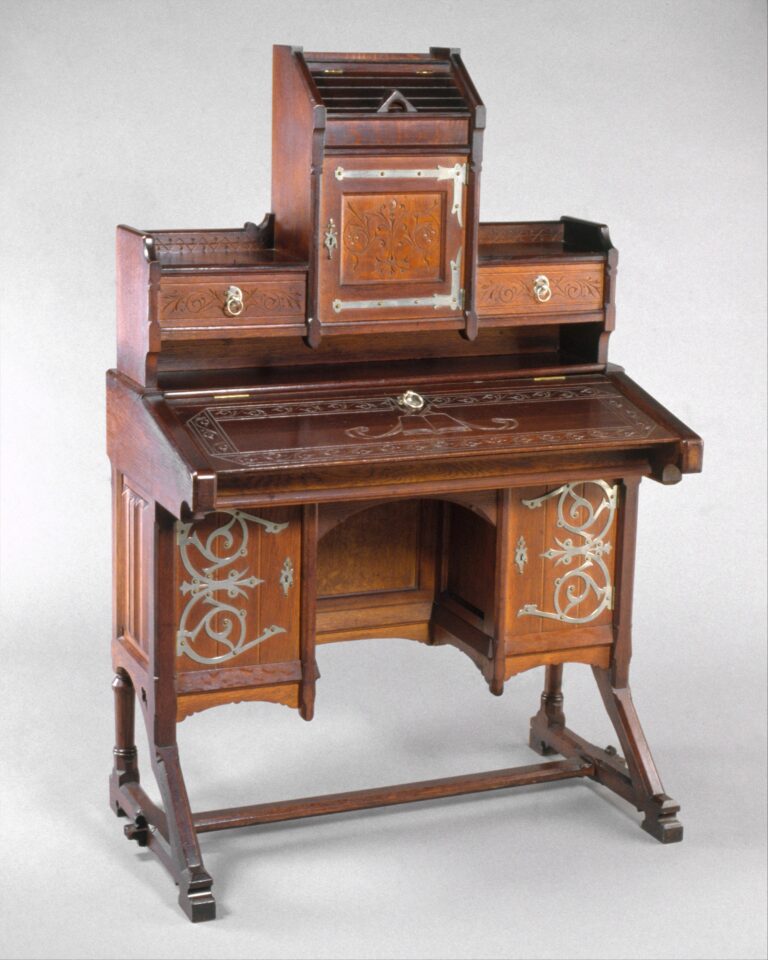
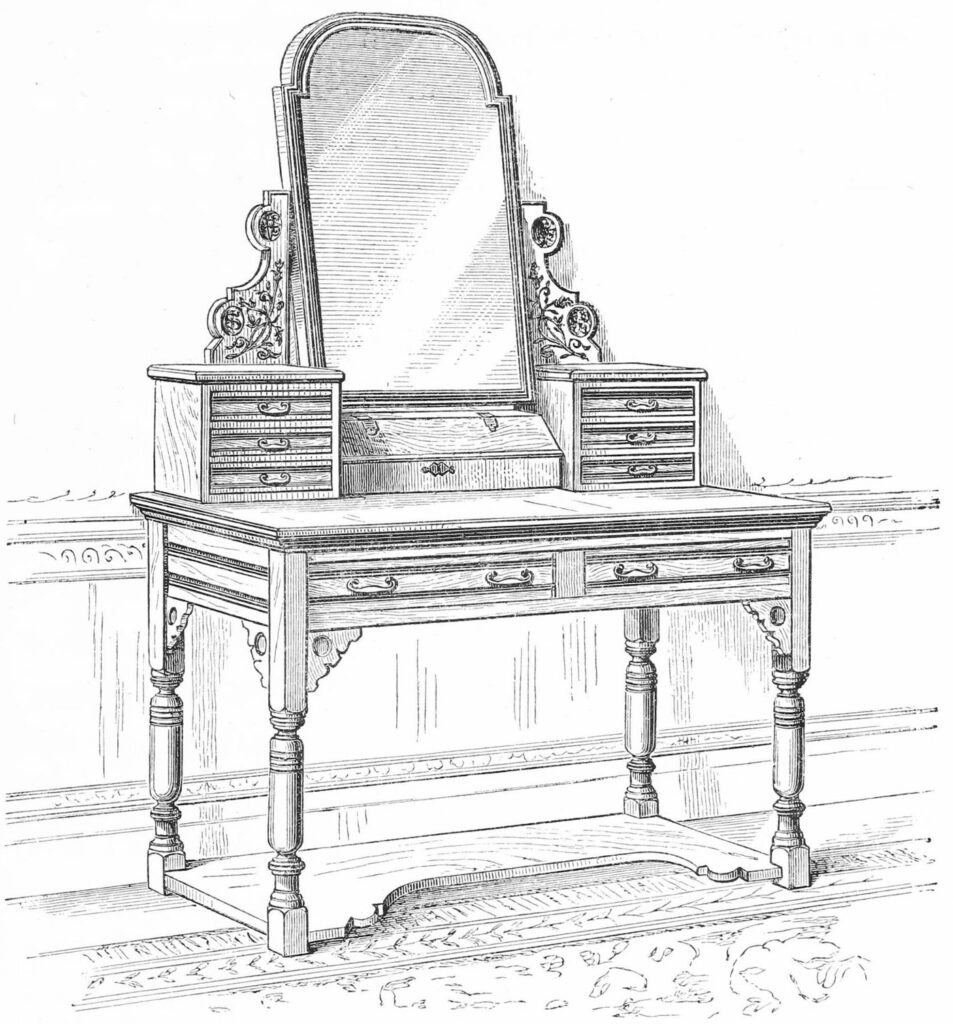
At the dressing table of a Victorian bedroom, Eastlake objected to the practice of encircling toilet tables with a muslin petticoat, generally stiffened by a crinoline of pink or blue calico, and found a marble-topped table with a few drawers cleaner and, though dearer at first, cheaper in the weekly wash. His example is a toilet table made by Jackson and Graham, with a tilting mirror, small drawers on either side and turned legs.
He wanted chests of drawers made of solid wood, rectangular and not bulging at the front, with drawers five or six inches deep so that nobody had to delve through strata of clothes for a coat or waistcoat. For hanging clothes he recommended a wardrobe, again by Jackson and Graham, over the ordinary upholsterer’s rounded corners and scrollwork.
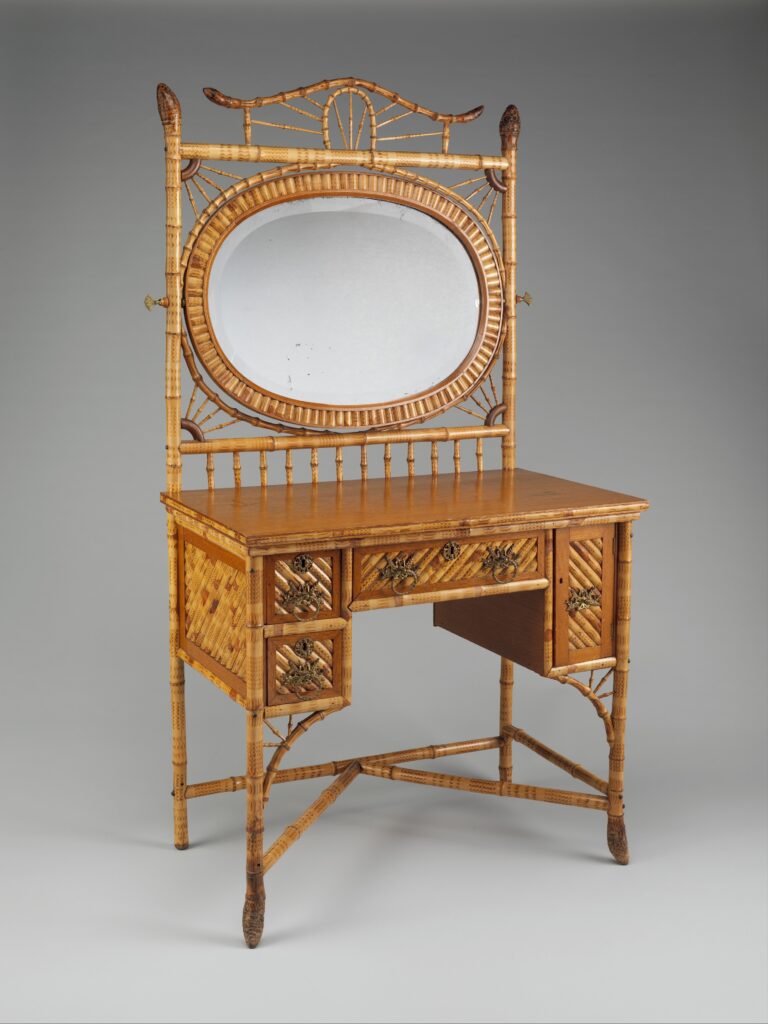
An American dressing table of about 1880 in the Met takes a different route. Made of bamboo with oak, sycamore and poplar, it has a pagoda-type cresting, which the museum says shows the fascination Oriental forms held for makers of the period. The Met’s record for a bamboo-style bed attributed to the Baumann Brothers describes a whole group of bedroom furniture, a dressing table, a washstand, a pair of chairs, a chiffonier, a table, a towel rack and a desk. Differences in the turnings suggest different manufacturers, so the original owner seems to have chosen the pieces from a showroom of bedroom furniture.
Curtains, carpets and a room that was too busy
Eastlake thought modern bedrooms too fussy. Glaring chintzes, elaborate wallpapers, French polish and rich draperies on every side might represent expense and a certain luxury, he wrote, but not comfort. He recalled bedrooms of the previous generation where lace bed-curtains, muslin toilet covers, pink calico and cheval glasses made one fancy oneself in a milliner’s shop. A room meant for rest, he said, should hold nothing that fatigues the eye by complexity.
Cleanliness drove several choices. Our English notions of cleanliness, Eastlake writes, would scarcely allow a bed covering that could not be washed, so the counterpane stayed. He also thought a bedside rug on a bare floor healthier than a fitted carpet in a London house, where dust gathers fast, though fitted carpets were now universal.
Beeton describes the seasonal version of the same routine: in spring or early summer the warm winter curtains were replaced by light muslin ones, carpets were taken up and beaten and beds pulled down so the joints could be cleaned, and the process was repeated in autumn when the warm bed and window curtains returned. See the complete guide to Victorian decor for the wider scheme of color and pattern.
What the evidence says about the Victorian bedroom
Both writers are partial witnesses. Eastlake was a reformer, so he describes what he wanted to change, and his complaints about muslin petticoats, and about the lace curtains of the previous generation, are evidence of what was or had been fashionable and not of what everyone owned. Beeton wrote for the mistress of a household that kept servants. The Met’s pieces come from rich households in New York. Not one of them is a typical bedroom, and the museum objects in particular should not be read as a picture of British homes.
What the sources agree on is the pattern of a Victorian bedroom: a room serviced by hand and increasingly argued over on grounds of health. For the way Victorian houses assigned jobs to rooms, see Victorian rooms designed for living, and for a modern argument about dim bedrooms, bedrooms darker, not brighter.
Sources
- Charles L. Eastlake, Hints on Household Taste in Furniture, Upholstery, and Other Details (London: Longmans, Green, 1878), chapter VIII, “The Bed-room” (Getty Research Institute copy, Internet Archive)
- Isabella Beeton, The Book of Household Management (1861), the housemaid’s duties (Project Gutenberg)
- The Metropolitan Museum of Art collection records: Bedstead, Herter Brothers (69.146.1), Bedstead from the Henry Gurdon Marquand House (1986.47.1), Dressing Table (1982.193) and Bedstead, attributed to Baumann Brothers (68.97.13)