A walnut chair in the Victoria and Albert Museum, made in England about 1845, has its seat and back covered in needlework roses. The museum calls them full-blown, and says roses and convolvulus of this kind also turned up on carpets, wallpaper and papier-mâché furniture. Under the needlework is something newer than the flowers: coiled metal springs, a technique the museum describes as recently developed, which allowed deeper upholstery. The same two ideas, an old style and a new technique, run through most Victorian chairs.
The V&A describes the back of that chair as an elongated cartouche or balloon shape, framed in carved wood, on cabriole front legs, and calls it typical seating for the parlor of a middle- or upper-class household. Its outline comes from the Rococo of the mid-eighteenth century, which Victorian Britain admired in its French form. The family it belongs to, in listings, is the balloon-back.
Balloon-backs, and the houses they stood in
The form was not reserved for the drawing room. The V&A has a mahogany balloon-back side chair of about 1855 whose horsehair seat covering is a replacement, and a child’s balloon-back of 1845 to 55 in turned wood stained to look like rosewood. Same outline, different budgets. A Victorian chair could be a walnut parlor piece or a child’s chair finished to look more expensive than it was, and the shape alone does not say which.
It is not only an English form either. The Smithsonian’s National Museum of African American History and Culture holds a walnut balloon-back side chair, dated 1875, with cabriole legs, a carved shoulder above the open back and a seat in gold striped brocade. It came from the home of Robert Smalls in Beaufort, South Carolina. Britannica describes Smalls as a war hero who commandeered a Confederate ship to escape and became the first Black captain of a vessel in United States service, and who served in Congress from 1875, during Reconstruction. The museum lists the maker of the chair as unidentified.
A second Smalls chair, a walnut armchair of 1870 to 75, has a balloon back with semi-wings, a deeply buttoned back in golden-brown upholstery and carved wooden trim, and the museum calls it a lady’s parlor chair with an open side. For both chairs, what the record documents is the house they stood in, not who made them.

Revival chairs: Gothic windows in mahogany
The Met’s Gothic Revival armchair by John and Joseph W. Meeks of New York, about 1850, has a pointed-arch back filled with tracery and, at its center, a rose window: an element the Met notes was executed in glass in the Gothic period and is here carved in wood. The spiral-turned posts and legs, the museum adds, are based on Elizabethan motifs that were enjoying their own revival. A cathedral window, in mahogany, on legs from another century.
Quality varied as much as the borrowing. The Met says Gothic Revival furniture of this quality is rare, and it documents an unmarked rosewood armchair of about 1847 to the early career of Thomas Brooks, a Brooklyn cabinetmaker. Its upholstery is a replacement, a detail worth remembering for any upholstery in a listing. The broader sequence of Gothic, Rococo and Renaissance revivals is in the Victorian furniture guide.

Chairs made by patent
Some Victorian chairs owe more to the patent office than the cabinetmaker’s bench. Gardner and Company of New York, the Met says, were the first firm to explore bent and veneered wood for seating, and the Met illustrates the point with a platform rocking chair. Its perforated three-ply veneer seat and back, formed from one piece, was covered by United States patent 127,045, issued to George Gardner on May 21, 1872. The Met lists the chair as walnut, plywood and cast iron.
Henry I. Seymour’s bentwood side chair, patented on May 31, 1870, was modeled closely on Michael Thonet’s model 4, after Thonet’s bentwood patent expired in December 1869. The Met says Seymour seems to have been the first American manufacturer to adapt the design, and that documented American bentwood is rare.
Victorian slipper chairs and Belter’s laminated seating
The slipper chair is a good place to see how much one furniture type could vary, and the Met holds two American examples. The first is by John Henry Belter, made in New York about 1855 in rosewood, with ash as a secondary wood (Met 51.79.9). The museum’s entry says its pierced and carved grapes and vines push the techniques of laminating and bending wood further than before. It also quotes an 1860 New York Times advertisement in which J. H. Belter & Co. said its furniture was built from seven to twenty-one thicknesses of veneer, laid with the grain at right angles to each other, and was lighter and far stronger than ordinary furniture. That is a sales claim, so treat it as the maker’s account of the method, not a measurement.
The second chair (Met 69.285) is American too, made in New York between 1870 and 1880, in beech. It stands 28½ inches high, against 44¼ for the Belter. Side by side, the two show that a slipper chair can be judged by its construction as well as its carving. How laminated wood changed Victorian seating is explained in the guide to Victorian furniture, and sofas of the same years are in the guide to Victorian sofas and settees.
Before you buy a Victorian chair
Begin with the cover. The V&A’s 1845 chair is notable because its original upholstery and springs survive in very good condition; the Met’s Brooks armchair and the V&A’s mahogany chair both carry replacements, and the museums say so. Ask what is known about when the covering was replaced and whether the springs and stuffing under it are original, and if the seller cannot say, treat the cover as replaced.
Check whether it is a single chair or part of a parlor set, as the Victorian settee guide explains for sofas, and look at the frame as the guide to a loose chair joint describes. For armchair vocabulary that crosses over from France, see the bergère and fauteuil guide.
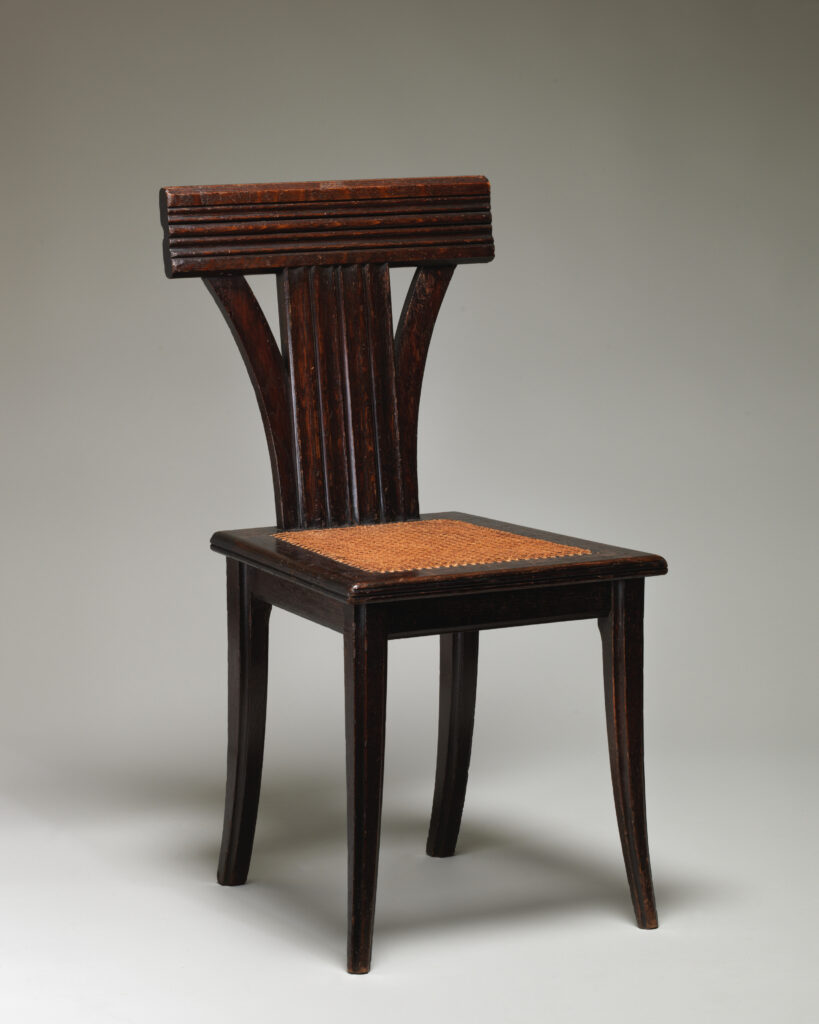
Then turn it over. The Met’s chair designed by George Edmund Street for the Law Courts in London, about 1880, carries the stamp of Gillows & Co. of Lancaster under the back seat rail, and the museum notes that the stamp was used towards the end of the nineteenth century and that a letter L followed by a serial number was introduced in the 1870s. Gothic linenfold in the splat, klismos-derived legs below: the Met calls the design eclectic, and the stamp is a useful clue to its date. Look under the seat rail before you ask for the story.
Sources
- Victoria and Albert Museum: Chair, W.93-1921, Child’s chair, CIRC.155-1950 and Side chair, CIRC.235-1960
- Smithsonian National Museum of African American History and Culture: Balloon-back side chair, 2010.28.4 and Walnut armchair, 2010.28.2
- Encyclopaedia Britannica, Robert Smalls
- The Metropolitan Museum of Art collection records: Armchair, Meeks (1985.189), Armchair, attributed to Thomas Brooks (1999.461), Platform rocking chair, Gardner and Company (1981.156.2), Bentwood side chair, Seymour (1984.448.2) and Side chair, George Edmund Street (2015.544)