Merriam-Webster dates the first recorded use of “settee” to 1716, of “sofa” to 1717 and of “chaise longue” to 1800. Victoria came to the throne in 1837. All three words were therefore older than her reign, and much of what the period changed was underneath the cover. A Victorian settee is, in practice, a seat for two or more people made during that reign, which ran from 1837 to 1901, and the vocabulary around it is looser than buyers tend to expect.
Merriam-Webster defines a settee as “a long seat with a back” or “a medium-sized sofa with arms and a back”, and a couch as an article of furniture for sitting or reclining, with sofa as its listed synonym. The names overlap, so they are a poor way to tell a Victorian settee from a sofa or a couch. Form is better: how many people it seats, what stands behind and beside the sitter, whether it reclines and which way the seats face. The museum examples here are mostly American, from the Metropolitan Museum of Art, with English evidence from the Victoria and Albert Museum.
Victorian sofa, settee and couch: what the words mean
Britannica treats “sofa” as another name for the settee, which it describes as an upholstered seat with a back and arms, designed for two or more people sitting or reclining. The earliest surviving examples, from seventeenth-century Europe, have sides that let down so the seat converts into a bed. It adds that the precedent was set of making the settee part of a matched set of chairs, a habit that matters for Victorian pieces.
The three words arrived by different routes. Merriam-Webster traces “sofa” to an Arabic word for a carpet or divan, by way of Turkish and Italian, and “couch” to a Middle English word for a bed. The settee is an alteration of the older “settle”. A carpet, a bed and a respelling of “settle” ended up as three words for seats that dictionaries still define partly in terms of one another.
Victorian settee and sofa forms, briefly
- Settee: a seat with a back and arms, for two or more people.
- Sofa: a long upholstered seat, usually with arms and a back, often convertible into a bed, according to Merriam-Webster.
- Love seat: a sofa for two persons.
- Tête-à-tête: two seats facing opposite ways, joined at the sides.
- Confidante: Britannica’s term for a sofa with a seat at each end, divided from the main seat by an upholstered arm; the name was later applied to seats like the tête-à-tête.
- Couch and chaise longue: a long seat for sitting or reclining. “Chaise longue” is French for “long chair”, and Britannica describes it as an elongated chair with an inclined back.
- Daybed and divan: a daybed is a couch that converts into a bed, and Britannica describes one as a long seat with one inclined end; a divan is a large couch, usually without a back or arms.
- Chesterfield: Britannica’s “large, very heavily stuffed and buttoned variety” of settee.
Rococo Revival sofas and the tête-à-tête
The curved, carved seat most people picture as a Victorian settee belongs to the Rococo Revival, one of several revivals laid out in the Victorian furniture guide. The Metropolitan Museum describes the style as inspired by eighteenth-century French sources and characterized by cabriole legs, strong C- and S-curves, and carved naturalistic ornament, particularly flowers. It was popular in America between 1845 and 1865, and Britannica says it borrowed the curves of the Louis XV originals, the cabriole leg above all. Britannica notes that the price of such furniture depended heavily on how much carving the frame carried.
The Met’s essay says Rococo Revival parlors usually held a suite of two sofas, two armchairs, four side chairs in matching silk, a center table and an étagère. For the eighteenth-century French armchairs, see bergère and fauteuil.
John Henry Belter is, the Met says, renowned for laminated and carved rosewood parlor suites in this style. He patented a method of steaming layers of wood glued together in molds, which gave furniture that was thin, strong and curved in two planes, and could then be carved more elaborately than had been imagined. The V&A’s Belter sofa has a back made from seven large sheets of veneer. The museum says that construction would have been expensive, but lighter and stronger than an assemblage of carved wood.
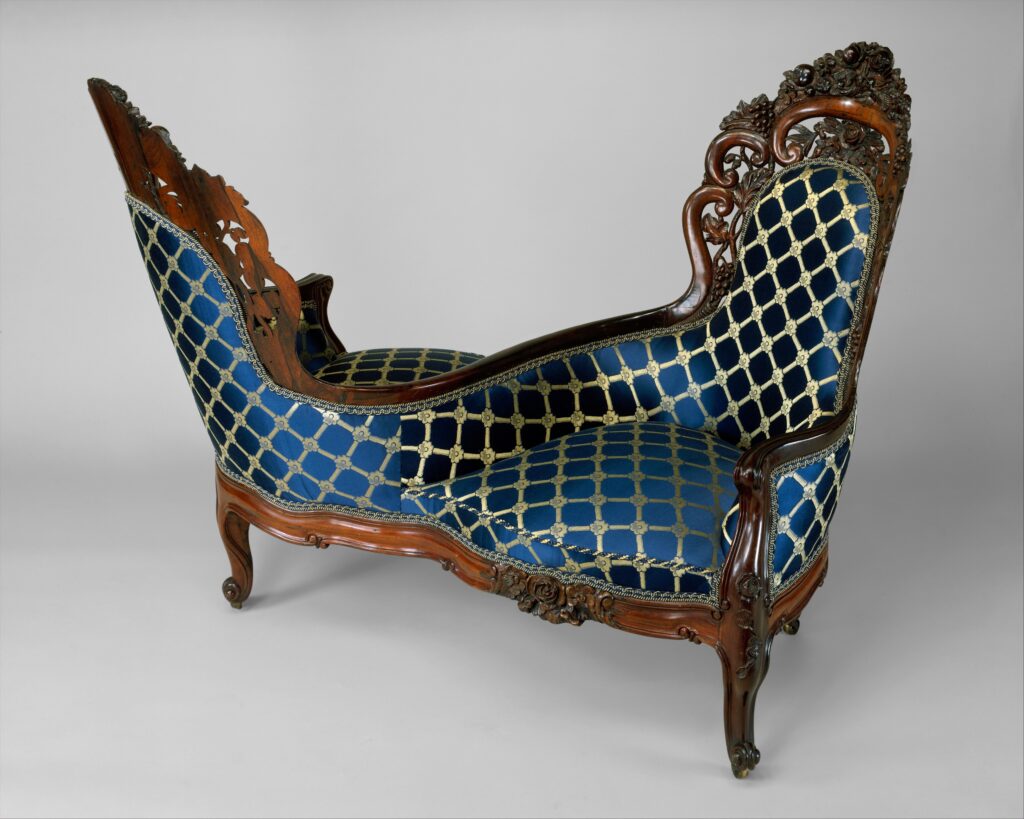
The piece above is a tête-à-tête from one of those parlor sets. The Met calls the tête-à-tête a mid-nineteenth-century French form, also known as a confident, in which two seats face opposite directions and are joined at the sides, which allowed discreet conversation. Britannica’s entry for the confidante, as it spells the name, describes an older sofa with a seat at each end, divided from the main seat by an upholstered arm, used in France from the mid-eighteenth century. The name was revived in the second half of the nineteenth century for seats that held two or more couples facing different ways, often in an S-shape.
A Gothic Revival couch, and the fainting couch
Not every Victorian settee or couch curved. The Met owns a couch made in America between 1851 and 1856 whose design, the museum says, derives from the sofa named for Madame Récamier, immortalized in Jacques Louis David’s portrait of 1804. The form reached the United States at the start of the nineteenth century and was here updated to suit the mid-century taste for the Gothic Revival. The maker is unidentified. The couch matches four chairs from Stanton Hall, a mansion in Natchez, Mississippi, although the Met says it is not known whether this couch was part of that ensemble.
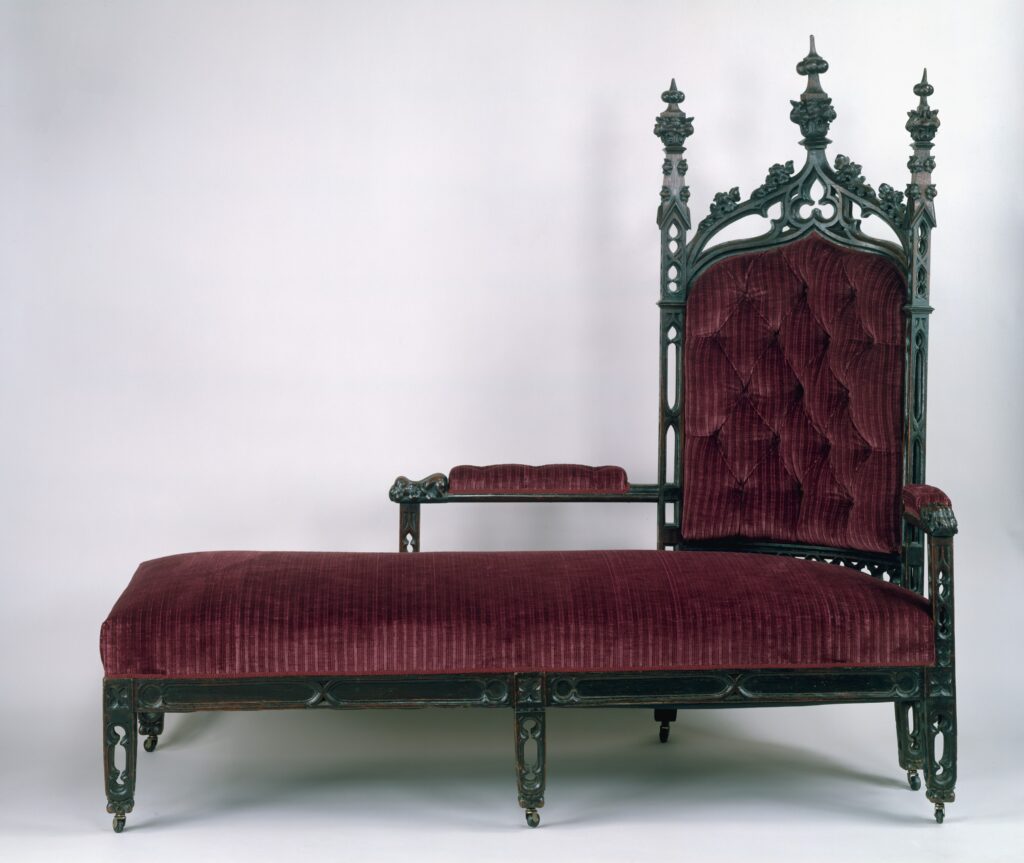
Anyone arriving in search of a Victorian fainting couch will find that the name appears in none of the museum or reference records used for this article. They speak of a couch, a chaise longue or a daybed, and the Met links its Gothic Revival couch to the sofa named for Madame Récamier. Popular accounts link the fainting couch to tight corsets, but none of the sources here supports that, so this page leaves the story out and describes the furniture.
Parlor suites: how sofas were sold
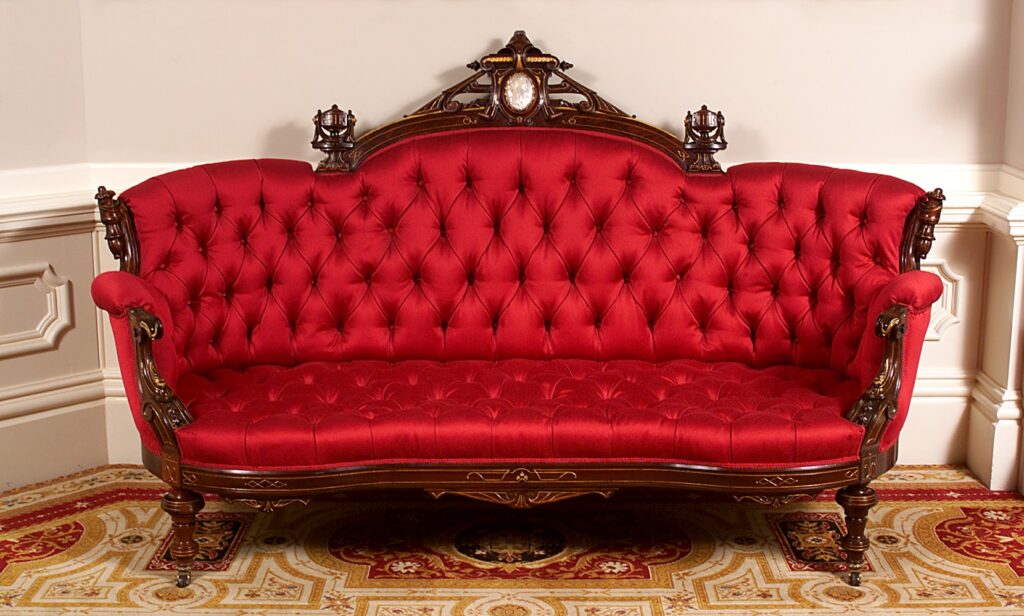
A Victorian settee or sofa found on its own may be a survivor from a larger set. The sofa at the top of this page is attributed to John Jelliff and Co. of Newark, New Jersey, and dates from 1868 to 1870. The Met says it furnished the sitting room, or rear parlor, of a mansion in Meriden, Connecticut, completed in 1870 and heralded as one of the state’s grandest houses. The rosewood furnishings were en suite: armchairs, side chairs, an overmantel mirror and window cornices, all embellished with mother-of-pearl medallions showing a lady’s head in profile.
The attribution rests on a nearly identical armchair at the Newark Museum and its bill of sale from the Jelliff firm. The owner was financially ruined soon after the house was finished, and the house and its contents were sold at auction.
The pattern repeats elsewhere in the Met’s records. A Louis XVI-style suite that the museum’s first president bought about 1856 and used in his music room included two sofas, and George Hunzinger’s settee, below, was part of a suite with two armchairs, four side chairs and a table. For the rooms these suites furnished, see the Victorian interior as a whole, or the wider Victorian decor guide.
Springs, buttons and what lies under the cover
Much of what changed in the Victorian settee and sofa is not visible from the front. Metal springs entered furniture construction in the first half of the nineteenth century, Britannica says, though the exact date is unknown, and they made chairs and sofas much more comfortable than the stuffing used in the eighteenth century. The Met’s essay on European revivalism mentions coil springs in the same context.
In its account of the Louis XVI revival, Britannica says the Louis XVI leg often appeared on upholstered furniture built on a flexible metal “Turkish” frame, where the legs were the only visible wood and the upholsterer’s art reached its height in elaborate tufting, tassels and braids. As photographed, the Jelliff sofa and the Gothic couch are both deeply buttoned.
The V&A’s Belter sofa shows where the evidence lies. After the museum bought it in 1983, it removed a modern red cover and investigated the under-upholstery. Original horsehair pads were still attached to the inside back and the arms. The back pad kept evidence of the original buttoning pattern. The seat pad, never buttoned, kept a distinctive curved and stitched edge along the front, and fibers of the original purple silk were found on the arm pads. A purple silk damask of appropriate design and date was chosen for the new cover.
Later Victorian settees: wire and lattice
Some Victorian settees are built from geometry, not from carved curves. The Met’s settee by George Hunzinger, made about 1876 to 1885, uses a technique he patented in 1876: flat steel wire covered with a continuous woven textile, woven into a grid. Each of the seat, back and arms is made of only two wires, one running in each direction. The Met calls it one of his most progressive designs and says it is one of only two known examples. Hunzinger secured at least twenty-one patents, used interchangeable parts, and made relatively inexpensive, high-quality furniture accessible to middle-class Americans.

The V&A’s example is E. W. Godwin’s settee, designed about 1869 for Dromore Castle in Ireland and based on Chinese low seats with lattice panels. It is ebonized mahogany, a choice the museum says suggests an Asian influence, and William Watt and Co., who made many of Godwin’s designs, advertised it in the 1877 catalogue Art Furniture at £10 10s. Neither piece looks like the carved, buttoned parlor sofa described above, and both date from Victoria’s reign.
Antique Victorian settee: original, copy or later fake?
Victorian makers copied older furniture as well as inventing their own. The V&A holds a double settee modeled closely on one of Thomas Chippendale’s ribbon-back designs. When it was bequeathed, the suite was thought to date from about 1760, but physical investigation and documentary research now suggest it was probably made for a Northumberland house its owners occupied from 1858 to 1877, and the museum dates the settee to 1850 to 1870. The museum says nineteenth-century makers reproduced Chippendale designs to meet demand for eighteenth-century style. Many examples, it says, appear to have been made after 1850 as fashionable reproductions, and after about 1890, when antique collecting grew in popularity, as fakes intended to deceive.
Two cautions follow. A Victorian settee can pass for an eighteenth-century one, and the museum needed more than a look to establish the difference. A Victorian reproduction is still Victorian furniture, so the question is whether the label is honest. For the checks that apply to any older piece, see a general buying checklist.
Reading a Victorian settee or sofa in front of you
Start with the form. Count the seats and note which way they face. Look at the back and arms, and at whether the seat reclines. Those answer the naming question better than the label on a sale-room listing.
Then look at the frame. Carved rosewood curves with flowers belong to the Rococo Revival, a pointed arch to the Gothic Revival, and an ebonized frame with lattice or woven wire to the later experiments described above. In Rococo Revival suites, Britannica says, the price depended heavily on the amount of carving. Ask whether it was made as one of a pair or a suite, since the records above show sofas made as part of suites with armchairs and side chairs.
Finally, ask what lies under the cover, because the cover may not be the original, as the Belter sofa shows. Pads, buttoning patterns and stitched edges are what the V&A used as a guide to that sofa’s original scheme.
Sources
- Encyclopaedia Britannica, Settee
- Encyclopaedia Britannica, Confidante
- Encyclopaedia Britannica, Furniture: 18th century, the Neoclassical style (the 19th-century section)
- Merriam-Webster, settee, sofa, couch, chaise longue, love seat, divan and daybed
- The Metropolitan Museum of Art, American Revival Styles, 1840–76 and European Revivalism
- The Metropolitan Museum of Art collection records: 68.133.1, 57.130.7, 1983.148, 1992.269 and 68.69.1
- Victoria and Albert Museum collection records: W.22-1983, W.6-1965 and W.16-1972