
The instinct in a dark bedroom is to lighten it. Pale walls, more lamps, a mirror opposite the window. It almost never works, because the problem is rarely that the room is dark. It is that it is dim, which is a different fault.
Dim and dark are not the same
A dim room has weak, flat, evenly spread light and pale surfaces that reflect just enough to look grey. A dark room has deep colour, strong contrast and small areas of warm light, and it reads as deliberate.
Painting a dim room white makes it dimmer. Painting it a deep colour makes it dark, which is what most bedrooms actually want to be.
What a dark bedroom does for the room
It reduces the apparent size of the room, which in a bedroom is desirable. It removes the visual noise of edges and corners. And it makes the bed, usually the palest object in the room, the thing the eye settles on.
The Victorians arrived at this without theorising about it, which is why period bedrooms are almost always deeper in colour than their living rooms.
A dark bedroom, painted in 1845
The Met owns a painting that makes the argument without any theory. Johan Vilhelm Gertner’s view of a bedroom in Bernstorff Palace near Copenhagen, painted about 1845, shows a room whose walls and ceiling are covered in the same delicate pink floral fabric. Daylight through the drapery, the museum says, softens the edges of forms and blurs detail into a rose-coloured glow. The colour does not stop at the walls, which is the first rule in the list below.
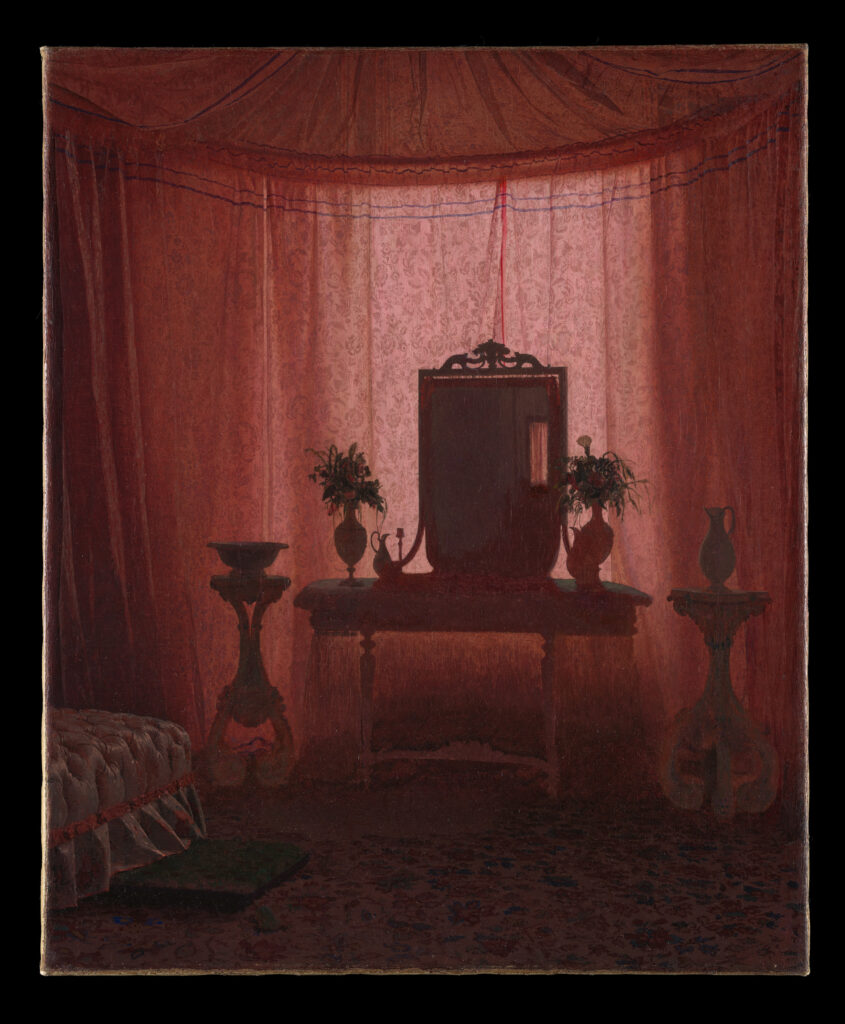
The mirror in front of the window reflects parts of the room that could not otherwise be seen, and the light is soft rather than bright. The room reads as deliberate, not dim. The museum thinks Gertner was given the commission because of his reputation as a portraitist, after the palace was renovated in 1842 under Christian VIII of Denmark.
How to make a dark bedroom work
- Take the colour over the ceiling too. A dark room with a white lid looks unfinished.
- Use a matt or chalky finish. Sheen in a dark colour shows every imperfection.
- Keep the bedding pale and plain, so it does the lifting.
- Light it at low level only, with two small warm sources rather than one overhead.
- Choose green-blacks, brown-blacks or deep greens over pure grey, which goes cold at night.
The room will look smaller and feel considerably better, which in a bedroom is the correct trade.