Japonisme is the name given to the Western taste for Japanese art that began in the middle of the nineteenth century, just after Japan opened its trade with the West. Britannica calls it an aesthetic cult that lasted about a generation in France and England and had a major impact on Impressionist painting. The Metropolitan Museum’s account starts in 1853, when Japanese ports reopened and a tidal wave of imports reached Europe.
For this journal the interesting part is what happened after the paintings. The taste moved from prints to cabinets, vases and whole rooms, and it left a recognizable look on late nineteenth-century furniture, especially the American Aesthetic furniture the Met collects. This page follows that path, then says what to look for on a piece.
What japonisme means
Britannica lists three spellings, Japanism, Japonism and Japonisme, and uses them for one thing: the influence of Japanese art on Western art and design. It is about the West looking at Japan. For the rooms and furniture Japan itself made, start with Japanese furniture and Japanese interior design.
In practice the word covers two habits. The first was collecting and quoting. The Met describes shiploads of what it calls Oriental bric-à-brac, among them fans, kimonos, lacquers, bronzes and silks, pouring into England and France, and it uses the French word japoneries for pictures that staged models in kimonos among conspicuous props.
The second habit was learning. The Met says Edgar Degas avoided the props and took the qualities he found sympathetic in Japanese prints: elongated formats, asymmetrical compositions, spaces emptied of all but color and line, and a focus on single decorative motifs. In the process, it adds, he redoubled his originality. The distinction is useful later, because furniture shows the same split between a borrowed surface and a borrowed idea.
How Japan reached the West
Trade is the short answer. The Met says that after the ports reopened in 1853, woodcut prints by the masters of the ukiyo-e school were on the crest of the wave. They showed Impressionist and Post-Impressionist artists that simple, everyday subjects from the “floating world” could be presented in appealingly decorative ways. Parisians saw their first formal exhibition of Japanese arts and crafts when Japan took a pavilion at the World’s Fair of 1867.
The founding stories are charming and, by the Met’s own wording, only reported. It is said that James McNeill Whistler discovered Japanese prints in a Chinese tearoom near London Bridge, and that Claude Monet first met them as wrapping paper in a spice shop in Holland. The museum is firmer that James Tissot and Degas were among the earliest collectors of Japanese art in France.
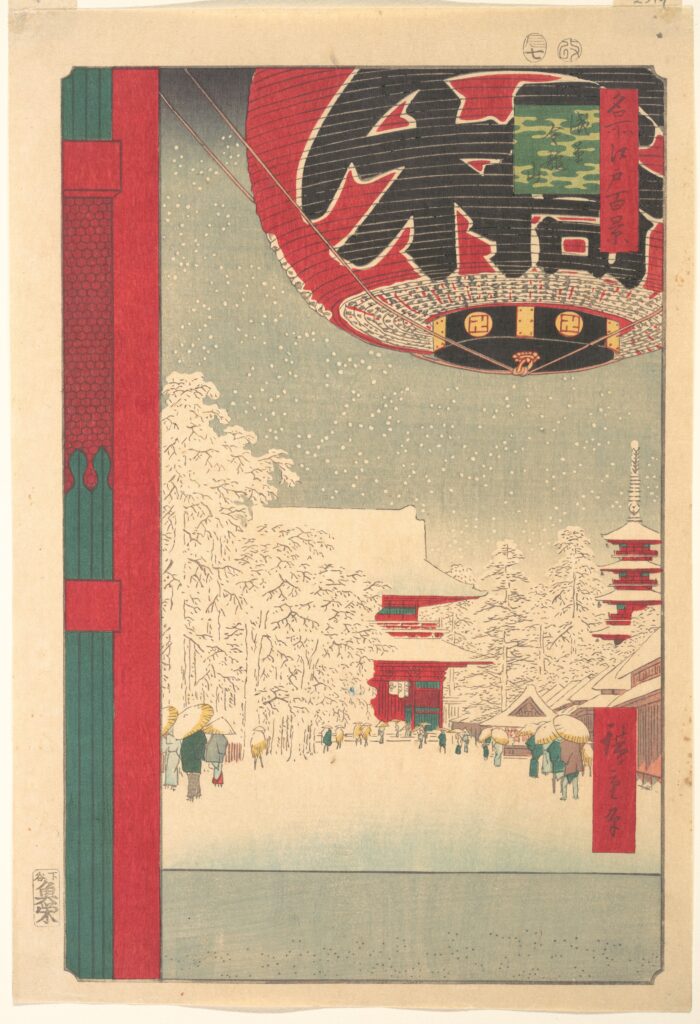
A print like this one shows the lesson Degas took. A huge lantern is cut off at the top of the frame, and the temple recedes in snow beyond it. The Met’s essay ties the unusual viewpoints of ukiyo-e prints to the work of Pierre Bonnard and Édouard Vuillard, and cites this Hiroshige among its examples.
From prints to rooms
Prints hang on a wall; furniture has to be built. On the interiors, Britannica is plain: in France, it says, an attempt to emulate Japanese interior design after the 1867 Paris exposition was less important and more ephemeral than the effect on painting. The furniture story is richer in the United States, in the Aesthetic work of the years around 1880, and the Met’s American Wing documents it well.
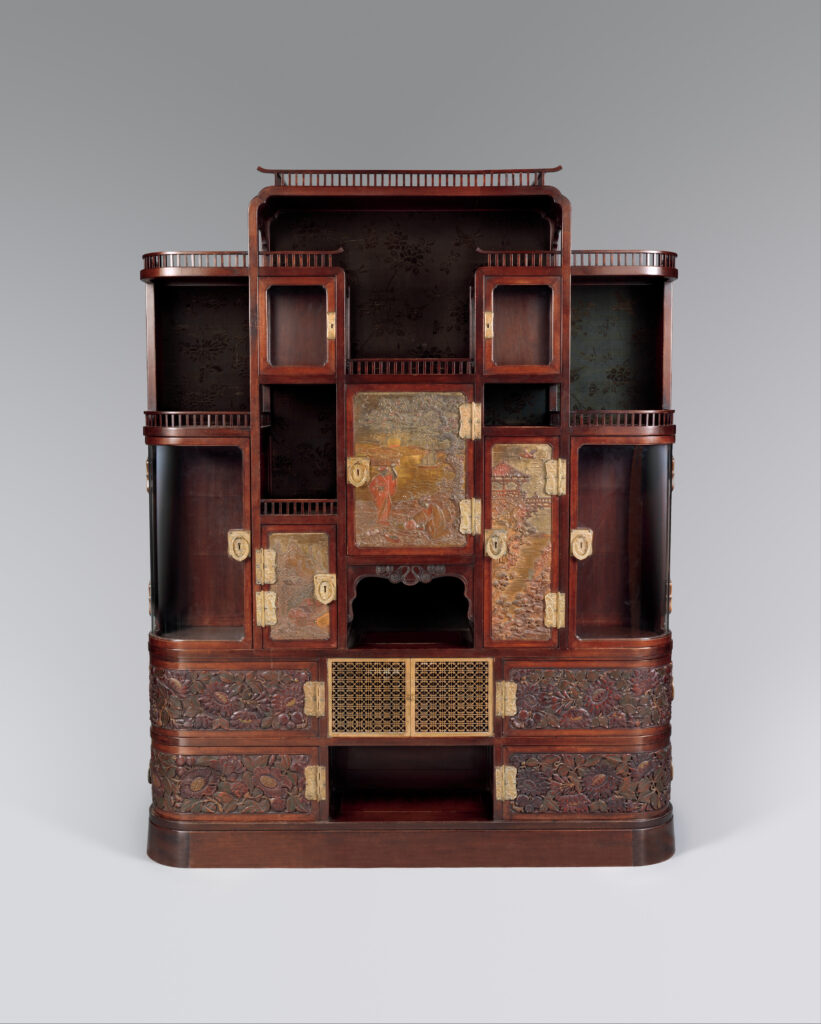
William H. Vanderbilt’s Fifth Avenue mansion, built in 1879, is the clearest case. The Met’s record for the cabinet at the top of this page describes the house’s Japanese parlor, next to the drawing room: a ceiling sheathed in golden bamboo set between red lacquer beams, walls almost hidden by cabinetry, and étagères with elaborate asymmetrical shelving. A contemporary description of the house, the museum notes, said that Japan had lent its ideas even where the workmanship was American.
The lower doors of the cabinet carry low-relief blossoms, leaves and pomegranates in the manner of carved lacquerwork, and three metal panels carry relief scenes, colored red and gold, that the museum says echo Japanese landscape painting. The maker was Herter Brothers, which the Met calls one of the premier cabinetmaking firms in New York.
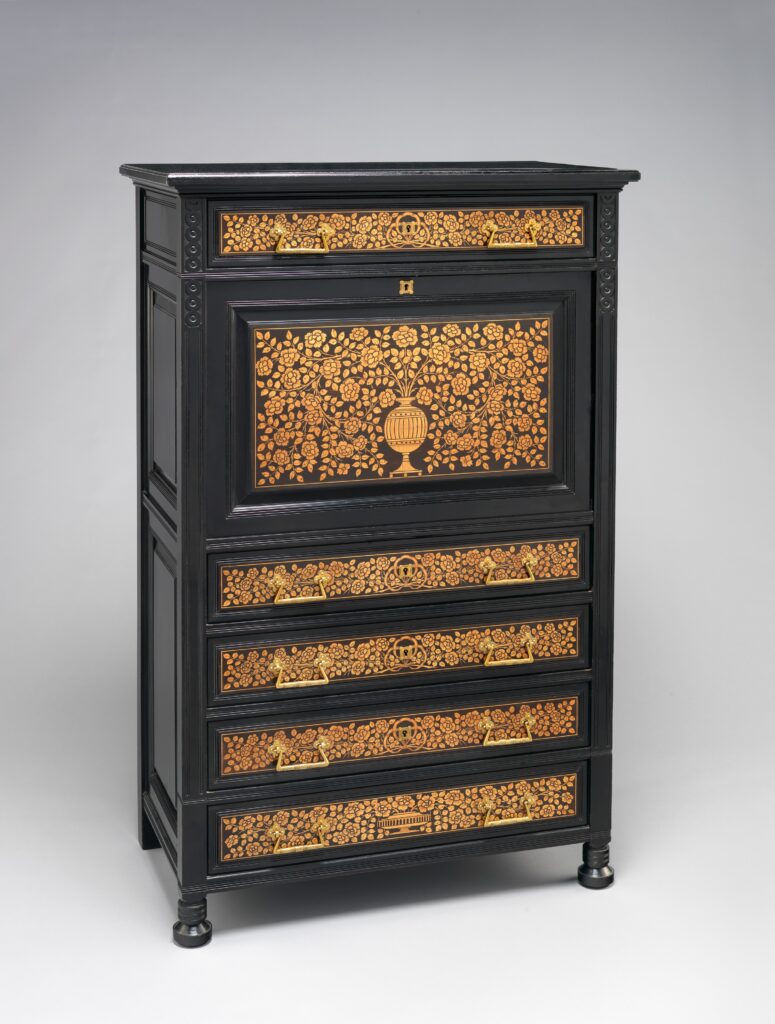
Herter Brothers’ desk for the financier Jay Gould, made in 1882 as a gift for his wife Helen, shows a quieter version. The Met reads it as high Aesthetic design: golden marquetry on a glossy black surface that reflects the influence of Eastern lacquerware, which the museum says strongly informed the Anglo-Japanese style of the period. The form is an eighteenth-century fall-front secretary, built in a simplified Eastlake, or reform, style, with a stylized floral motif rooted in Near Eastern sources. Japan is one ingredient among several. The reform side of the story is in the Eastlake furniture guide.
Charles Tisch, a German immigrant cabinetmaker in New York, gave the Met his cabinet in 1889 and described it as a purely American production of his own manufacture that had won first prize at the New Orleans exposition of 1884 to 85. The museum lists what it borrowed: Japanese fretwork, Eastlake-inspired spindles, Aesthetic Movement inlay patterns and classical Ionic columns. Its asymmetry and variously sized compartments, the Met adds, recall imperial Chinese wall units for displaying ceramics.
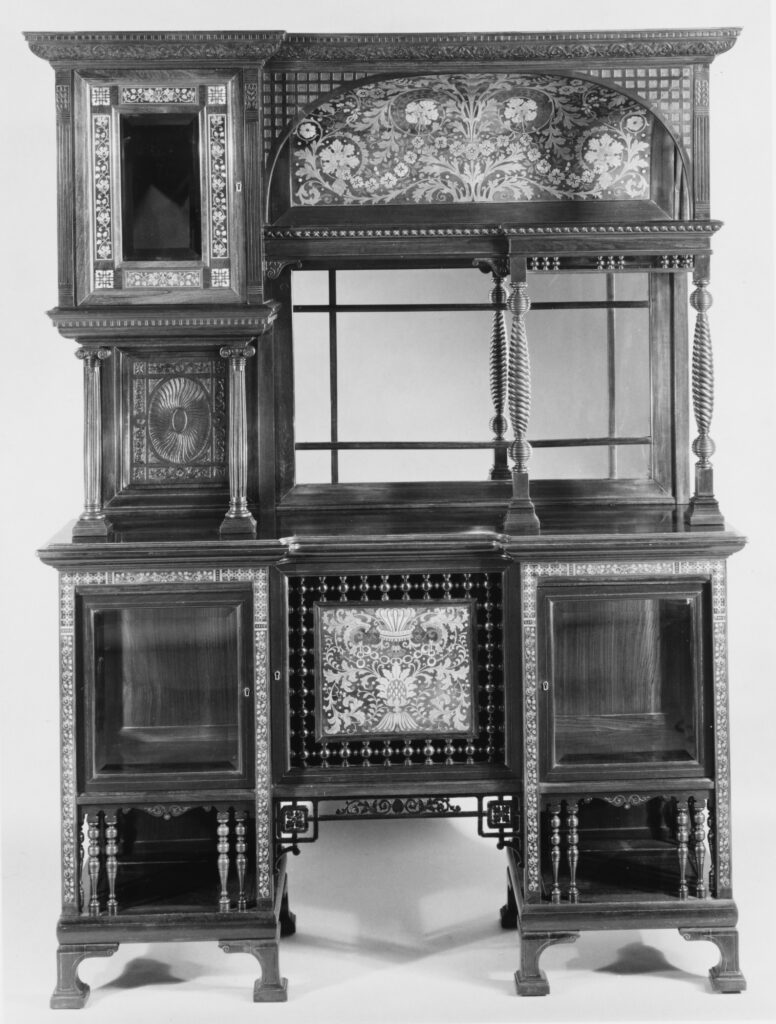
The photograph is a black-and-white record shot, but the structure shows: uneven compartments, turned spindles and an inlaid panel, all on one piece.
Not everything exotic is Japanese
The 1867 exposition is a good reminder that labels need care. The same Paris fair that gave Parisians their first formal look at Japanese crafts also showed a cabinet by Maison Barbedienne, which the Met catalogs as colorful cloisonné enamel in floral and scrolling patterns derived from Near Eastern art, set in the shape of a Renaissance collector’s cabinet with Moorish-style arches inside. William H. Vanderbilt bought it for his mansion. A glittering exotic cabinet of 1867 is not, on that record, a Japanese-influenced one.
Reading Japanese influence on a piece
The museum records above suggest a short list of things to look for. They are questions to ask a piece, not proof of date or maker.
- Surface. Black or red grounds with gold decoration that echoes lacquer, as on the Gould secretary, or carving “in the manner of” lacquer, as on the Vanderbilt cabinet.
- Asymmetry. Shelves and compartments of different sizes, set off-center, instead of the matched halves of earlier cabinets.
- Fretwork and bamboo. Pierced geometric panels and bamboo detail, which the Met names on the Tisch cabinet and the Vanderbilt ceiling.
- Mixed company. Japanese motifs next to Eastlake spindles, Near Eastern patterns or classical columns are normal, not suspicious. They are how the Aesthetic period worked.
Japonisme was not only furniture. The Met’s bone-china vase from Minton’s, dated 1879, carries the movement in its catalog title: Vase with Aesthetic Japonisme birds. A bird on a flowering stem sits on a cream ground, with gilt handles and rim. Birds and flowering stems are the subject the title names, and they show that the taste reached tableware as well as cabinets.
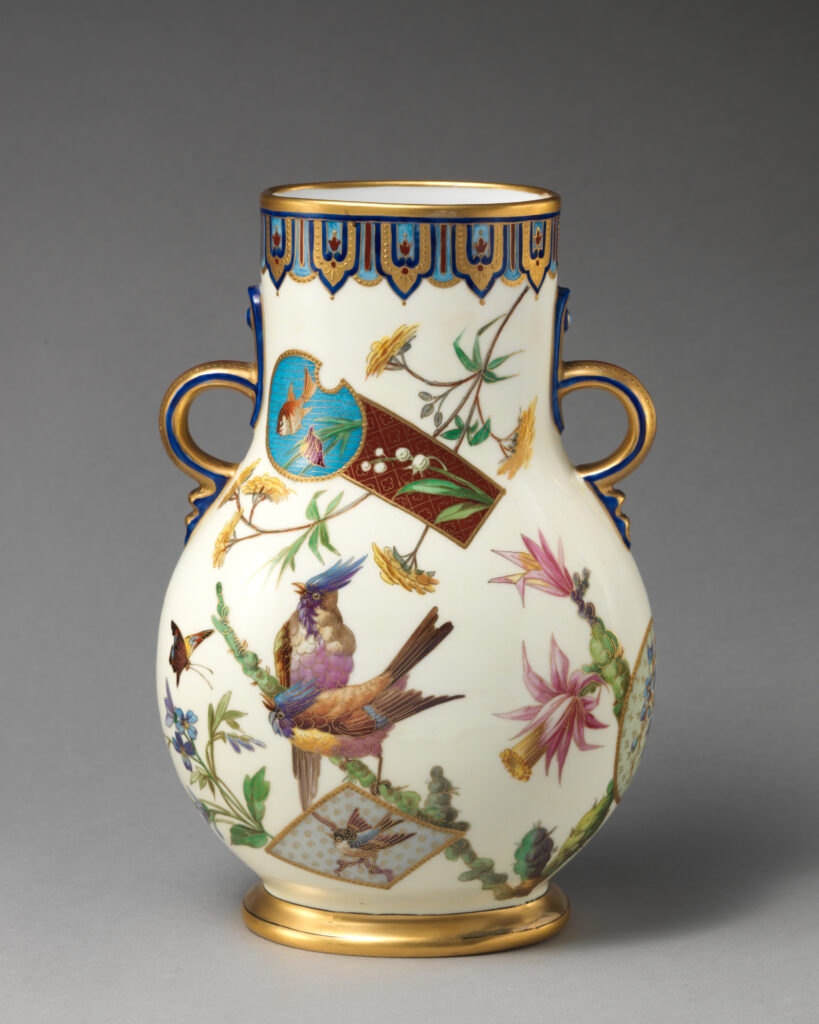
Sellers use Anglo-Japanese, Aesthetic Movement, Eastlake and japonisme almost interchangeably. The useful question is which features of a piece are Japanese-derived, which were added by the maker’s own taste, and what the seller can document. The general questions for any seller are in the buying guide.
Where japonisme sits in the wider story
Japonisme overlaps several other pages here. The English reformers who used Japan as one source are part of the Victorian furniture guide. The French Art Nouveau furniture page covers a later generation of designers who also drew on Japan. A Danish thread, from Arnold Krog’s work for the Royal Porcelain Factory in the 1880s to the Japandi look, is traced in the Japandi guide.
Sources
- Colta Ives, “Japonisme”, Heilbrunn Timeline of Art History, The Metropolitan Museum of Art (October 2004).
- Encyclopaedia Britannica, “Japanism”.
- The Metropolitan Museum of Art, cabinet, Herter Brothers, 1879 to 82 (2014.530.2); secretary from the Jay Gould House, Herter Brothers, 1882 (69.146.3); cabinet, Charles Tisch, about 1884 (69.245).
- The Metropolitan Museum of Art, cabinet, Maison Barbedienne, 1867 (2017.666); vase with Aesthetic Japonisme birds, Minton’s, 1879 (2018.62.58); Kinryūsan Temple at Asakusa, Utagawa Hiroshige, 1856 (JP2519).