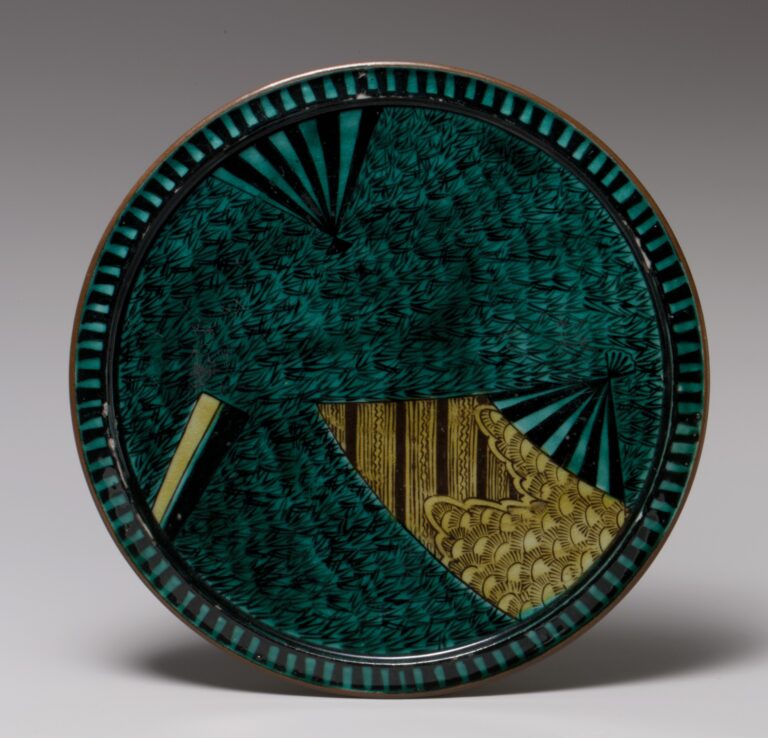
Satsuma ware looks like porcelain from across a room: an ivory ground, fine gold, tiny enamelled flowers. Close up, it is pottery. The Met catalogues its eighteenth-century Satsuma incense burner as earthenware, and the Walters Art Museum describes its Meiji Satsuma vase as earthenware too, which is why the guide to antique Japanese porcelain treats Satsuma as a different case.
This guide sticks to museum records: the Met and the Walters for the objects, plus one appraiser’s 2024 column for the question collectors ask most, how to spot a modern copy. Where a source gives an opinion rather than a record, the text says so.
What Satsuma ware is: earthenware, not porcelain
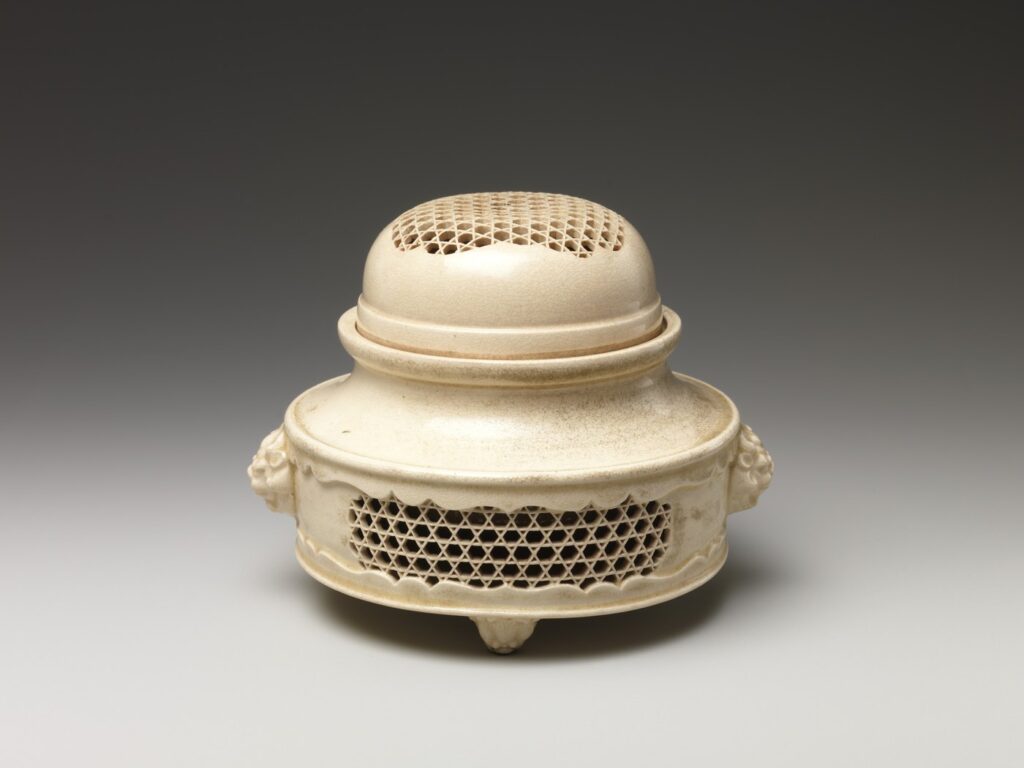
Satsuma ware is Japanese pottery named for Satsuma Province in Kyushu. The Met’s record for the burner above says it was produced there from the sixteenth century by Korean potters brought over to Japan, and that Satsuma ware was later made in Kyoto as well, which it calls Kyoto Satsuma.
The body is the point. The Met describes this one as earthenware under a transparent glaze, and adds that the material is a transition between porcelain and earthenware, fired at a lower temperature than porcelain. The Walters records its Chin Jukan XII incense burner as white earthenware with overglaze enamels and its tall Meiji vase as earthenware ceramic with overglaze enamel and gilding. A seller who calls a piece Satsuma porcelain is using a loose label, and the polite reply is to ask what the description is based on.
Two looks turn up under the one name. Early pieces are restrained and often undecorated. Later ones, made for Western buyers, are covered in painted scenes. The next sections take them in that order.
Early Satsuma and the Korean potters
The Met’s burner is small, 9.4 cm (3 11/16 in) high, and plain on purpose: molded and pierced, with lion masks and a lattice band, and no painting at all. The record reads that plainness as a sign of the ware’s earlier history, along with the harmonic proportions and delicate curves of the object.

Antique Trader’s 2024 “Ask the Experts” column, by the appraiser Anthony J. Cavo, describes early Satsuma, which he dates to the seventeenth century, as sparingly decorated, with large unpainted cartouches, and made in more colors and glazes than the cream ground people picture today. That is one appraiser’s summary, not a museum record, but it matches what the Met says about restraint.
Connoisseurs kept preferring this early work. The Met notes that after Satsuma pieces appeared at the 1867 Paris Exposition and became popular with Western collectors, the most appreciated collectibles for connoisseurs remained early Satsuma ware.
Crackle glaze: what you are looking at
The fine network of lines is the first thing most people notice. The Met calls a transparent, slightly yellowish crackled glaze “a typical glazing technique” for Satsuma ware. The Walters describes the ware as having a distinctive ivory-colored ground and a finely crackled transparent glaze, and records its Chin Jukan XII burner as having a minutely crackled white glaze. Yellowish, ivory, white: the museums themselves use three words for the ground, so a cream-versus-white argument settles nothing on its own.
Crackle that belongs to the glaze is not the same as a crack through the body. When you look at photographs, ask for the inside of the lid and the foot in raking light, so a hairline, a chip or a glued join has somewhere to show itself.
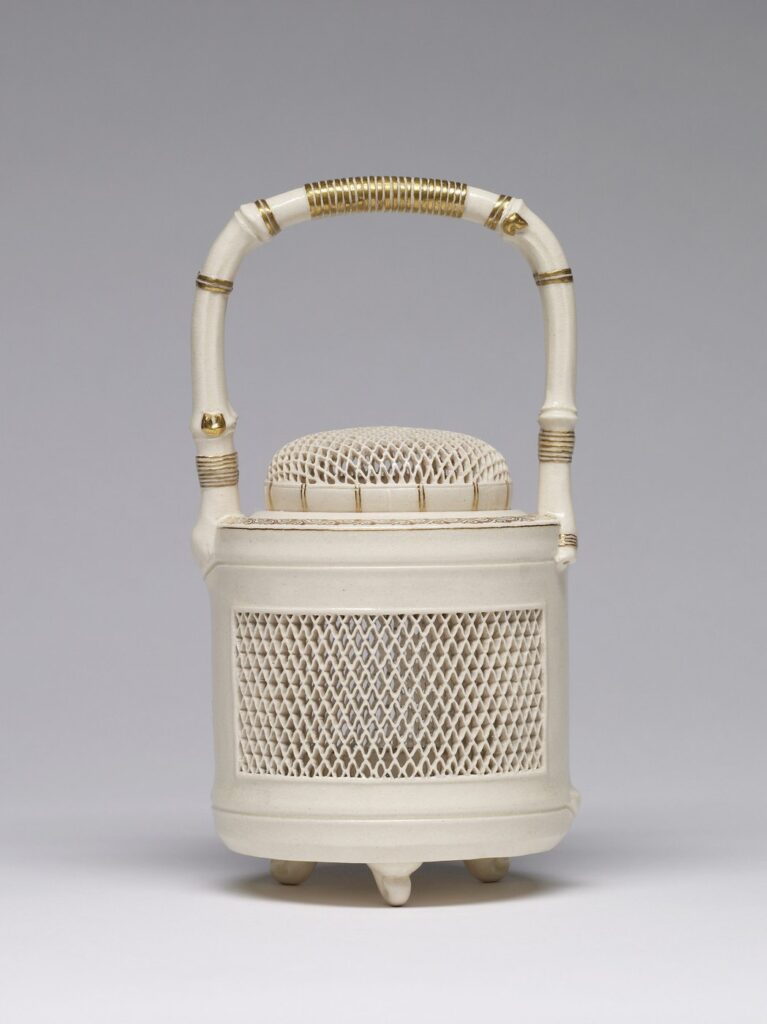
The Walters gives the details of that burner. It has a vine motif on the rim in overglaze red and gilt, pierced lattice-work side panels, a detachable cup, a handle in the form of bamboo and three feet. It was shown in the 2018–2019 exhibition “Meiji Restoration for Satsuma Ware” at the Kagoshima Prefectural Museum of Culture Reimeikan.
Edo or Meiji: from restrained to export
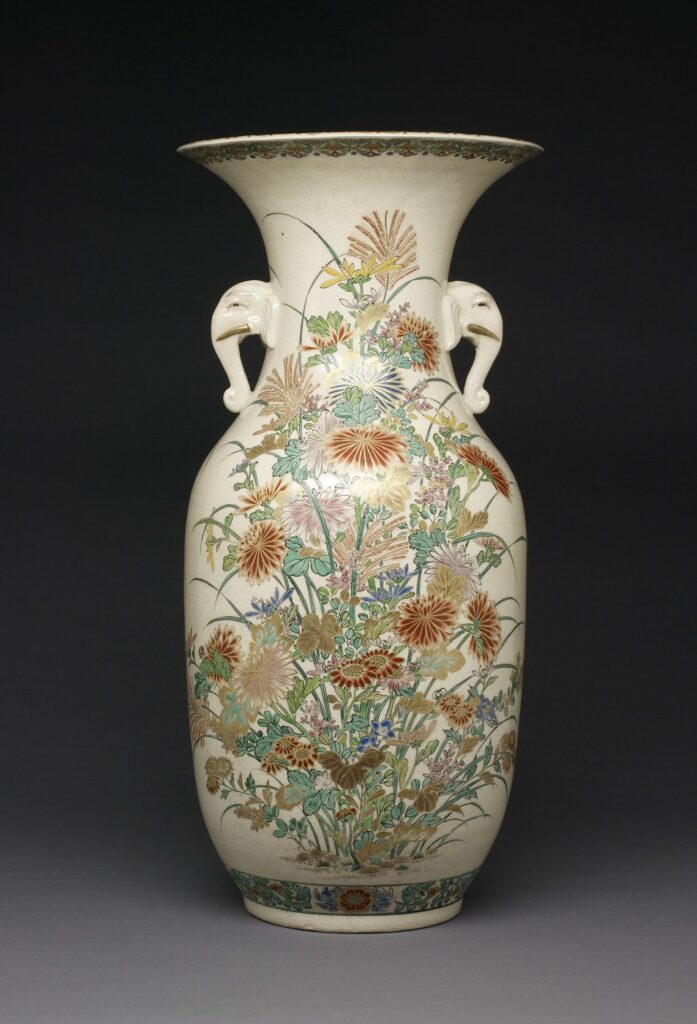
By the mid-Meiji period (1868–1912), the Met says, Satsuma ware was extensively decorated in overglaze polychrome paint and gold, with bird-and-flower compositions, scenes inspired by woodblock prints and similar popular Japanese imagery, to satisfy the demands of Westerners. The Walters says much the same from the other side: most Satsuma wares were made for export, and so carry pagodas, flowers, birds and figures in kimonos.
The date label is often a range rather than a verdict. The Met dates its enamelled and gilded burner 91.1.287 to 1865–70 and gives the period as Edo or Meiji, because the Meiji era began in 1868. The Walters labels its signed burner the same way, as 19th century (Edo, Meiji). A listing that hedges between the two periods is, in these cases, following the museums.

The Met’s record adds a detail that is easy to miss: the reticulated cover is enamelled too, so the openwork is part of the decoration and not only a way to let the scent out. The burner is 10.6 cm (4 3/16 in) high and came to the museum by the bequest of Edward C. Moore in 1891, a little over two decades after it was made, which shows how quickly Satsuma reached Western collections.
Scale changes the look as well. The Walters vase below, with its elephant handles and autumn flowers, is 55.8 cm (21 15/16 in) tall, about six times the height of the Met’s early burner.
Marks are a large subject and this guide does not try to decode them. The Walters records its Chin Jukan XII burner as signed, with an inscription it gives as “Satsuma Jukan sei.” Cavo says pieces usually carry an artist’s signature and a Satsuma mark, often with the red Shimazu clan mark, a circle with a cross in it, and he knows of at least ten Satsuma mark types. He points readers to Gotheborg.com for marks and to Nancy N. Schiffer’s Imari, Satsuma, and Other Japanese Export Ceramics.
Satsuma versus Kutani and Imari
All three can show red, gold and enamels, so decoration is the weakest test. Body, glaze and region are better.
- Satsuma: earthenware under a crackled glaze, tied to Satsuma Province in Kyushu, with an ivory or cream ground.
- Kutani ware: porcelain painted in overglaze enamels and tied to Kaga province, with a debate over where its earliest pieces were made.
- Imari ware: a name that points to the port the porcelain left from, and to a look in blue, iron red and gold, not to one kiln.
Kutani and Imari are covered in their own guides. For where Japanese ceramics sit beside furniture and interiors, the Japanese styles section is the place to start.
Condition, repairs and what to ask before you buy
Enamel and gold sit on top of the glaze, and the museums’ own words, “overglaze,” “gilding,” “gilt,” are a reminder that they can wear. Before you buy, these are fair questions:
- Is the body earthenware, and what is that based on?
- Is the decoration hand-painted, and is the painting crisp where the gold is worn?
- What does the mark or signature say, and in which script?
- Are there repairs, overpainting or regilding, and can you see the foot and the inside of the lid?
- What is known about where the piece has been?
Size is no guide either way. A burner of 9.4 cm and a vase of 55.8 cm are both documented Satsuma, so a seller’s mention of “a small piece” or “a big statement piece” says nothing about authenticity. The same goes for price: ask the questions above before the figure starts to feel like evidence.
Modern “Satsuma-style” pieces are very common on the market, so this deserves care. Cavo’s column offers rules of thumb. He says genuine Satsuma is made in Japan, hand-painted with Japanese imagery and marked in Japanese, and that English wording such as “Made in,” “Hand-Painted,” “Genuine” or the word “Satsuma” itself is a post-World War II trait. He adds that “Royal Satsuma” pieces with English marks date to the late twentieth or early twenty-first century, when they were mass-produced.
Treat that as an appraiser’s guide, not a test with a guaranteed result. A mark is one clue among several, and a piece with no English on it is not automatically old. The body, the glaze and the quality of the painting still have to agree with each other, and if the money matters, a specialist in Japanese ceramics should handle the piece in person.
Common questions
Is Satsuma ware porcelain? The museum records say no. The Met and the Walters both catalogue the pieces shown here as earthenware, though the Met adds that the body is a transition between porcelain and earthenware.
Why does the glaze look cracked? It is a crackled glaze, which the Met calls a typical glazing technique for Satsuma ware. The fine network is part of the surface, not damage.
Is all Satsuma ware Meiji export ware? No. The Met’s burner is eighteenth century and undecorated, while the Walters says most Satsuma ware was made for export, so the decorated Meiji look is the common one rather than the only one.
What is Kyoto Satsuma? The Met’s record says Satsuma ware was produced in Satsuma Province in Kyushu from the sixteenth century and later in Kyoto as well, and it calls the later work Kyoto Satsuma. Cavo makes the same point about origin from the other direction: genuine Satsuma is made in Japan, not China.
Does “Royal Satsuma” mean it is old? According to Cavo, no: he dates English-marked Royal Satsuma to the late twentieth or early twenty-first century.
Sources
- The Metropolitan Museum of Art, Incense Burner (koro) and Cover with Molded and Reticulated Design, 19.14.2a–c.
- The Metropolitan Museum of Art, Incense Burner, 91.1.287.
- The Walters Art Museum, Incense Burner, Chin Jukan XII, 49.1772.
- The Walters Art Museum, Vase with Autumn Flowers and Elephant Handles, 49.2193.
- Anthony J. Cavo, “The Key to Authenticating Satsuma,” Antique Trader, 11 July 2024.
- Related guides on this site: Antique Japanese Porcelain, Kutani Ware, Imari Ware.