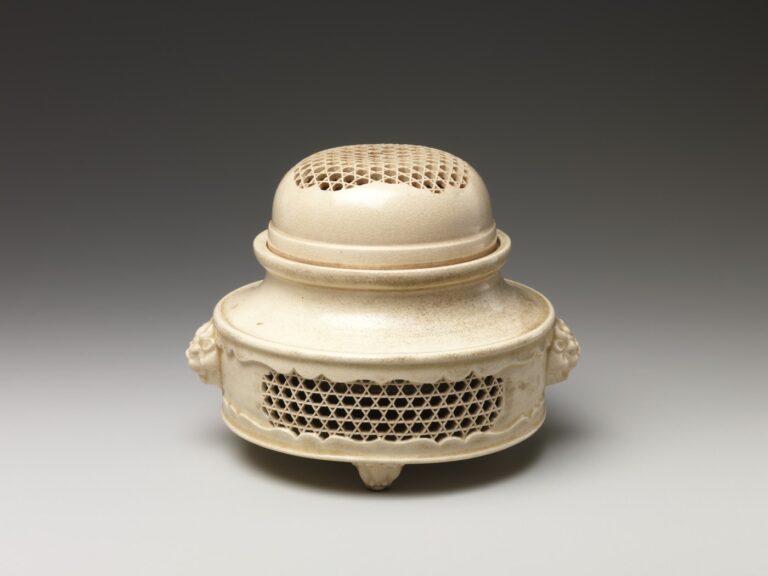
Search the Metropolitan Museum for Imari ware and the records answer in three phrasings: “Arita ware, Imari type,” “Ko Imari type” and “Imari style.” One vase carries an eighteenth-century date beside a period given as “Late Edo or Early Meiji.” The hedging has a reason, and it starts with the name.
Imari ware is Japanese porcelain from the Arita kilns, painted in underglaze blue and finished with overglaze enamels, red and gold above all. Imari itself is a port, and by the eighteenth century the word described a look that Chinese and European factories copied as well. A label that says Imari therefore tells you less than it seems to, and reading the label together with the object is a large part of identifying a piece.
Imari ware: a color style, not a kiln
Imari is a port near the Arita kilns, from which the porcelain went to Nagasaki for Dutch and Chinese merchants to collect, so export porcelain from Arita is sometimes called Imari ware as well as Arita ware, as the Met’s essay on Edo-period porcelain explains. The same essay uses “early Imari” for the first blue-and-white wares, made mostly for Japanese buyers, and the later wares most collectors mean by Imari were typically made for export. The kilns and the other Arita looks are covered in the guide to antique Japanese porcelain; the Journal’s other pieces from the period sit under the Japanese style pages.
Blue, iron red and gold
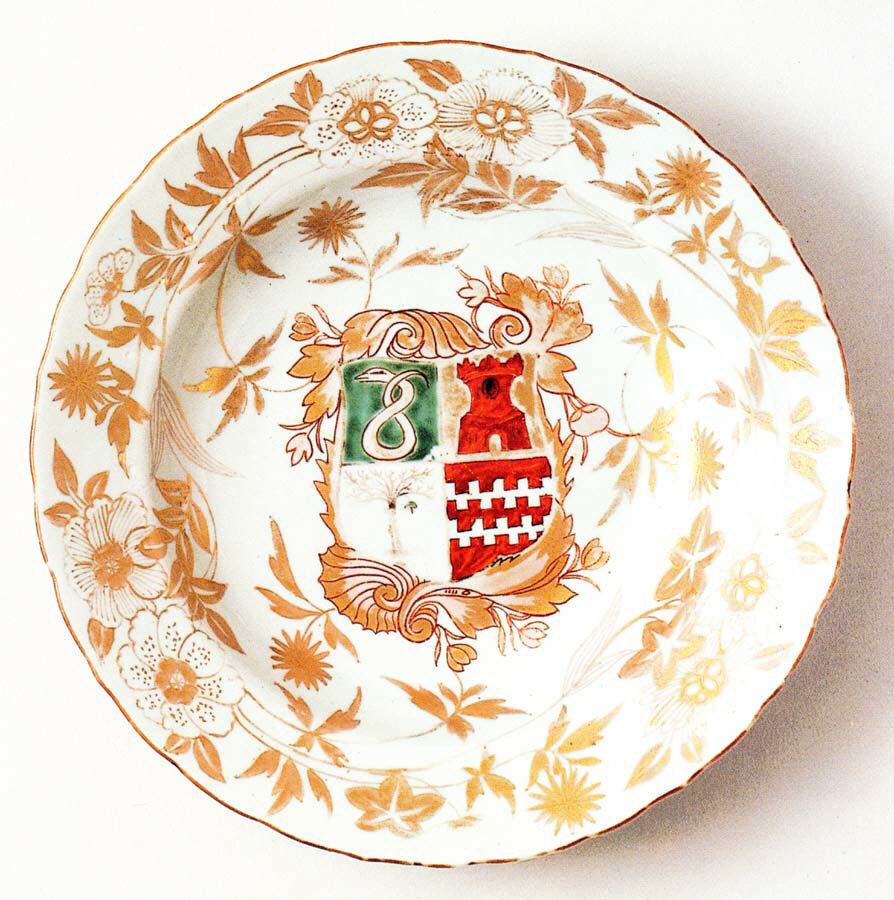
The look that gave Imari its name is a three-color scheme, and the order of work shows in the records. Blue is painted on the white body first and fired under a clear glaze. Red, gold and often green go on afterward, over the glaze, in colored enamels, a technique the Met’s essay says was developed in the 1630s. The dish below is catalogued as blue under the glaze, polychrome enamels and gold, in the Ko Imari style.

Britannica describes Old Imari, which it dates from the 1640s, as perhaps the most striking of the enameled Arita wares for the richness of its colors and designs, with decoration that generally covers the whole vessel. Kakiemon, the other great enameled ware, is described by the Met as figures, animals and flowers on a milky white ground, a different balance from Old Imari’s fully covered surface.
Japanese or Chinese Imari?
Because the scheme sold, it was copied. The V&A catalogues a large dish of the early eighteenth century as made at Jingdezhen in China and decorated to imitate the colors and design of Japanese export porcelain, and records that Jingdezhen kilns were imitating these wares from the late seventeenth century. Chinese Imari, the museum adds, became a popular export to Europe during the Kangxi period (1662–1722), and several European factories imitated the style in the eighteenth century.
That leaves three possible origins for one look: Arita, Jingdezhen and Europe. The museum records read for this article give no field test that separates them, and none is invented here. What the records do is name the origin first: the Met’s Japanese pieces say “Arita ware” and the V&A’s copy says Jingdezhen. A seller who cannot say which of the three is meant has not yet identified the piece.
Nor is every Chinese enameled dish of the period an Imari copy. The Met notes that famille verte, a palette dominated by greens, reached Europe at about the same time as the Japanese Imari and Kakiemon color schemes and was largely overshadowed by them.
Imari vases, chargers and covered jars
The Met’s essay says the Dutch encouraged Arita to fill the gap left by Chinese porcelain and sent wooden or earthenware models of designs and of European vessel shapes for the potters to copy. The forms therefore say as much as the paint does. The V&A describes one Arita bottle of about 1700 to 1720 as “of a type made solely for export,” one of a pair.
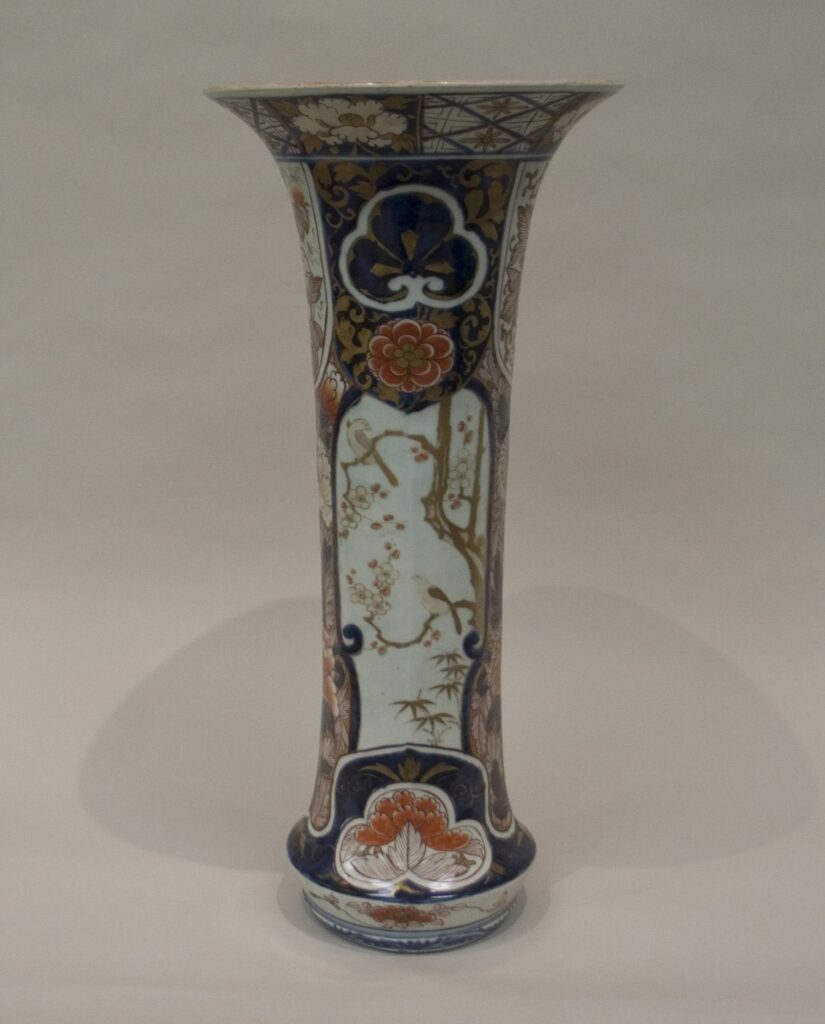
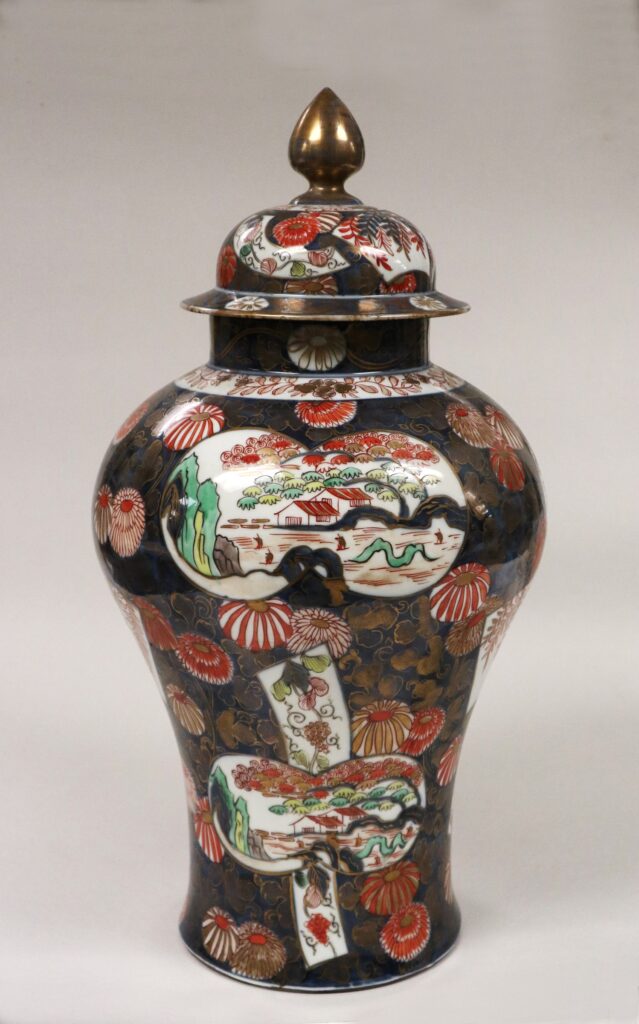
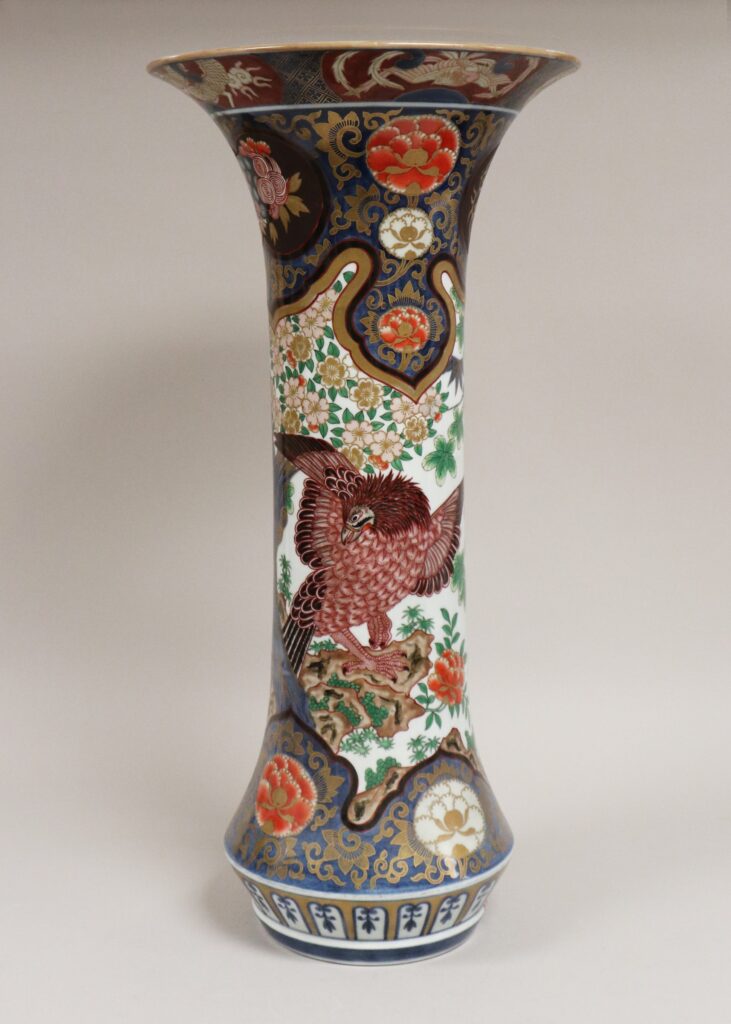
This vase stands about 23 inches (59 cm) high and flares at the mouth, and its record names the three colors outright: blue under the glaze, iron red and gold. The covered jar below is about 20 inches (52 cm) tall and was made around 1680. The Met catalogues it as parts a and b, so for any lidded piece it is worth confirming that cover and body belong together.
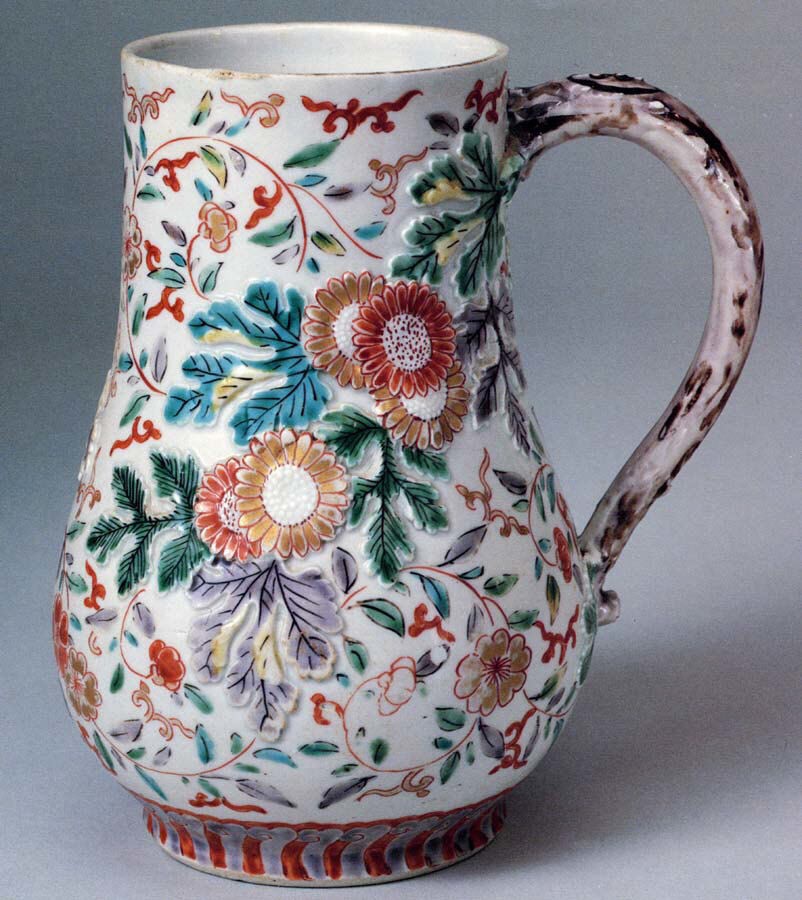
Large dishes, which sellers often call chargers and the Met simply titles Large Dish, come in the same big sizes: the dish at the head of this article (93.3.157) measures nearly 22 inches (55 cm) across. Smaller pieces show the European market more directly. A handled tankard is a Western drinking vessel, which fits the Met’s account of the Dutch sending models of European shapes to Arita.
The armorial plate goes a step further. A coat of arms painted at the center, on a Western heraldic shield, points to a commission for a Western client. The Met catalogues it as Arita ware of the Ko Imari type, with overglaze enamels and gold, and dates it to the eighteenth century.
Edo or Meiji Imari
“Ko Imari” means old Imari, and in the records read here the Met uses it for pieces from the late seventeenth and eighteenth centuries. The Edo period ended in 1868, but the Imari look did not. In 1875 Fukagawa Eizaemon, who had run his family workshop at Arita since 1861, helped found the Koransha Company to make ceramics for export. The V&A holds a Fukagawa dish of that year in underglaze blue, enamels and gold, with a diameter it gives as 91.4 cm (36 inches), citing a published catalogue; it was shown at the Philadelphia Centennial Exhibition in 1876. The Western enthusiasm for Japanese goods that followed is the subject of the story of Japonisme.
The line between Edo and Meiji pieces is thin in the Met’s own records. It catalogues one vase as eighteenth century and gives its period as Late Edo or Early Meiji; a similar vase, 23.225.385, has the same medium and period but a nineteenth-century date. When a seller offers a single century with confidence, ask what it rests on. The same hedging turns up on Japanese earthenware, and the Met’s Satsuma labels are walked through in the guide to Satsuma ware.
Marks on Imari
Turning a piece over is the usual first move, and the base can mislead. The Smithsonian’s Freer Gallery of Art records an Arita dish of 1740 to 1780 whose base bears a crudely written imitation of a Ming Chenghua reign mark, a reign that ended in 1487, along with five spur marks. A mark that claims a date more than two centuries too early is a good reason to read the rest of the piece rather than the base.
The other kind of mark is more useful. The Fukagawa dish carries an inscription in Japanese that names the Fukagawa workshop at Sarayama in Hizen and the country, “Great Japan,” which points to a named maker and a place, and to the export venture of 1875. A copied reign mark proves nothing about the piece. Photograph the base whatever it shows, and ask what the mark is claiming before asking whether it is true.
Reproductions, repairs and condition
The museum records read for this article describe period copies, from Jingdezhen and from European factories, but none covers modern reproductions of Imari, so there is no sourced test for them here. The question to put to a seller is the one above: which origin is claimed, and on what evidence?
Repairs are the other question, and the U.S. National Park Service’s museum guidance names ultraviolet light as the examination for finding them. Many adhesives used on broken ceramics fluoresce under long-wave UV, often more strongly as they age, so a join can show as a bright line against the dark body, and fills often glow differently from the original. The same guidance warns that some conservation adhesives, such as Acryloid B72, do not fluoresce, so a dark result does not prove a piece has never been mended.
Ask for daylight photographs and a written condition report, and for a large or lidded piece have a conservator look at it.
Questions collectors ask about Imari
Is Imari valuable, and how much are Imari plates worth? The sources read for this article give no market values, and Imari runs from seventeenth-century export jars to large Meiji factory dishes, so a single price would mislead. Compare sold auction results for pieces of the same size, period and condition, and ask for a written description.
How can you tell the age of Imari ware? Start with the label: “Ko Imari,” old Imari, points to the earlier enameled wares, which Britannica dates from the 1640s. Then look for evidence that narrows it, such as a workshop inscription like Fukagawa’s of 1875, and treat museum dates as ranges, as the Met’s hedged vase shows.
How do you tell if an Imari vase is real? “Real” is two questions. Is it Japanese, rather than a Jingdezhen or European copy? And is it Edo or Meiji? A museum-style attribution answers the first, a dated inscription or a documented comparison helps with the second, and UV light helps with repairs. No single test settles all of it.
Sources
- The Metropolitan Museum of Art, “Edo-Period Japanese Porcelain” (Heilbrunn Timeline of Art History essay)
- Britannica, “Imari ware”
- Victoria and Albert Museum, bottle, Arita, 1700–1720 (C.1517-1910)
- Victoria and Albert Museum, dish made at Jingdezhen in imitation of Japanese Imari (C.1474-1910)
- Victoria and Albert Museum, dish by Fukagawa Eizaemon, 1875 (341-1877)
- Smithsonian National Museum of Asian Art, dish, Arita ware (F1965.17)
- National Park Service, Conserve O Gram 1/10, “The Use of Ultraviolet Induced Visible-Fluorescence in the Examination of Museum Objects”
- The Metropolitan Museum of Art, Dish, China, Kangxi period (11.60.99)
- Met object records (public domain, Open Access): 93.3.157, 93.3.131, 93.3.231, 23.225.115a, b, 2002.447.82, 2002.447.87, 23.225.384, 23.225.385.