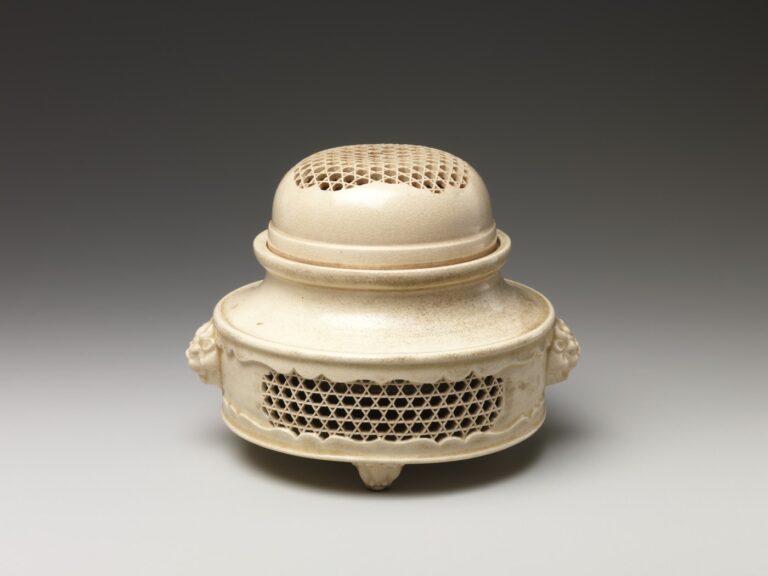
Kutani ware is Japanese porcelain decorated in overglaze enamels and tied to Kaga province, now Ishikawa prefecture. The name covers two quite different things: the bold early pieces of the seventeenth century, called Ko-Kutani or Old Kutani, and the many nineteenth-century wares that borrowed the name. The short overview in the guide to antique Japanese porcelain is the place to start. This guide goes further into the early wares, the question of where they were made, the later revival and the Meiji export pieces.
Every claim comes from the Metropolitan Museum’s records, Britannica, the Yakimono association page on Kutani ware or a 2024 research paper. Where they disagree, the guide says so.
Ko-Kutani and the attribution question
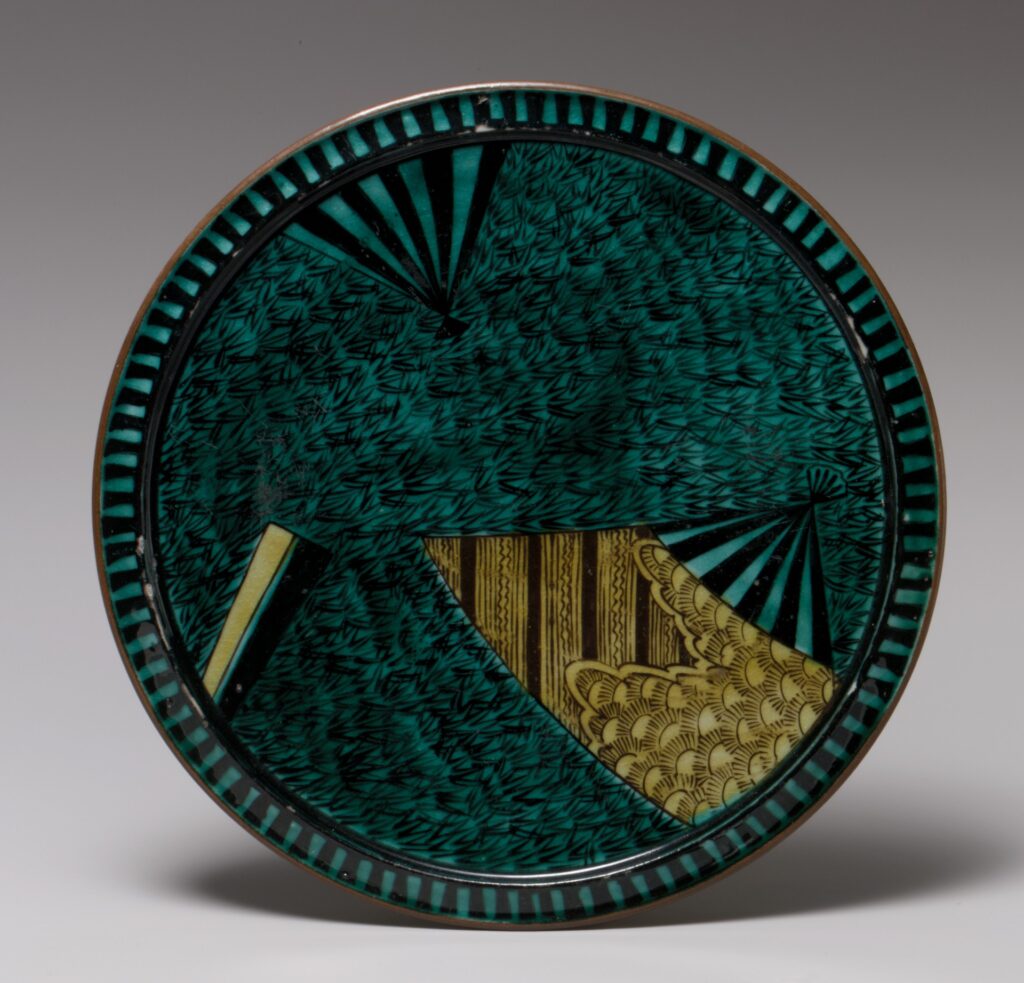
Production is usually dated to the mid-1650s. The Yakimono association gives about 1655, when Maeda Toshiharu, lord of Daishoji, had a retainer set up a kiln in Kutani village. Britannica says the Maeda family had a kiln there by 1656, with gray, coarse-grained clay under a white or blue-white matte glaze and dark, restrained colors. The association says pottery was made there for about 45 years, and Britannica says the kiln was abandoned some time in the Genroku period (1688–1704).
Where the early wares were made is disputed. Britannica notes that some authorities now assert most Old Kutani was actually made at Arita, in present-day Saga prefecture. A 2024 paper in Coatings, by Riccardo Montanari, Hiroharu Murase of the Ishikawa Prefectural Museum of Art and colleagues, says the question has been debated for over a century. The Kaga attribution is the long-established one, and the Arita theory has been gaining popularity in Japan on curatorial grounds.
The authors analyzed the museum’s Ko-Kutani collection, shards from the Kaga kiln site and works by Nonomura Ninsei by X-ray fluorescence, and argue for Kaga: potters who settled in the Maeda domain after being expelled from Arita in 1637, with enameling influenced by European techniques. Their own abstract admits there is no general agreement.
The Met’s records show the same split. Plate 2002.447.92 is catalogued as “Arita ware, Ko Kutani style,” others as “Hizen ware, Ko Kutani style,” and dish 66.118.8 as “Ko Kutani ware.” “Ko-Kutani” as a style label is safer than a place name.
The five colors
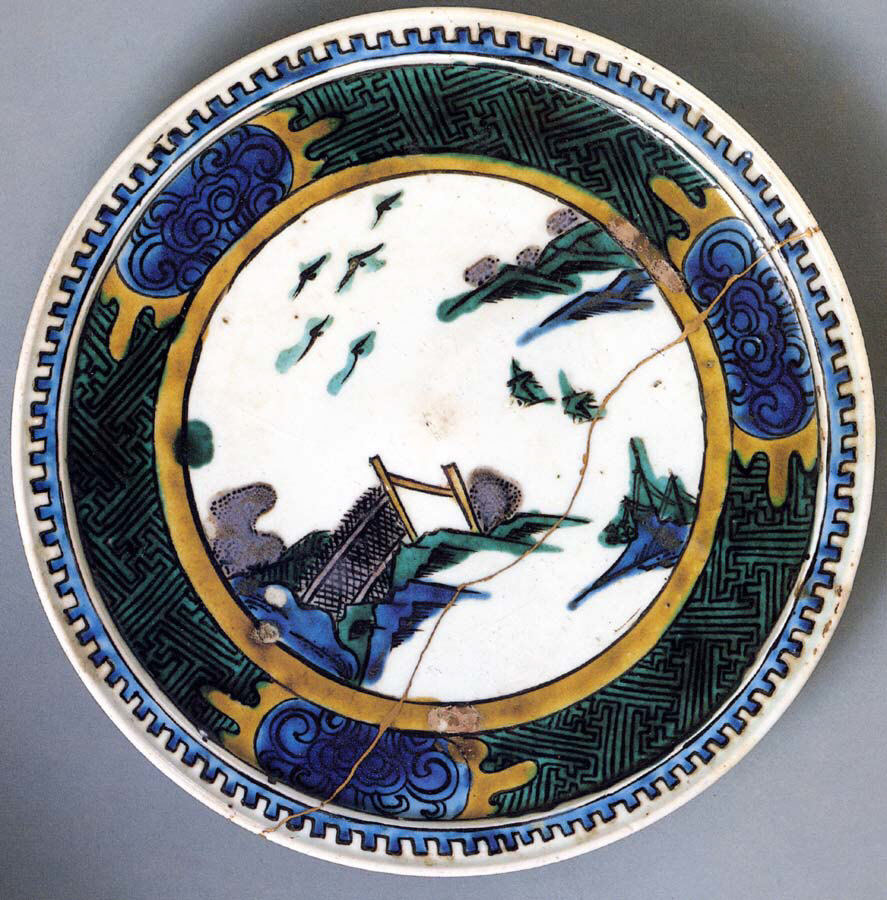
The association page describes five colors: green, yellow, red, purple and Prussian blue, painted over the glaze with special tools in a technique called uwa-e. It attributes the five-color aesthetic to Kusumi Morikage, a painter of the Kano school. Britannica describes the early palette more narrowly: greens, yellows and some reds at first, with purples and dark blues later. “Green Kutani” covers most of the surface in a green or blue-green glaze with one or two colors added. Britannica says the bold designs drew on Chinese ceramics, paintings and textiles.
The Met labels plate 91.1.145 as decorated in five colors.

Kaga and the nineteenth-century revival
The association page says the kiln then stood idle for about a century, and that the Kaga clan later opened a kiln at Kasugayama in Kanazawa, followed by many others, each with its own style. Britannica dates the renaissance to the early nineteenth century, with another kiln at Kutani in the 1820s. The association lists the revival styles with dates: Mokubei (1804), Chinese-inspired illustrations on a red base; Yoshidaya (about 1820), which avoids red and spreads patterns over the whole surface; Iidaya (about 1835), with detailed figures and gold; and Shoza (about 1850), which used Western paints.
The Met’s records use some of the same names. Plate 2002.447.100 is “Kutani ware, Yoshidaya revival.”
Meiji export Kutani
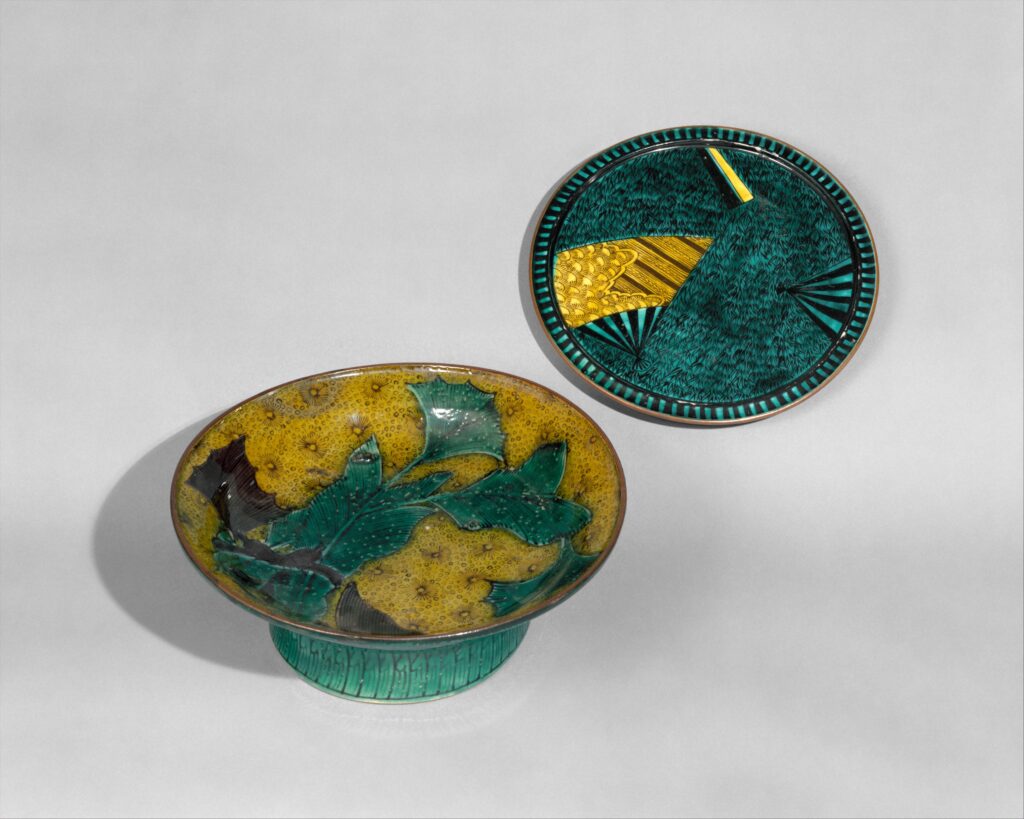
Britannica describes a style using gold on a coral-red ground, perfected in a burst of activity that began in the 1860s, when Western-style pigments were adopted. By the 1890s, it says, modern Kutani ware had become a major Japanese export. The association page lists Eiraku (about 1865), with gilt techniques borrowed from Kyoto Kiyomizu ware and gold illustrations on red, and says Shoza became the main style of industrial production from the Meiji period.
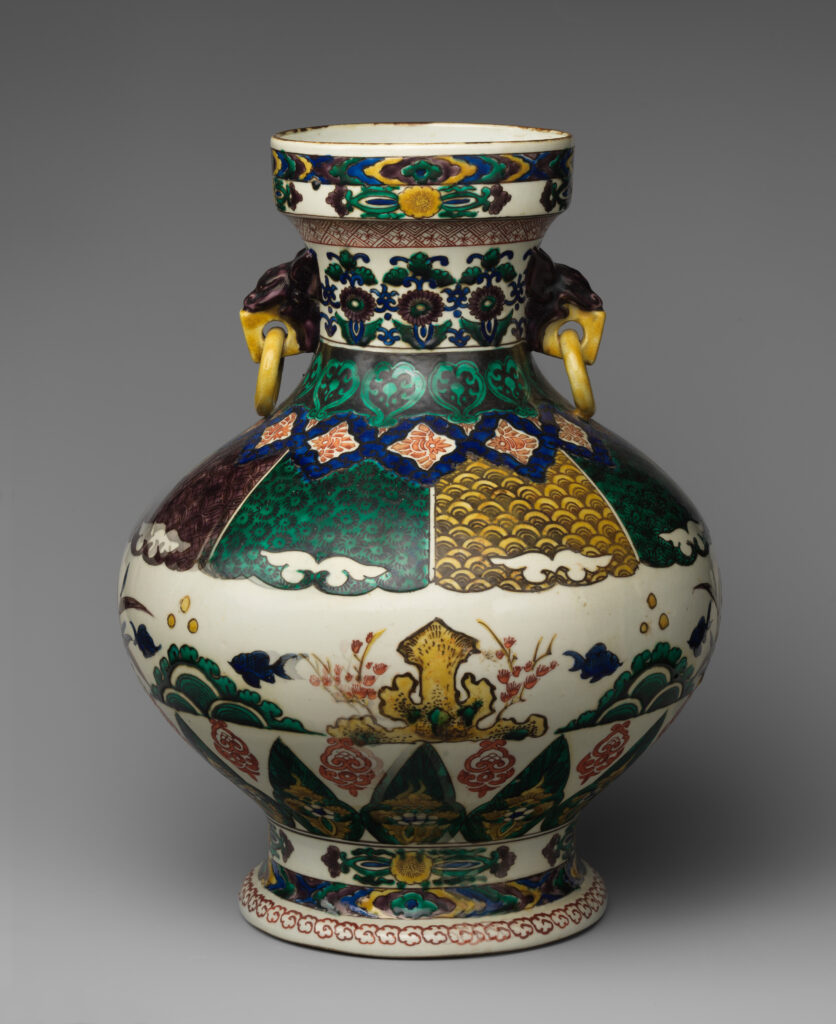
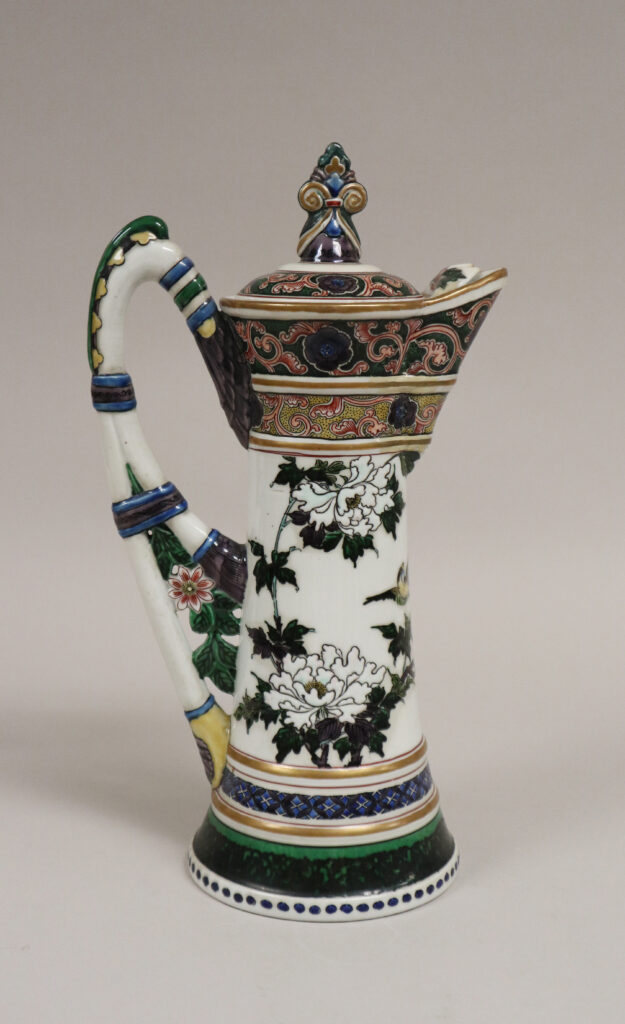
Britannica adds a warning: the name “Kutani” is now loosely applied to a great variety of nineteenth-century Japanese ceramics, many with no connection to Ishikawa prefecture. The Met catalogues mid-nineteenth-century pieces such as the ewer below, and the vase above, as “Hizen ware, Kutani type.” Neither is dated to the Meiji period itself. The sources read here do not say how much of this export ware survives or how it is ranked.

Kutani versus Imari
Britannica describes Imari ware as porcelain from the Arita kilns in Hizen province, in white, celadon, black and blue-and-white wares with underglaze painting as well as overglaze enamels. Kutani is the overglaze-enamel tradition of Kaga, and Britannica singles out the dark, restrained palette of the early pieces. The labels overlap, though: the Met catalogues bowl 23.225.169 as “Arita ware, Imari type, Ko Kutani style,” which is one more reason to read the whole label. The style that pairs blue under the glaze with red and gold enamels is covered in the guide to Imari ware. Satsuma, by contrast, is earthenware under a crackled glaze rather than porcelain, and has its own guide to Satsuma ware.
Reproductions, condition and what to ask
Reproductions and condition are outside what these sources cover, so ask for provenance and a written description. The label itself deserves scrutiny. Britannica says “Kutani” is applied loosely, and the Met catalogues some pieces labeled “Kutani type” as pottery, such as plate 91.1.145, rather than porcelain. Useful questions:
- Is the body porcelain or pottery?
- Is the piece called Ko-Kutani, a revival style or a Meiji export piece, and on what basis?
- What is the date range claimed, and does it fit that style?
- Does the seller name a place, Kaga or Arita, and is that backed by a record?
One Met record notes a mark: dish 66.118.8, catalogued as Ko Kutani ware, has a “fuku” mark inside the footring. None of the sources read for this guide explains how to read Kutani marks, so it offers no guide; treat a mark as something to ask about.
The wider tradition sits in the Japanese section.
Common questions
Is Kutani ware porcelain? Britannica calls it Japanese porcelain. The Met catalogues some Kutani-type pieces as pottery, so check each piece.
Where was Ko-Kutani made? It is disputed. The Kaga attribution is long established, a 2024 study argues for it, and some authorities now say most Old Kutani was made at Arita.
What are the five colors? The association page gives green, yellow, red, purple and Prussian blue, painted over the glaze.
Sources
- Encyclopaedia Britannica, “Kutani ware.”
- The Yakimono association (yakimono.or.jp), “Kutani Ware.”
- Riccardo Montanari, Hiroharu Murase and others, “The Origin of Ko-Kutani Porcelain: New Discoveries and a Reassessment,” Coatings 14 (2024), 1146.
- Met object records (public domain, Open Access): 2002.447.101, 2002.447.92, 91.1.145, 2002.447.100, 91.1.112, 23.225.227a,b, 91.1.144, 66.118.8 and 23.225.169.