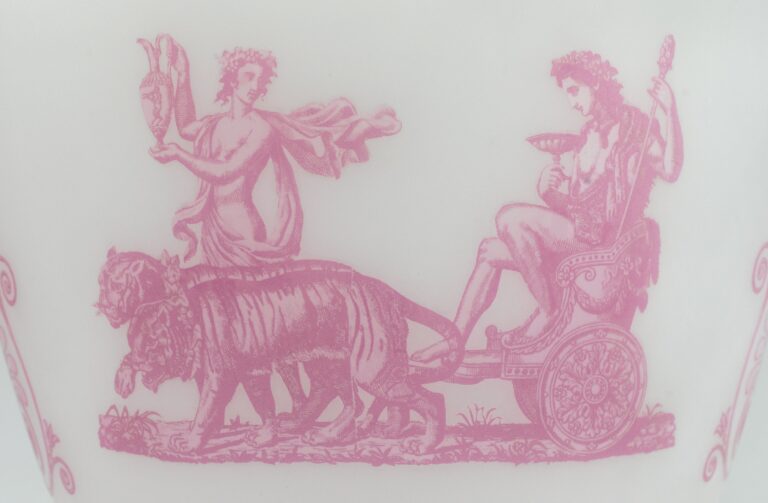
Venetian glass is a name that covers glassmaking in Venice from the 13th century at the latest, according to Britannica, to the present, and a good many later imitations, so the first step in identifying a piece is to ask which Venice it comes from: Renaissance Venice, the Murano glasshouses of the 1800s, or somewhere else that copied the look. Museum records are useful here because they state a date and a place for each object, and sometimes say what the glass is made of.
This guide reads the glass through five objects in the Cleveland Museum of Art, from the late 1400s and the 1800s, with the history from Britannica. It dates each piece by what the records say, and says where the sources leave a question open.
Venetian glass at a glance
| Type | What the record says | Date | Record |
|---|---|---|---|
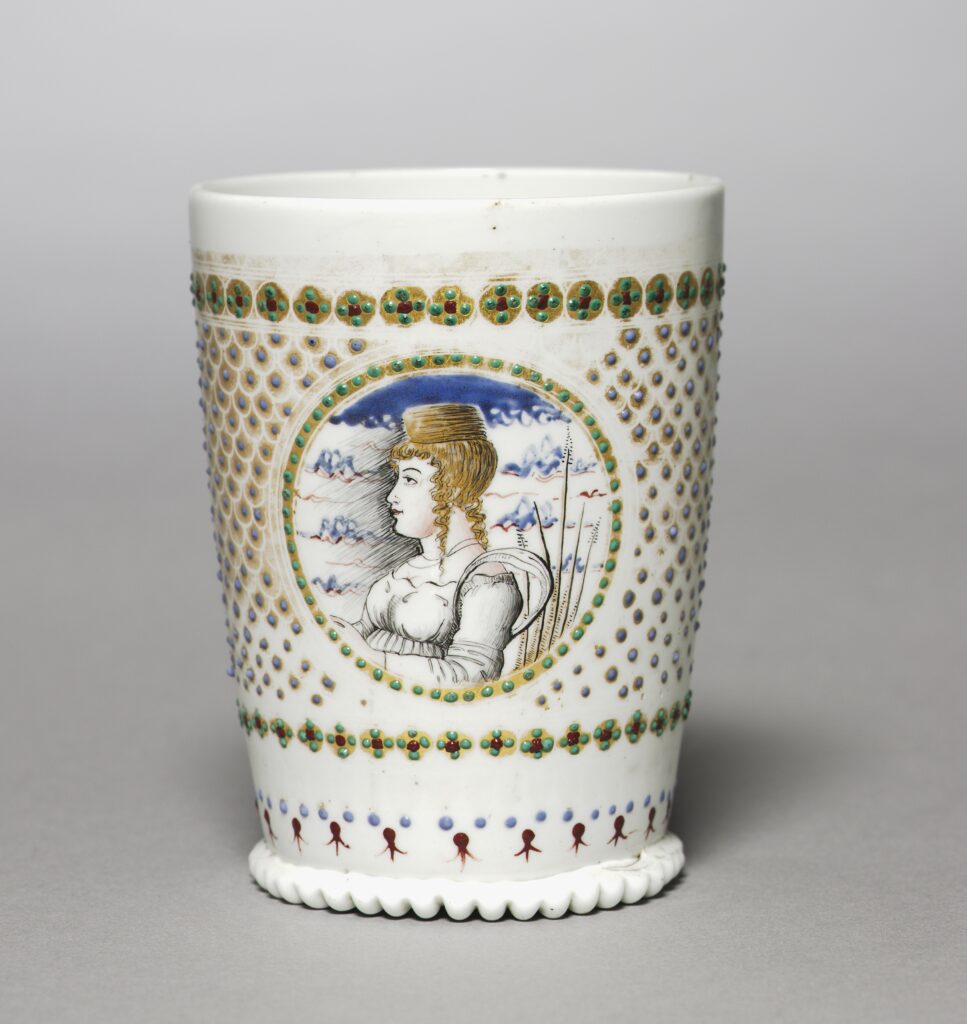
| Lattimo (milk glass) | Opaque white glass, enameled; the Cleveland record says it imitated Chinese porcelain | Late 1400s | Cleveland 1955.70 |
| Enameled and gilded glass | Clear glass with painted enamel and gold, the Renaissance Venetian decoration | Late 1400s | Cleveland 1949.176 |
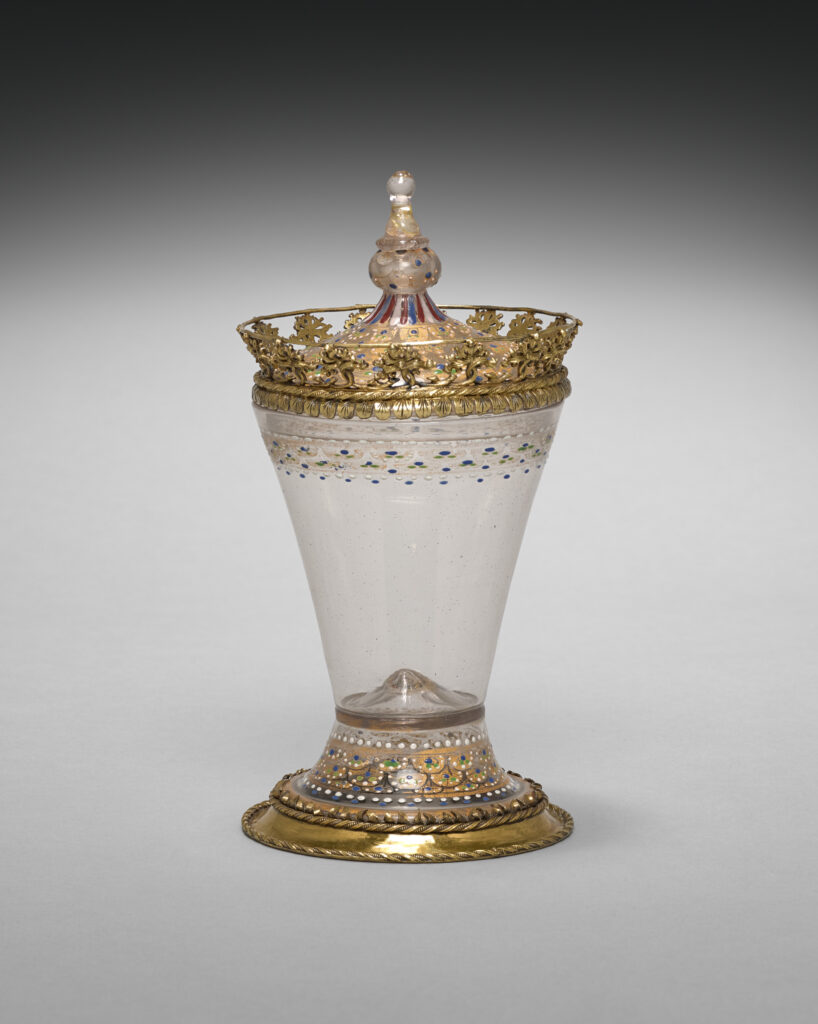
| Glass with gilt-silver mounts | Enameled and gilded glass given a silver-gilt mount | About 1490 to 1500 | Cleveland 1950.573 |
| Murano glass of the 1800s | Colored glass, enameled (the Peddler Goblet is also gilded), catalogued as Venice (Murano), 19th century | 1800s | Cleveland 1953.364, 1960.38 |
Where the glass comes from
Britannica defines Venetian glass as the variety of glasswares made in Venice from the 13th century, at the latest, to the present. A glassblowers’ guild existed in Venice from 1224, but the earliest surviving pieces that can be dated with certainty are from the mid-15th century, so the early history is largely conjectural. In 1291 the glasshouses moved across the lagoon to the island of Murano, where they have remained.
In the 15th century, Britannica says, glassmakers worked to perfect cristallo, clear glass that approximated rock crystal. By the 16th century they had mastered adding color to clear glass and removing the natural smoky tint from it, and gilding and enameling were also known. The techniques were guarded, with severe penalties for workmen who defected.
Late 1400s: milk glass, enamel and gold
The Marriage Beaker is the guide’s earliest object. Cleveland catalogues it as opaque glass, lattimo, enameled, from late 1400s Venice, and says that by the mid-1400s the word had come to mean glass made milky by opacifying materials such as an oxide of tin. The museum adds that it imitated Chinese porcelain, and that only fourteen surviving lattimo vessels are recorded. Beakers like this one may have been betrothal or wedding gifts; this one is enameled with idealized portrait heads of a young man and woman. For the porcelain it imitated, see blue and white porcelain.

The Standing Cup and the Covered Beaker show the other Renaissance decoration, enamel and gilding on clear glass. Cleveland dates the cup to the late 1400s and the beaker to about 1490 to 1500, and records the beaker with gilt-silver mounts. Neither record carries a description, so the dates and materials are all the museum says.
Techniques you will meet in descriptions
Britannica names the techniques of the 16th century that catalogues still use. Millefiori joins canes of different colored glass so that a section shows many small flower-like beads. Calcedonio simulates marble and other stones. Latticinio incorporates rods of opaque, usually white, glass in patterns. Diamond engraving also became possible in the 16th century as glass quality improved.
Drinking glasses were the staple product of the 16th and 17th centuries, and Britannica says their peculiarly Venetian characteristic was the elaborate working of the stem with tools such as pincers while the glass was still malleable. Symmetrical “wings” were drawn out at each side, and Britannica adds that this type of drinking glass and some other vessels with elaborately flared bowls are usually called bouquetiers, “flower holders”.
What “Murano glass” means
Britannica describes Murano as the island north of Venice, founded between the 5th and 7th centuries, which developed greatly after 1291 when the glass furnaces moved there, and became the manufacturing center for Venetian work, exported in large quantities across Europe. At its 16th-century peak, Murano had more than 30,000 inhabitants; glassmaking continues there on a much reduced scale, and a Museum of Glass Art in the Giustinian Palace records the history.
So Venetian glass names the glass and Murano names the place where it has been made since 1291. Cleveland follows that logic: its 1800s pieces are catalogued as Venice (Murano), 19th century, and its Renaissance pieces simply as Venice. This guide uses the museum’s words and does not claim to settle how dealers use “Murano” for later glass.
The 1800s: Murano revival pieces

Britannica’s view is that in the 19th century little was done that was worthwhile apart from the reproduction of older types; that is its judgment of the period, not something the Cleveland records say. Cleveland dates two Murano pieces to the 1800s. The Peddler Goblet, in green and blue glass, enameled and gilded, shows a peddler asleep under a tree and robbed by monkeys, a subject the museum says also appears on the famous Monkey Cup at The Met Cloisters; it adds that peddlers were traditionally believed to share many of the monkeys’ vices. Another part of the decoration shows Venus emerging from the sea and the Three Graces.

The Tazza with a Frieze of Putti, in enameled blue glass, is also catalogued as Venice (Murano) of the 1800s. The record has no description. Together the two show what a museum record can state for 19th-century Murano work: a date in the 1800s and a place.
How to tell what you are looking at
A Venetian-looking glass can be Renaissance Venice, a 19th-century Murano revival, or glass made elsewhere in the Venetian style. Britannica says many glassmakers from Venice defected despite the restrictions, and from the 16th century, France, Germany, England and the Netherlands produced their own versions of Venetian types, called façon de Venise, “Venetian fashion”. It adds that 17th-century types continued to be reproduced in later centuries, and that reproduction of 17th-century types continues today. Britannica’s article on mirrors says that a method of backing flat glass with a tin-and-mercury amalgam came into widespread production in Venice in the 16th century; the glass behind such mirrors is covered in how to date antique mirrors.
- Ask for the museum-style description: place (Venice, Murano, or “façon de Venise” elsewhere), date as a range, and materials.
- Treat “Venetian” on its own as a style, not a date or a place.
- Check whether decoration is enamel, gilding or both, and whether a mount is original. Cleveland records the silver-gilt mount on its beaker.
- Britannica’s view is that 19th-century Venetian work was mostly reproduction of older types, so check the date and do not assume age from the style.
- A photograph cannot separate a Renaissance piece from a later copy; a dated, sourced record can.
French crystal is a separate tradition, covered in how to identify Baccarat crystal.
Questions about Venetian glass
Is Murano glass the same as Venetian glass? Murano is the island where the glass has been made since the glasshouses moved there in 1291, according to Britannica. Venetian glass is the name for the glass; Murano is the place.
How can I tell an old piece from a copy? Look for a stated date and place from a museum or a documented sale, not the word “Venetian”. Britannica notes that Venetian types were made in other countries from the 16th century and reproduced in later ones.
What is lattimo? Milk-white opaque glass. Cleveland says the word had come to mean glass made milky by opacifying materials such as an oxide of tin, and that it imitated Chinese porcelain.
What is cristallo? Britannica defines it as the clear glass of Venice that approximated rock crystal, which glassmakers worked to perfect in the 15th century.