Antique mirrors are two objects in one frame: a sheet of glass with a metal backing, and the woodwork around it. They age differently, they are replaced at different times, and a museum will often date them separately. That is the useful starting point for anyone trying to work out how old a mirror is, because the frame is usually the loudest piece of evidence and the least reliable.
This guide reads the dating clues one at a time — the plate, the silvering, the frame, the backing — against conservation literature, Britannica and the catalog records of five museum mirrors. Where the sources disagree, and on the question of mercury versus silver they disagree sharply, the guide says so instead of picking the tidier answer.
What the clues on antique mirrors can and cannot tell you
Britannica’s account of mirror making gives the frame of reference. Glass backed with metal came into use in the late 12th and early 13th centuries; by the Renaissance, Nürnberg and Venice were the known centers; and a method of backing flat glass with a thin sheet of reflecting metal, an amalgam of tin and mercury, came into widespread production in Venice in the 16th century. Venetian workmen carried the secret away, and by the middle of the 17th century mirror making was practiced extensively in London and Paris. Britannica also notes the thing that complicates every attempt to date antique mirrors by their frames: frames reflected the general taste of the time and were often changed to accommodate alterations in taste, being cheaper and hence more easily replaced than the mirror itself.
So a date is built from several clues that have to agree. Here is the short version, with the rest of the guide behind it.
| Clue | What it shows | Source |
|---|---|---|
| Size of the plate, and joins | Blown-and-flattened glass gave a plate no bigger than about four by two feet; casting, from the late 17th century, reached nearly nine by five feet. Tall early mirrors are therefore often made of two plates with a visible join. | Conservation account of the process (Williamstown); V&A record of a ca. 1707 looking glass |
| The reflective layer | Mercury-tin amalgam, or chemically deposited silver. The two look broadly similar and have to be told apart by how they fail. | Williamstown Art Conservation Center |
| How the mirror is failing | Silver corrodes to a warm yellow-brown; a mercury-tin amalgam goes the bluish color of tin oxides and loses reflectance in holes and dark speckling, often concentrated low down. | Williamstown Art Conservation Center |
| Thickness and tone of the glass | Historic glass of both kinds is generally thicker than modern glass and often darker in tone. | Williamstown Art Conservation Center |
| Bevel | A bevel can date the plate rather than the frame. The V&A dates one mirror’s frame to about 1675 while noting that the bevel may indicate an 18th-century replacement plate. | V&A record O78988 |
| Backing board | Backs are replaced more often than anything else. The same V&A mirror has a non-original softwood board. | V&A record O78988 |
| The frame | Dates the taste, not necessarily the mirror. Frames were changed as fashion changed. | Britannica |
The plate: size, joins and thickness
The Williamstown Art Conservation Center’s technical account of mercury amalgam mirrors describes the process in detail. Molten glass was blown and spun into a cylinder, then cut into a rectangular sheet, which yielded a plate no larger than about four by two feet. With the glass-casting method of the late 17th century, glassmakers reached plates of nearly nine by five feet. The glass was polished with successively finer abrasives by hand until machines took over the grinding and polishing in the 1850s.
That single fact about size explains a construction you meet constantly in early tall mirrors. The V&A’s record of a London looking glass of about 1707 puts it plainly: glass was not available at the full size, so large mirrors are usually made of two pieces, one for the longer lower section and a separate shaped piece for the upper. That mirror has two bevelled plates held by ten transverse brass binders. The Metropolitan Museum’s early 18th-century walnut looking glass below is built the same way, and the join sits where you would expect it.
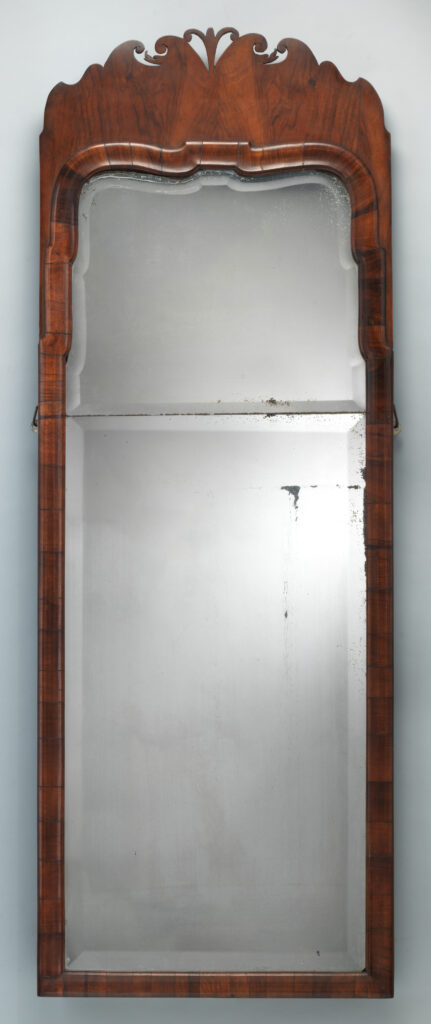
A single tall plate in a frame that claims to be early is worth a question, not an accusation: it may be a later replacement in an old frame, which is common and not in itself dishonest. What it is not is evidence of an early date.
The silvering: mercury-tin or silver, and why 1835 is not a cut-off
Britannica dates the modern technique precisely: the chemical process of coating a glass surface with metallic silver was discovered by Justus von Liebig in 1835, and this advance inaugurated modern mirror making. A great many dealer and appraisal guides turn that date into a rule — mercury before 1835, silver after — and treat it as a way of sorting antique mirrors into two bins.
The conservation literature does not support the rule. Williamstown states that mercury-tin amalgam remained the predominant form of mirroring through the 19th century, that the two processes co-existed, and that silvering won out only in the early 20th century. Both things are true at once: 1835 is when silvering becomes possible, not when amalgam stops. A mercury-tin plate can therefore be decades later than the method’s invention would suggest, and the honest conclusion from a mercury back is made before about 1900, not made before 1835.
Telling the two apart is a matter of how they fail, and the conservation account gives the tests. Historic glass of both types is generally thicker than modern glass and often darker in tonality. A thin piece of white paper held against the glass generally looks brighter over a silvered mirror than over a mercury-tin one. As the metal layer corrodes, silvered mirrors develop the warm, yellow-brown tone of tarnish, while mercury-tin mirrors take on the bluish color of tin oxides. Silvered mirrors were almost always varnished or painted to protect the silver; mercury-tin mirrors generally were only painted or varnished for use in humid places and at sea. And because liquid mercury migrates downward in a mirror hung vertically, deterioration often concentrates in the lower half, creating holes of lost mirroring and a darkened, speckled look.
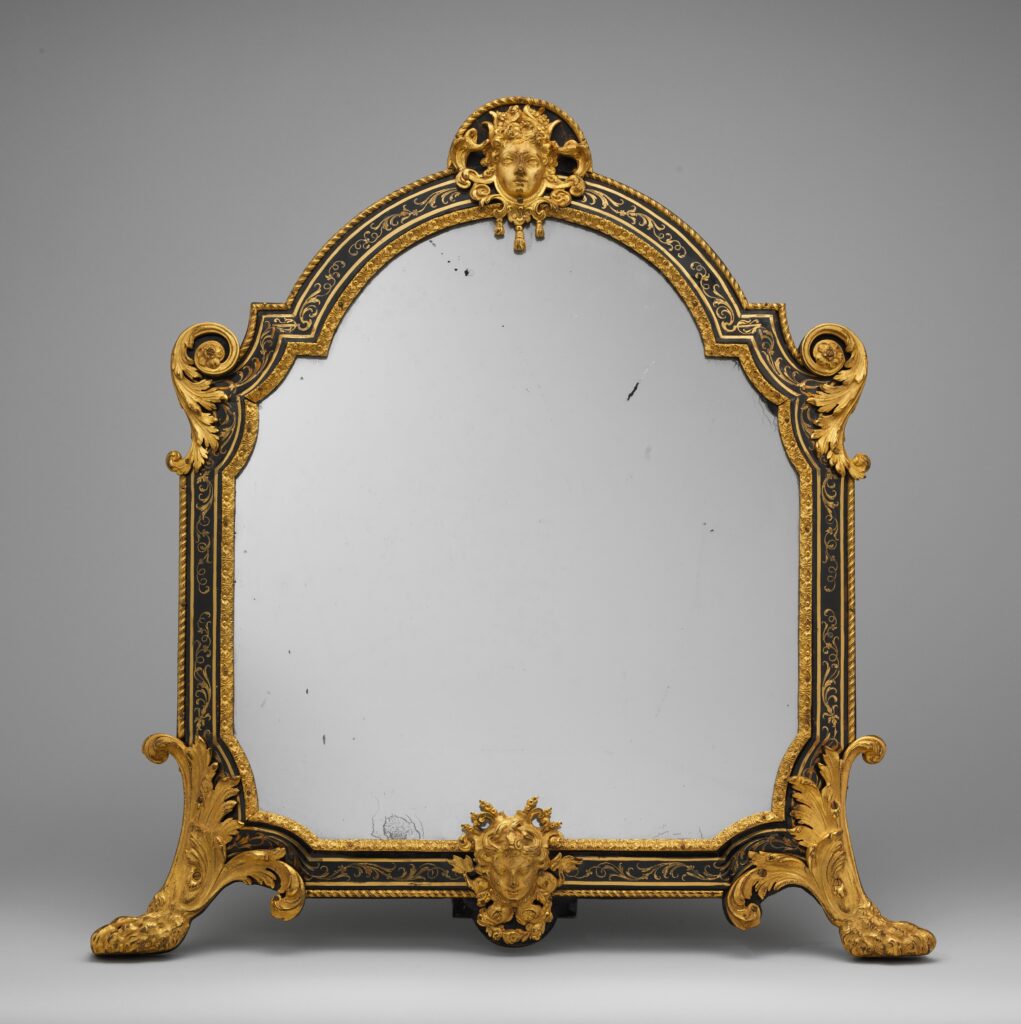
None of this is a test you can run from a photograph, and it is worth saying that the marks sold as “antiqued” glass imitate exactly this kind of decay. Speckling is a reason to look closer, not a date.
Mercury and safety
A mirror with a mercury-tin back still contains mercury, and the conservation guidance on handling it is specific. Mercury is acutely toxic and its vapor enters the bloodstream when inhaled. Williamstown reports that amalgam mirrors are not generally considered a serious source of mercury vapor — rooms lined floor to ceiling with them tested well below safety limits in Danish conservator Per Hadsund’s measurements — and identifies the real risk as liquid mercury, which can bead up along the bottom edge between the glass and the backing board. Dust or debris in contact with it must be treated as mercury waste. A vacuum must never be used, because it releases vapor into the air, and professional conservation advice should be sought before a backing board or dust cover is removed. The mirror should also be kept in its original orientation rather than turned over, since flooding the drier areas with the pooled liquid causes further damage.
The frame, the backing and the things that get replaced
Britannica’s furniture history gives the sequence of frames: early ones of ivory, silver, ebony or tortoiseshell, or veneered with marquetry of walnut, olive and laburnum; carvers such as Grinling Gibbons producing frames to match a whole decorative scheme; the tradition of setting a mirror over the mantelpiece, the overmantel, which becomes steadily more architectural until Robert and James Adam are designing fireplace units from hearth to ceiling. By the end of the 18th century painted decoration had largely supplanted carving, with floral patterns or classical ornament, and the French were producing circular mirrors in neoclassical gilt frames that sometimes held candlesticks. Cheaper 19th-century production then put mirrors into wardrobes and sideboards and across public interiors.
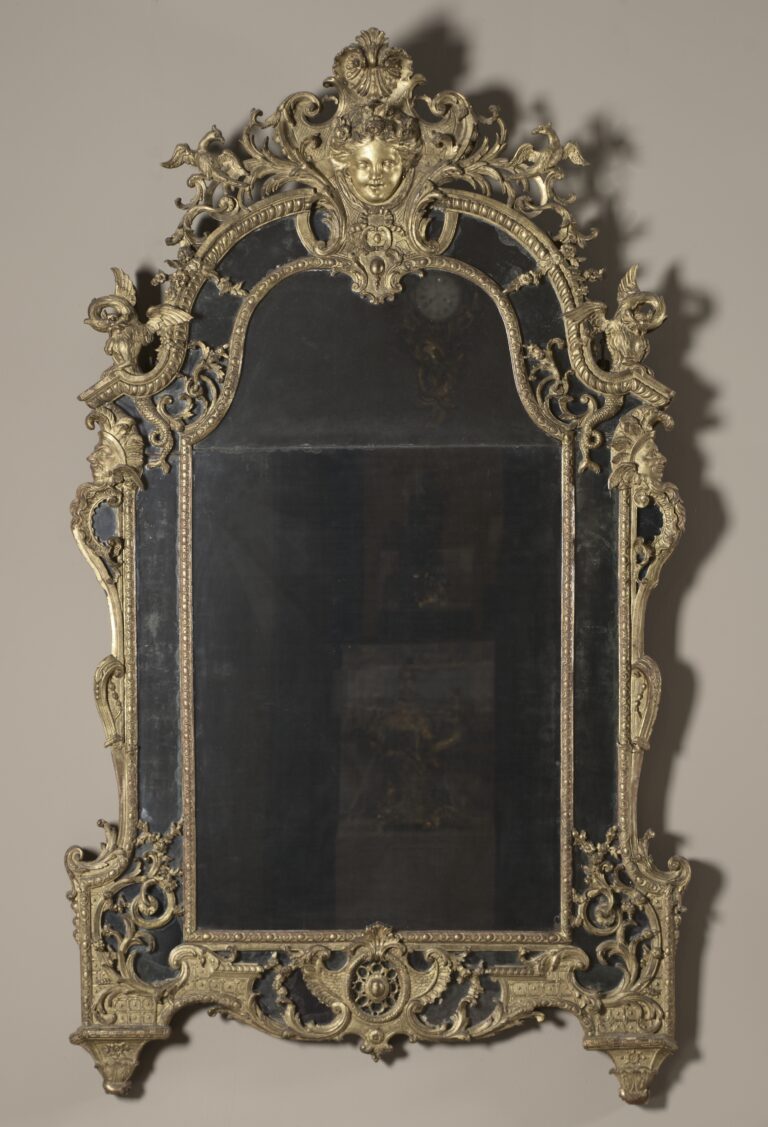
The carved giltwood overmantel at the top of this guide sits in that story. Cleveland dates it to about 1740 and gives it to James Pascall; the carved ostrich feathers along the top are, the museum says, a likely reference to the emblem of Frederick, Prince of Wales, whose French and modern tastes set him against his father George II. That is a dating argument from ornament, and it is the kind that holds up: it points at a decade, not at a plate.
For what happens underneath, the V&A’s record of an English mirror of about 1675 is the clearest short lesson in reading antique mirrors that exists in a catalog entry. The frame is veneered with oyster-cut kingwood. The glass has tin amalgam silvering and is backed with a non-original softwood board. And the museum’s own verdict on the plate is split: the glass is of the correct thickness for the date, but the bevel may indicate that it is an 18th-century replacement. Three components, three different ages, stated as uncertainty rather than resolved.
One more confusion worth clearing. A “silvered” frame is not the same thing as a silvered glass. The V&A’s carved mirror of 1665–72 bearing the arms of Gough is silvered pine — silver leaf over a gesso ground — and its protective varnish has been lost, so the leaf has tarnished. Its mirror plate, the record notes, is original. Frame and plate are described separately because they are separate problems.
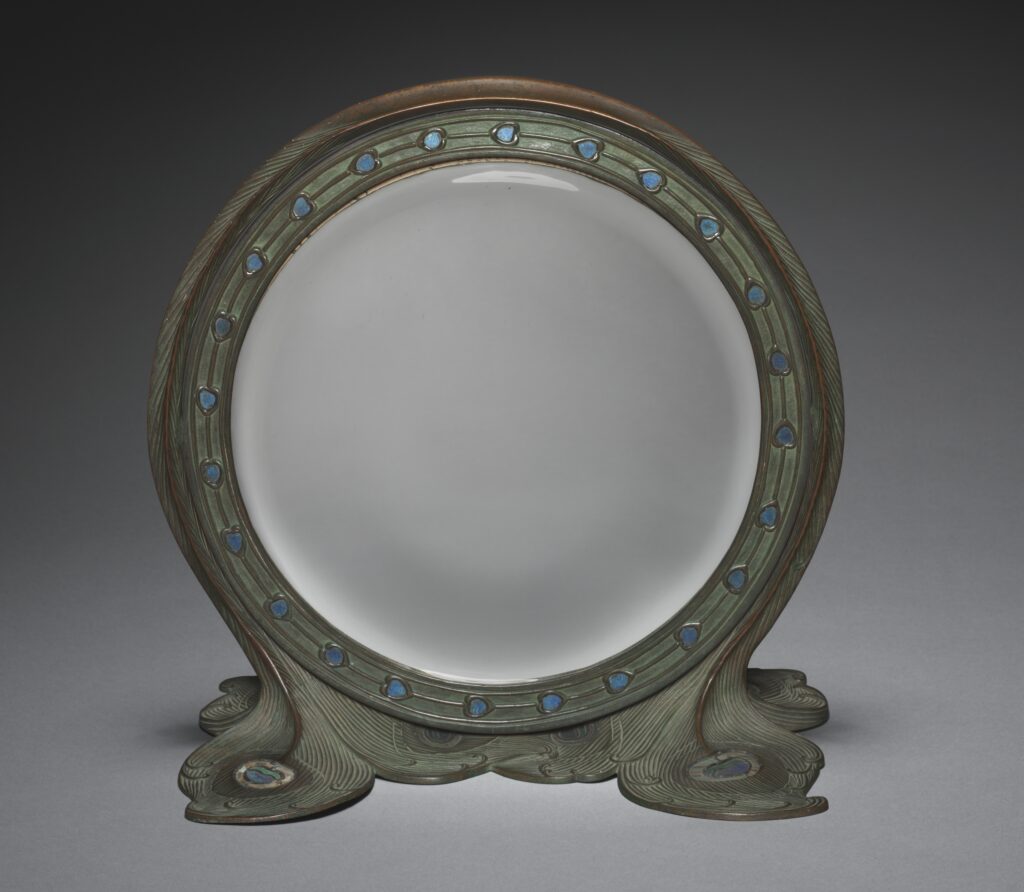
Later mirrors are easier to place and worth knowing for contrast. Cleveland’s dressing table mirror of about 1900 to 1902 is bronze with a band of Favrile glass mosaic, made by the Tiffany Glass & Decorating Company and stamped on the underside; the museum sets it among the “fancy goods” the firm expanded into by 1900. Its plate is bright and even in a way an amalgam plate of 1700 is not.
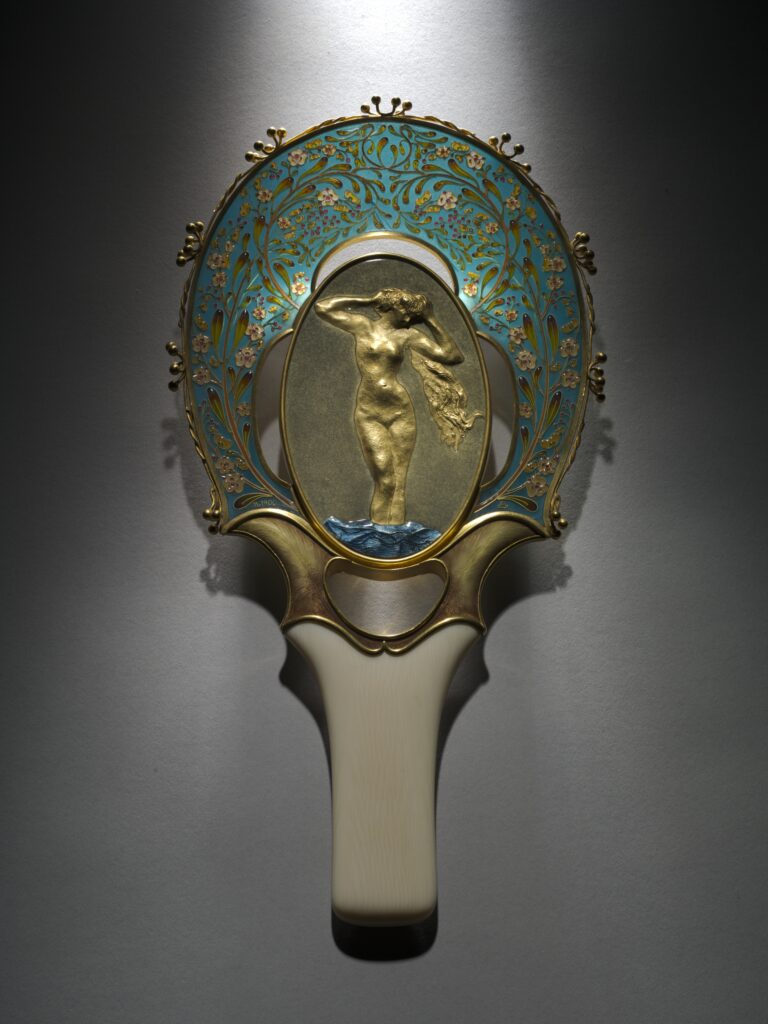
The French hand mirror of about 1900, designed by Félix Bracquemond for the banker Baron Joseph Vitta, carries a Venus modeled by Auguste Rodin, enamel work by Alexandre Riquet and goldsmithing by the Falize firm. The reason to end on it is that almost everything datable about it is signed, marked or documented — the opposite of the anonymous plate in an old frame, and a reminder of how much of dating is just reading what the object states about itself.
How to date antique mirrors in practice
- Look at the back before anything else, and look without taking it apart. Boards, nails, labels and old repairs are where the history is.
- Date the plate and the frame separately, then ask whether the two stories agree.
- Check whether a tall mirror is one plate or two, and where the join falls.
- Read the failure, not just the pattern: bluish and speckled, concentrated low, suggests an amalgam; warm yellow-brown suggests tarnished silver.
- Treat a mercury back as evidence of a date before about 1900, not before 1835.
- Treat a bevel, a backing board and a hanging fitting as replaceable parts until something shows otherwise.
- If a mercury-backed mirror is coming apart, stop and ask a conservator rather than opening it up.
For the French overmantel type specifically — the mirror with a painted or carved panel above it, and the four museum names used for it — see the guide to the trumeau mirror. The gilt-bronze mounts that appear on the grandest frames are covered in ormolu and gilt bronze, the veneered and inlaid work behind many early frames in marquetry and parquetry, and the other great test of marks and glass quality in how to identify Baccarat crystal.
Questions about antique mirrors
How can I tell if a mirror is mercury or silver? By how it is failing and how it reads against white paper. Conservation guidance gives three signs: a mercury-tin amalgam turns the bluish color of tin oxides and breaks into holes and dark speckling, often worse in the lower half; silver tarnishes warm yellow-brown; and white paper held to the glass looks brighter over silver. Neither can be confirmed from a photograph.
Does foxing mean a mirror is old? No. It means the reflective layer has decayed, which happens to both kinds of mirror and is also produced deliberately on new “antiqued” glass. It is a prompt to check the other clues.
Why is the glass in my old mirror in two pieces? Because of the size limits of the glass itself. Plates blown and flattened reached about four by two feet, and the V&A notes that large mirrors were usually made of two pieces for that reason, with the shaped section at the top.
Is the frame a reliable way to date antique mirrors? Less than it looks. Britannica notes that frames followed the taste of the time and were often changed when taste changed, being cheaper to replace than the mirror itself.
Is an antique mirror with mercury backing dangerous? Intact ones are not generally considered a serious source of mercury vapor, on the conservation measurements cited above. The risk is liquid mercury pooled at the bottom edge. Do not vacuum it, do not take the back off, and get professional advice before any work.
Sources
- Kathleen Payne de Chavez, “Historic Mercury Amalgam Mirrors: History, Safety and Preservation”, Williamstown Art Conservation Center, Tech Notes, Spring 2010 (read in full).
- Britannica, “Mirror (optics)”, including its furniture section on mirrors and their frames.
- Victoria and Albert Museum records: O78988 (mirror, ca. 1675, tin amalgam silvering, non-original board), O52802 (mirror, ca. 1707, two plates), O7889 (mirror, 1665–72, silvered frame, original plate).
- The Cleveland Museum of Art, Open Access (CC0): 2006.3, 1977.168, 1978.43.
- The Metropolitan Museum of Art, Open Access: 10.125.348a, 1985.177.