The standard advice on how to identify Baccarat crystal is to read the base. On an old piece the base may say nothing at all, and that is less alarming than it sounds: by its own account, Baccarat did not sign its work systematically until 1860, and for decades after that the usual mark was a paper label.
Baccarat dates its founding to 1764 (some references give 1765), and its crystal to a formula worked out in 1816. Britannica adds that a Belgian lead-crystal manufacturer acquired the firm in 1817 and that it has specialized in lead crystal since. For a collector the question is narrower than the company’s history: which mark belongs to which period, and what an object can still tell you once the mark is gone.
The mark, period by period
Baccarat’s own account of its signatures gives a clear sequence.
- Before 1860: pieces were generally unsigned, which the house says makes early work harder to authenticate.
- 1860 to 1936: most production carried a paper label. Lighting fixtures were the exception.
- From 1936: acid etching became the standard signature across the house’s production.
- Limited editions and exceptional pieces: sometimes engraved, occasionally with a designer’s stamp or a serial number, alongside the etching.
- Early 2000s onward: a discreet laser-marked logo.
Its identification page describes the same marks without dates: an engraving in the crystal, a red octagonal label or, more recently, a laser-etched logo, and on older pieces the words “Baccarat” or “Baccarat France,” sometimes with an acid-stamped seal. The useful test is whether the mark fits the date the piece claims. A paper label on a 1920s decanter is what the sequence predicts; a fresh laser logo on something sold as nineteenth-century is not.
Lighting is the exception to the label rule. For chandeliers Baccarat describes a small engraving or a metal plate reading “Baccarat,” usually on the metal frame, and on newer models a red crystal drop etched with a B. The Journal’s guides to antique chandeliers and French chandeliers cover how those frames and drops are built, and antique lamps the smaller fittings. On a Baccarat fixture, look at the frame first.
A signature melted into the glass
Paperweights offer one of the rare early signatures. Britannica dates Baccarat’s paperweights from 1846. The Corning Museum of Glass holds a lead-glass millefiori paperweight from 1848 whose side carries a signature cane inscribed “B/1848,” set among silhouette canes of a goat, stag, dog, horse, rooster, bird and flower. A letter and a year fused into the glass cannot peel off, which is more than a paper label can say. One record shows the kind of evidence worth looking for on a weight; it does not mean every Baccarat weight was signed.
Four pieces, read one at a time
Four museum pieces show what else a collector can read when the base is blank.
A vase identified by its process, 1867
The Petit Palais’s vase néo-grec is an amphora-shaped crystal vase, 45.3 centimeters tall, with its figures drawn in pink on a white ground like an antique cameo: Bacchus in a chariot drawn by two tigers on one side, a bacchante in a cart pulled by four goats on the other, a Greek key frieze at the neck, gilt lines at the joints.
The museum credits the decoration to the new acid-etching process developed by the chemist Kessler, notes that a similar model was shown at the 1867 Exposition universelle, and names two other examples, at the Chrysler Museum in Norfolk and the Musée d’Orsay, the latter in blue crystal on white. That is a different, and in some ways firmer, kind of evidence than a signature: a documented model, a dated exhibition and sister pieces in other museums.

A vase that looks like someone else, about 1909
The vase aux cactus shows how style can mislead. It is acid-etched colorless crystal with gilding, its cactus plants dark and edged in gold against a frosted ground. The Petit Palais’s commentary calls it one of the few Art Nouveau pieces Baccarat showed at the 1909 exhibition in Nancy, and adds that, unlike Daum or Gallé, the house stayed long faithful to crystal and gilt-bronze pieces in the Louis XV and Louis XVI manner, and only rarely turned to naturalistic or floral decoration.
A cactus-covered Baccarat is therefore the exception, and an exception deserves a mark, a catalogue entry or an exhibition record before it deserves the name.

A cut decanter, 1890 to 1900
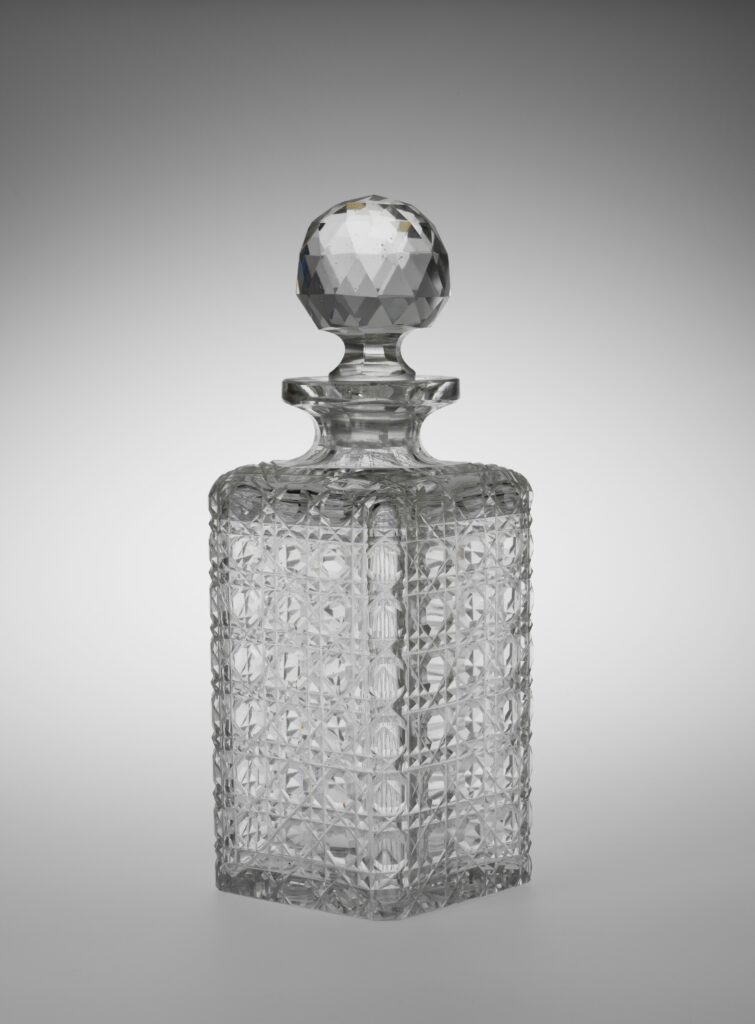
The Met’s decanter falls inside the label years Baccarat describes, so a paper label is the mark to expect, and a paper label is easily lost. It is wheel-cut glass 22.5 centimeters tall, square in section, under a faceted ball stopper. Cutting is the part of Baccarat’s guidance that a photograph can test. The house asks for flawless cuts, symmetrical patterns and sharp edges, and names the diamond, fern and Nancy cuts as examples. Look closely at the photograph and the cutting speaks for itself: crosshatching and round facets, cut on the wheel.
An engraved pitcher, about 1880
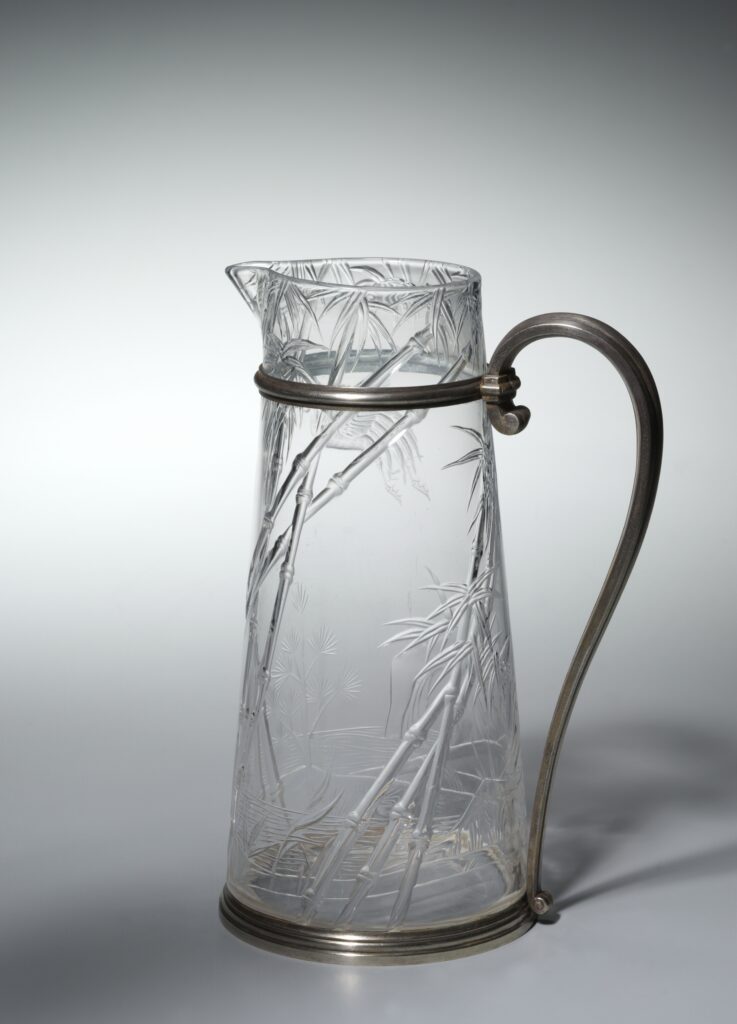
The Cleveland Museum of Art’s pitcher has bamboo stems and leaves cut into colorless glass, with a metal collar at the rim and a metal handle. Cleveland records it as glass with metal mounts, 24.5 centimeters high, made by the Baccarat glasshouse; the mounts are described only as metal.
When a listing names a maker for a mounted piece, ask what the name covers: the glass, the mounts or both. A description worded “in the manner of Baccarat” makes a different claim from one that says Baccarat, as the note on reading an auction catalogue explains.
What a mark can’t prove
To identify Baccarat crystal with confidence, weight, bubbles and black-light tests are not enough: they say something about the material, and none of them names a maker. Lead crystal is a material, not a maker: Corning defines lead glass as glass with at least 20 percent lead oxide in the batch, a recipe George Ravenscroft patented in 1674, and calls “crystal” the popular term for the colorless kind. Baccarat’s own checklist for a glass is clarity, symmetry, crisp cutting and no air bubbles unless the design calls for them, which describes good glass rather than Baccarat glass.
A mark does not settle it alone, either. A piece can be genuinely Baccarat and still not old: the Smithsonian Libraries hold a Baccarat company catalogue, dated about 1987, titled Baccarat, the museum reproduction collection. The mark answers who; the date has to come from the form, the cutting, and whether the mark is the kind that period used.
Photograph the base, the sides and the stopper, and any label, before asking anyone, and ask a seller for the same. For a piece that matters, Baccarat advises buying from its boutiques or authorized resellers and asking for a certificate of authenticity on exceptional pieces; for an antique with no paperwork, the realistic route is a specialist who can handle the piece and judge the cutting.
Sources
- Baccarat, When did Baccarat begin signing its creations?; How to identify Baccarat crystal?; How to identify a Baccarat glass?; How to identify a Baccarat chandelier?; The history.
- Baccarat glass, Encyclopaedia Britannica.
- Corning Museum of Glass: Paperweight, 83.3.85; Lead glass; Crystal.
- Petit Palais, Paris Musées: Vase néo-grec, PPO03792; Vase aux cactus, PPO03815.
- Decanter with stopper, 2009.226.12a, b, The Metropolitan Museum of Art; Pitcher, 1997.266, The Cleveland Museum of Art.
- Smithsonian Libraries, record for Baccarat, the museum reproduction collection.