The blue on a Chinese porcelain jar came, for part of its history, from Iran. Cleveland’s Yuan-dynasty jar of the 1300s is painted with cobalt imported from there, likely from Kashan, and the Victoria and Albert Museum says the pigment used at Jingdezhen was either from Yunnan or brought from the Middle East. Blue and white porcelain is white porcelain painted with cobalt under a clear glaze, and most of what a collector can read in it comes from how that blue was handled.
That makes the first question about a piece less “is it old?” than “what is it?”: Chinese, Japanese or Dutch, made for the court or for export, early or late.
Blue and white porcelain in the Yuan: cobalt from Iran
Sources disagree on the earliest examples. The V&A says blue-and-white first appeared in the Tang dynasty (618 to 906), with a coarse, greyish body. Britannica says underglaze blue had been used in the Middle East from at least the ninth century and was introduced to China in the Yuan dynasty (1279 to 1368). Both put the decisive change in the Yuan, when the V&A says potters at Jingdezhen refined their clay by adding kaolin and improved their firing, and the blue became vivid. This article takes the Yuan as the start of the porcelain most people mean.
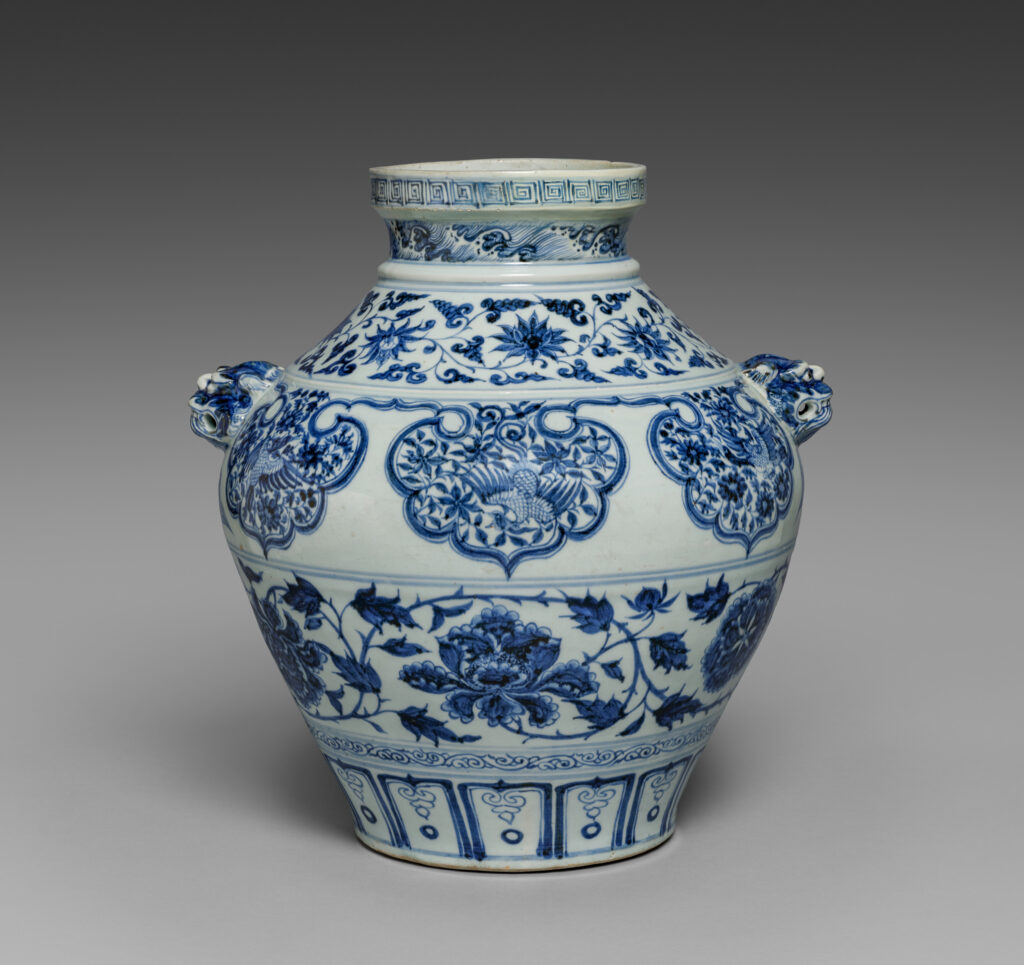
Cleveland’s jar with lion-head handles shows what that looks like. The museum calls it a classic example of Yuan blue and white porcelain, appreciated for its strong profile, brilliant blue and firm delineation of the patterns, and says the type was made no later than the 1330s for the court, for ordinary buyers and for overseas trade. The band of cloud collars with phoenixes against floral grounds has parallels in the decorative arts of Ilkhanid Iran. The V&A adds that much Yuan blue-and-white was meant for the Middle Eastern market, typically in large vessels with Chinese flowers and animals.
The V&A also describes how the blue was handled: dark and light blue combined for contrast, or a pattern reserved in white on a densely painted blue ground, with the pigment sometimes used to draw detailed outlines. Those are the first things to look at on any piece.
Ming: court wares, then export
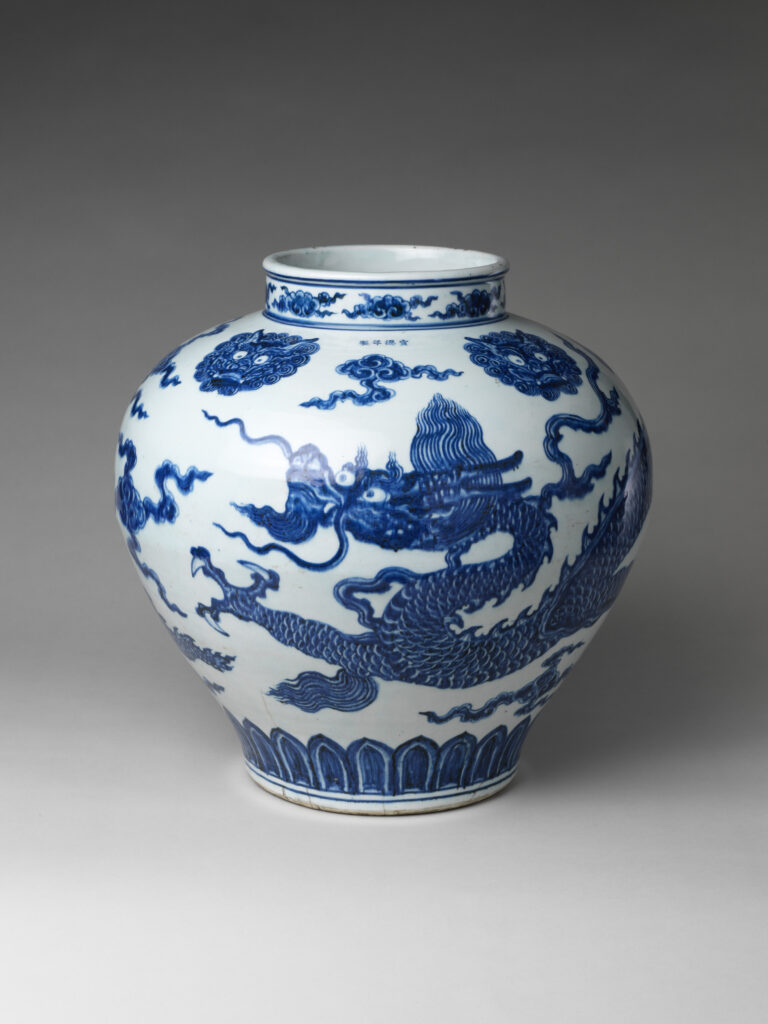
A piece made for the court can carry its date on it. The Met’s dragon jar, 19 inches high and made at Jingdezhen on court commission, is dated to the reign of the Xuande emperor by an inscription on its shoulder. The museum calls white porcelain painted with cobalt blue, a style that first flourished in China in the fourteenth century, arguably the most important development in the history of ceramics.

Cleveland’s Zhengde bowl shows how far other cultures shaped the blue. The museum says arabesques, designs of intertwined flowing lines inspired by Middle Eastern culture, appear on Chinese blue and white porcelain from the 1300s, and that the early Ming emperors, the Zhengde emperor in particular, promoted Islam and commissioned porcelain with Islamic calligraphy.
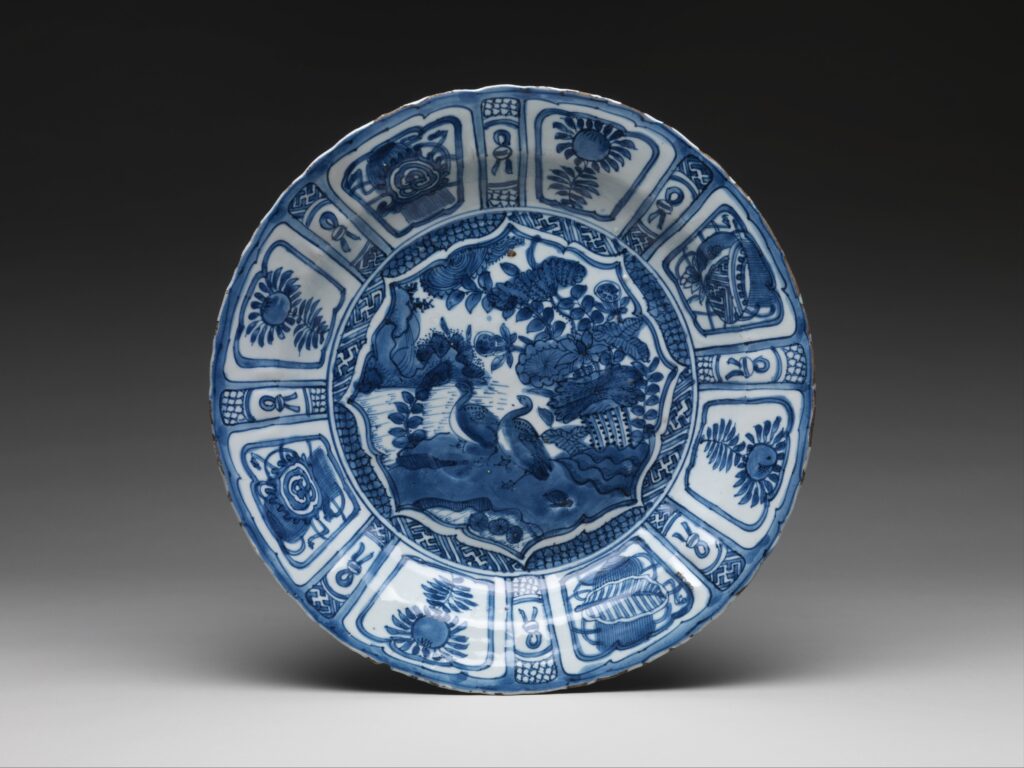
By the early sixteenth century, the Met’s essay on Chinese export porcelain explains, Portugal had opened trade routes to the Far East and Chinese potters began making wares specifically for export. Blue and white porcelain dominated that trade until the very end of the seventeenth century. The dishes became known as kraak porcelain, from the Dutch name for the Portuguese carrack, and a kraak dish is recognizable by a wide border divided into panels around a central stylized landscape. Porcelain rode at the lowest level of the ships, the essay adds, as ballast and because water did not harm it, unlike the tea stored above.
Export also changed the shapes. The V&A shows a cruet made at Jingdezhen about 1680 to 1700 that imitates a glass bottle for oil and vinegar, and the Met says models, now thought to have been wooden, were sent to Chinese potteries so that European forms such as mugs, ewers and candlesticks could be copied.
Transitional and Kangxi: new buyers, finer brushwork

When the Ming ended, potters lost imperial patronage. Cleveland’s square bottle comes from that gap. Its shape derives from European gin bottles, and its brilliant blues and fantastic animals, among them a leopard, a qilin and a horse, are characteristic, the museum says, of the transitional period between the Ming and Qing, when potters experimented to find new clients in China and abroad. The museum can date it only to a window of about ninety years, from the Chongzhen reign or the Kangxi reign.
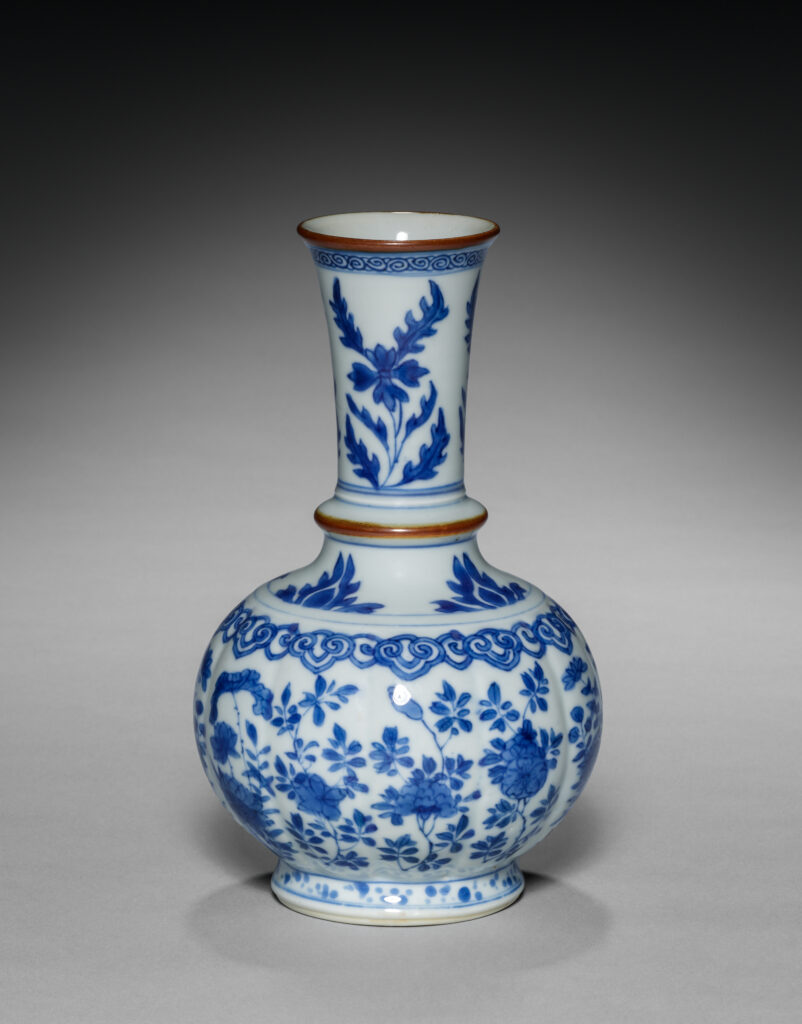
Under the Kangxi emperor the painting reaches its peak. Cleveland says designs on blue and white porcelain reached their highest painterly quality during his reign, with decorators matching the skill of professional painters, and that the brilliant blues suited the educated class, the court and foreign markets. The V&A names one technique, fenshui, in which the blue is laid in several shades to give an effect much like ink painting, and says Kangxi blue-and-white later became some of the most highly prized by collectors in Europe. Chinese porcelain painted in overglaze enamels instead of cobalt, such as the pink-dominated famille rose, is covered in the guide to famille rose porcelain.
A Jiajing mark on a Kangxi dish
A reign mark names the dynasty and the emperor under whom a piece was made, in four or six Chinese characters, usually on the base. Christie’s lays out the pattern. In a six-character mark the first two characters give the dynasty, Da Ming or Da Qing, the next two the emperor, and the last two, nian zhi, mean made; a four-character mark leaves out the dynasty. On porcelain the most common form is written in underglaze blue inside a double circle.
Marks begin to appear regularly at the start of the Ming and continue through the Qing, so a piece from an earlier dynasty should not have one. Christie’s notes one gap. In 1667 the Kangxi emperor forbade his mark on porcelain, in case the pieces were smashed and thrown away, which is why many pieces of his time carry only an empty double circle or an auspicious symbol, such as an artemisia leaf or a lingzhi mushroom.
The catch is that a mark is not a date. Christie’s says that for hundreds of years Chinese artisans copied the marks of earlier reigns out of respect for those periods, that these “apocryphal” marks were not necessarily meant to deceive, and that it is not uncommon to find fifteenth-century Ming marks on Kangxi blue and white porcelain. Xuande and Chenghua are among the most copied.

Cleveland holds a clear case. Its Kangxi dish, painted with a river landscape after the Yuan master Ni Zan, is catalogued as made between 1662 and 1722, yet the museum’s inscription record lists a Jiajing reign mark of the sixteenth century on the base, and the page says outright that the inscription is apocryphal. The poem on the front is more candid. It asks what to present to a gentleman and answers: a picture of the Xiang River.
The Ashmolean’s Barlow Collection catalogue shows the same habit from the other side. It describes a thinly potted white-slip bowl with two dragons that copies a bowl of Xuande mark and period, though the originals differ in material, proportions and design, and the base carries a spurious four-character Xuande mark in underglaze blue.
So the mark goes last. Christie’s advice is to weigh it against the quality of the piece: on a work made for the imperial household the mark should match the finesse of the painting, and a poorly written one is a warning, while on the ordinary wares of the same reign, which it calls minyao, less careful marks are common. A factory can date its work differently, as at Sèvres, where a letter inside the factory mark gave the year; the guide to reading Sèvres date letters and marks shows what that kind of evidence looks like beside an emperor’s name.
Chinese, Japanese or Delft?
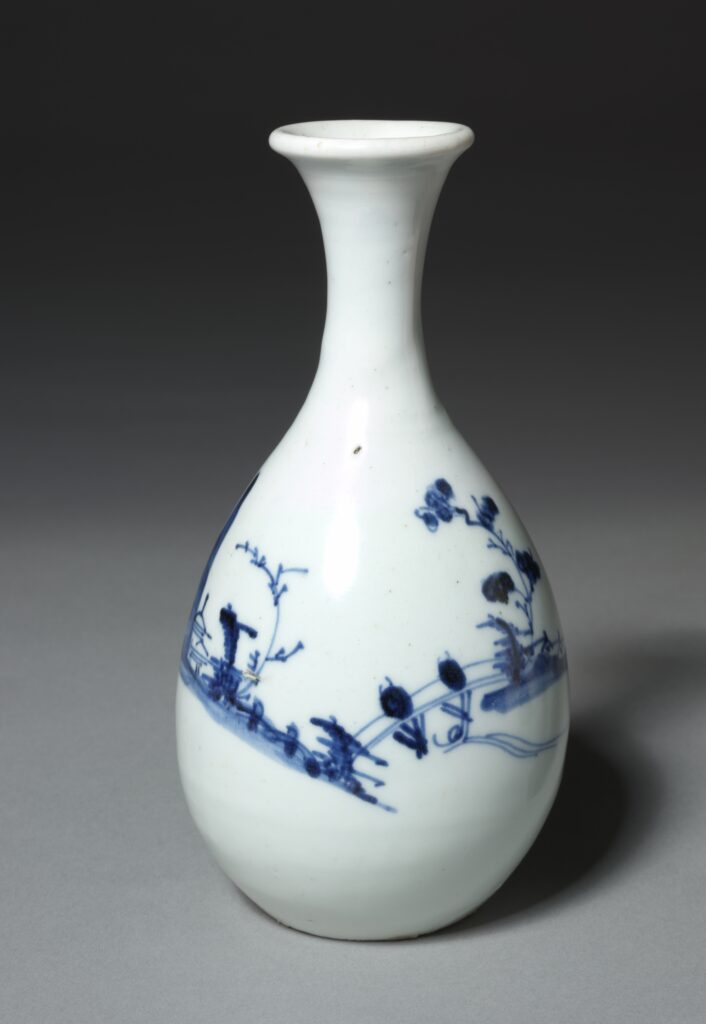
Blue and white porcelain traveled, and so did the look. The V&A says the Arita kilns in northwestern Kyushu are famous for blue-and-white porcelain imitating Chinese styles, and that the repeated linear pattern on one Arita bowl comes from a simplified version of the Chinese character shou, for longevity. Cleveland’s Hizen sake bottle gives the Japanese side a different origin. After Hideyoshi’s invasions of Korea, the museum says, skilled Korean potters were resettled in Japan and found the kaolin that high-fired porcelain needs, so the first white Japanese porcelains were made by Korean potters using Korean shapes and decoration.
That is the short version of a long subject. The guide to Imari ware follows the Arita kilns through the Dutch trade, and the overview of antique Japanese porcelain places Imari beside Kakiemon and Nabeshima.
Delft is the one that is not porcelain. The Met’s Delft dish of about 1660 is tin-glazed earthenware painted with cobalt blue, and the museum says the tin glaze most likely came from the Islamic world, where it was developed in the ninth century in response to imported Chinese ceramics. The plate’s shape and design, it adds, parallel Chinese kraak ware, the kind of dish shown earlier. The medium line on a museum record settles the first question: tin-glazed earthenware is a different material from porcelain painted under a clear glaze, however alike the blue looks.

What to check, in order
The museum sources read for this article give no field test for age, and none is invented here. What they do support is a short order of questions. What is it made of: porcelain painted under a clear glaze, or tin-glazed earthenware? Where was it made: Jingdezhen is thought to have made the best Chinese blue-and-white, the V&A says, but the ware was also made elsewhere in China, in Japan and Korea, and in Delft. For which market: a kraak-type dish, a European shape such as a cruet or a gin bottle, and a large Yuan vessel each point to a different buyer. The mark comes last.
Old descriptions help with history but not with dating. The V&A explains that in the 1850s and 60s Aesthetic Movement collectors such as Whistler and Rossetti prized antique Chinese blue-and-white, sometimes called “Nankin” or “Old blue,” and that by the late nineteenth century it was an essential part of the “house beautiful,” with sideboards and cabinets designed to display it. A catalogue that says Nankin or Old blue is using the language of that Victorian craze, not naming a period.
Ask what the attribution rests on: the body, the painting, the shape, or only the mark. An attribution that rests on the base mark alone rests on a feature that was copied for centuries.
Questions people ask about blue and white porcelain
What is blue and white porcelain called?
In Britain, collectors once called Chinese pieces “Nankin” or “Old blue,” according to the V&A. The export dishes of the late 1500s and early 1600s are called kraak, a name the Met traces to the Portuguese carrack. Museum records simply say blue-and-white, or, more exactly, porcelain painted with cobalt blue under a transparent glaze.
Is all blue and white porcelain Chinese?
No. The V&A says Chinese blue-and-white inspired local porcelain in distant markets, including the Arita kilns of Japan, and Delft earthenware borrowed the look without being porcelain at all.
Which period is the most prized?
The V&A says blue-and-white from the Kangxi reign (1662 to 1722) later became some of the most highly prized by collectors in Europe, and that Victorian collectors valued it for the skill of its pre-industrial manufacture. What any one piece is worth is a separate question that the sources read for this article do not answer.
Sources
- Victoria and Albert Museum, Chinese blue-and-white ceramics, last updated 17 April 2024.
- Encyclopaedia Britannica, Blue-and-white ware.
- The Metropolitan Museum of Art, East and West: Chinese Export Porcelain.
- The Metropolitan Museum of Art records: Jar with dragon, 37.191.1; Plate with Geese in a Lotus Pond, 16.93; Dish with flowers and birds, 30.86.3.
- The Cleveland Museum of Art records: Jar with Lion-Head Handles, 1962.154; Bowl (wan) with Water Plants and Arabesques, 1957.359; Transitional Blue-and-White Square Bottle, 2018.293; Lobed vase, 2020.174; Dish with Landscape and Inscription, 2019.176; Sake Bottle, 1992.117.
- Christie’s, A guide to reign marks on Chinese ceramics, 9 May 2025.
- Ashmolean Museum, Eastern Art Online, The Barlow Collection: white ware bowl with two dragons.
- Related guides on this site: Imari Ware, Antique Japanese Porcelain, Sèvres Porcelain.