Federal style furniture can be remarkably spare until you look closely. A Baltimore dining-table leg at the Metropolitan Museum of Art carries a pale bird medallion and a descending chain of bellflowers. The outline is a simple taper; much of the ornament happens inside it.
In American furniture, Federal describes the neoclassical work associated with the early republic, roughly 1785–1820. Geometric forms, contrasting veneers and fine inlay are useful starting points. They belong to a wider vocabulary that also includes reeded legs, classical chair shapes and increasingly sculptural ornament. A straight-legged sideboard and a curule chair can both belong within that history. 1,2
What makes furniture Federal?
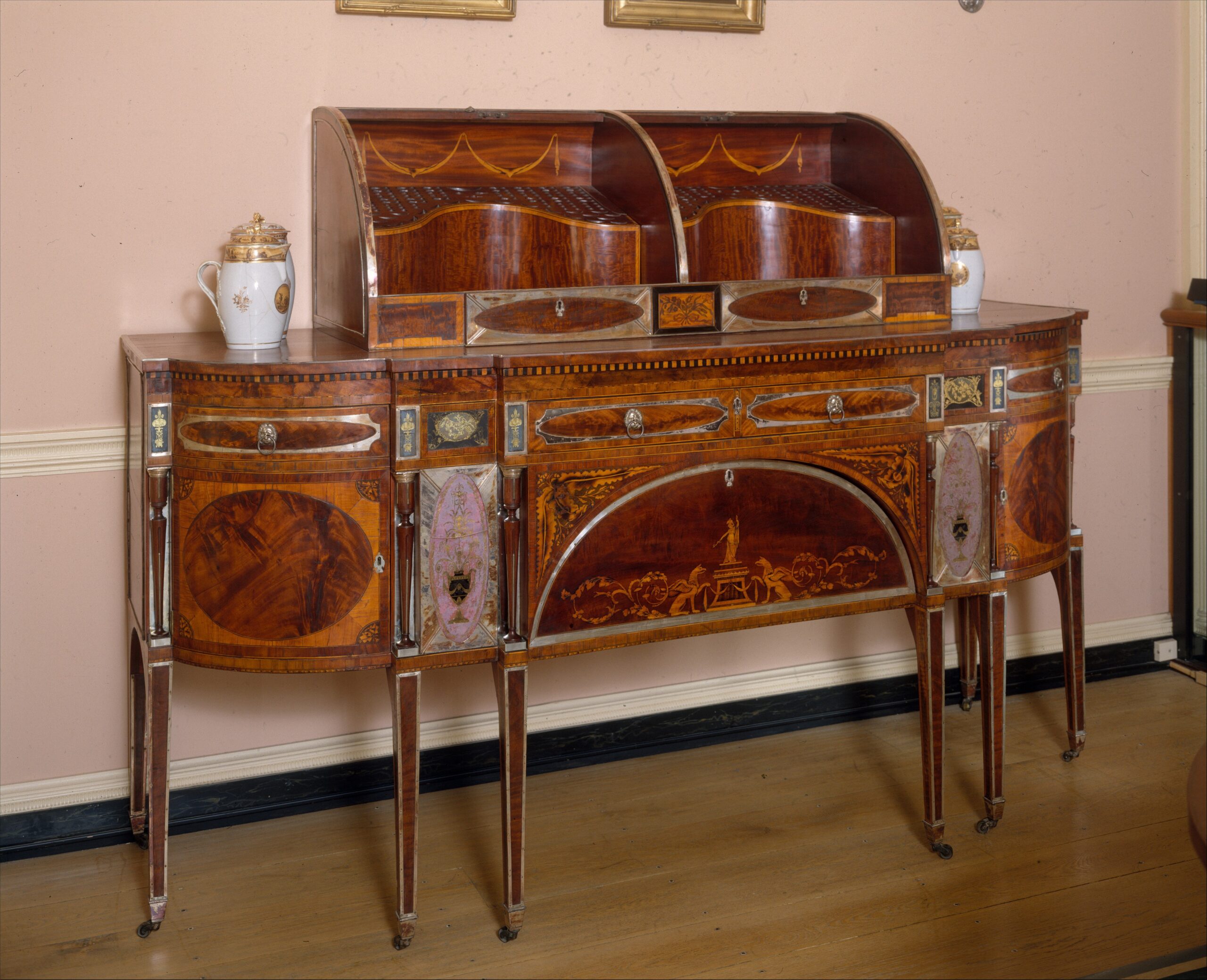
Look first at the relationship between the main shape and its decoration. On the Met’s sideboard of about 1795–1805, long tapering legs support a broad cabinet whose figured wood, light borders and ornamental panels divide the front into distinct shapes. The outline remains legible through a considerable amount of decoration. 3
Federal furniture grew from the neoclassical taste that American makers adapted from European designs. Robert Adam’s interiors and the published designs of George Hepplewhite and Thomas Sheraton helped establish its vocabulary. Hepplewhite’s Cabinet-Maker and Upholsterer’s Guide appeared in 1788; Sheraton’s Cabinet-Maker and Upholsterer’s Drawing-Book followed in 1793. Their designs offered American workshops models to adapt. 1
Treat Federal as a period and design context, rather than a single furniture shape. The useful question is how the proportions, surface decoration and construction work together. Dating and attribution need more evidence than a recognizable silhouette.
Veneer and inlay: follow the pale lines
The sideboard makes a good place to separate materials from patterns. Its record lists mahogany and satinwood alongside silver, copper and verre églomisé: glass decorated on its reverse. The light and dark areas therefore do not all represent the same technique. Look separately at figured wood, inserted ornament and glass panels. 3
Veneer supplies a sheet of wood over a surface; inlay sets contrasting material into it. In Baltimore work, narrow borders and fine lines of stringing frame larger panels, while medallions and bellflowers concentrate ornament in smaller areas. The Met’s Baltimore catalogue describes these techniques in detail, including the use of contrasting woods and shaded inlay. 2
On the dining-table detail below, the pale ornament follows the narrowing leg. You can see the medallion above and the repeated flower forms below without losing sight of the support itself. Compare that small-scale decoration with the much larger patterned panels on the sideboard: surface ornament works at more than one scale.
The dining tables date to 1795–1810 and are recorded as Baltimore work. Their mahogany is accompanied by tulip poplar, white pine and sycamore. A museum’s materials list describes the object as a whole; it does not mean every listed wood is visible in a single photograph. 4,5

Tapered legs, reeding and the foot below
A square taper has flat faces that narrow toward the floor. Turned legs have a rounded profile; reeding adds repeated raised rounded ridges along them. These distinctions help describe the support before you consider how it ends. Hepplewhite-associated designs often use straight tapered legs and spade feet, while turned, reeded legs are frequently associated with Sheraton. The associations overlap. 2
For the terminal shape, use the separate guide to types of furniture feet. A spade foot is a feature at the bottom of a support; “tapered” may describe the leg above it. Keeping those descriptions separate gives you a more precise account of what you are looking at.
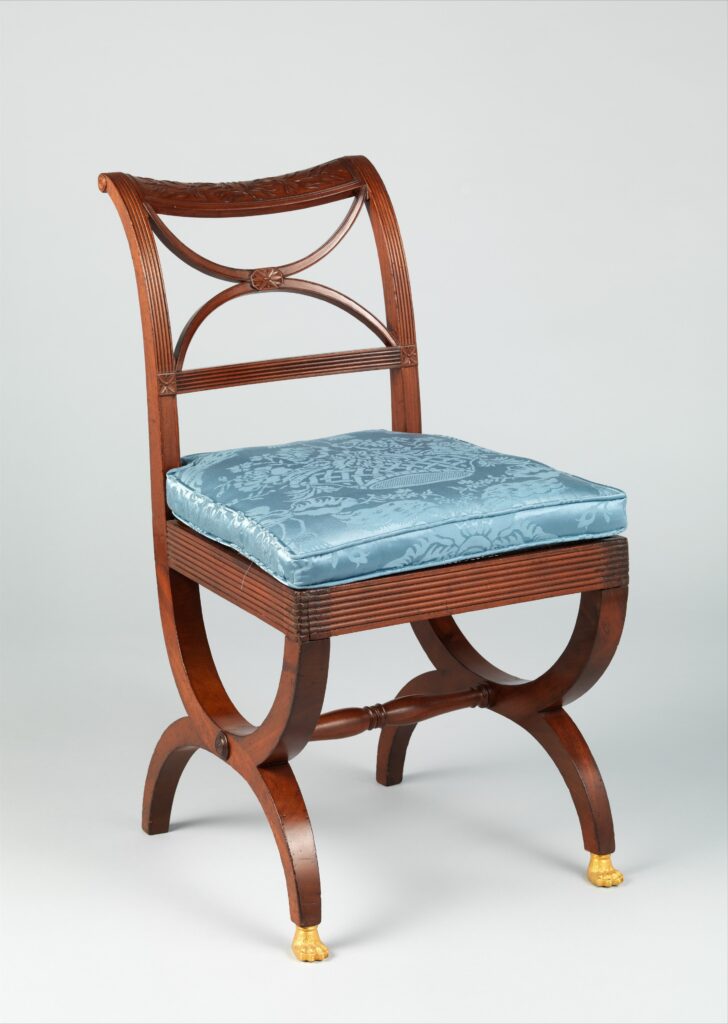
The curule chair shown at the top offers a useful counterexample to a straight-legged definition of Federal furniture. Its curved, crossing supports draw on the ancient Roman curule form. The Met attributes it to Duncan Phyfe and dates it broadly to 1791–1818. Those crossed members belong to the design; the reference to an ancient folding seat does not establish that this chair folds. 6
Hepplewhite and Sheraton: influences that overlap
The familiar shorthand gives Hepplewhite the shield back and Sheraton the square back. It is convenient until a particular chair refuses to cooperate.
The Met’s Baltimore catalogue identifies a shield-back chair derived from Sheraton and a straight-back chair closely following Hepplewhite. Both have straight tapered legs. Use the names to discuss design influences, with a particular pattern-book comparison where one is known. A back shape alone cannot assign a chair to either designer. 2
The Benkard Room offers another example of adaptation: a New York sofa of 1800–1805 combines features from two Hepplewhite designs. Nearby chairs follow a Sheraton plate. Furniture makers could select and combine published ideas rather than reproduce an entire design unchanged. 7
“Hepplewhite style” also does not mean made by Hepplewhite. An American object may reflect a British publication while retaining the materials, construction and proportions of its own workshop. In a description, “shield-back chair with tapered legs” is often a better first step than an unsupported designer’s name.
Sideboards, chests and secretary bookcases
Federal identification becomes more useful when you connect the decoration with the furniture’s purpose. Sideboards provided storage and display for dining equipment. The Met’s example incorporates different materials across a large cabinet, with ornamental panels that reward a close view. Its attribution remains qualified: possibly Baltimore or Philadelphia. 3
A chest of drawers gives you another case form to examine. Use the antique chest of drawers guide for the basic object, then describe the front, veneer patterns, supports and feet of the particular chest. A period label should add information to that description, rather than replace it.
The Met’s secretary bookcase of 1795–1810 combines book storage above with a secretary drawer below. The drawer opens to provide a writing surface and fitted compartments. Its record allows either Philadelphia or Baltimore as its place of manufacture. 8
That mechanism is worth checking before applying a name. The guide to what a secretary desk is explains the broader furniture type. Here, writing, storage and the display of books share one substantial piece of case furniture. The ornament can be light even when the object is large.
Regional work: Baltimore, Boston and New York
Regional attribution brings together construction, woods, proportions and decoration. The Baltimore dining-table pair provides a dated reference for finely inlaid mahogany work. The sideboard’s uncertain Baltimore-or-Philadelphia origin shows why a handsome veneer or a familiar motif cannot settle the question alone. 3,4,5
Boston work introduces other combinations of skills. A bedstead of 1810–15 in the Met is possibly by Thomas Seymour, with additional qualified attributions for its carving, painted decoration and cornice. It is a reminder that a single finished object can represent several specialists. Retaining “possibly” matters as much as retaining the date. 9
In New York, the sofa below and the curule side chair are both attributed to Duncan Phyfe. The sofa dates to about 1810–20 and combines mahogany, cane and gilded brass. Curved supports, open caning and small metallic ornaments give it a different character from the inlaid Baltimore table. Both belong in a discussion of Federal-era design; they show how much variation the period contains. 6,10

Later classical forms and reproductions
Toward the later Federal years, classical references could become more sculptural. The curule sofa makes that development visible in the frame itself. Its crossed supports carry the classical association beyond a motif applied to a flat surface. 10
Duncan Phyfe’s career continued well beyond the Federal period, so his name alone does not provide an early-republic date. The Met’s account follows his changing designs and also discusses contemporary competitors and later reproductions. Phyfe rarely labeled his work; an attribution needs evidence that a resemblance cannot supply. 11
For an unfamiliar piece, begin with a description you can support: the form, the front, the leg section, the foot and the decoration. Then compare that combination with dated records. The useful result may be “Federal-style sideboard with contrasting veneer and tapering legs.” A narrower date, city or maker should follow the evidence available for that object.
Sources
1. Matthew Thurlow, American Federal-Era Period Rooms, The Metropolitan Museum of Art, 2009.
2. Marilynn Johnson Bordes, Baltimore Federal Furniture in the American Wing, The Metropolitan Museum of Art, 1972.
3. The Met, Sideboard, about 1795–1805, 45.77.
4. The Met, Dining table, 1795–1810, 19.13.1.
5. The Met, Dining table, 1795–1810, 19.13.2.
6. The Met, Side chair, attributed to Duncan Phyfe, 1791–1818, 60.4.4.
7. The Met, Benkard Room.
8. The Met, Secretary bookcase, 1795–1810, 46.67.89.
9. The Met, Bedstead, possibly Thomas Seymour, 1810–15, 18.110.64.
10. The Met, Sofa, attributed to Duncan Phyfe, about 1810–20, 60.4.1.
11. Peter M. Kenny and Matthew Thurlow, Duncan Phyfe and Charles-Honoré Lannuier, The Metropolitan Museum of Art, 2004.
Part of the Complete Guide Buying Vintage Furniture: A Complete Guide Read the full guide →