The types of furniture feet on one piece do not always match. A New York chest-on-chest at the Metropolitan Museum, dated 1760–90, has carved claw feet in front and ogee-bracket feet behind. Looking only at the front would miss half its vocabulary.
Foot names describe the lowest part of a support: a rounded bun, a curved bracket, a smooth pad or a claw gripping a ball. They help you describe what you have, but identifying the shape and identifying the age are separate jobs. Start with the outline, then look at the rest of the furniture.
Types of Furniture Feet: names and types
A cabriole is a curved leg, not a foot. Its outline bends outward at the knee and inward toward the ankle; the foot is the termination below. The distinction matters because similar legs can end in quite different shapes.
| Foot type | What to look for | Museum example |
|---|---|---|
| Ball | A rounded, approximately spherical support | — |
| Bun | A compressed ball, wider and flatter | Cleveland kast, about 1710–40 (below) |
| Bracket | An angled support with a shaped inner edge, often read at a case corner | Townsend chest, 1765 (below) |
| Ogee bracket | A bracket with an outward-and-inward curved profile | Boston chest, 1770–95 (below) |
| Club | A plain rounded termination to a cabriole leg | — |
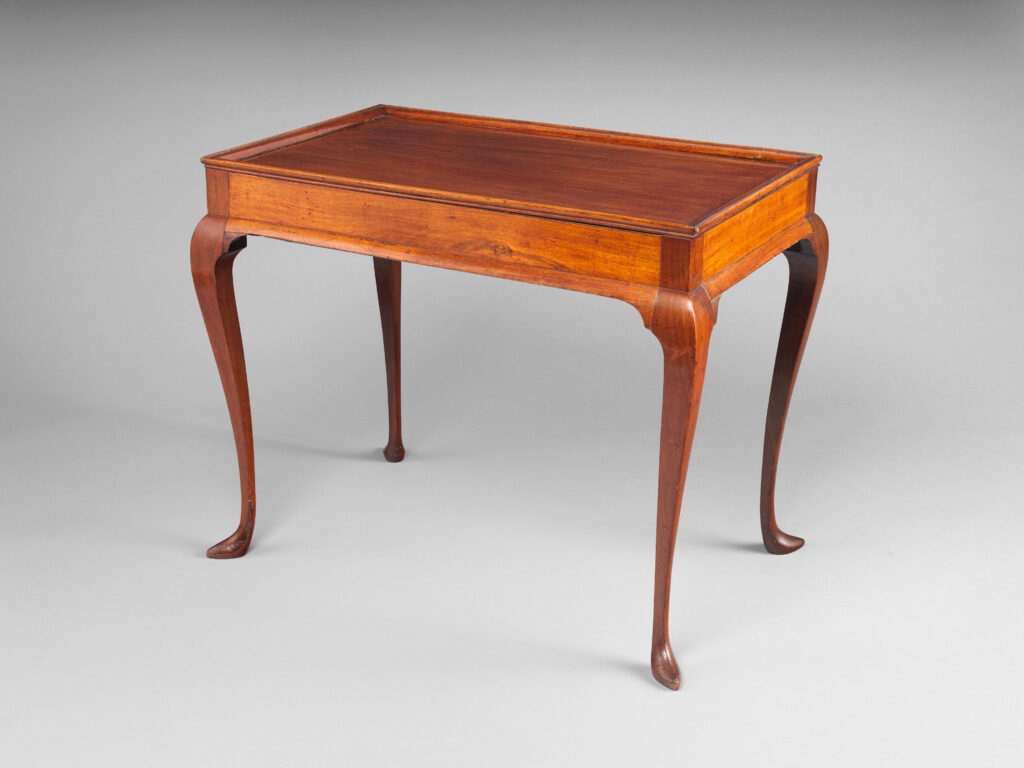
| Pad | A rounded foot resting on a disc or pad | Newport tea table, 1740–60 (above) |
| Ball-and-claw | Talons wrapped around a ball | New York side chair, 1765–75 (below) |
| Paw | A carved animal paw | — |
| Trifid | A foot divided into three lobes or facets | Philadelphia chair, about 1735–95 (below) |
| Block or Marlborough | A square termination, commonly below a straight leg | — |
| Spade | A distinct tapered termination; some examples are oval rather than square | New York armchair, 1770–90 (below) |
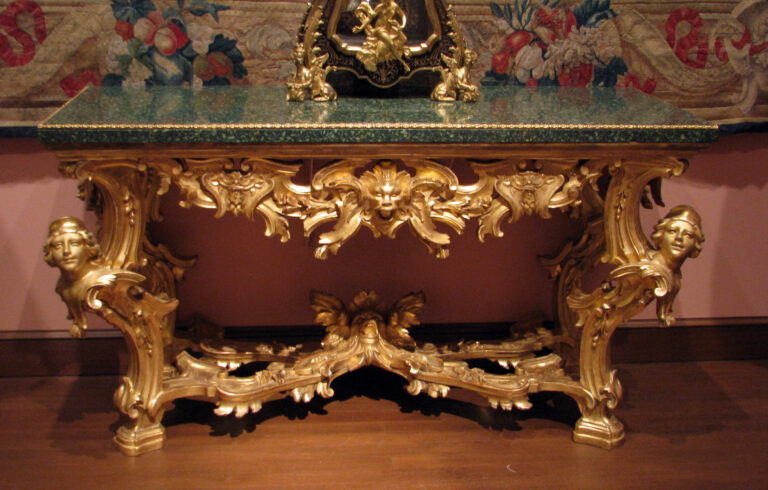
| Scroll | A termination shaped into a curl or volute | — |
The table separates related shapes rather than treating every alternative name as interchangeable. In particular, Getty’s Art & Architecture Thesaurus distinguishes a club foot from a pad foot by the disc beneath the latter. A description that simply says “rounded feet” loses that detail.
Ball and bun feet: how flattened is the shape?
Getty defines ball feet as spherical and bun feet as flattened balls. The difference is easiest to judge from the side, where the height of the rounded part can be compared with its width. A low, broad shape belongs in the bun family rather than being called a ball merely because it is round.
Cleveland’s Dutch-American kast, a large wardrobe dated about 1710–1740, provides a documented bun-foot example. The museum names the feet in its description and relates the cabinet’s paneled surface and projecting cornice to Dutch predecessors. Its feet belong to a whole architectural composition, not a detached date clue.
That is the useful way to employ a dated example: compare the relationship between the foot and the case above it. Do not turn the date of one wardrobe into the beginning or end of every bun foot. The museum names the foot type explicitly, making the record a firmer comparison than an unattributed image of a similar cupboard.
Bracket feet: read the corner and the profile
Bracket feet have an angular or L-shaped character, with a shaped inner edge. “Bracket” names a family; “ogee bracket” narrows the description to a curving profile. Check the foot from an angle rather than relying on a straight-on view of the drawer fronts.
John Townsend’s chest of drawers of 1765 makes the relationship between case and base particularly clear. The shell-carved drawer fronts project and recede, while the feet carry those lower corners down to the floor. The colour photograph shows their shaped sides as well as their fronts. The Met identifies the chest as one of Townsend’s signed or labeled case pieces.

For a specifically named ogee example, Historic New England records a Boston oxbow chest of 1770–1795, accession 1958.202. Its label describes feet curving outward at the top and inward at the center, calling the form ogee bracket or swelled bracket. It is a distinct, documented example of the ogee profile, rather than a reason to call every shaped bracket foot ogee.
The antique chest of drawers guide considers the case as a whole. A foot description is most useful alongside that fuller reading of the drawers, proportions and construction.
Club and pad feet: find the disc
Club and pad feet are close enough in outline to be confused. Getty defines the club as a plain circular termination and reserves pad for the version set on a disc. Look below the rounded toe: is there a distinct low platform underneath it?
The featured Newport tea table, 1740–60, is the museum’s explicit pad-foot example. Its slim cabriole legs finish in pointed pads beneath a restrained rectangular top. The foot is much easier to see against the pale ground than it would be in a furnished-room photograph.
Use the museum’s wording for the pictured object. “Pointed pad” describes this table; it does not mean every pointed termination should be renamed a pad. The disc, the toe and the leg above should be read together. The distinction lets you describe two similar feet without treating their names as exact synonyms.
Ball-and-claw, paw and trifid feet
A ball-and-claw foot has two legible parts: a ball and the talons gripping it. A paw is an animal-foot motif without that defining grasped ball. Trifid describes a three-part termination, with lobes or facets rather than a modeled animal’s anatomy.
The New York side chair of 1765–75 below is a documented claw-and-ball example. The Met specifically calls its feet square claw-and-ball, placing them alongside the carved back and patterned seat rail as characteristic New York features. The chair’s date and place come from the museum’s attribution, not from the presence of claws alone.

There is variation within this one foot type. Denver Art Museum’s comparison of American chairs discusses the position of the toes in New York and Boston examples and the flattened ball of a Philadelphia chair. Those are comparisons between documented objects, not a promise that one photograph will identify an unknown chair’s city.
A trifid example is the Philadelphia side chair dated c. 1735–1795 at the Museum of Fine Arts, Houston, B.69.246. Its record explicitly describes a three-part foot. The broad date range is worth retaining: “trifid” does not justify replacing it with a precise year. In a description, “three-lobed” records the visible feature without suggesting that it represents an animal’s paw.
Block, spade and scroll feet
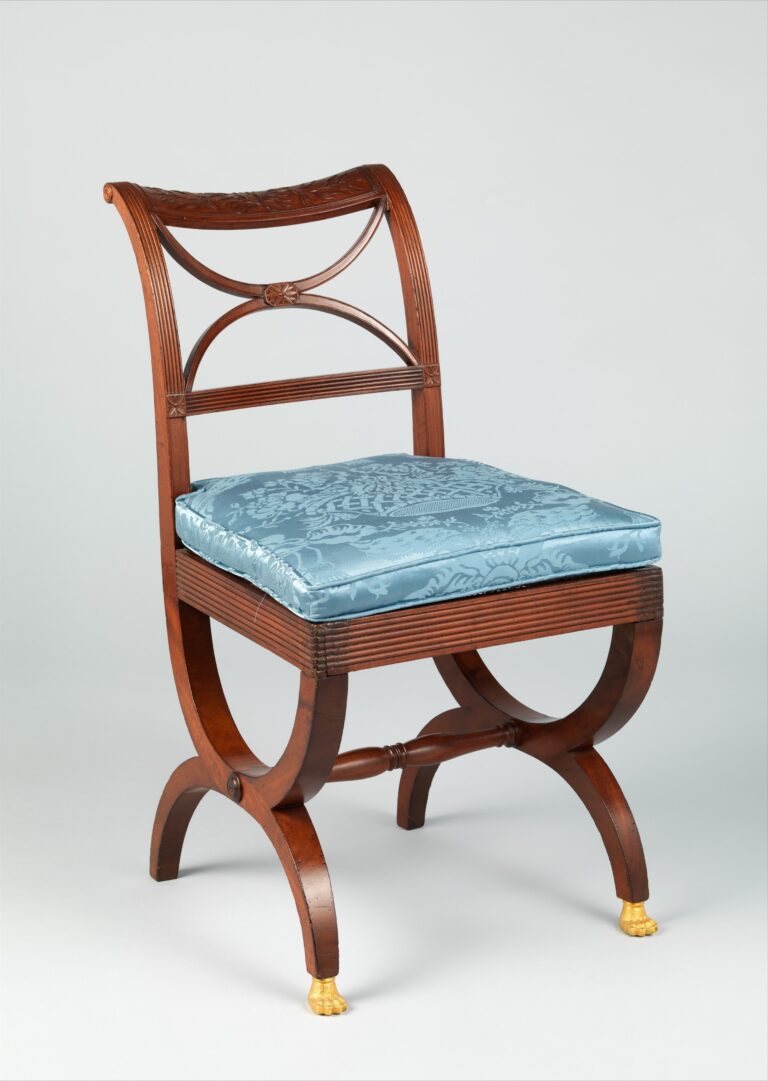
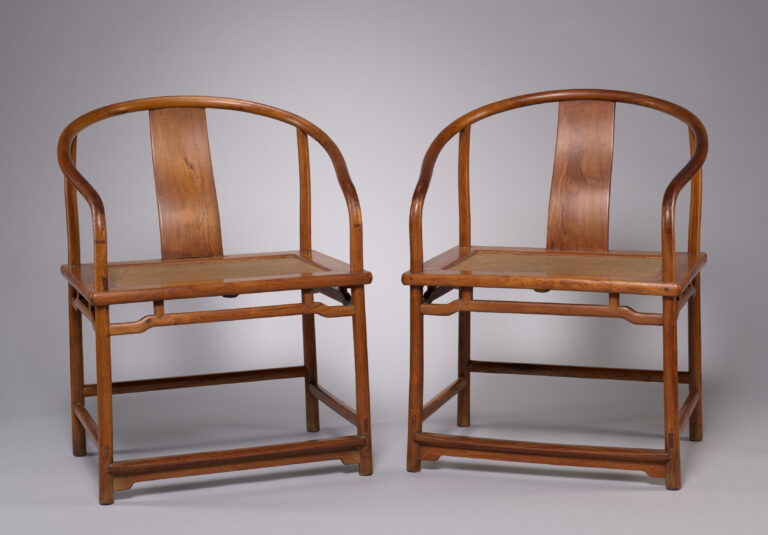
The Philadelphia Museum glossary defines block or Marlborough feet as square terminations, usually below straight legs, and scroll feet as ends shaped into volutes. Describe the termination rather than borrowing the name of the entire leg.
Spade feet deserve a little care. The Met’s New York armchair of 1770–90, accession 1984.287, has tapering rear legs ending in what the museum calls oval spade feet. Its front feet are conspicuously claw-and-ball. A front photograph would therefore be a poor illustration of the feature named in that rear-foot description. The record is also a reminder to check which legs a catalogue description is talking about.
Casters and metal caps are hardware; describe them separately from the foot’s shape.
Can furniture feet tell you the age?
They contribute evidence. They do not settle the date alone. The Met’s account of American Queen Anne and Chippendale furniture describes changing fashions but also emphasizes that the transition was gradual and uneven. Older forms remained in use after newer ornament arrived.
That limits the familiar shortcut of “pad means Queen Anne, claw means Chippendale.” Those associations help orient a comparison, but a style assessment also has to account for the back, rails, proportions, carving and construction. Compare the whole piece rather than treating those two feet as the decision.
The same discipline applies to later furniture. The Victorian chairs guide is the relevant next comparison when you are reading a nineteenth-century chair; a familiar foot name should not pull it into an eighteenth-century date without further evidence.
For an unidentified piece, make the description progressively more specific: “rounded foot,” then “rounded foot on a disc,” then “pad foot.” Keep that observation separate from the proposed age. The New York chest-on-chest offers a final useful reminder: describe the back feet too.
Sources
- The Metropolitan Museum of Art: American Furniture, 1730–1790: Queen Anne and Chippendale Styles, Nicholas C. Vincent, 2009; object records for 1981.360, 27.57.1, 57.158.1, 64.249.3 and 1984.287.
- Getty Art & Architecture Thesaurus: ball feet, bun feet, paw feet, club feet and pad feet; furniture feet by motif.
- Philadelphia Furniture: Glossary of Furniture Terms, from *American Furniture 1650–1840: Highlights of the Philadelphia Museum of Art*.
- Cleveland Museum of Art: Kast, 2019.59; Historic New England: Chest of Drawers, 1958.202; Museum of Fine Arts, Houston: Side Chair, B.69.246.
- Denver Art Museum: 3 Things Chair Legs Reveal about Design & History, Kati Woock, 2015.