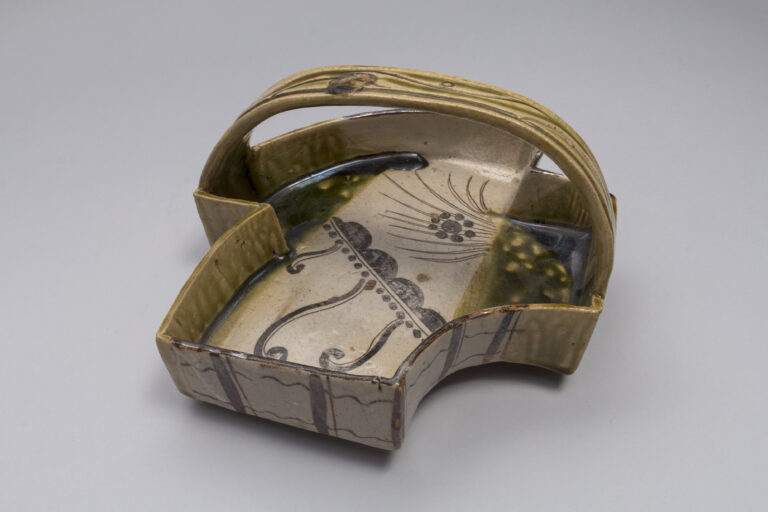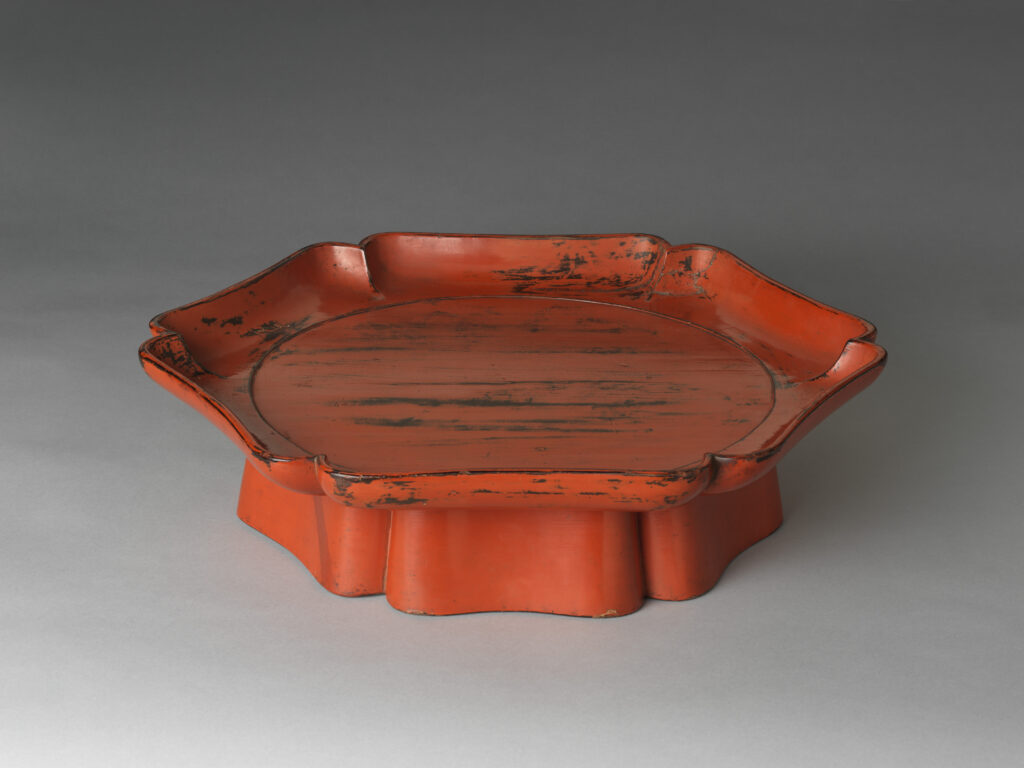
A red Japanese lacquer tray from the fifteenth or sixteenth century is dark across the middle, the red topcoat worn through to black, and the museum that holds it treats that as the appeal. The Metropolitan Museum of Art says wares of this kind are treasured in Japan for the effect that builds up over time, as the black base emerges from beneath the worn red.
That is one end of a wide range. At the other is a black tray with three gold crabs moving among grasses, two of them with inlaid backs. Between the two sit trays whose outline, carving or label carries the real information, and the word “tray” in a listing says little about which kind is being sold.
Worn red over black: Negoro
Negoro is plain red-and-black lacquer. The National Gallery of Victoria says the name comes from the Buddhist temple Negoro-ji, where simple red and black lacquerware was made for daily and ceremonial use, and that long use shows the black undercoat where the red has worn away, an effect it ties to the wabi-sabi love of old and faded things.
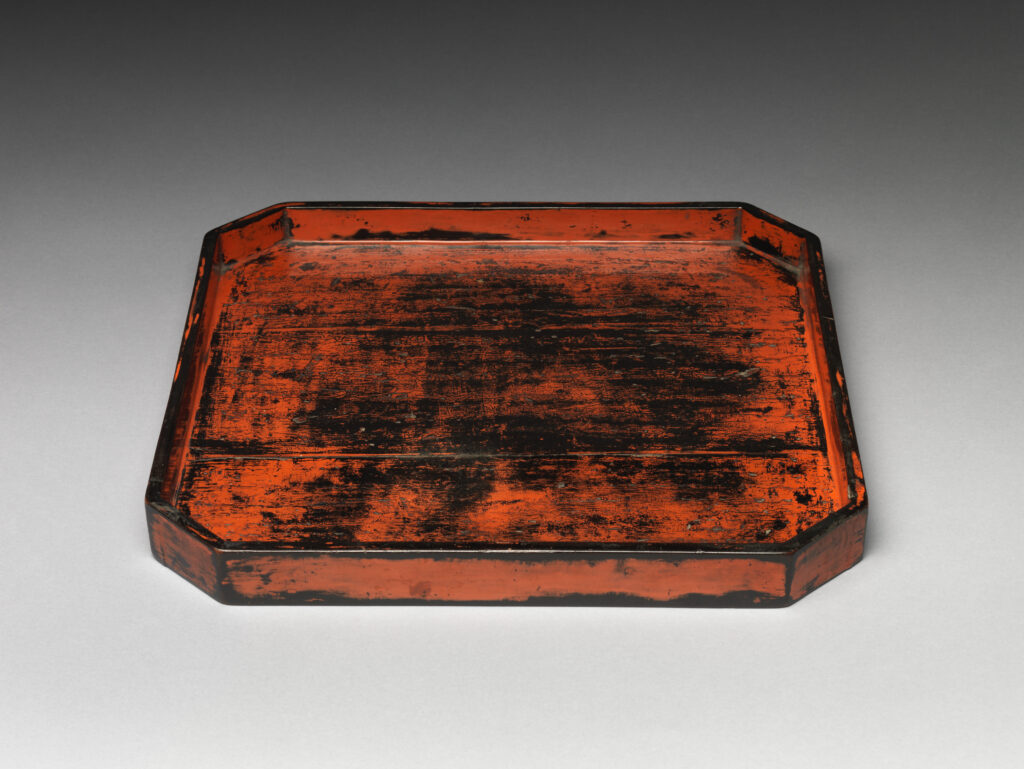
In the photograph, the middle of this serving tray is dark where the red has gone, with red surviving toward the edges and the angled corners. The Met dates it to the fifteenth or sixteenth century and says it probably held a simple meal of rice, soup and vegetables, its shape descending from ceremonial offering trays of pieced cypress, a form used in Japan since the eighth century.
Let the shape tell you the job
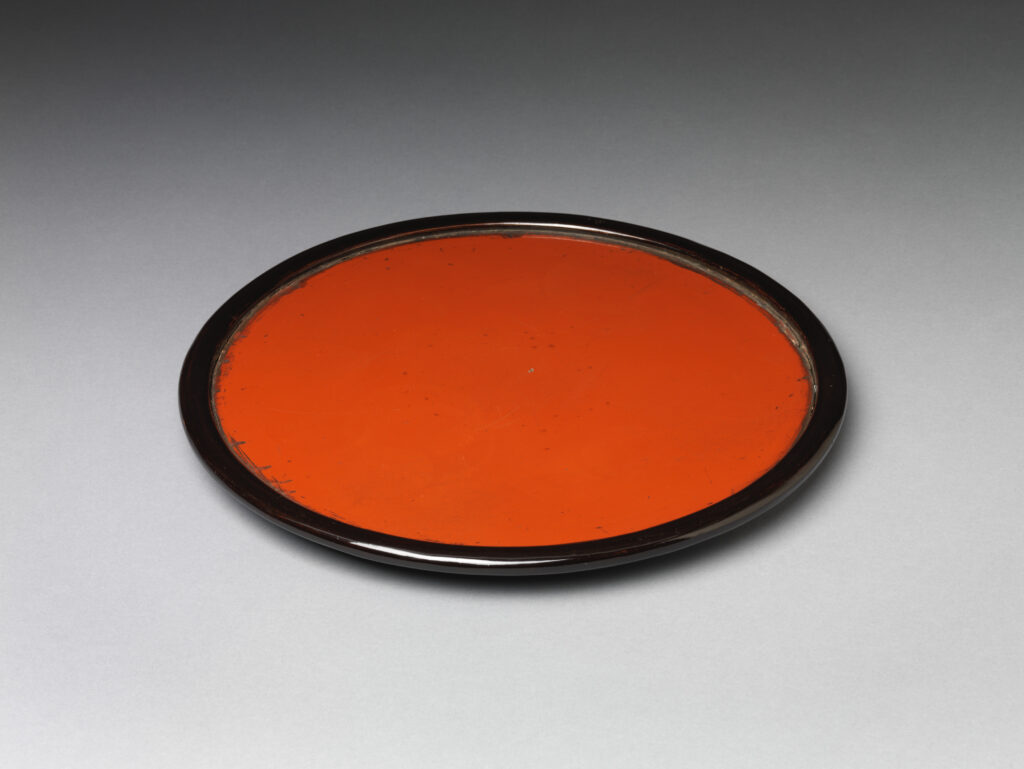
A round red tray with a black rim and underside belongs to the type called hinomaru-bon, or rising-sun tray, after its likeness to the Japanese flag. According to the Met, this one is inscribed in red lacquer with the name of the Tōdaiji temple, and such trays carry meals to monks during the two-week shuni-e purification ritual at Tōdaiji’s Hokkedō hall in Nara. Its date is given only as the Edo period, 1615 to 1868.
Flower-shaped trays, called rinka-bon, have another history. Their petal-shaped outline was inspired, the Met says, by Chinese flower-shaped ceramics and lacquers that medieval Japan prized as imported art, and chrysanthemum-shaped trays were being made by Japanese craftsmen from about the middle of the thirteenth century. Most were used with tea bowls to serve tea, a reminder that trays and Japanese tea bowls often belonged together.
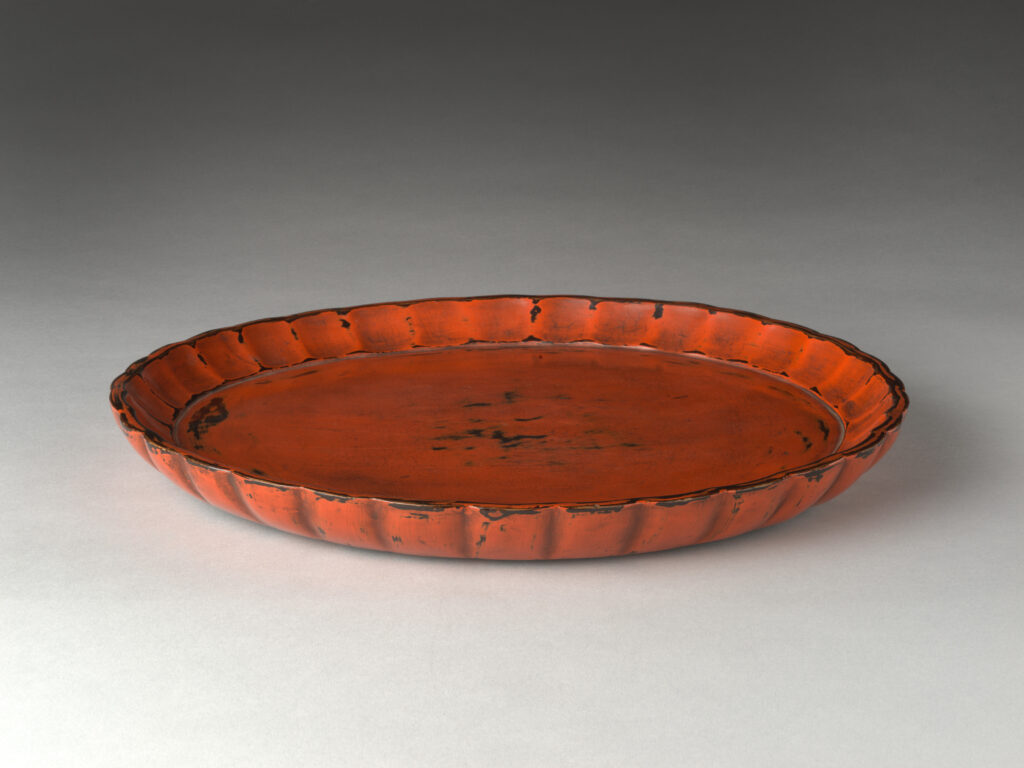
The second lobed tray, 14 5/8 inches (37.1 cm) across, is Negoro too: a shallow dish with a scalloped border and a red surface darkened with wear. It was carved from a single piece of wood, and large lobed trays appear often in medieval Japanese paintings of tea gatherings and banquets.
When the decoration is the point
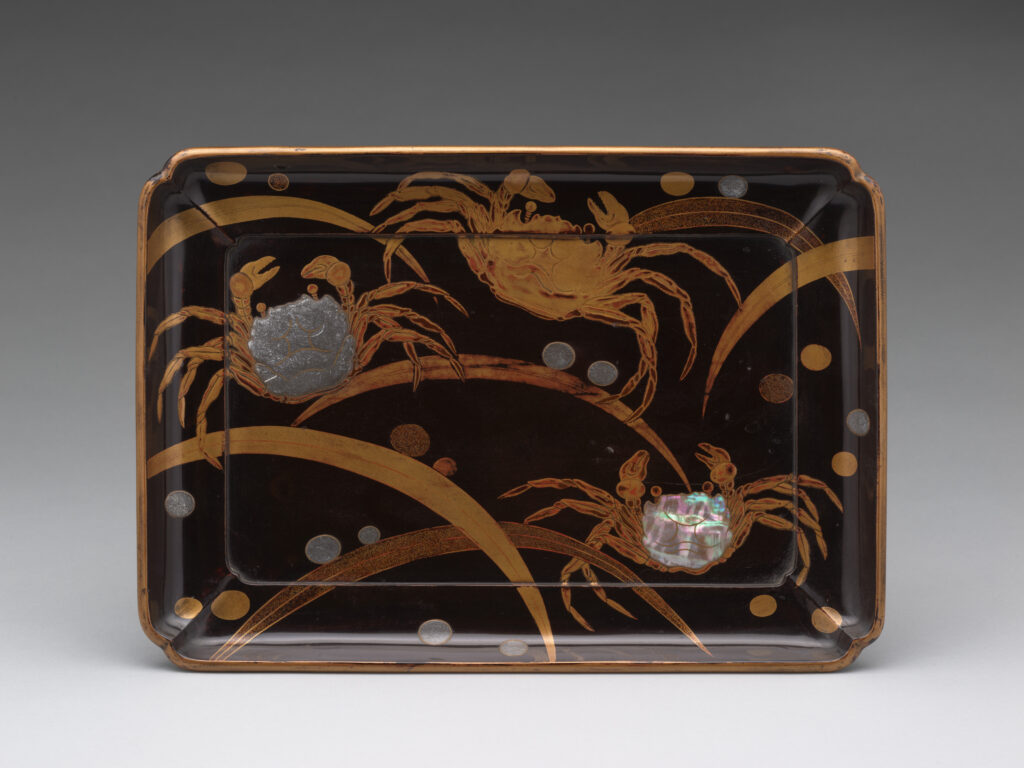
Not every tray is meant to wear down. A tray for an incense burner and utensils, made in the early seventeenth century, is black lacquer with gold hiramaki-e, mother-of-pearl inlay and tinfoil, and in the photograph three gold crabs move among grasses. How maki-e gold decoration is made is explained in the Journal’s guide to Japanese lacquerware.
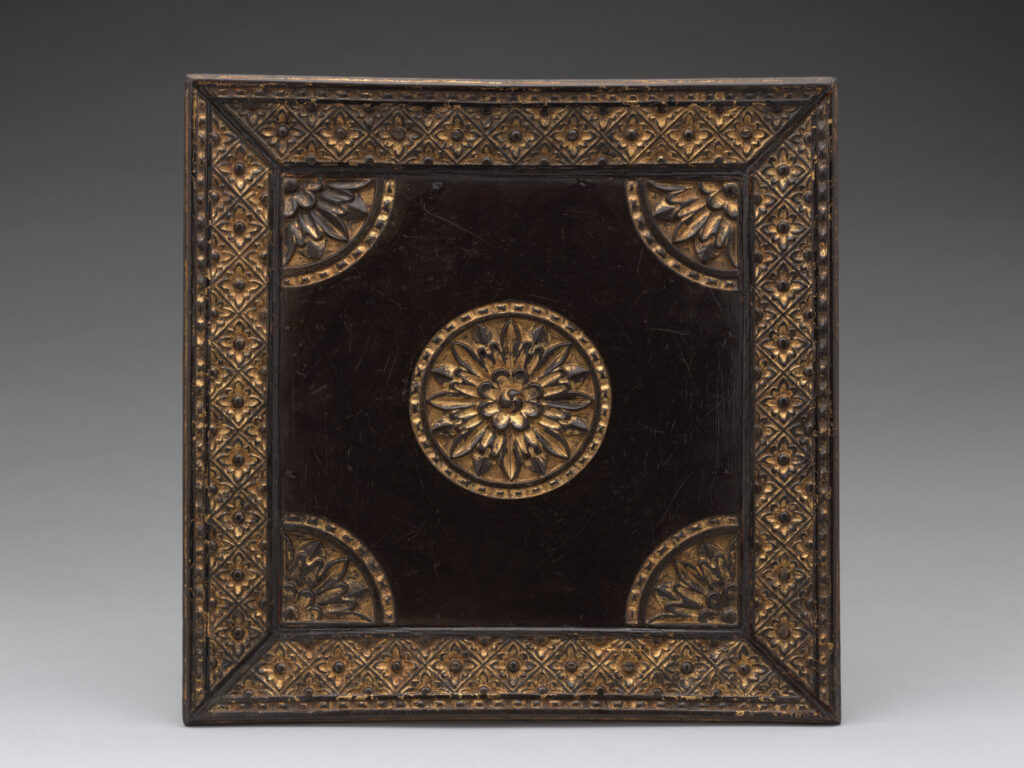
Decoration can also be carved. A square tray of the thirteenth or fourteenth century, in black and gold lacquer, is catalogued as Kamakura bori; the photograph shows a central flower medallion, quarter-round corner pieces and a patterned border. The Victoria and Albert Museum describes the technique as lacquer carving imported from Song-dynasty China, developed in Japan in the Kamakura period (1185 to 1333) and introduced by Chinese Buddhist priests: the wood is carved, coated in many layers of lacquer and polished. It adds that Kamakura-bori is still made by traditional craftsmen in Kamakura today, so a carved surface alone is a reason to ask about age, not an answer to it.
Reading the maker’s name on a Japanese lacquer tray
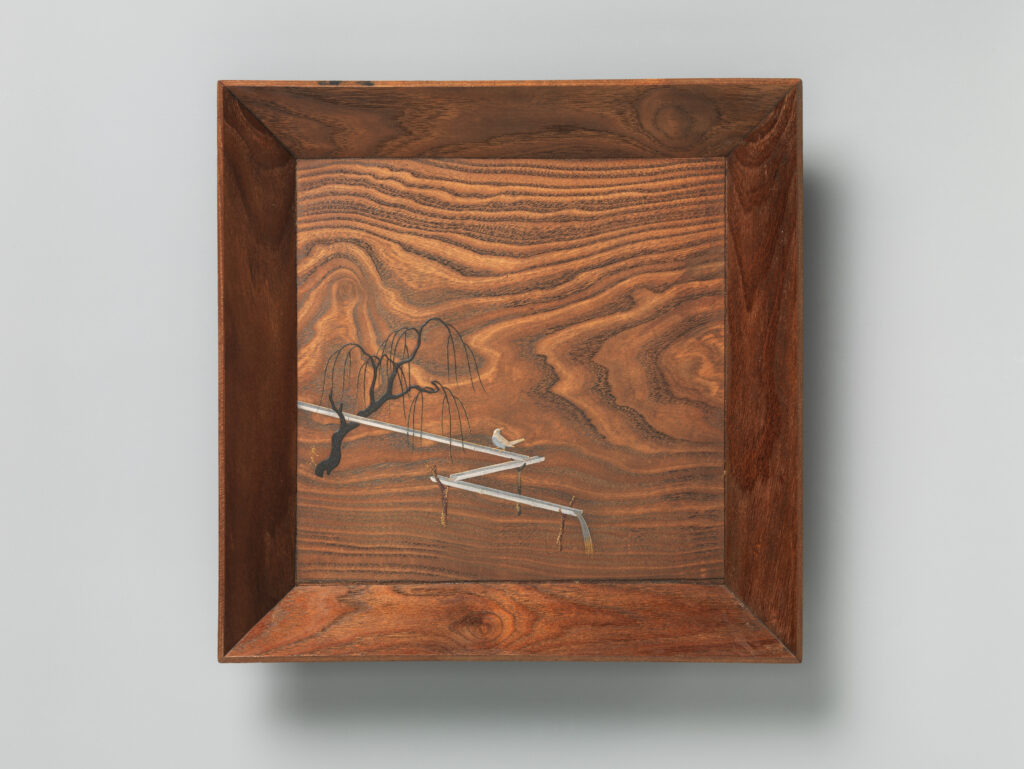
Labels can be worded with care. A square tray in wood and maki-e, dated to the Meiji period, is catalogued as attributed to Shibata Zeshin (1807 to 1891); another tray is “Lacquered by Shibata Zeshin,” and a small hiramaki-e tray with cut-out silver foil, gold and mother-of-pearl is “Style of Shibata Zeshin.” One name, three claims, and a seller’s “Zeshin tray” could be any of them.
Dates and sizes a photograph hides
Dating is hedged too. At the Met, several small black trays with hiramakie in gold and silver are dated “Edo or Meiji period,” nineteenth century, a span that crosses the change of era in 1868, while others in the same group are given as mid-nineteenth or late nineteenth century. If a museum will say “Edo or Meiji” for some of them, a tighter date in a listing deserves a stated basis.
Size is the other detail a photograph hides. The smallest tray named here, the hiramaki-e tray in the style of Zeshin, measures 3 5/16 by 6 7/16 inches (8.4 by 16.4 cm), while the flower-shaped Negoro tray that opens the article is 21 7/16 inches (54.5 cm) across. Both are “trays,” so ask for the dimensions before anything else.
On a Negoro tray the wear is part of the appeal, as the museums quoted above describe it. On a gilded tray it is the first thing to look at, and the first thing to ask a seller about.
Sources
- Flower-Shaped Tray (Rinka-bon), 2015.500.2.60.
- Large Negoro Lobed Tray (Rinka-bon), 2019.193.18.
- Round Tray, 2015.500.2.11.
- Serving Tray with Angled Corners, 2015.500.2.15.
- Tray for incense burner and utensils, 2019.193.27.
- Square Tray (Kamakura bori), 2019.193.23.
- Square Tray, attributed to Shibata Zeshin, 2015.500.2.46; Tray, 36.100.154; Tray, 54.77.
- Tray, 81.1.250; Tray, 81.1.256; Tray, 81.1.240; Tray, 81.1.241.
- National Gallery of Victoria, Circular tray (Marubon), Negoro lacquer, 15th century, AS1-1989.
- Victoria and Albert Museum, Glitter, box by Shozan Mitsuhashi, 1999, FE.135:1,2-2002 (the museum’s summary of Kamakura-bori).
- Related guides on this site: Japanese Lacquerware, Chawan, and the Japanese style pages.