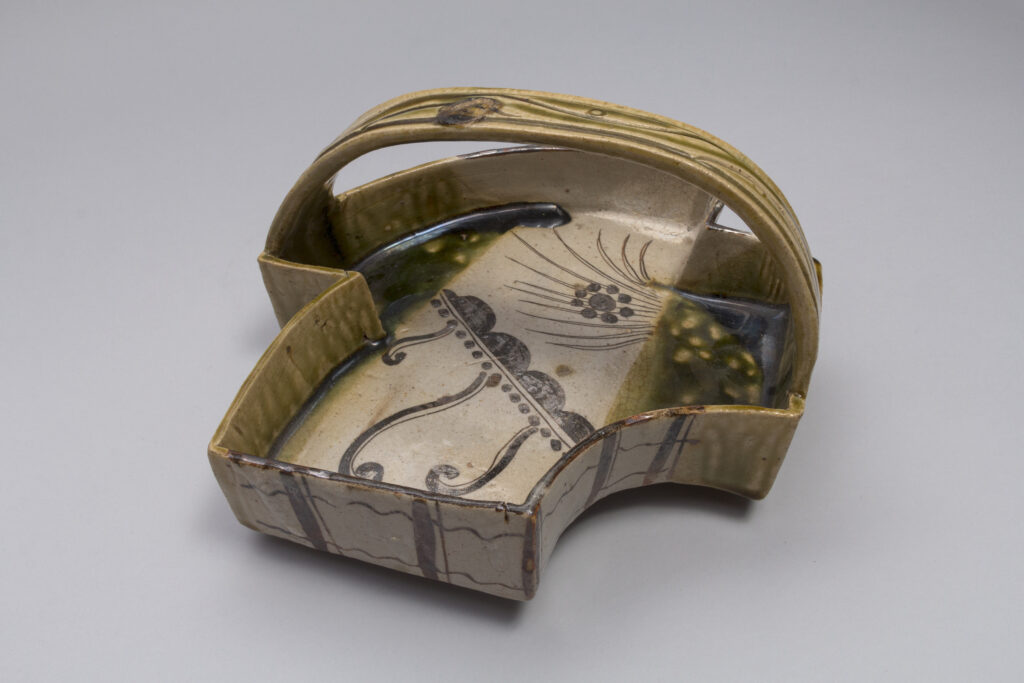
On an early seventeenth-century piece of Mino ware at the Metropolitan Museum of Art, a flaw is treated as evidence. A fine drying crack has been sealed beneath the transparent glaze, and the iron-oxide stain has bled into the neighboring copper-green glaze, an interaction the museum calls characteristic of Oribe ware.
Mino ware is the pottery of the Mino region in Gifu Prefecture, and it is a family rather than one style. Kogei Japan, a traditional-crafts site, counts more than fifteen types registered as traditional crafts, among them Oribe, Shino and Setoguro, an all-black glaze. Museum labels use the same vocabulary: “Mino ware, Shino type,” “Oribe type,” “Iga type.” The word after “Mino ware” says which look is meant, so read it first.
The tea bowls of this family, Black Seto and Black Oribe among them, are in the Journal’s chawan guide. This one stays with what else came out of the same kilns: dishes, ewers, jars and the small vessels of a tea-gathering meal.
Shino: a white glaze over iron brushwork
Shino is best known as the white one. Britannica describes it as a glazed ware from Mino Province, generally covered in a rich white feldspar glaze, sometimes with plant motifs drawn in iron under the glaze, and perhaps the most typical pottery of the Azuchi-Momoyama period.
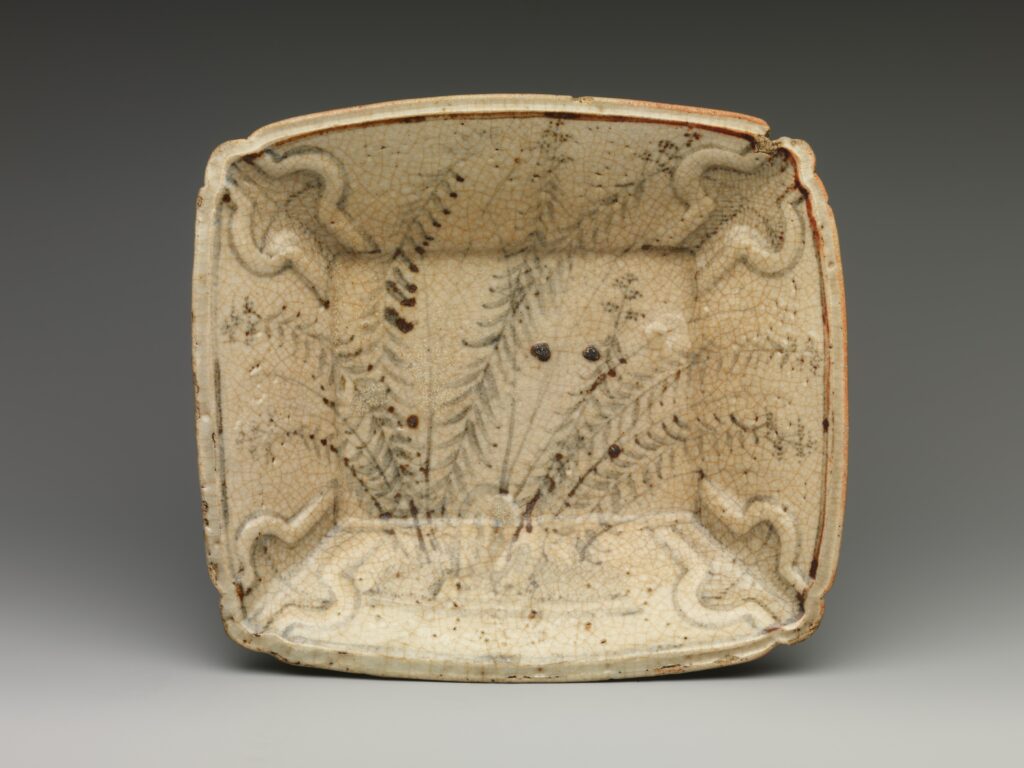
In the photograph, the dish with autumn grasses has fern-like grasses in iron brown under a milky glaze, and scrolled corners. The Met adds that the iron oxide was painted directly onto the white stoneware body, and that the glaze looks milky because of its high feldspar content and the firing temperatures reached in the kiln.
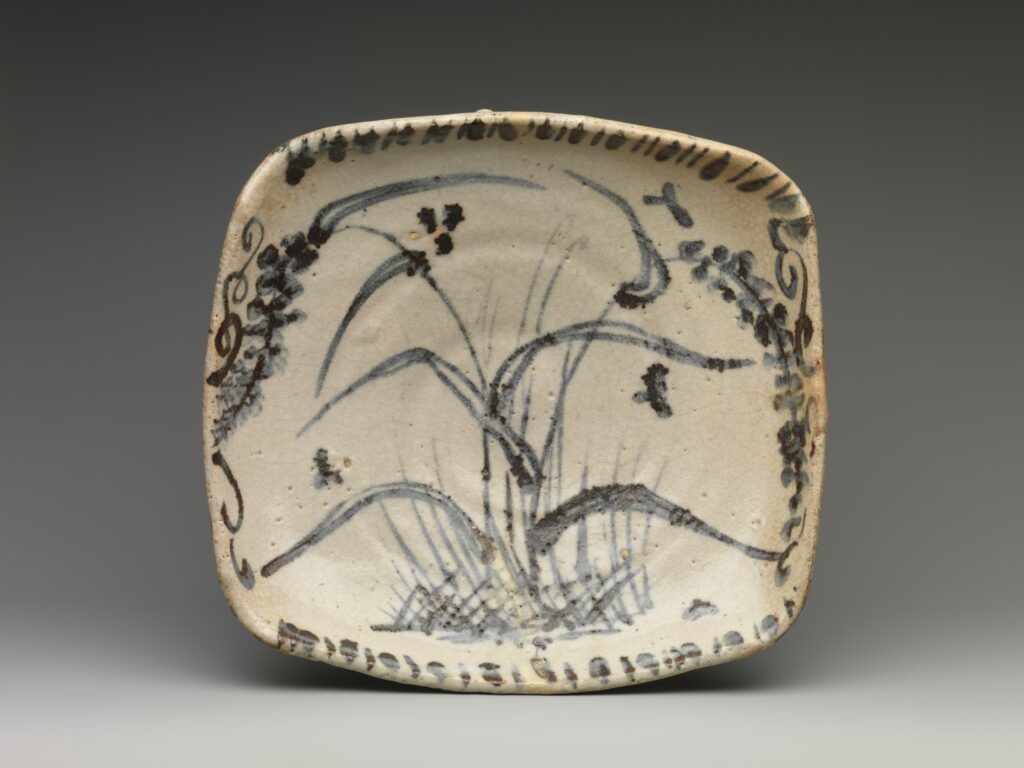
The second dish, with reeds painted in iron under a thick, crackled glaze, has small ceramic knobs on the outside of the rim. They probably helped with handling, but their look, like the rough texture and thick glaze, was greatly valued in the tea ceremony.
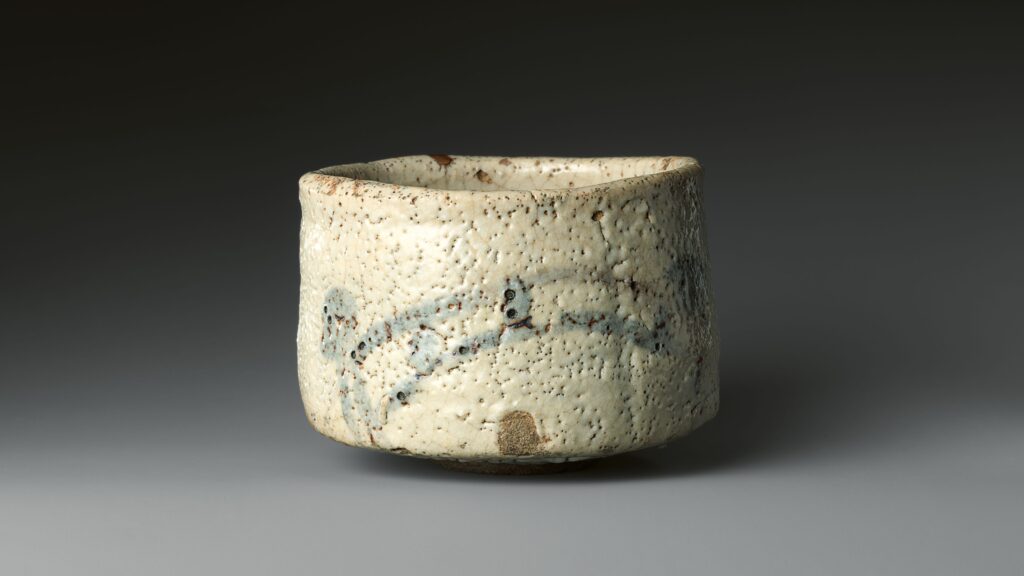
A Shino tea bowl carries the same brushwork. A bare patch sits under its painted bridge, and it marks where the potter’s finger held the bowl while it was dipped in glaze, a “fingerprint” left as a trace of making.
Oribe: copper green and iron brown
Oribe is the pairing the dish at the top shows, copper-green glaze beside dark iron-brown drawing. The Met links the style to the tea master Furuta Oribe (1544 to 1615) and dates this dish to the late Momoyama period, and Kogei Japan likewise ties Oribe ware to his aesthetics and a deep green glaze.
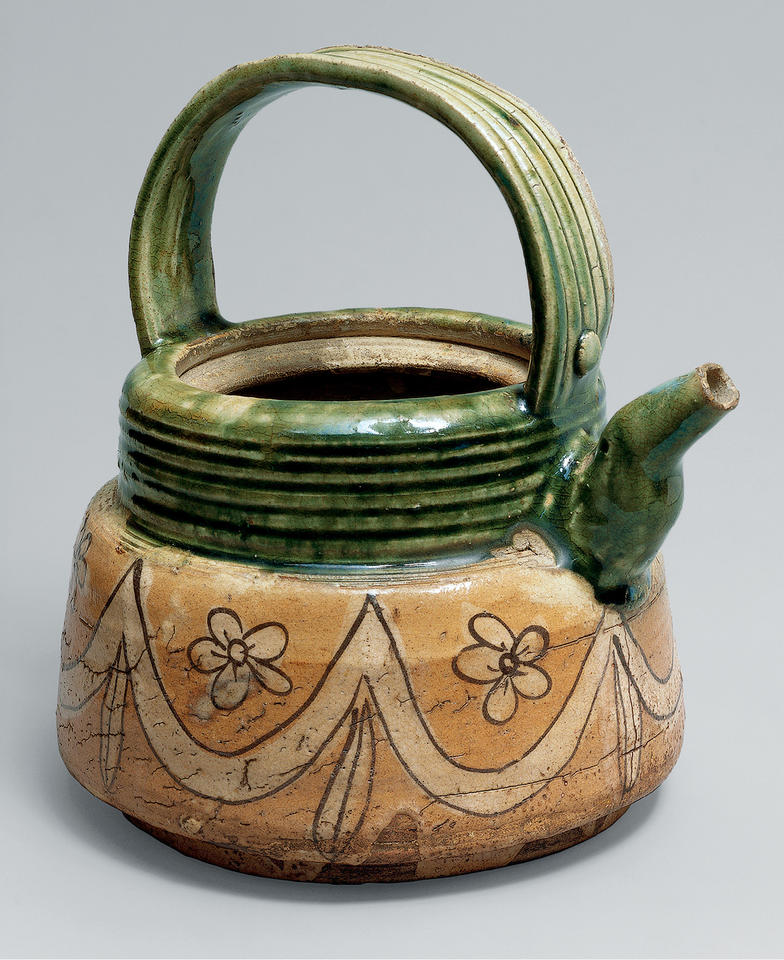
The ewer below was made for replenishing the water jar in the tea ceremony: a green ribbed handle and neck over a body drawn in brown. Its record reads the swags on the lower half as a curtain of the kind used to screen off a cherry-blossom picnic, with blossoms painted in iron brown and white slip.
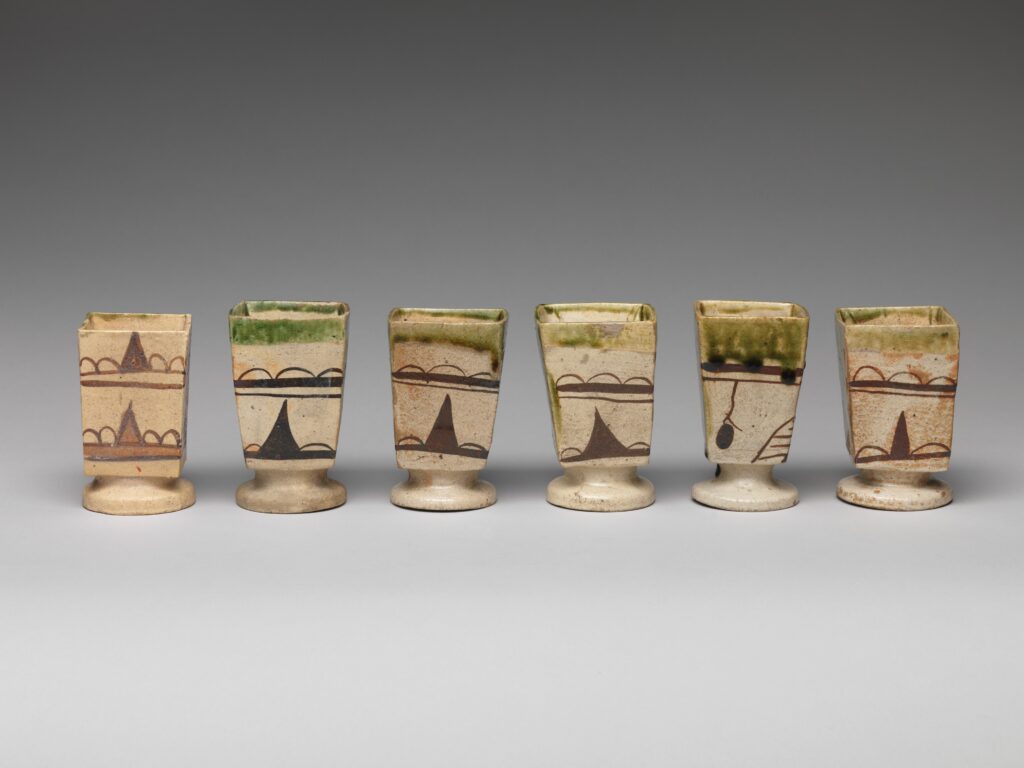
The small cups in the photograph below are mukōzuke, side dishes the Met says were set on the far side of guests’ trays at a cha-kaiseki meal, before the whisked green tea, typically holding vinegared foods, dressed vegetables or sashimi. Their shape was inspired by imported European wine glasses.
Brown glaze and borrowed looks
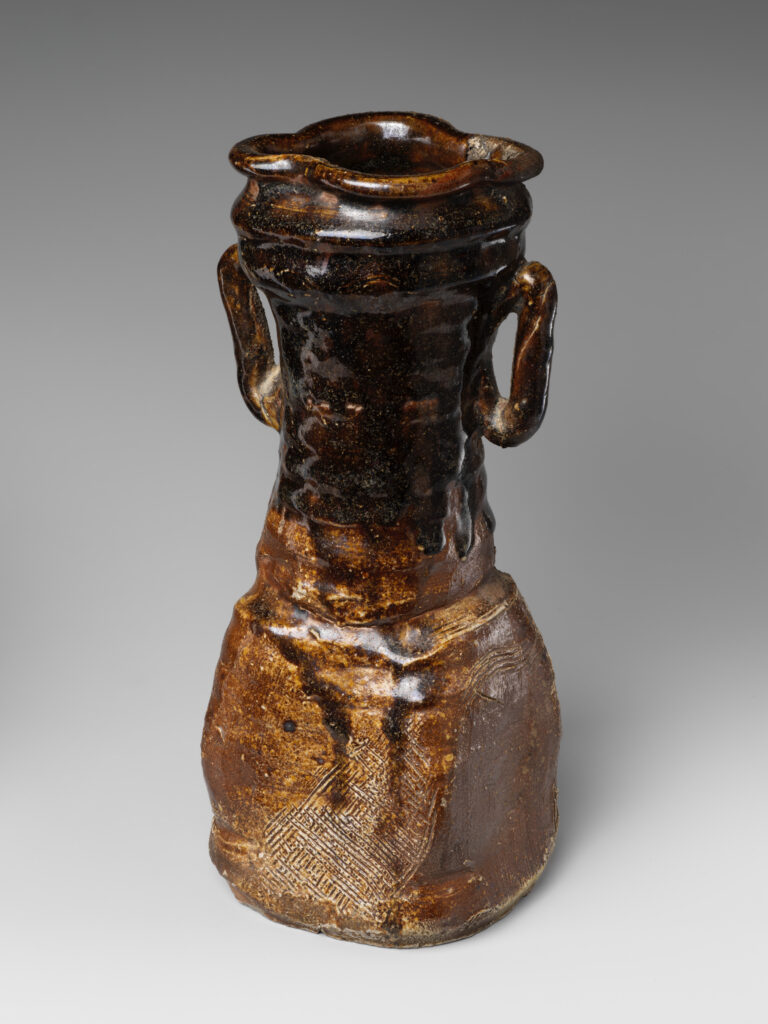
Not every piece of Oribe is green. The brown flower holder below is tall, with two small handles and a flared mouth, its glaze running in darker streaks. Its record calls it rare and says the warm brown iron glaze resembles Karatsu ware while the asymmetrical, rustic form recalls Iga ware, a crossover among the Oribe, Iga and Karatsu traditions.
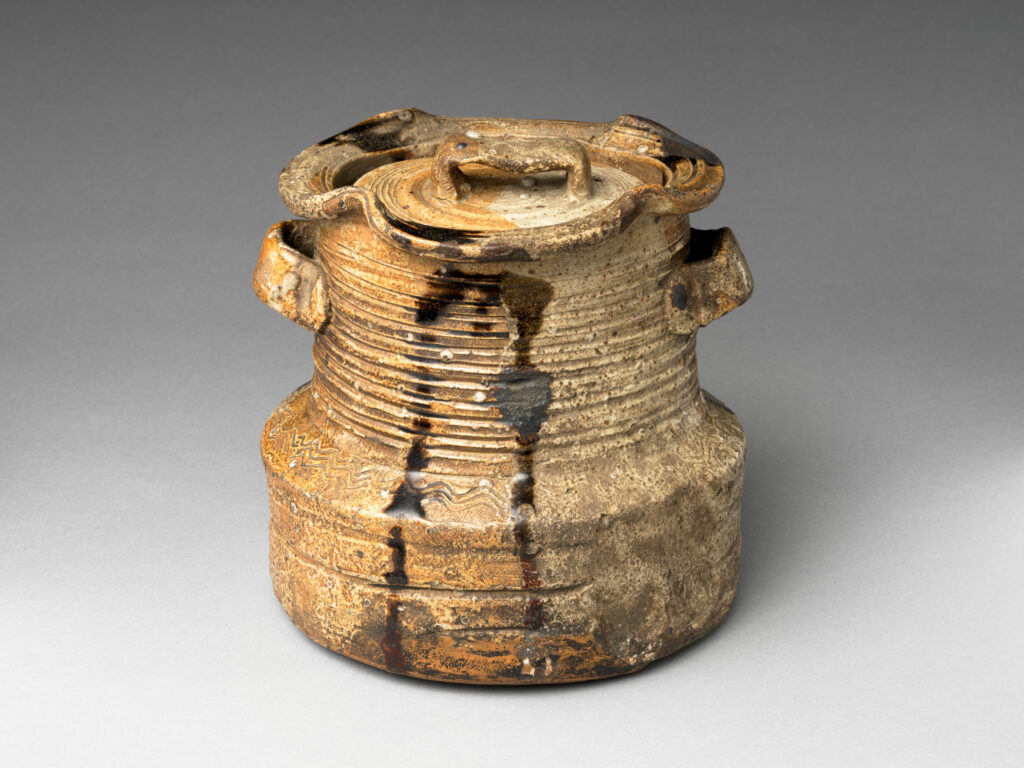
Iga is spelled out in the squat freshwater jar below, catalogued “Mino ware, Iga type”: ridged, lugged and streaked with ash glaze. The Met explains that potters at the Motoyashiki kiln in Mino reproduced Iga ware’s irregular forms and rustic surfaces, and that imitations of other regional styles occurred even though potters’ movement between kilns was generally regulated. “Mino” in the label is where it was made; “Iga type” is the look it borrows.
What “Mino ware” on a label does not tell you
The same type words cover long spans of time. The Met catalogs a pair of early nineteenth-century bowls as “Mino ware, Oribe type,” an eighteenth-century teabowl as Oribe type and an eighteenth-century flower vase as Shino type. According to Kogei Japan, Shino ware’s golden age was the Azuchi-Momoyama period, its production disappeared during the Edo period, and Arakawa Toyozō (1894 to 1985) revived it. That is one source’s account, and Britannica, quoted above, goes no further than calling Shino typical of the Azuchi-Momoyama period. Either way, “Shino” or “Oribe” in a listing does not give a date.
Nor does “Mino ware” settle the body. Everything pictured here is stoneware, yet a nineteenth-century cup decorated in blue underglaze is catalogued as porcelain (Mino ware), and Kogei Japan says porcelain production began in Mino in the last years of the Edo period. For the porcelain side of Japanese ceramics, the Journal’s guide to antique Japanese porcelain is the place to start.
Three questions sort a listing, then: which type word follows “Mino ware,” what date is claimed and on what basis, and whether the body is stoneware or porcelain. A listing that answers only the first has said very little.
Sources
- Dish (織部扇面形手鉢), 1975.268.443.
- Molded Dish with Autumn Grasses, 1975.268.435; Dish with Reeds, 1975.268.433.
- Shino Tea Bowl with Bridge and Shrine, 2015.300.271.
- Ewer (Suichū) with Cherry Blossoms and Picnic Curtain, 2015.300.270a–c.
- Set of Six Side Dishes (Mukōzuke), 1975.268.440.
- Brown Oribe Flower Holder (Hanaire) with Handles, 2024.123.
- Freshwater Jar (Mizusashi), 17.118.83a, b.
- Records read for the dating and body notes: Bowl, 64.67.1; Bowl, 64.67.2; Teabowl, 93.1.76; Flower Vase, 93.1.80; Cup, 91.1.212.
- Britannica Editors, Shino ware, opened and read 2026-10-31.
- Kogei Japan (Japan Traditional Crafts Aoyama Square), Mino Ware (Mino Yaki).
- Related guides on this site: Chawan, Antique Japanese Porcelain, and the Japanese style pages.