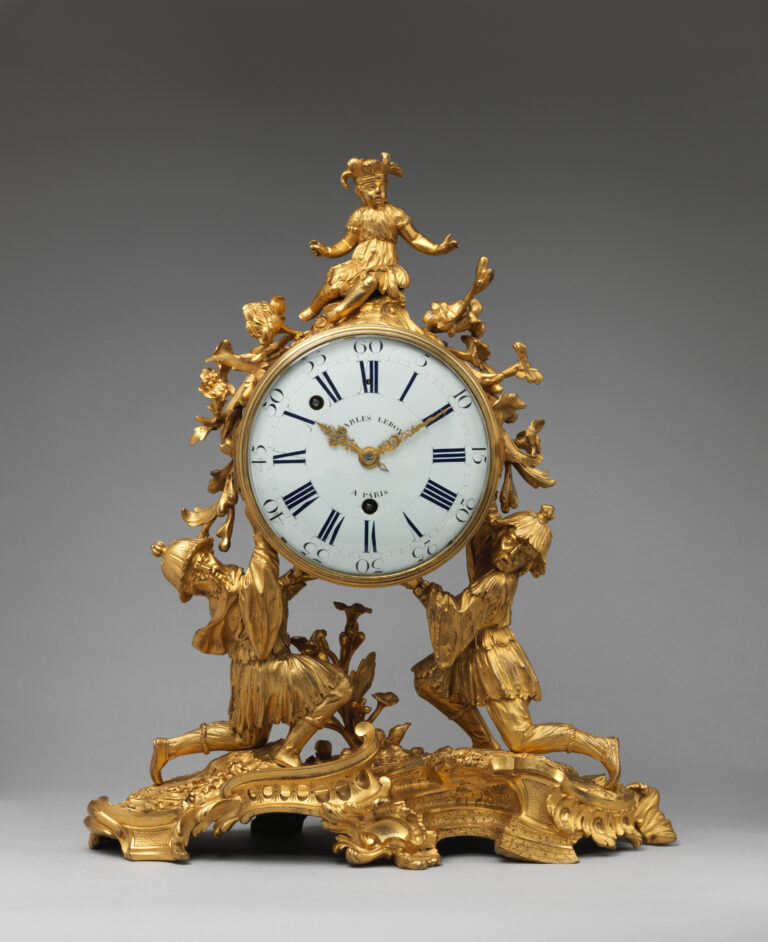
Types of antique clocks are easiest to tell apart by two things you can check in a minute: where the clock was made to stand, and what drives it. A clock hung on a wall, stood on the floor, set on a shelf or a mantel, placed on a table or carried in a pocket belongs to a different family, and each family grew out of a change in how clocks were powered and regulated.
This guide reads the main types of antique clocks from museum records at the Metropolitan Museum of Art and the Cleveland Museum of Art, with the clockmaking history from Britannica. It is about the shape and power of the clock. French cases, with their makers’ stamps and gilt-bronze mounts, have their own guide.
Types of antique clocks at a glance
| Type | How to recognize it | Museum example | Record |
|---|---|---|---|
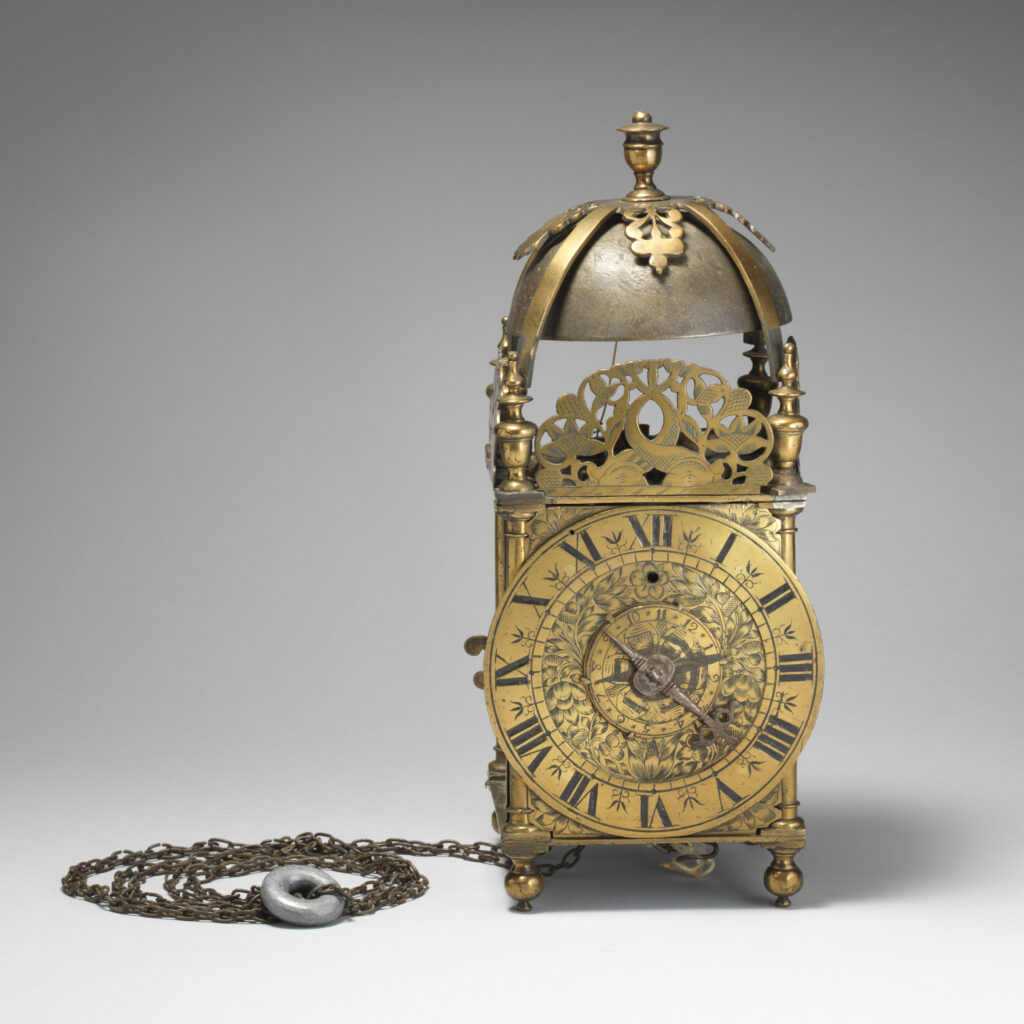
| Lantern clock | A brass case with a bell under a dome on top; a chain and weight drive it | Brass, about 1660 | Met 10.125.387 |
| Bracket clock | A small standing spring clock; the Met’s example is 25 cm high | Mahogany, 1755, John Fordham | Met 64.101.869 |
| Tall-case (longcase, “grandfather”) clock | A floor-standing case whose trunk hides a long pendulum and the weights | Tiffany & Co., New York, about 1880 | Cleveland 1992.70 |
| Banjo clock | A wall clock with a round dial on top, a narrow waist and a rectangular base | Curtis and Dunning, Concord, 1813 to 16 | Met 1971.180.36 |
| Shelf clock | A small upright case made for a shelf; in America, where factory clockmaking began | Levi Hutchins, Concord, about 1786 | Met 2023.301a–c |
| Mantel clock | A decorative case for the mantelpiece | Lenzkirch and Tiffany & Co., 1901 | Cleveland 2009.443 |
| Cabinet or table clock | A small, often jeweled clock to keep on a table or in a cabinet | James Cox, London, about 1770 to 75 | Cleveland 2009.77 |
| Portable clock | A small spring-driven clock to be worn or carried | P. Herbier, France, about 1580 to 1600 | Cleveland 1929.996 |
Weights or a spring: the first question
Britannica describes the first mechanical clocks with clear records as large weight-driven machines set in towers, turret clocks, regulated by a verge escapement. Then, about 1450, clockmakers probably in southern Germany or northern Italy began to make small clocks driven by a spring, the first portable timepieces.
That split still sorts most types of antique clocks. A weight needs room to fall, so weight-driven clocks hang on a wall or stand tall, while the small clocks for shelves, tables and pockets are usually spring clocks.
Wall clocks: the lantern clock and the banjo
The Met’s lantern clock, of about 1660, is all brass and 63.5 cm high, with a bell under a pierced dome; in the photograph, the chain and weight that drive it lie beside the clock. The record names no maker.

The banjo clock is American and much later. Britannica credits Simon Willard of Roxbury, Massachusetts, with the timepiece that came to be known as the banjo clock. On 8 February 1802 he patented an eight-day pendulum clock in a case with a round top bearing the dial, an elongated central part and a rectangular base. The shape of the top inspired the name, which Willard himself did not use.
The Met’s banjo clock was made by Curtis and Dunning of Concord in 1813 to 16, in mahogany and gilded gesso, with verre églomisé tablets, the decorated glass panels in the waist and base.
Floor clocks: why the tall case exists
The tall case was a solution to a practical problem. Britannica explains that after Christiaan Huygens applied the pendulum to clocks from 1656, weight-driven wall clocks with short pendulums were made in wooden cases. These eight-day clocks had very heavy weights, and many fell off weak plaster walls. The next step was to extend the case to the floor, and the grandfather clock was born. In 1670 English clockmakers introduced the long, or seconds, pendulum with the anchor escapement; a pendulum with a one-second swing is about 39 inches (990 mm) long, which is why the trunk is tall.
Britannica also notes that Benjamin Willard, Simon’s brother, was known for his longcase clocks, a style later called the grandfather clock.
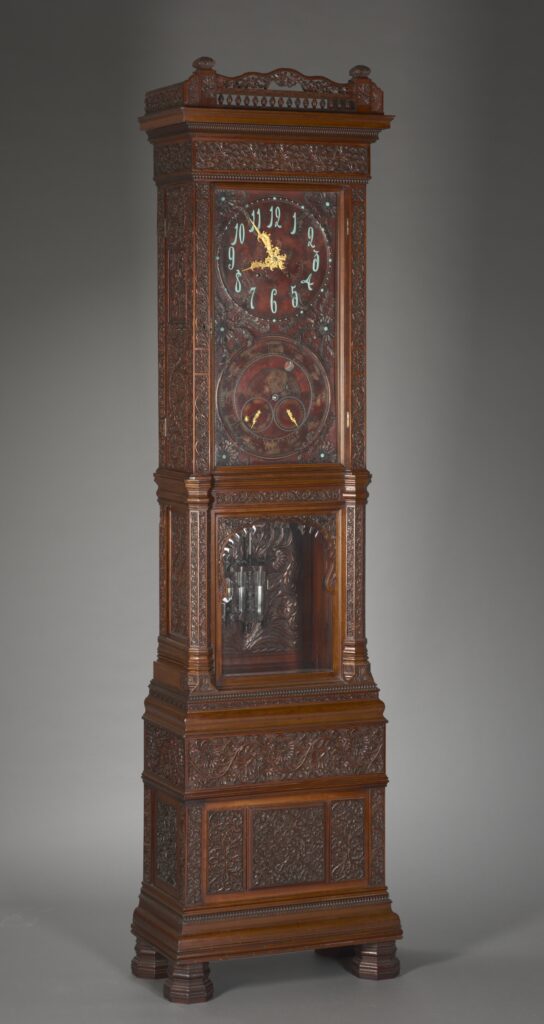
Cleveland’s tall clock shows how late the form lasted and how far its case could travel in style. Made by Tiffany & Co. in New York about 1880, it is mahogany and teak, 247 cm high, with gilded and patinated metal dials. The museum links its design to Associated Artists, the decorating firm Louis Comfort Tiffany joined in 1879, whose partner Lockwood de Forest traveled in India to find carved wood and other decorative pieces for their designs. Louis Comfort Tiffany’s studio is better known for the lamps in Tiffany lamps.
Clocks for a shelf, a mantel or a table
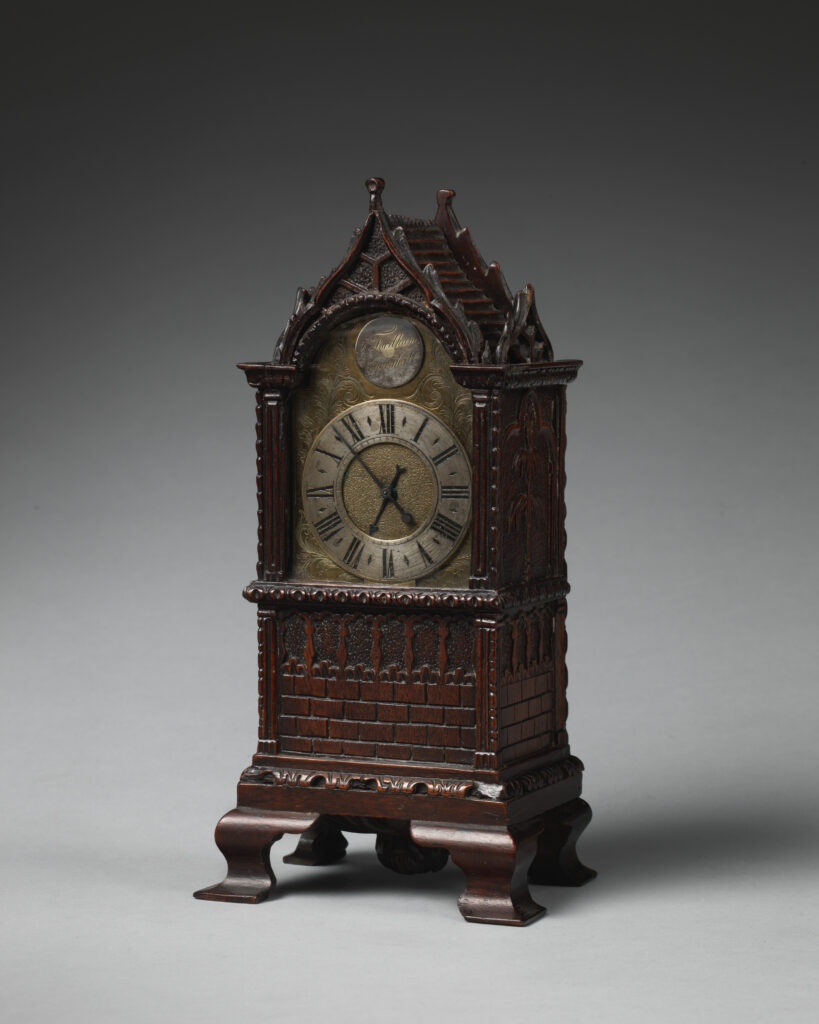
The Met catalogues this small standing clock as a bracket clock. It is by John Fordham of Coggeshall in England, dated 1755, and only 25.4 cm high, in a mahogany case.
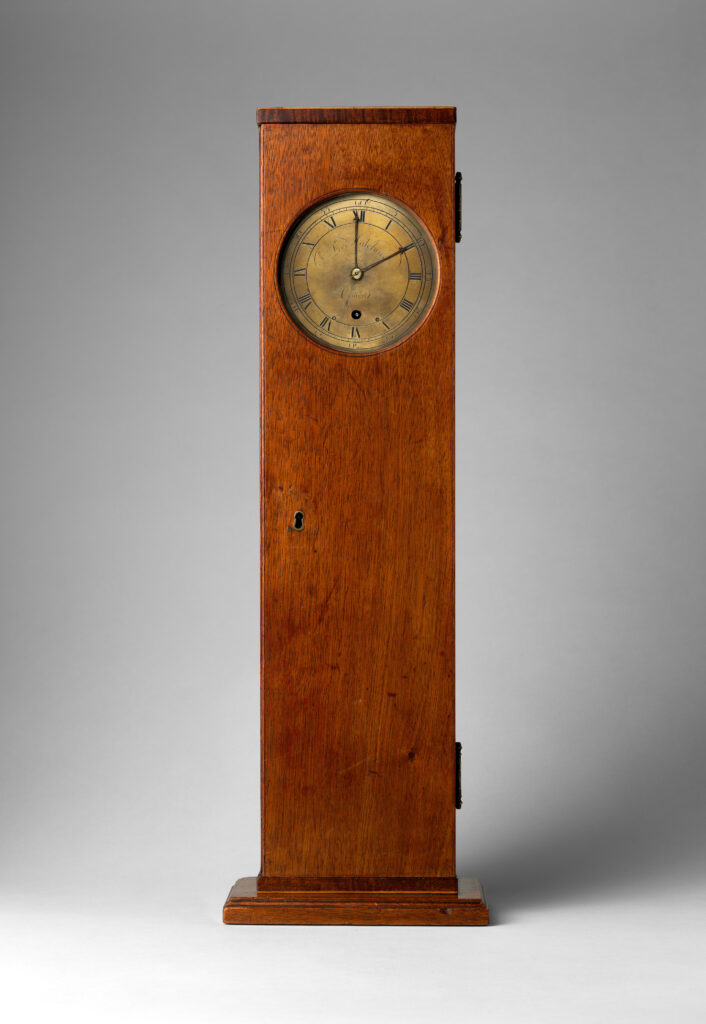
In America the shelf clock is where factory clockmaking began. The Met’s shelf clock by Levi Hutchins of Concord, about 1786, is mahogany with brass and steel and stands 62.9 cm high. A generation later, Britannica says, Eli Terry of Plymouth, Connecticut, became the father of the U.S. mass-production clock industry. He received the first clock patent granted by the U.S. Patent Office in 1797, hired Seth Thomas and Silas Hoadley in 1807 to make 4,000 wooden movements, and then specialized in one-day wooden shelf clocks, designed in 1814 and patented two years later.
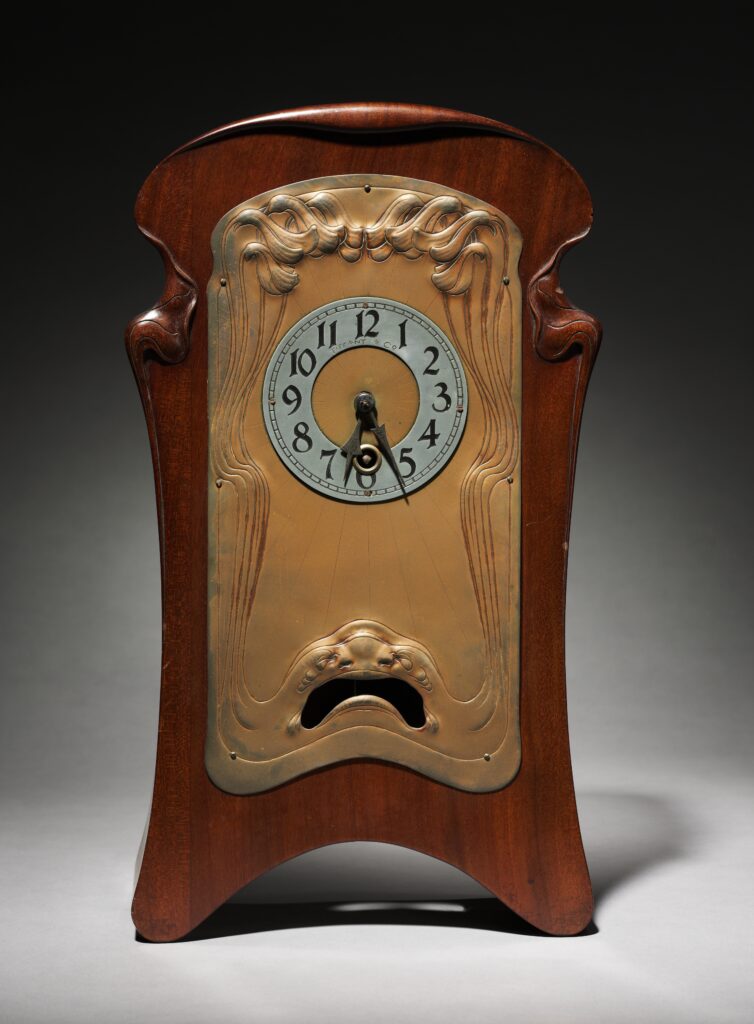
The mantel clock is a case made for the mantelpiece, and its look follows the furniture fashion of its day. Cleveland’s mantel clock of 1901, in brass and mahogany, is credited to the German Lenzkirch clock factory and Tiffany & Co.

Smaller still are the cabinet or table clocks. Cleveland’s, by the London goldsmith James Cox, about 1770 to 75, is gold and agate with an enamel dial, 16.5 cm high. The museum says small cases with clocks and moving mechanical devices that played tunes were especially popular then, and that Cox was known for such tuneful surprises, though this one no longer has its mechanism.
The French mantel clock, with its separate case maker and clockmaker and its gilt-bronze case, is a type of its own and is covered in antique French clocks; the metal itself is explained in ormolu and gilt bronze.
Clocks to carry

The spring made the portable clock possible. Cleveland’s cross-shaped clock, made in France about 1580 to 1600 by P. Herbier, is only 5.8 cm high, in enameled gold and rock crystal with a pearl, with a loop at the top to hang it.
The carriage clock belongs to this family too, a small travelling clock. We did not find an open-access colour image of a period carriage clock to show here. The closest record we read is the Met’s pendule d’officier (officer’s clock) of about 1800 by the firm of Meuron et Companie of Geneva and Paris, 22.5 cm high, with a gilt-bronze and enamel case (Met 1998.293).
How to tell the type of an antique clock
- Look at where it was made to stand: wall, floor, shelf, mantel, table or pocket.
- Look for the power: a chain, cord or weights mean a weight-driven clock; a winding hole with no weights usually means a spring.
- On a tall clock, the length of the trunk tells you whether it was built for a long pendulum.
- Read the dial and the movement for a maker’s name and town, as the Met records do for Fordham of Coggeshall or Hutchins of Concord.
- Treat the type as the start of the identification, not the end. A French or gilt-bronze clock needs the checks in antique French clocks.
Questions about types of antique clocks
What are the main types of antique clocks? By where they stand: wall clocks (lantern, banjo), floor clocks (tall-case or longcase), shelf and mantel clocks, bracket and table clocks, and portable clocks to wear or carry.
Why is a grandfather clock so tall? Britannica explains that heavy weight-driven wall clocks often fell off plaster walls, so the case was extended to the floor. From 1670 English makers used the long seconds pendulum, about 39 inches, which the tall trunk houses.
Who invented the banjo clock? Britannica credits Simon Willard, who patented his eight-day clock in 1802. The name came from the shape of the case; Willard did not use it.
Were antique shelf clocks mass-produced? In America, yes, from the early 1800s. Britannica calls Eli Terry the father of the U.S. mass-production clock industry and dates his wooden shelf clocks to 1814.
Sources
- Encyclopædia Britannica, Clock, Eli Terry and Simon Willard.
- The Metropolitan Museum of Art, Open Access records: lantern clock 10.125.387, bracket clock 64.101.869, banjo clock 1971.180.36, shelf clock 2023.301a–c, pendule d’officier 1998.293.
- The Cleveland Museum of Art, Open Access (CC0) records: tall clock 1992.70, mantle clock 2009.443, cabinet clock 2009.77, cross-shaped clock 1929.996.