The Metropolitan Museum of Art catalogs one tall French oak piece as a “pier mirror (trumeau de glace)” and its neighbors in the same gift as “pier glass,” “pier glass (encadrement de glace)” and “pier glass (overmantel).” Four labels for what looks like one kind of object, and the first thing to learn about a trumeau mirror is that its name depends on who is doing the describing.
What the word means
Merriam-Webster gives trumeau two senses. One is the central pillar of a medieval doorway. The other is an overmantel treatment of eighteenth-century France: a pier glass surmounted by an oil painting or a decorative, often carved panel. Wikipedia, which defines pier glass and trumeau mirror together, supplies the logic of the name: trumeau is the French word for the space between windows, and a pier glass is a mirror hung on that wall, usually tall and narrow to fit it.
The Met’s first piece, the pier mirror (trumeau de glace), has that arrangement: the record names a painting in the manner of Nicolas Lancret (1690 to 1743), gives the size as 110 by 36 inches (279.4 by 91.4 cm) and the material as oak.
Pier glass, overmantel, encadrement: the labels
The same gift of 1906 includes a pier glass catalogued with the French phrase encadrement de glace (07.225.74), a French oak piece of the late seventeenth or early eighteenth century that measures 288 by 150 centimeters. The Met also holds a carved and gilded mirror frame fragment of the eighteenth century, 19 3/4 by 23 3/4 inches (07.225.389), catalogued as carved and gilded wood alone.
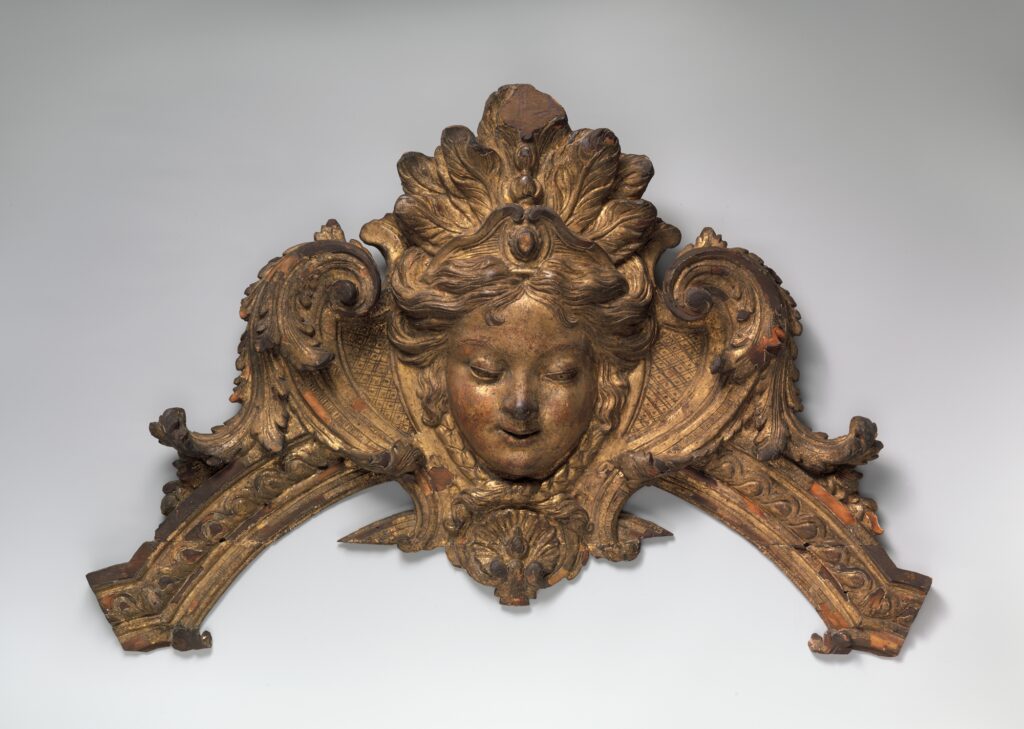
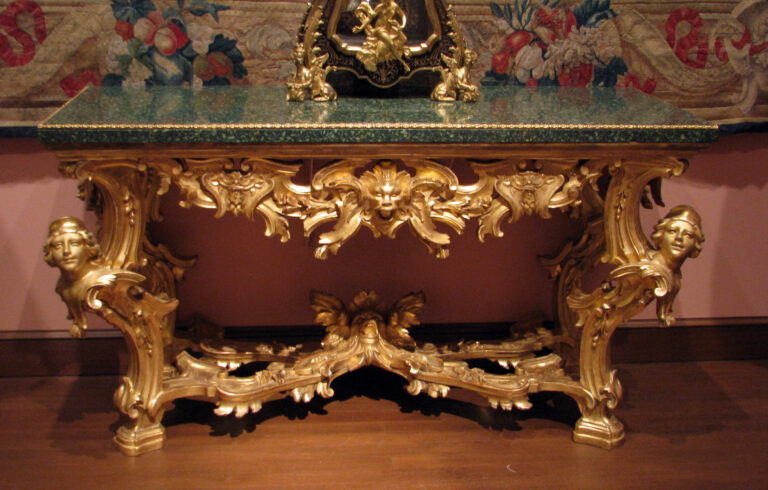
A later piece is catalogued as a pier glass (overmantel), French, about 1770 to 1790, in painted and gilt wood, 241 by 140 centimeters. Wikipedia notes that a pier table or console typically stood below a pier glass, often made as a matching set, so the Journal’s guide to antique French console tables is the natural next read.
The Met’s paneling known as the Louis XV Room, ca. 1720 to 25 with later additions, shows glass built into a wall: its record places carved overdoor panels above two side mirrors.

Wikipedia dates trumeau mirrors to the later eighteenth century. Among the records read for this article, the earliest titled “trumeau” is a drawing dated 1742, which is a reason to treat a date in a listing as something to check, not a fact of the word.
The same object under an English name
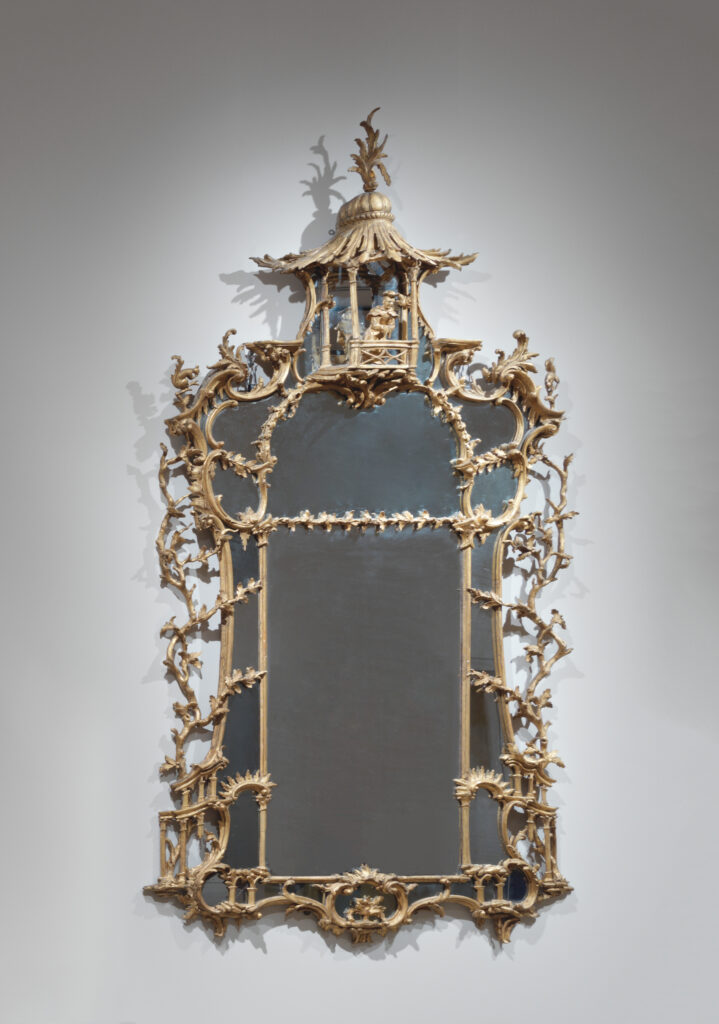
Pier glass is the English-speaking label, and it is not French only. The Met’s pair of British pier glass mirrors of about 1760, in carved and gilt linden wood, 9 feet 6 inches by 55 inches (289.6 by 139.7 cm), are described as Rococo chinoiserie incorporating elements from designs by Thomas Chippendale (1754) and by William Ince and John Mayhew (1762), and were formerly at Shillinglee Park in Sussex. The photograph shows a pagoda-shaped crest and a branching, open frame, a long way from the painted-panel French type. For the French Rococo curves in furniture, see the Journal’s guide to Louis XV furniture.
Trumeau on paper
Two paper records show the word trumeau at work in the eighteenth century, in the design of a trumeau mirror frame. A pen-and-ink design dated 1742 by Domenico Silvestro Giannotti is titled “Design for a Carved Mirror Frame Surmounting a Mantle (Trumeau),” and in the photograph the sheet carries a handwritten inscription beginning “Trumeau.” An eighteenth-century etching by Johann Esaias Nilson is titled “Trumeau de Glace, Orné avec les quatres parties de la Vie humaine,” (55.503.12).
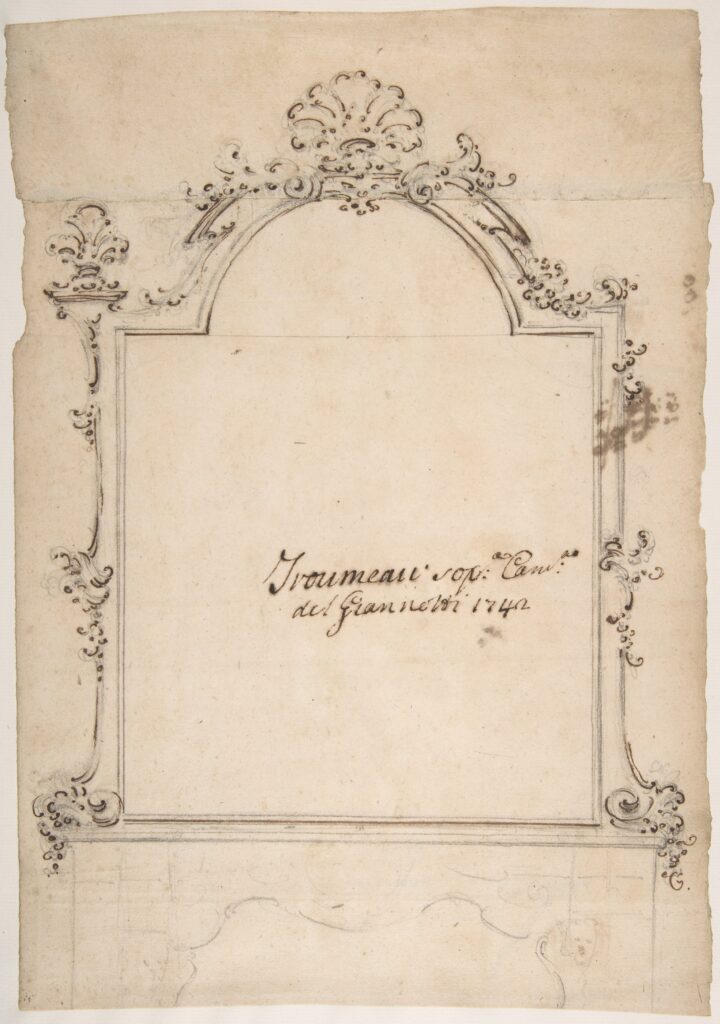
An Italian draftsman and a German printmaker both used the French word, which suggests it had traveled as a design term. That is an inference from two titles, not a finding.
What a listing can leave out
The Met’s records show how much a label can omit. The pier glass frame carved by Jules Degoullons (about 1671 to 1737) and André Le Goupil about 1724, 137 by 98 inches (348 by 248.9 cm), is catalogued as a frame; the painted panel on the first piece is catalogued “in the manner of” a named painter; and none of those five pier glass records carries a description.
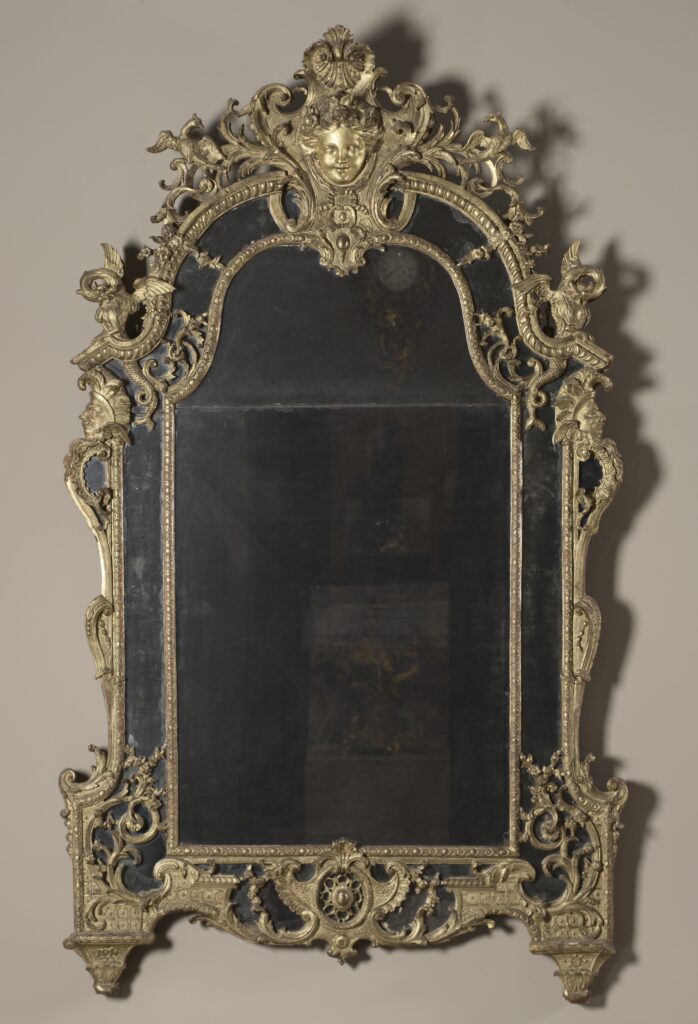
The Cleveland Museum of Art catalogs the wall mirror at the top of this page just as “Wall Mirror,” carved and gilded wood, 96 by 56 1/2 inches, and its record gives no description either.
A trumeau mirror in a listing therefore needs three answers: whether the glass is there, whether the panel is original to the frame, and what the dimensions are. For dating the glass itself, from plate joins to mercury-tin and silvered backs, see how to date antique mirrors.
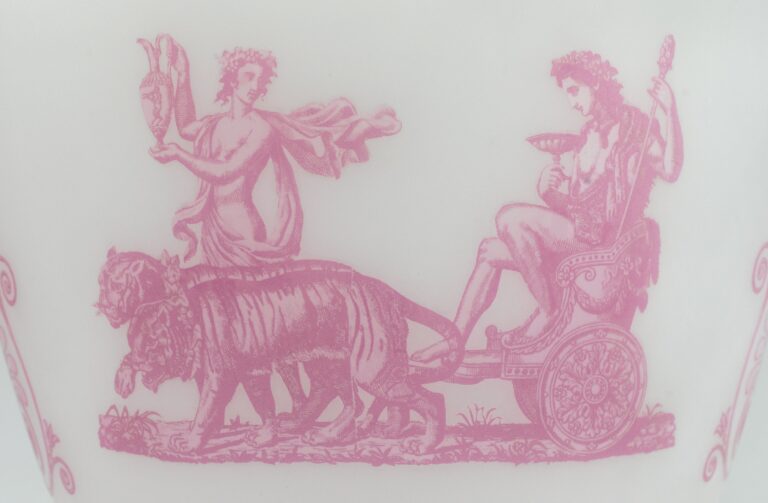
Shape matters too, and a mirror in a decorative frame is not automatically a pier glass. Wikipedia describes a pier glass as generally long and tall to fit the wall between windows, and Merriam-Webster’s trumeau carries a painting or carved panel above the glass. The Venetian-style mirror below, from the author’s family shop, is wide rather than tall, with a copper-pink cut-glass border on a green ground and no painted panel.
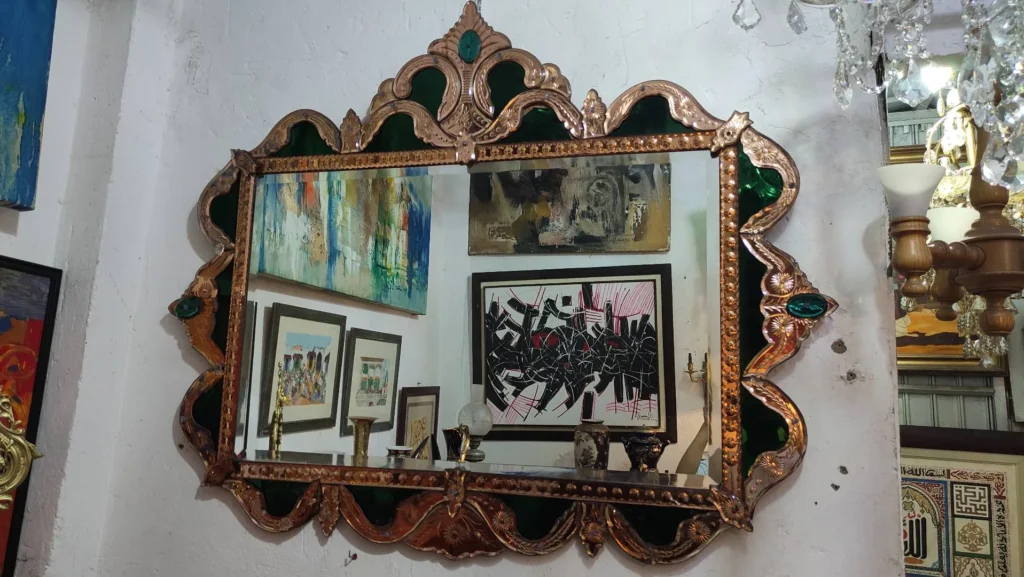
The words trumeau mirror name a mirror, a panel and a frame sold as one object, and a listing should say which of the three it actually has.
Sources
- Pier mirror (trumeau de glace), 07.225.15; Pier glass (encadrement de glace), 07.225.74; Pier glass (overmantel), 07.225.128; Pier glass, 07.225.158; Pier glass frame, 07.225.150.
- Pier glass mirror (one of a pair), 55.43.1 (and its pair 55.43.2).
- Design for a Carved Mirror Frame Surmounting a Mantle (Trumeau), Giannotti, 49.63.275; Trumeau de Glace, Orné avec les quatres parties de la Vie humaine, Nilson, 55.503.12.
- The Cleveland Museum of Art, Wall Mirror, France, c. 1720, 1953.153 (Open Access, CC0; record read 2026-11-04). The Metropolitan Museum of Art, Mirror frame fragment, 07.225.389, and The Louis XV Room, 07.225.147 (record read in full 2026-11-04).
- Merriam-Webster, trumeau, opened and read 2026-11-02.
- Wikipedia, Pier glass, opened and read 2026-11-02 (a short encyclopedia entry; used for the name and the console-table note only).
- Related guides on this site: Antique French Console Table, Louis XV Furniture, and the French style pages.