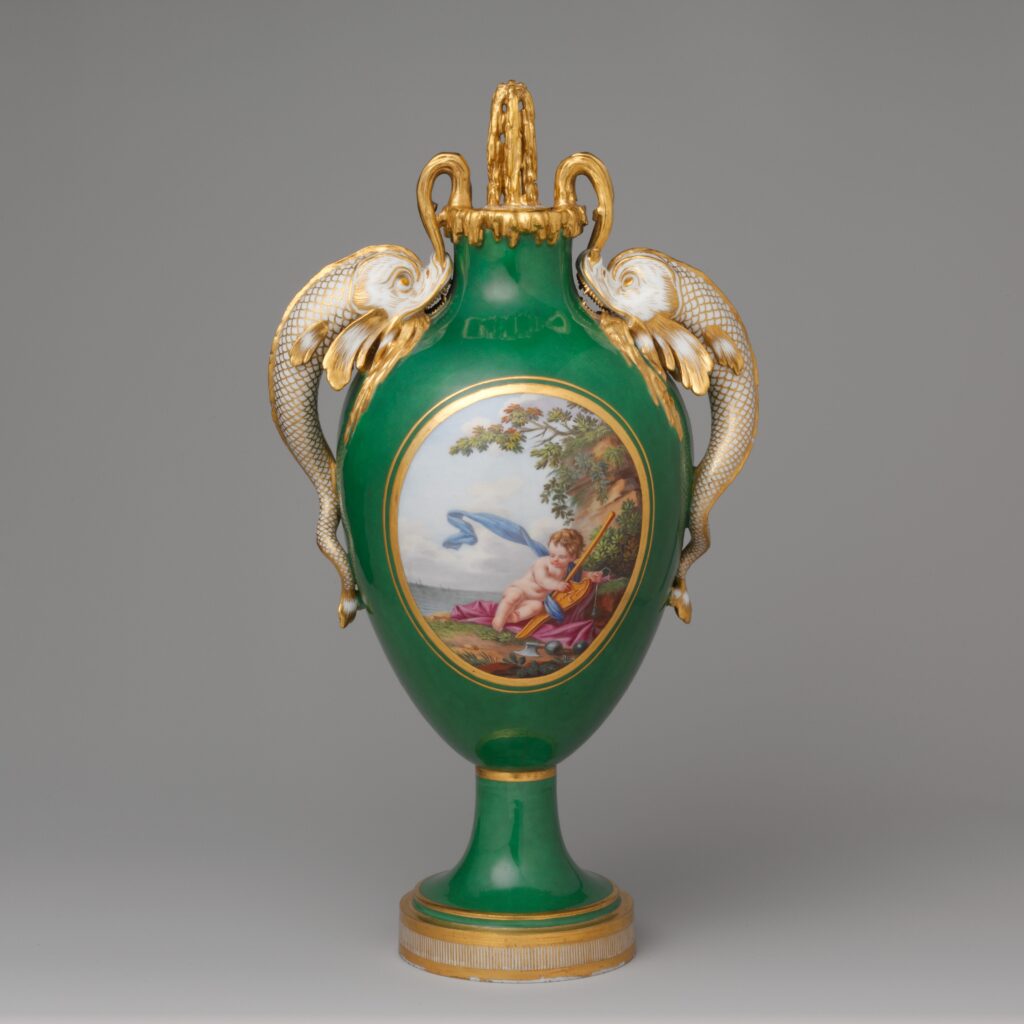
With Sèvres porcelain the eye reads color first, and the green vase with the dolphin handles is the place to start. The body is a flat, even green, and the only drawing on it is an oval of sky and shore where a small figure plays an instrument. The dolphins curl up from the shoulders in gilt and white, their scales picked out in a lattice. It stands about thirteen inches high. Nothing about it says how many people it took.
Sèvres porcelain: a factory, not a maker
Sèvres is a place and an organization before it is a style. The Met traces the factory to Vincennes in 1740, reestablished in larger quarters at Sèvres in 1756, with Louis XV an early investor and sole owner from 1759. Waddesdon Manor, which holds Rothschild Sèvres, describes the making of a vase as a relay: plaster molds for the body, handles and ornaments, paste pressed into each, the parts joined with slip, then firing and glazing. Next comes the ground color, then the painted scenes, then several layers of gilding, each stage done by a different contributor.
That relay is why the Met’s records name more than one person. The dolphin vase is given to the factory, with its decoration attributed to Charles Nicolas Dodin. Another vase in the Met’s collection names a painter, a gilder and the printmaker whose design the painter copied. A piece of Sèvres porcelain is closer to a small production line than to a signed work, and the marks on its base are the record of who did what.
Soft paste, then hard
Look at the medium line on each Met record and a pattern appears. The Sèvres porcelain of the 1760s and 1780s here is soft-paste, the artificial body for which the factory was famous in the eighteenth century. The tray further down, from 1836, is hard-paste. Britannica says true hard-paste porcelain could not be made in France until the raw materials turned up at Saint-Yrieix in 1769. The Met adds that Alexandre Brongniart, appointed administrator in 1800, improved the hard-paste composition and that soft paste was abandoned in 1804.
So the paste is a clue to the period, as the shape and the color are. It is also the sort of detail a seller can be asked for, since the Met prints it on every record.
A tower, and the ground colors

A vase made to be seen in a pair was where a factory could show off. The Met says this one takes the shape of a fortified tower, with buttresses ringing the top of the body and small gilt-porcelain cannons beneath them. The lids are high domes with dormer windows and a cupola for a finial, and the body carries painted trophies of war. The painting is unusually fine, the museum notes, which suggests a commission, yet a factory list of unsold stock from 1770 describes the pair precisely. They had neither found a buyer nor been given away.
Compare the greens. On the tower the green is a trim, set against white. On the dolphin vase it is the whole body, and on the mounted pair further down it is the whole body again, in a brighter apple tone. Waddesdon lists the ground colors used on Sèvres porcelain, among them pinks, greens, yellows and blues, with black and white as well. The ground is laid first, and everything else is arranged around it.
Two vases, six years apart

The Met owns two vases des âges, and the record for this one is a good lesson in reading Sèvres porcelain marks. Both are the largest size of the model, 19 1/2 inches high, with handles in the form of busts of bearded men. Both have the dark blue ground the factory called beau bleu and the same gilded laurel garlands. Each bears the painter’s mark of Dodin and the gilder’s mark of Henri-Martin Prévost. The scene on the front of each comes from a print by Moreau le jeune, in his Seconde Suite d’Estampes, a series on fashion and costume.
They look like a pair that left the factory together. The date letters on the bases say otherwise. One is marked with the letters ‘ee’, for 1782. The other carries a double ‘ll’, for 1788. Six years separate the two, and the museum notes it.
The letters come from the factory’s own system. Waddesdon explains that from 1754 a letter inside the interlaced Ls, the cipher it ties to Louis XV, dated each year’s work, and that once the alphabet was complete the letters were doubled, until the practice was dropped in 1793 at QQ. Painters had marks of their own too. At Waddesdon a crescent moon above the factory mark identifies Louis-Denis Armand, who painted birds, and the mark served as a signature that also showed how much he was to be paid.
Porcelain on furniture
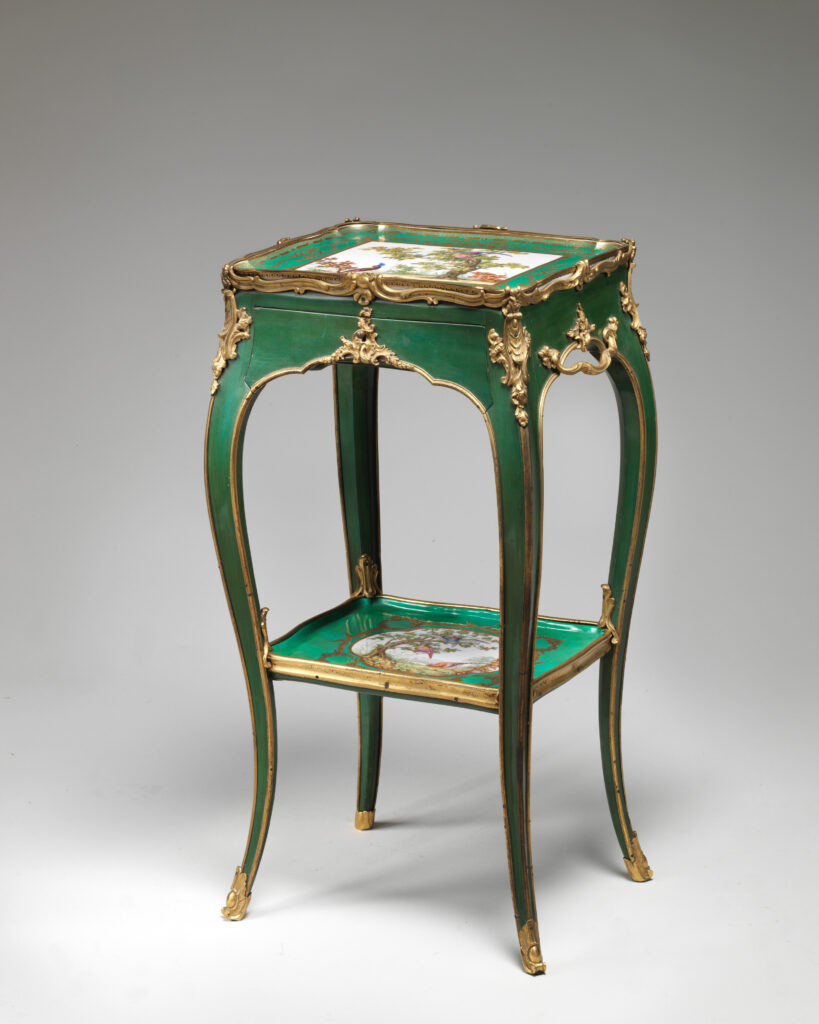
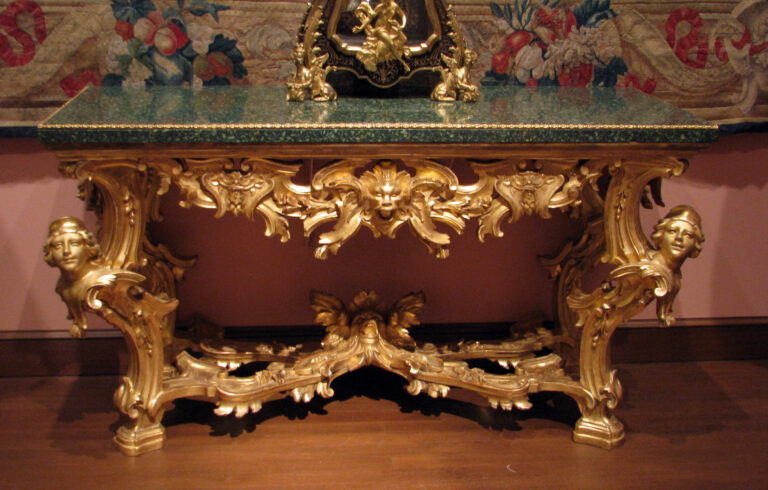
Not all Sèvres porcelain is a vase. The factory also made plaques for cabinetmakers to set into tables, desks and cabinets. The Met’s record for this table says it comes from the Hillingdon collection, whose seventeen pieces of porcelain-mounted furniture the Samuel H. Kress Foundation acquired in 1947 and gave to the museum in 1958, making it the foremost repository in the world of Sèvres-mounted furniture. The Louis XV furniture guide explains how dealers called marchands-merciers acted as middlemen between craftsmen and clients and had Sèvres plaques made for mounting on furniture.
The small table in the photograph, one of a pair, has a green ground, a painted plaque in the top and another on its lower shelf. Read the record to the end and you find the catch. The table is attributed to Bernard II van Risenburgh, or possibly to Bernard III van Risamburgh, and the plaques are by Sèvres, but the lower tray plaque is by Minton, the English firm, and dates from after 1851. A piece can be part Sèvres and part something else, and a museum catalogs it that way.

The mounted pair of apple-green vases takes a different route. Their porcelain is soft-paste, and the gilt-bronze parts, ram’s heads linked by a swag, a collar and a base, are metalwork added to the porcelain. For how the bronze side of such pieces is judged, see the guide to ormolu and gilt bronze.
A tray for a queen
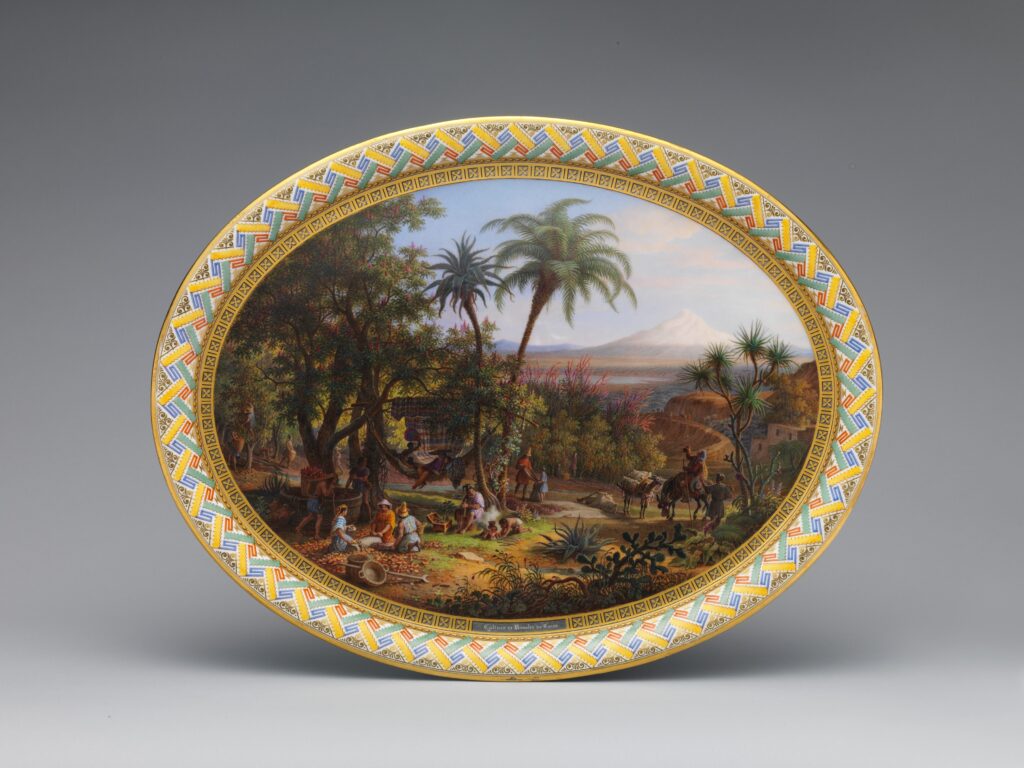
The factory that made the vases did not stop in 1789. Under Brongniart it moved into the nineteenth century with new forms, new enamel colors and a taste for services that told one story. This tray belongs to a coffee service of 1836, commissioned by Louis Philippe for Queen Marie-Amélie. Each scene shows the cultivation of cacao or the preparation of hot chocolate, painted by Jean-Charles Develly, and the Met says the stages and utensils are shown with surprising historical accuracy.
The border is a different hand’s invention. The museum describes its colorful motifs as entirely fanciful, meant to evoke ancient Aztec designs. The body is hard-paste, the soft paste long abandoned. The Met’s record adds that the service was bought in 1986, when collecting nineteenth-century Sèvres porcelain was uncommon among American museums.
Marks are evidence, not proof
Waddesdon says marks play a key part in verifying an object’s authenticity, and the records above show why: on Sèvres porcelain they tell you the year, the painter and the gilder. The same marks are what a copyist reaches for. Dawsons Auctioneers writes that the blue interlaced double L, usually enclosing a letter or two for the date, was frequently copied, and that marks were forged throughout the nineteenth century. Cheap forgeries show obvious flaws in the painting and gilding or the evenness of the glaze, it adds, but better fakes exist and can be mistaken for the real thing.
One firm made the point at scale. A collector’s reference, the Gotheborg glossary, describes Edmé Samson of Paris, founded in 1845, as producing copies of Chelsea, Meissen, Sèvres and Derby, as well as Chinese export porcelain. It reports that the firm used a variety of marks on its reproductions and left some pieces unmarked.
The table with its Minton plaque makes the same case from the museum side. Before a mark, ask what the whole object is: the paste, the quality of the painting and gilding, whether the plaque belongs to the table, whether a pair was made together. The two vases des âges show that even a genuine pair can be six years apart.
Sources
- The Metropolitan Museum of Art: Vase with cover (vase à dauphins), 58.75.67a, b; Vase with cover (vase en tour), 56.80.1a–c; Vase with cover (vase des âges), 86.7.1a, b; Pair of mounted vases (vase à monter), 1978.12.4, .5; Tray, 1986.281.4; Eating and work table, 58.75.46.
- The Metropolitan Museum of Art, Sèvres Porcelain in the Nineteenth Century.
- Waddesdon Manor, Collection in Focus: Sèvres Porcelain, 20 July 2026.
- Encyclopaedia Britannica, Sèvres porcelain.
- Dawsons Auctioneers, How to Identify Sèvres Porcelain, 11 March 2024.
- Gotheborg, Samson, Edmé et Cie.
- Related guides on this site: Louis XV Furniture, French Furniture Styles, Ormolu and Gilt Bronze.