Put a bergère chair next to a fauteuil, and the difference is obvious. Describe one down the phone, and it gets harder, because both are French armchairs, both are usually gilded or painted, and both tend to be sold under the same loose heading of “Louis XV chair”. The difference is at the sides.
A fauteuil has open arms. A bergère has closed ones: the space between the arm and the seat is upholstered. Everything else in this guide follows from that one detail, including how the two chairs were used, how they were built, and how to tell an eighteenth-century example from a later copy.
What the two words mean
Fauteuil is the French word for an armchair. Merriam-Webster defines it as an armchair, especially an upholstered chair with open arms. A bergère, which is French for “shepherdess”, is the armchair with closed arms. The Metropolitan Museum of Art’s essay on French seat furniture lists the two side by side among the pieces of a typical suite: side chairs, fauteuils, bergères, settees, stools and a daybed, all with matching upholstery.
A note on pronunciation, since it stops people searching for the right thing. Bergère is said ber-ZHAIR. Fauteuil is foh-TOY in French, and Merriam-Webster also lists the anglicised FOH-til. Both are regularly typed without the accent, as in “bergere chair”. It is the same piece.
Open arms: the fauteuil
In a fauteuil, the padded armrest is carried on a slim support that rises from the seat rail, so you can see through the side of the chair to the carved wooden frame underneath. That exposed frame is where the carving and the gilding show.
Fauteuils came with two kinds of back. The fauteuil à la reine has a flat back and was the more formal model. The fauteuil en cabriolet has a concave back and an overstuffed seat cushion. According to the Met, the cabriolet was not placed against the wall but in the centre of the room, one small sign of the move towards comfort and informality that the Met traces through the period.
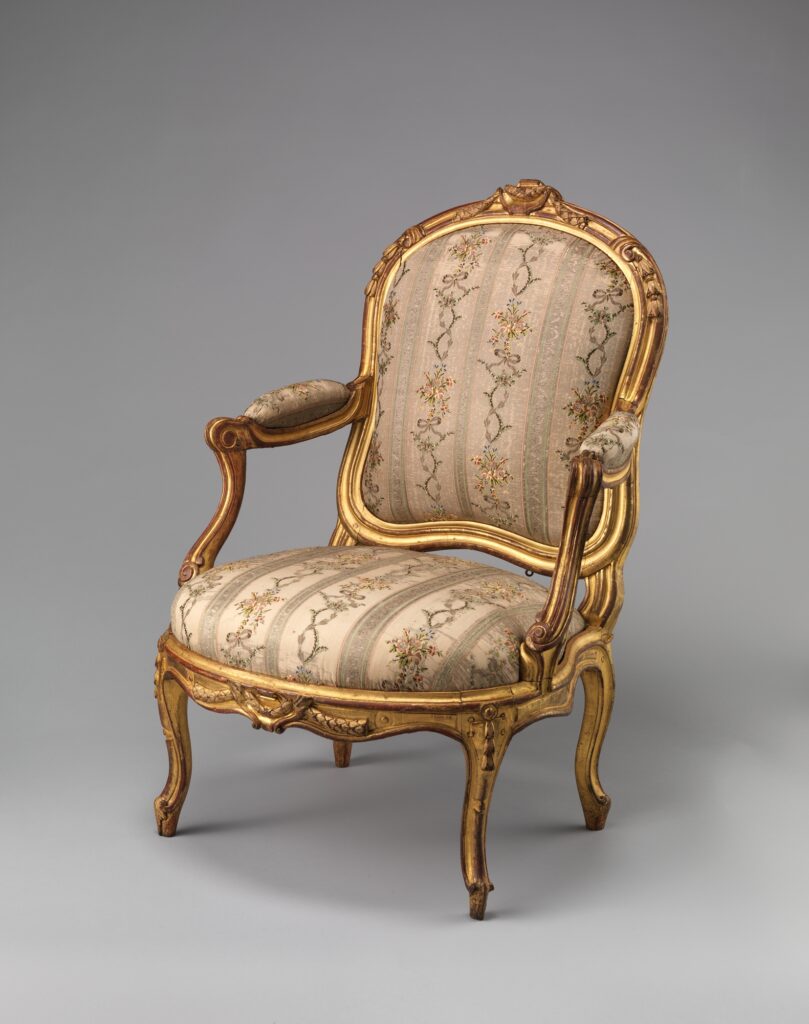
The chair above is a fauteuil à la reine stamped by Louis Delanois. The Met describes it as transitional, with cabriole legs and curving arm supports from the Rococo and laurel garlands from the new neoclassical taste. It is also described as à chassis: the seat, back, and arm pads can easily be removed to change the upholstery.
Closed arms: the bergère
The Met’s account of the bergère is short and clear. This kind of armchair, upholstered between the arms and the seat, was introduced at the beginning of Louis XV’s reign, when furniture became less formal and more comfortable. The armrests are set back from the front corner of the seat rail to make room for the wide dresses called à panier.
The bergère at the top of this page shows the rest of the type: a broad seat with a loose cushion, closed sides that make the chair feel enclosed, and a gilded frame that stays visible around the upholstery. The Met also points to incised decoration on the outer back of that chair. It suggests the bergère was meant to stand in the middle of a room, not against the panelling.
There are larger relatives. The marquise, for example, is an enlarged armchair in which two people could sit close together. But the closed arm is the test. If the sides are open, it is a fauteuil, whatever the seller calls it.
Louis XV or Louis XVI armchair?
Both chairs exist in both styles, so the open or closed arm tells you the type and the outline tells you the period. The Met’s essay separates them this way.
- Rococo (Louis XV, roughly 1730 to 1760): a frame that seems to flow in one curving line, cabriole legs, curving arm supports set back from the front of the seat, and high-relief carving of leaves, scrolls and flowers.
- Neoclassical (Louis XVI, from about 1760): geometric backs that are square, rectangular or oval, straight legs that are turned or spirally fluted, arm supports placed directly over the legs, and a medallion or wreath on the top rail.
- Transitional (from about 1760, overlapping the two): a still-curving but more restrained outline with neoclassical ornament such as interlaced bands, urns or acanthus leaves.
The two museum chairs on this page, both dated to about 1765, show the overlap: the Met describes the Cresson bergère as rococo and the Delanois fauteuil as transitional.
How to tell an original from a copy
Shape alone proves very little. Britannica notes a revival of the Rococo by the 1830s, so a chair in the right shape can be much later than it looks. Three things are worth checking, in this order.
1. Look underneath for a stamp
From 1743 it became the rule in Paris to stamp every piece of furniture offered for sale with its maker’s name. A second stamp, JME, was added once the guild’s inspectors had approved the quality. The guild was dissolved in 1791, which puts genuine guild stamps between 1743 and then. Look underneath the frame: the Met’s record for the bergère pair at the top of this page notes the mark L.CRESSON stamped underneath one of them.
Read a stamp with care. Ten members of the Cresson family were masters of the Parisian guild in the eighteenth century, four of them called Louis, so the Met can only say its bergères are probably by Louis I Cresson. A missing stamp does not condemn a chair either: royal cabinetmakers and independent craftsmen (artisans libres) worked outside the guild’s regulations.
2. Expect the upholstery to be newer than the frame
Fabric wears out. Several of the Met’s catalogue entries for chairs of this kind record modern or non-original silk, including the Delanois fauteuil above. New covers are not a warning sign. Judge the frame.
3. Check the frame and its finish
Parisian chairmakers worked mostly in walnut or beech, and most chairs were painted or gilded by specialist gilders over a base of gesso. Both museum chairs on this page are carved and gilded, one in beechwood and one in walnut. Those are the materials to expect. A frame in something else, or gilding that looks suspiciously perfect, is a reason to ask more questions.
If you are looking at a “vintage bergère”
The word describes a form, not a date. Merriam-Webster defines a bergère as an upholstered armchair “of an 18th century style”, so a chair made in the 1920s, or last year, can reasonably carry the name. Ask for a photograph of the underside and the joints, and for any stamp, before you talk about price. The wider timeline is set out in the guide to French furniture styles.
If you are weighing one up, the guide to buying vintage furniture covers what to inspect, and repairing a loose chair joint and six chairs worth restoring cover what can be fixed. For the wider picture, see the complete guide to French vintage decor.
Sources
- The Metropolitan Museum of Art, French Furniture in the Eighteenth Century: Seat Furniture
- The Metropolitan Museum of Art, The Golden Age of French Furniture in the Eighteenth Century
- The Metropolitan Museum of Art, Armchair (bergère), possibly by Louis I Cresson, ca. 1765 (1971.206.5), open access image at the top of this page
- The Metropolitan Museum of Art, Armchair (fauteuil), Louis Delanois, ca. 1765 (07.225.59)
- Merriam-Webster, bergère and fauteuil
- Encyclopaedia Britannica, Interior design: 19th and early 20th centuries in Europe