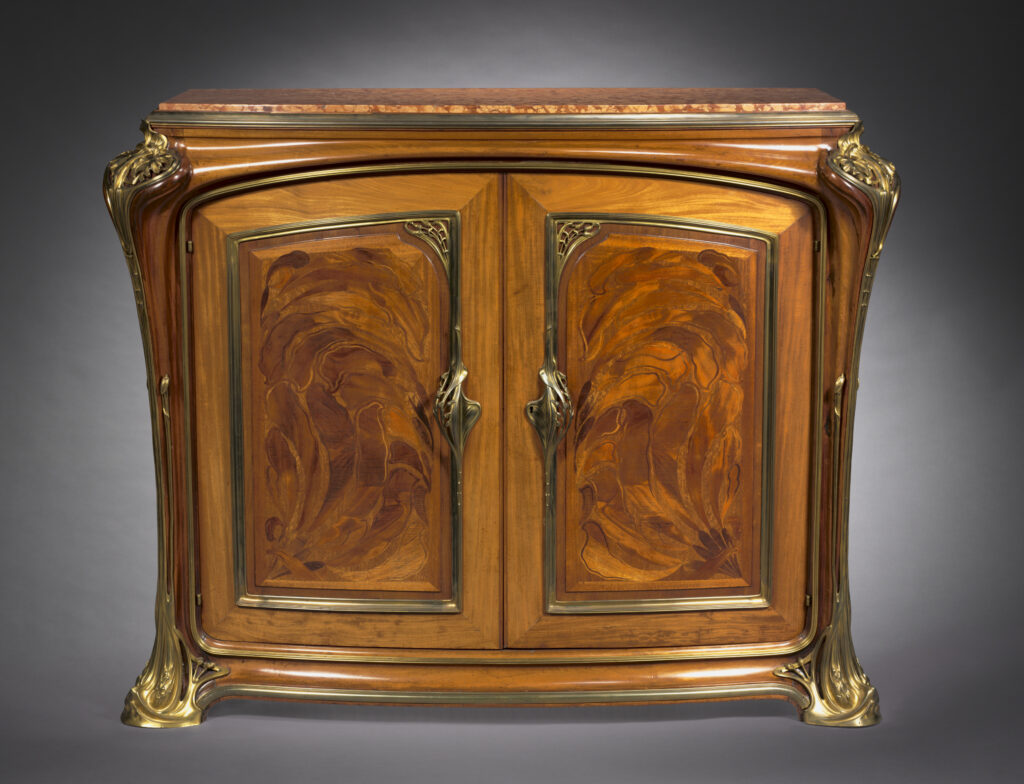
Until about 1890, the workshop of Louis Majorelle in Nancy made furniture in eighteenth-century styles, as his father’s had. By 1900, the Cleveland Museum of Art says in its biography of him, he had become the main producer of Art Nouveau furniture, and perhaps the main one in Europe. A cabinetmaker who made his living reproducing eighteenth-century pieces changed his catalogue, and that change is a useful way into the style. Art Nouveau furniture was, Britannica says, a deliberate attempt to create a new style free of imitative historicism.
This guide uses French makers as its case study, because France supplied the style with several of its names. Art Nouveau itself was international, and the later sections say where the French story stops.
A style built on one line
Britannica names the distinguishing characteristic as an undulating, asymmetrical line, often taking the form of flower stalks, buds, tendrils and insect wings. In the three-dimensional arts, it adds, the whole form is caught up in that organic rhythm, so that structure and ornament fuse. The Met traces the whiplash curves partly to botanical studies and to illustrations of deep-sea organisms, such as those in Ernst Haeckel’s Art Forms in Nature of 1899. Both museums credit the Arts and Crafts movement and Aestheticism as forerunners, and both mention Japanese prints. The Met adds that they flooded Western markets after trading rights were established with Japan in the 1860s.
Dates depend on whom you ask. Britannica puts the style between about 1890 and 1910, while the Met dates it from the 1880s until the First World War. The name came from a Belgian journal in the 1880s, and in December 1895 the Paris dealer Siegfried Bing opened a gallery called L’Art Nouveau.
In France the style was also known as Style Jules Verne, Le Style Métro and Art belle époque, and the Exposition Universelle of 1900 introduced it to a wide public. The Met notes that the furniture shown there kept the French craft tradition and shared stylized natural motifs with the Rococo, which is the thread to hold on to.
Bing’s own designers were not all French. The Met’s record for a 1899 side chair by Edward Colonna, who was born in Germany and had lived in the United States since 1882, says Bing recruited him along with Louis Sullivan and Louis Comfort Tiffany, and that Colonna designed a complete salon for the 1900 exposition. The museum calls the chair an expression of the essence of Art Nouveau without any of the excess of ornament sometimes employed. That last phrase is a fair warning that the style had its extravagant side.
Nancy: from reproductions to the new style
The Met describes Émile Gallé as the first major exponent of the style to take nature as a guiding principle, and the inspiration for the group of Nancy artists now called the École de Nancy. His cow-parsley cabinet is covered in the guide to French furniture styles. Majorelle, also based in Nancy, followed a different route. He trained as a painter, returned to Nancy to run the family workshop after his father died in 1879, and, Britannica says, began about 1890 to produce work conceived in the new manner.
His business model matters as much as his curves. Britannica describes a modern workshop that used both machine and hand labor, which let him increase production and lower prices. The Cleveland biography adds that the factory could offer luxury furniture within the range of the middle class. Majorelle’s catalogs between 1900 and 1914 show suites for individual rooms and furniture built on botanical themes, with polished woods and bronze mounts in the eighteenth-century tradition.
The cabinet at the top of this page, dated about 1910, comes from the firm’s later work. Cleveland points to the curvilinear, abstract marquetry on the doors, an inlaid, veneered pattern of the kind explained in the guide to marquetry and parquetry, and the record lists metal mounts. By Britannica’s dating, 1910 is late in the style’s run.
The bench below looks back. Cleveland says French designers of Art Nouveau furniture began to take inspiration from Rococo pieces of about 1750, the period described in the Louis XV guide, and that this bench shows the Majorelle firm’s version of that taste. The attribution is the museum’s own, “attributed to”, and the record adds that the bench is presently covered with a Japanese brocade of about 1900.

Guimard and the Paris line
Hector Guimard was an architect, decorator and furniture designer, and Britannica calls him probably the best-known French representative of Art Nouveau. His Castel Béranger apartment building in Paris, built from 1894 to 1898, was one of the first Art Nouveau buildings outside Belgium, and his cast-iron Métro entrances of 1898 to 1901, in plantlike forms, are his best-known works. Britannica says the Belgian architects Victor Horta and Henry van de Velde influenced him, and the Met lists the “Style Métro” among the French names for the movement, so a station entrance lent one of its French names to the whole style.
The chair below is dated about 1907 and made of pearwood with a tooled leather back and seat. Cleveland’s record gives little beyond that, with no commission, workshop or context, and none is guessed at here. It is at least a reminder that Guimard, in Britannica’s description, was a decorator and furniture designer as well as an architect.

Beyond France: Bugatti and the wider movement
The style had many local names. Britannica lists Jugendstil in Germany, Sezessionstil in Austria, Stile Floreale or Stile Liberty in Italy and Modernismo in Spain, and the Met adds Style nouille in Belgium. It also had different temperaments. Britannica singles out Charles Rennie Mackintosh for a predominantly geometric line, and Antoni Gaudí as perhaps the most original artist of the movement, who went beyond line to curving, colored, organic buildings. Few of these look like a Majorelle cabinet.
Carlo Bugatti is the awkward case. He was Italian, the Met notes that his furniture was shown at the Turin exhibition of 1902, and Cleveland records him as active in France after about 1902. Cleveland dates the cabinet below about 1895 and places it in France, which sits uneasily with that biography, a loose end the record does not resolve.
The same record describes an asymmetrical piece with a tower-like element, onion-shaped arches of Islamic inspiration, white-metal inlays and sepia-painted parchment panels that show Japanese influence, plus mirrored and green glass and silk tassels, all organized into a coherent design. A vellum panel is signed in pseudo-Japanese letters “Casati”. The museum found no professional artist of that name and suggests it may be the work of the society woman Marchesa Casati.
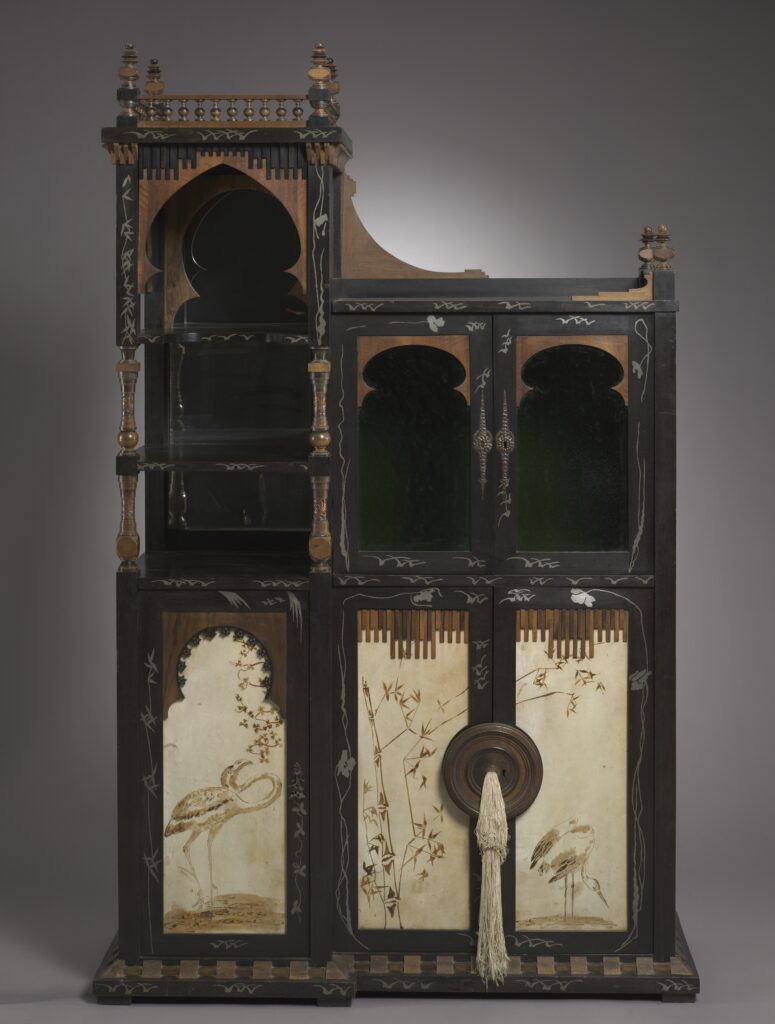
There is little whiplash line here, and the record describes none. Its interest lies in arches, inlays and parchment. The Met itself says the range of late nineteenth-century trends before the First World War can be defined only loosely under the Art Nouveau label, which is worth remembering when a listing uses the name.
How to recognize Art Nouveau furniture
The museum sources point to a short set of things worth checking on a piece, with the caution that none is a test on its own:
- The line. Look for asymmetry and undulating curves drawn from plant and insect forms, as Britannica describes them, in the shape of the piece as well as in applied ornament.
- Structure and ornament as one. Britannica describes the form and the ornament fusing, so check whether the carving or inlay follows the shape of the piece or sits on top of it.
- Mixed woods and veneers. Gallé’s cabinet combines several kinds of maple with chestnut, satinwood and walnut, and Majorelle’s doors rely on marquetry.
- Cast mounts. The Met points to finely cast gilt mounts on the leading French cabinetmakers’ work, and Britannica notes Majorelle’s bronze mounts, a practice described in the guide to ormolu and gilt bronze.
- An eighteenth-century memory. Rococo curves and French craftsmanship stayed in the mix, especially in Nancy and Paris.
Britannica adds that after 1910 the style appeared old-fashioned and was generally abandoned as a distinct decorative style. The Met sees its influence in Art Deco furniture, whose sleek surfaces are enriched with exotic veneers and ornamental inlays. Majorelle himself kept working in a modified, opulent Art Nouveau after the First World War, as Britannica records, so a later date does not rule a piece out.
Notes for collectors
Production varied. The Met says most of Gallé’s furniture designs exist in numerous examples, but that its cabinet is a rare model with one other known version, in the Musée de l’École de Nancy, and Majorelle’s mechanized workshop was built to make furniture in quantity. Questions worth asking include whether a piece is signed or labeled, what the attribution rests on, whether any upholstery is a later covering, as the Cleveland bench’s brocade of about 1900 may be, and whether the mounts and veneer are intact. The wider checks on condition and provenance are in the buying vintage furniture guide.
Sources
- The Metropolitan Museum of Art, Heilbrunn Timeline of Art History: Cybele Gontar, Art Nouveau
- Encyclopaedia Britannica: Art Nouveau, Louis Majorelle and Hector Guimard
- The Cleveland Museum of Art collection records: Cabinet, Louis Majorelle (1976.53), Bench, attributed to Louis Majorelle (1971.28), Chair, Hector Guimard (1985.96) and Cabinet, Carlo Bugatti (1984.177)
- The Metropolitan Museum of Art collection records: “Ombellifères” (cow parsley) Cabinet, Émile Gallé (1982.246) and Side chair, Edward Colonna (26.228.5)
