Antique lamps of the oil age start from a simple fact: for thousands of years a lamp was a dish of oil with a wick in it, and then, in the 1780s, someone improved on the idea. Britannica calls the Argand burner the first basic change in lamps in thousands of years, and says an Argand lamp gave about ten times the light of an earlier lamp of the same size. The catch was oil: it burned more of it. Brighter rooms at a higher running cost was the deal that shaped much of the lamp trade that followed, and it is a different story from the candle fixtures in the guide to antique chandeliers.
This guide to antique lamps covers the oil-lamp age: the Argand lamp, its relatives and the kerosene lamp that replaced them. It does not cover electric lamps made for electricity, and the best-known of those, Tiffany’s, have a guide of their own in Tiffany lamps.
Ten times the light
The Argand burner was patented in England in 1784 by a Swiss, Aimé Argand. It put a cylindrical wick between two concentric metal tubes, so that air rose through the middle of the flame as well as around it, and a glass chimney increased the draft. The Corning Museum of Glass dates the inventor’s tubular-wick burner to 1782 and notes that the chimney is part of why these lamps burn efficiently.
The Met’s British Argand lamp of 1800 to 1815 shows how early makers housed the burner. It is catalogued as Sheffield plate, earthenware and glass, and stands 17 1/2 inches high. The Met’s record points to its mate, and a single lamp from a pair is worth a question about where the other went.
The astral lamp, or lighting a table
The Met describes the astral lamp as a variety of Argand lamp whose flattened, ring-shaped reservoir allows an uninterrupted flow of light across a table. Its example, by Archer and Warner of Philadelphia, dates to about 1855 and is brass and glass, with a round etched shade.
American makers of the 1830s worked in a plainer style. The Met’s pair by Henry N. Hooper and Company of Boston, about 1835, is brass and glass, and the museum calls it an early work of a leading Boston lighting firm, with a simple, architectural design related to the Grecian plain style in architecture and furniture. It adds that these lamps are rare in retaining their original surface, so a lamp with its original finish is the one to prize, and one that has been polished or refinished is the one to ask about.

Whale oil, kerosene and hundreds of patents
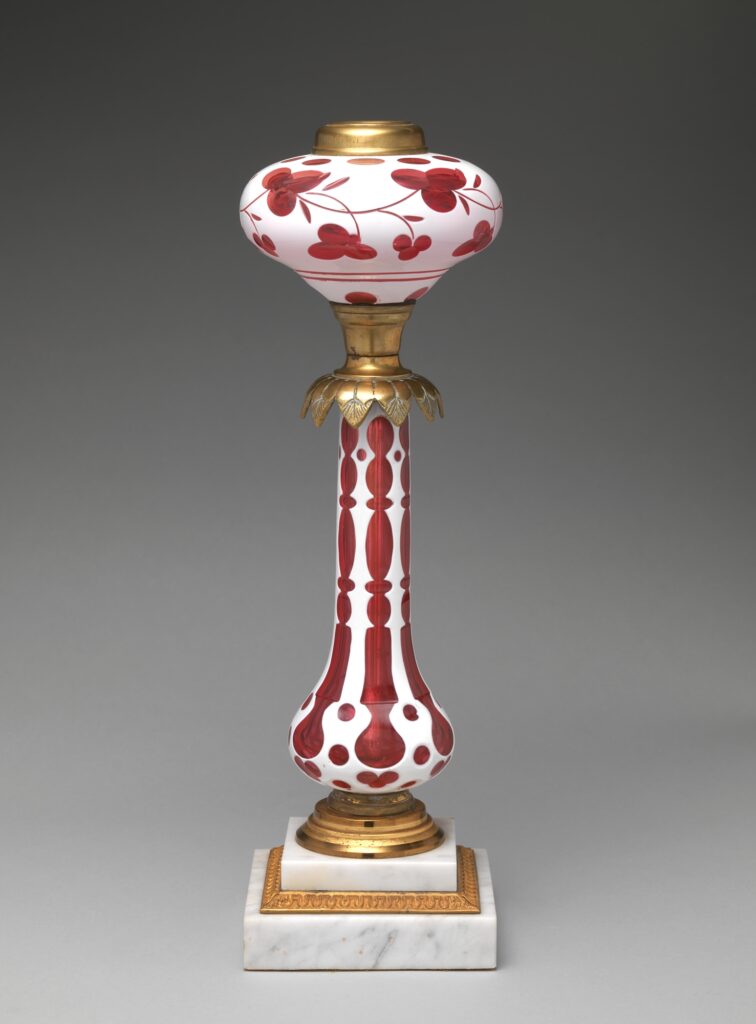
Simpler antique lamps stayed in use alongside the Argand type. The Met’s whale oil lamp of 1825 to 50 is a small lacy pressed-glass piece, 7 1/2 inches high, with a blown-glass font on a pressed-glass base. The two parts are how it was made, so the buyer’s question is whether this font and this base are the pair the maker joined.

Kerosene changed the market. Britannica says kerosene lamps were widely used from the 1860s, until electric light, and calls them safe, efficient and simple to operate. The oil rose up the wick by capillary action alone, a knob raised or lowered the wick to set the flame, and a glass chimney, used more widely and effectively than on any earlier lamp, steadied the flame. No inventor of the kerosene lamp can be named, it adds, but hundreds of people filed patents for modifications, among them the duplex burner of 1865 with two flat wicks.
In Europe, the entry says, Argand burners with cylindrical wicks stayed in wide use.
A French lamp that was really a candlestick
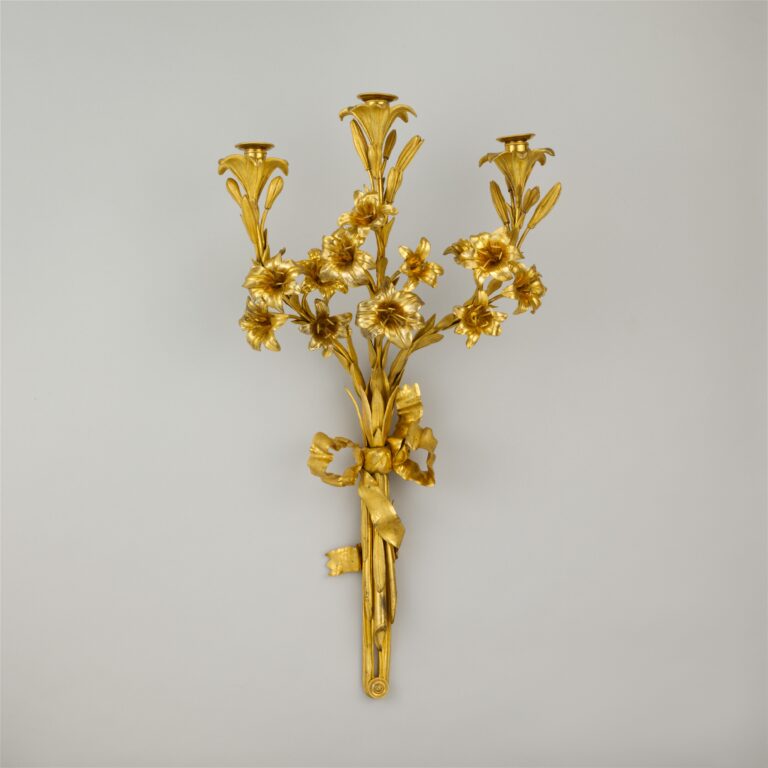
Not every antique lamp burned oil. The Met’s French table lamp of about 1795 to 1800, in gilt bronze, steel and tôle, stands 29 1/2 inches high, with three candle sockets under an adjustable metal shade on a rod. It is a table lamp in name and a candle fixture in practice, which shows how loosely the word is used. Its chandelier cousins, in bronze and crystal, are in the guide to French chandeliers.
Victorian kerosene lamps: how they worked and why they took over
Britannica says kerosene lamps were widely used from the 1860s, when kerosene first became plentiful, until electric lighting arrived (Britannica, kerosene lamp). The design was simple: a vessel of kerosene with a wick, fed by capillary action alone, with one adjustment knob that raised or lowered the wick to vary the size of the flame. Against other oil lamps, Britannica calls them safe, efficient and simple to operate. A glass chimney, which it says was used more widely and effectively on kerosene lamps than on any earlier lamp, made the flame steadier, brighter and cleaner.
Britannica adds that no inventor of the kerosene lamp can be named, and that hundreds of people filed patents for modifications. In 1865 came the duplex burner, with two flat wicks set near each other to add heat and brilliance, while in Europe Argand burners with cylindrical wicks stayed in wide use. On a lamp in front of you, those are the parts to look at: the burner, the wick knob and the chimney it was made to carry. For the rooms these lamps lit, see the guides to Victorian furniture and Victorian sofas and settees.
Before you buy antique lamps
What is sold as an antique lamp can run from an early oil fixture to a much later table lamp, so start by asking what burner the lamp was made for. If the answer is oil, ask what has been done to it since. A lamp built for oil and later wired for electricity is common, and the wiring, which is usually newer than the lamp, is the part to have checked by a qualified electrician.
Ask which parts are original, especially glass shades and chimneys, which break, and which are the easiest parts to replace with something merely similar, and ask about the finish, since the Met calls original surface rare on its Boston Argand lamps.
Dealers and auction houses sell the same antique lamps, and a good condition report names what is original, what is replaced and what has been rewired. The general points on condition, repairs and price are in the buying vintage furniture guide. If your question is how to use a lamp in a room, not how to date one, the case for one good lamp is the better start.
Sources
- Encyclopaedia Britannica: Argand burner and Kerosene lamp
- Corning Museum of Glass, Argand lamp (Glass Dictionary)
- The Metropolitan Museum of Art collection records: Argand Lamp, Henry N. Hooper and Company (2002.391.1a–e), Argand lamp, British (24.116.4a, b), Astral Lamp, Archer and Warner (68.111.1), Whale Oil Lamp (14.38.2) and Table lamp, French (1977.75)